EduNinja
[Maximum number: 1]

Fig. 4.1 shows an arrangement for producing stationary waves in a tube that is closed at one end.
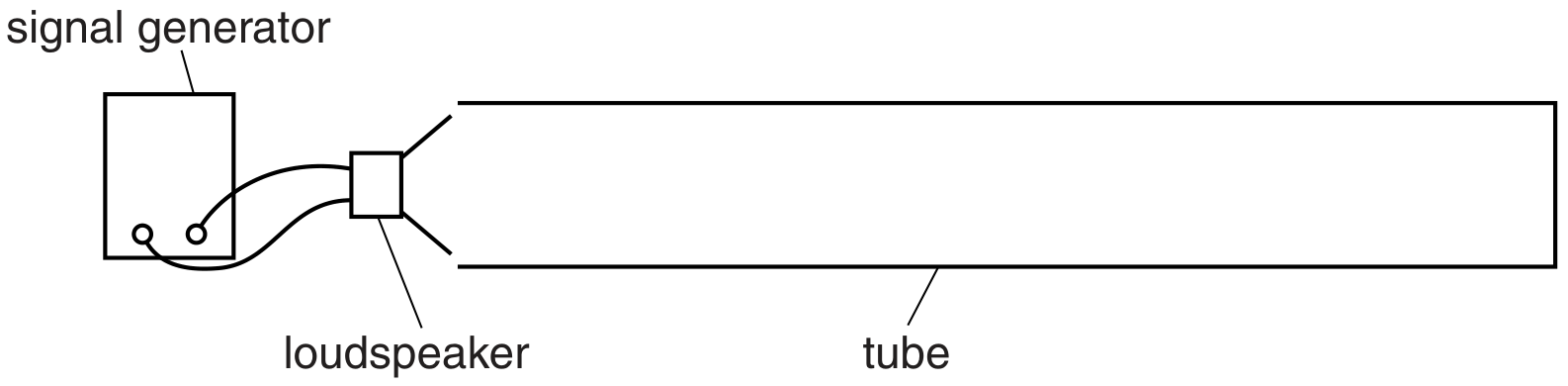
Fig. 4.1

Fig. 4.1

(a)

One of the stationary waves that may be formed in the tube is represented in Fig. 4.2.

Fig. 4.2

Fig. 4.2

[ 1 ]
(i)

Describe the motion of the air particles in the tube at
1. point P,
2. point S.

[ 1 ]
[Maximum number: 1]

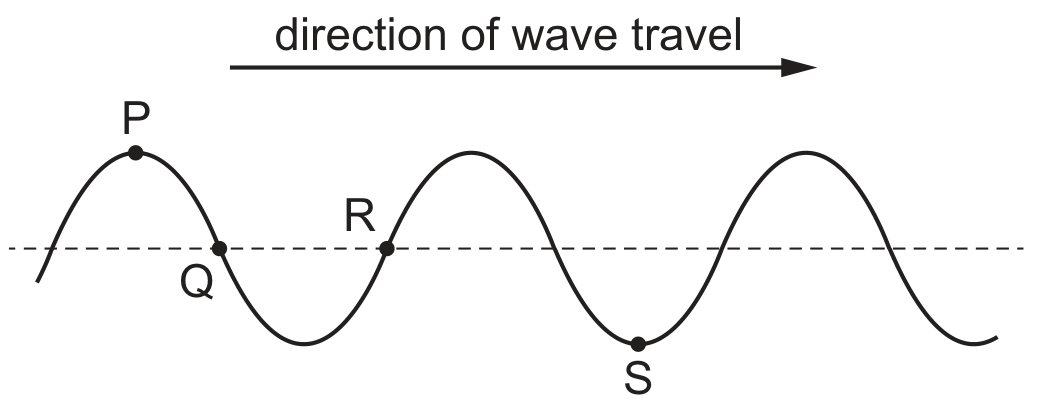
A wave travels on the surface of water. P, Q, R and S are four particles of water on the surface.
The diagram shows the positions of the particles at one instant. The direction of travel of the wave is from left to right.

Question image

Which two particles are about to move upwards?

A

P and R

B

P and S

C

R and S

D

Q and S

[Maximum number: 1]

Which row is correct for both progressive transverse waves and progressive longitudinal waves?

transverse waves

longitudinal waves

contain compressions
and rarefactions

some can travel
in a vacuum

can be polarised

contain compressions
and rarefactions

vibrations are perpendicular
to the direction of travel of
the wave energy

can be polarised

some can travel
in a vacuum

vibrations are perpendicular
to the direction of travel of
the wave energy

[Maximum number: 1]

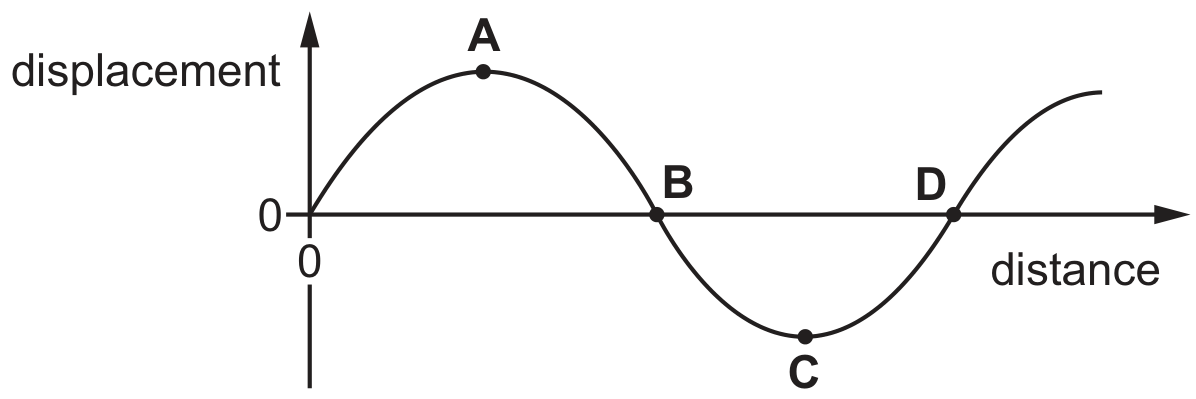
A longitudinal wave is travelling from left to right. The graph shows the variation of the displacement of the particles with distance along the wave at one instant in time.

Displacements to the right are positive; displacements to the left are negative.
Which labelled point represents a compression?

Question image
[Maximum number: 1]

Which statement about longitudinal waves and transverse waves is not correct?

A

Both waves can be polarised.

B

Both waves can form stationary waves.

C

Both waves can transfer energy as progressive waves.

D

Both waves obey the equation v=fλv=f \lambda.

[Maximum number: 1]

Which statement about longitudinal waves is correct?

A

Longitudinal waves include radio waves travelling through air.

B

Particles in a longitudinal wave vibrate at right-angles to the direction of transfer of wave energy.

C

Some types of longitudinal wave can be polarised.

D

Stationary waves can be produced by the superposition of longitudinal waves.

(a)

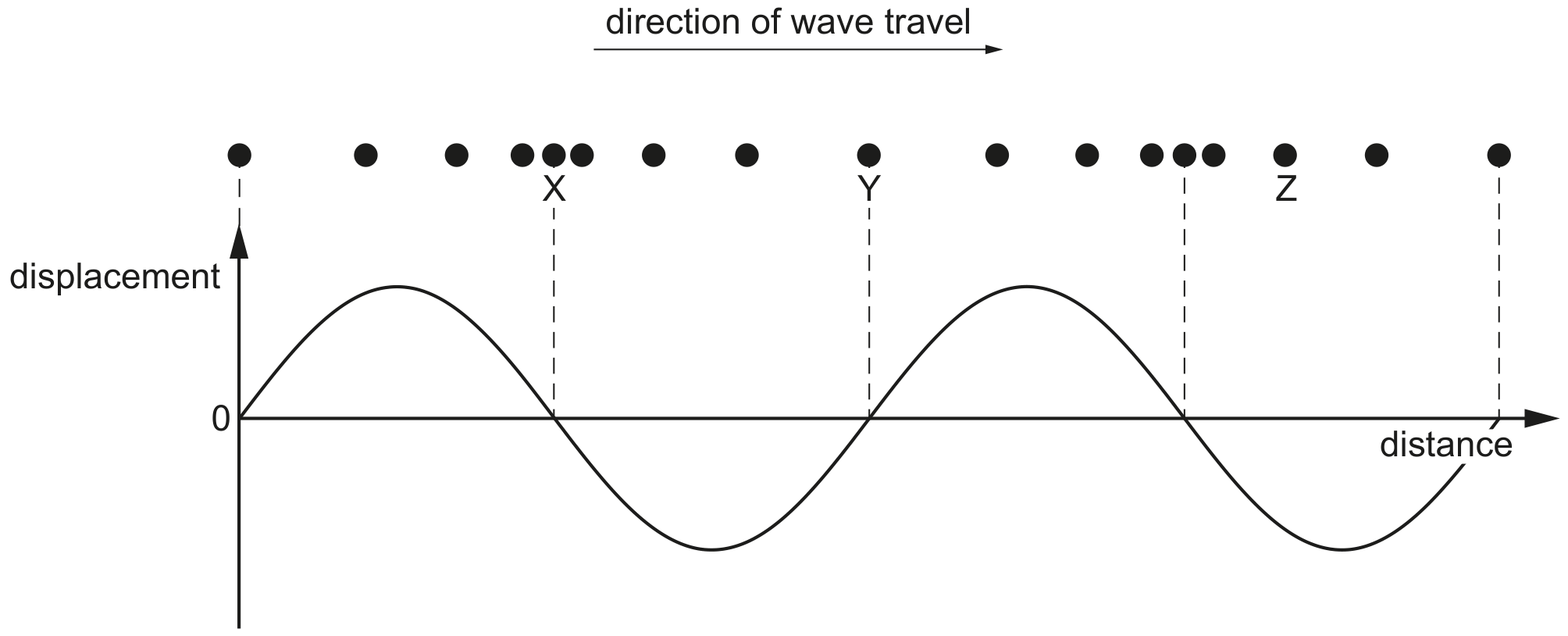
A progressive longitudinal wave travels through a medium from left to right. Fig. 4.1 shows the positions of some of the particles of the medium at time t0t_{0} and a graph showing the particle displacements at the same time t0t_{0}.

Fig. 4.1

Fig. 4.1

Particle displacements to the right of their equilibrium positions are shown as positive on the graph and particle displacements to the left are shown as negative on the graph.

The period of the wave is T.

[ 4 ]
(i)

On Fig. 4.1, sketch a line on the graph to represent the displacements of the particles for the longitudinal wave at time t0+T4t_{0}+\frac{T}{4}.

[ 3 ]
(ii)

State the direction of motion of particle Z at time t0+T4t_{0}+\frac{T}{4}.

[ 1 ]
[Maximum number: 1]

A long rope is held under tension between two points A and B . Point A is made to vibrate vertically and a wave is sent down the rope towards B as shown in Fig. 5.1.

Fig. 5.1 (not to scale)

Fig. 5.1 (not to scale)

The time for one oscillation of point A on the rope is 0.20 s . The point A moves a distance of 80 mm during one oscillation. The wave on the rope has a wavelength of 1.5 m .

(a)

State and explain whether the waves on the rope are

[ 1 ]
(i)

longitudinal or transverse.

[ 1 ]
[Maximum number: 2]

A long rope is held under tension between two points A and B . Point A is made to vibrate vertically and a wave is sent down the rope towards B as shown in Fig. 5.1.

Fig. 5.1 (not to scale)

Fig. 5.1 (not to scale)

The time for one oscillation of point A on the rope is 0.20 s . The point A moves a distance of 80 mm during one oscillation. The wave on the rope has a wavelength of 1.5 m .

(a)

State and explain whether the waves on the rope are

[ 2 ]
(i)

progressive or stationary,

[ 1 ]
(ii)

longitudinal or transverse.

[ 1 ]
(a)

By reference to the direction of propagation of energy, state what is meant by a transverse wave.

[ 1 ]
0