[Maximum number: 1]
Polarisation is associated with certain waves.
Which waves cannot be polarised?
A
radio waves from a transmitter
B
sound waves from a moving source
C
ultraviolet rays from the Sun
D
X-rays from an X-ray emitter
 EduNinja
Polarisation is associated with certain waves.
Which waves cannot be polarised?
radio waves from a transmitter
sound waves from a moving source
ultraviolet rays from the Sun
X-rays from an X-ray emitter
When plane-polarised light of amplitude a is passed through a polarising filter as shown, the amplitude of the light emerging is .
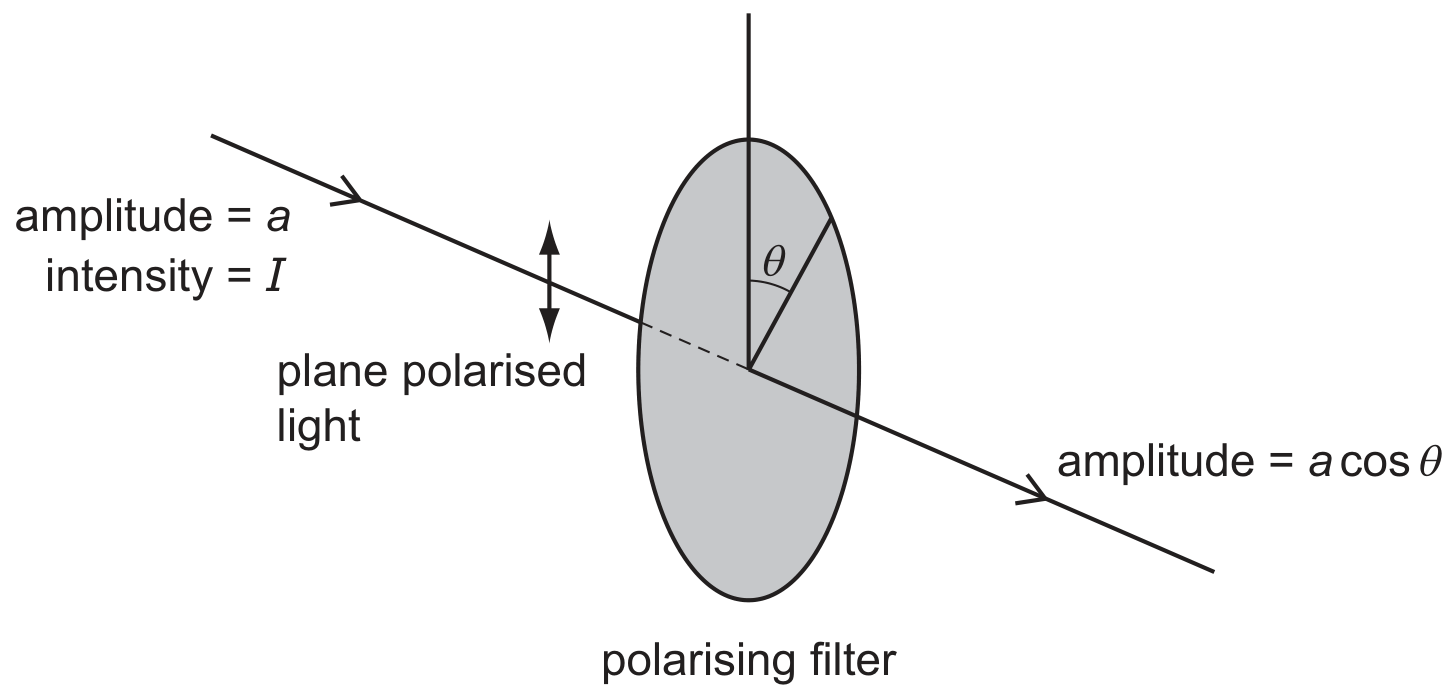
The intensity of the initial beam is I.
What is the intensity of the emerging light when is ?
0.250 I
0.500 I
0.750 I
0.866 I
A wave that can be polarised must be
longitudinal.
progressive.
stationary.
transverse.
Which statement describes a situation when polarisation could not occur?
Light waves are reflected.
Light waves are scattered.
Microwaves pass through a metal grid.
Sound waves pass through a metal grid.
A beam of vertically polarised light is incident normally on a polarising filter. The filter can be rotated so that it is always in a plane perpendicular to the beam. The transmission axis of the filter is initially vertical.
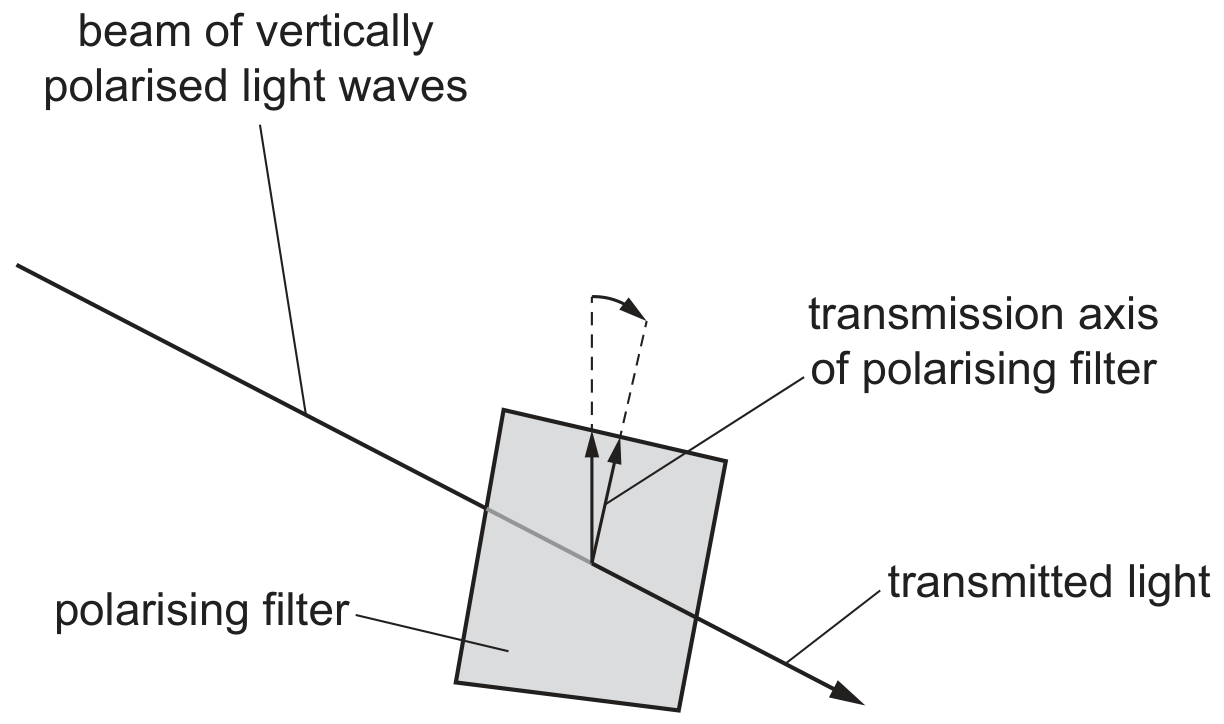
The filter is first rotated clockwise by an angle of so that the transmitted light waves have intensity . The filter is then rotated clockwise by a further angle of .
What is the new intensity of the transmitted light waves?
A vertically polarised beam of light is incident normally on a polarising filter. The transmission axis of the filter is at an angle of to the horizontal.
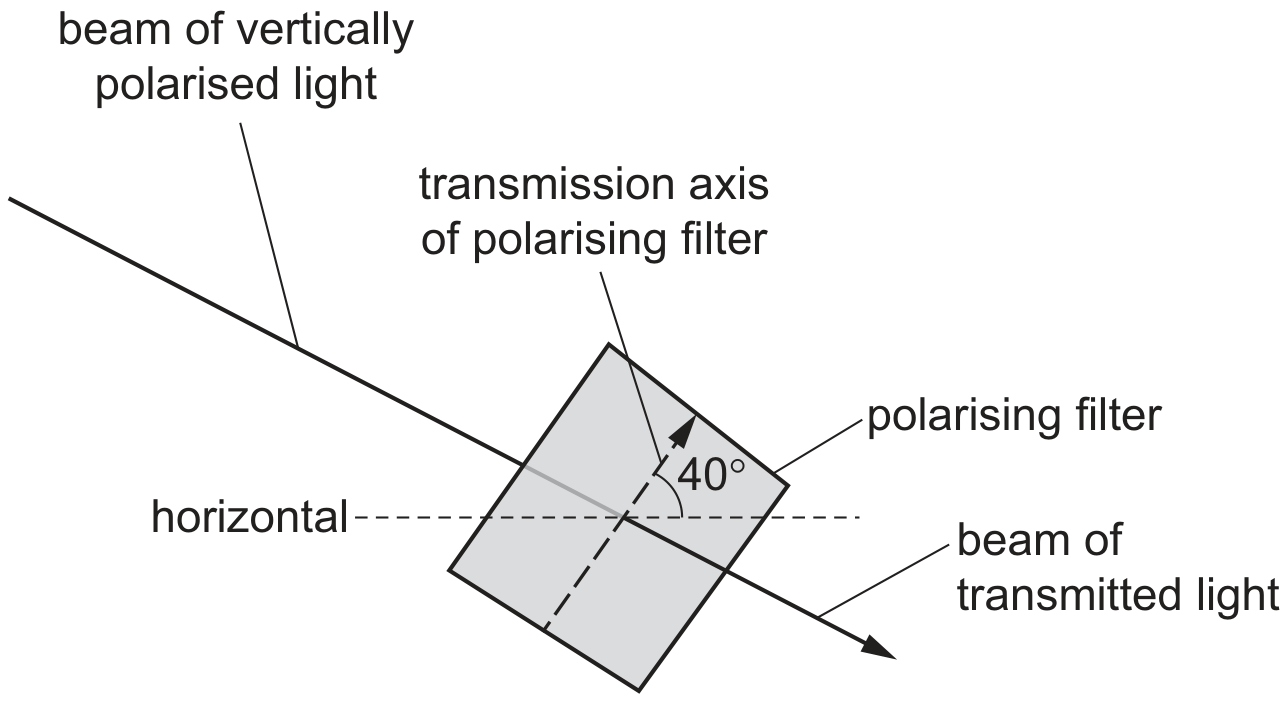
What is the ratio ?
0.41
0.59
0.64
0.77
A vertically polarised beam of light of intensity is incident normally on a polarising filter.
The transmission axis of the filter is at to the vertical. The beam of light transmitted by this filter is then incident normally on a second filter. The transmission axis of the second filter is horizontal.
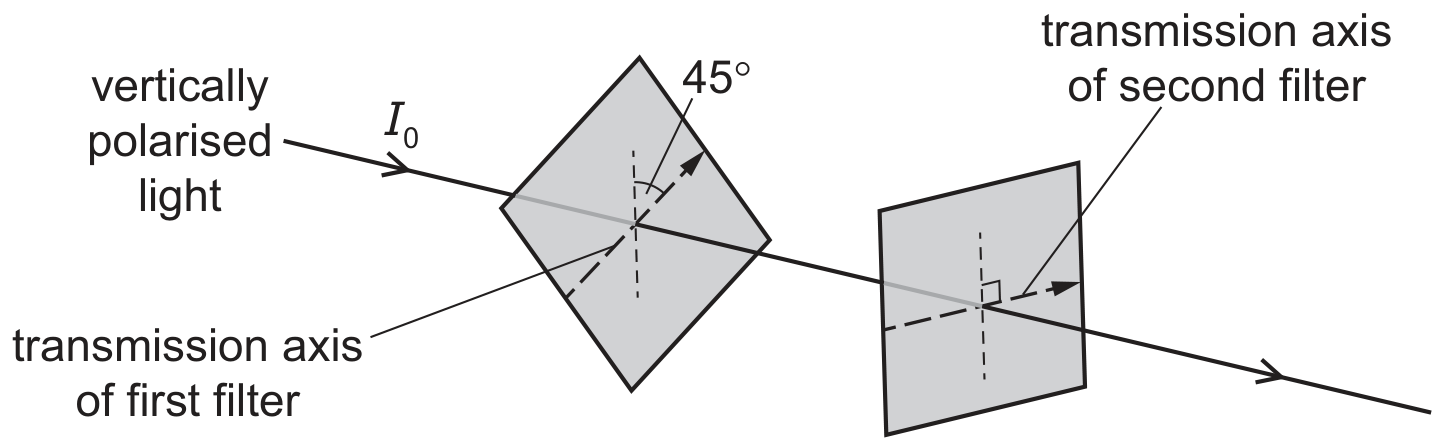
What is the intensity of the beam of light after transmission through the second filter?
0
Vertically polarised microwaves are emitted from a source. The microwaves are detected by a receiver that is connected to a cathode-ray oscilloscope (CRO). The waveform displayed on the screen of the CRO has an amplitude of 2.6 cm .
A metal wire grid that acts as a polarising filter is now placed between the source and the receiver. The filter is orientated so that the plane of polarisation of the transmitted wave is at an angle of to the vertical.
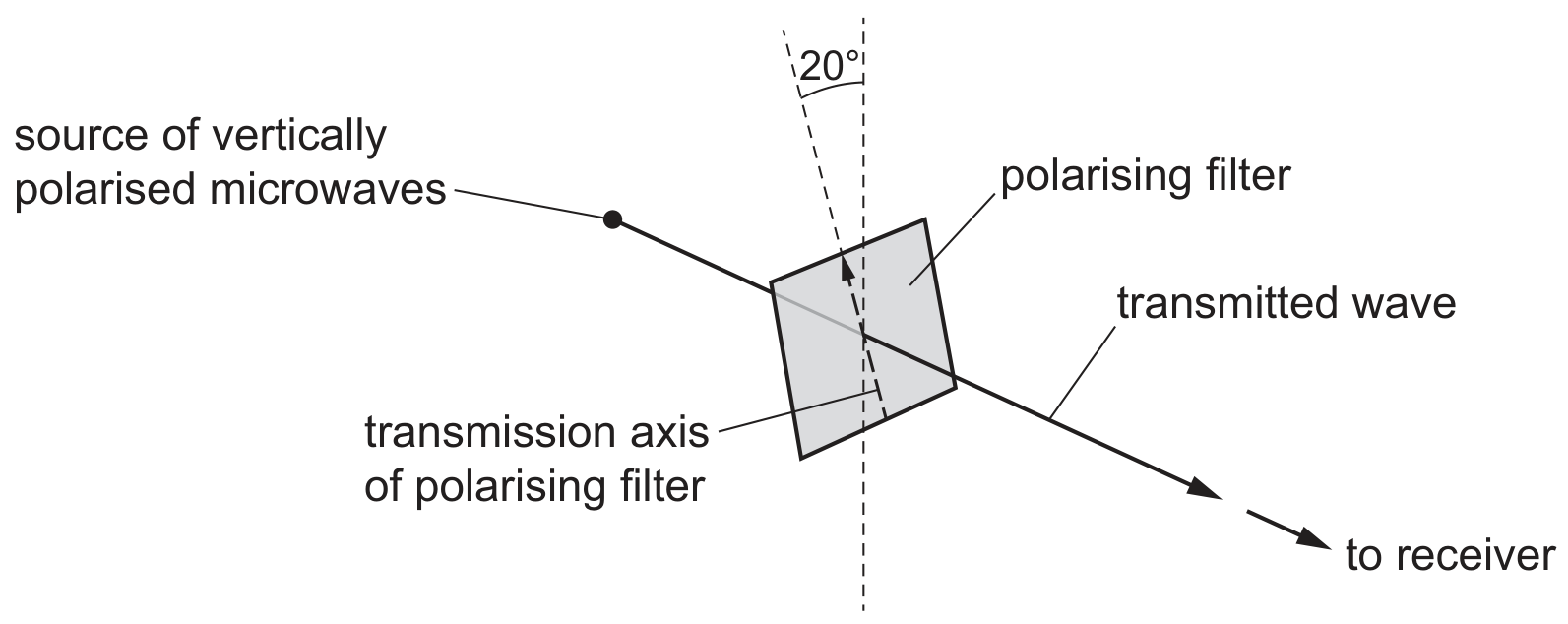
The distance between the source and receiver is unchanged. The settings on the CRO are also unchanged.
What is now the amplitude of the waveform displayed on the screen of the CRO?
2.3 cm
2.4 cm
A plane polarised wave has amplitude A. The wave is incident normally on a polarising filter.
The transmission axis of the filter is at angle to the plane of polarisation of the incident wave.
What is the amplitude of the wave that emerges from the filter?
A vertically polarised electromagnetic wave of intensity is incident normally on a polarising filter. The transmission axis of the filter is at an angle of to the vertical.
The transmitted wave from the first filter is then incident normally on a second polarising filter. The transmission axis of this filter is at an angle of to the vertical.
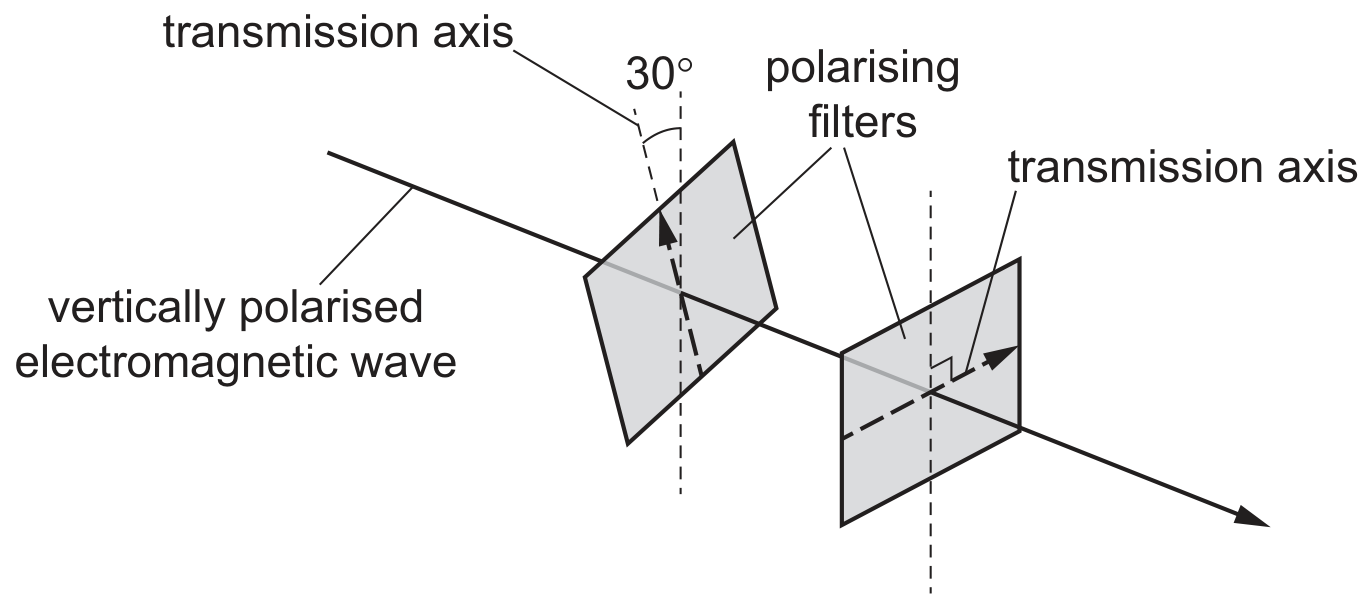
What is the intensity of the wave after passing through the second filter?
0