EduNinja
[Maximum number: 2]

The drag force FDF_{\mathrm{D}} acting on an object falling through air is given by

FD=12CρAv2F_{\mathrm{D}}=\frac{1}{2} C \rho A v^{2}

where A is the cross-sectional area of the object,
v is the velocity of the object in the air,
ρ\rho is the density of the air and
C is a constant called the drag coefficient.

(a)

The mass of the sphere is 49 g .

Calculate the drag force FDF_{\mathrm{D}} acting on the sphere.

FD=F_{\mathrm{D}}=
[ 2 ]
(a)

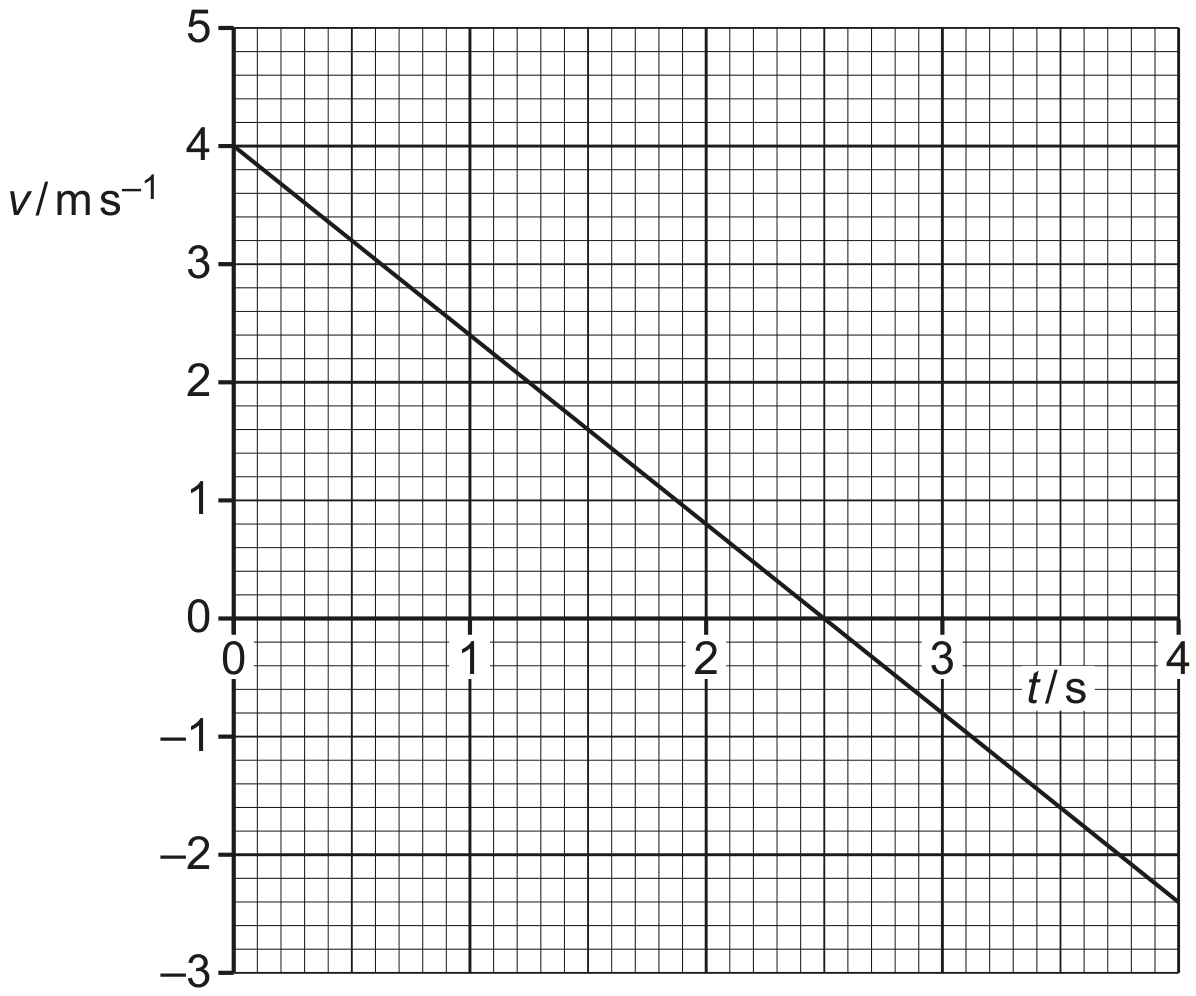
A rock of mass 7.5 kg is projected vertically upwards from the surface of a planet. The rock leaves the surface of the planet with a speed of 4.0 ms14.0 \mathrm{~ms}^{-1} at time t=0. The variation with time t of the velocity v of the rock is shown in Fig. 1.1.

Fig. 1.1

Fig. 1.1

Assume that the planet does not have an atmosphere and that the viscous force acting on the rock is always zero.

[ 4 ]
(i)

Determine the change in the momentum of the rock from time t=0 to time t=4.0 st=4.0 \mathrm{~s}.
change in momentum = Ns

[ 2 ]
(ii)

Determine the weight W of the rock on this planet.
W= N

[ 2 ]
(a)

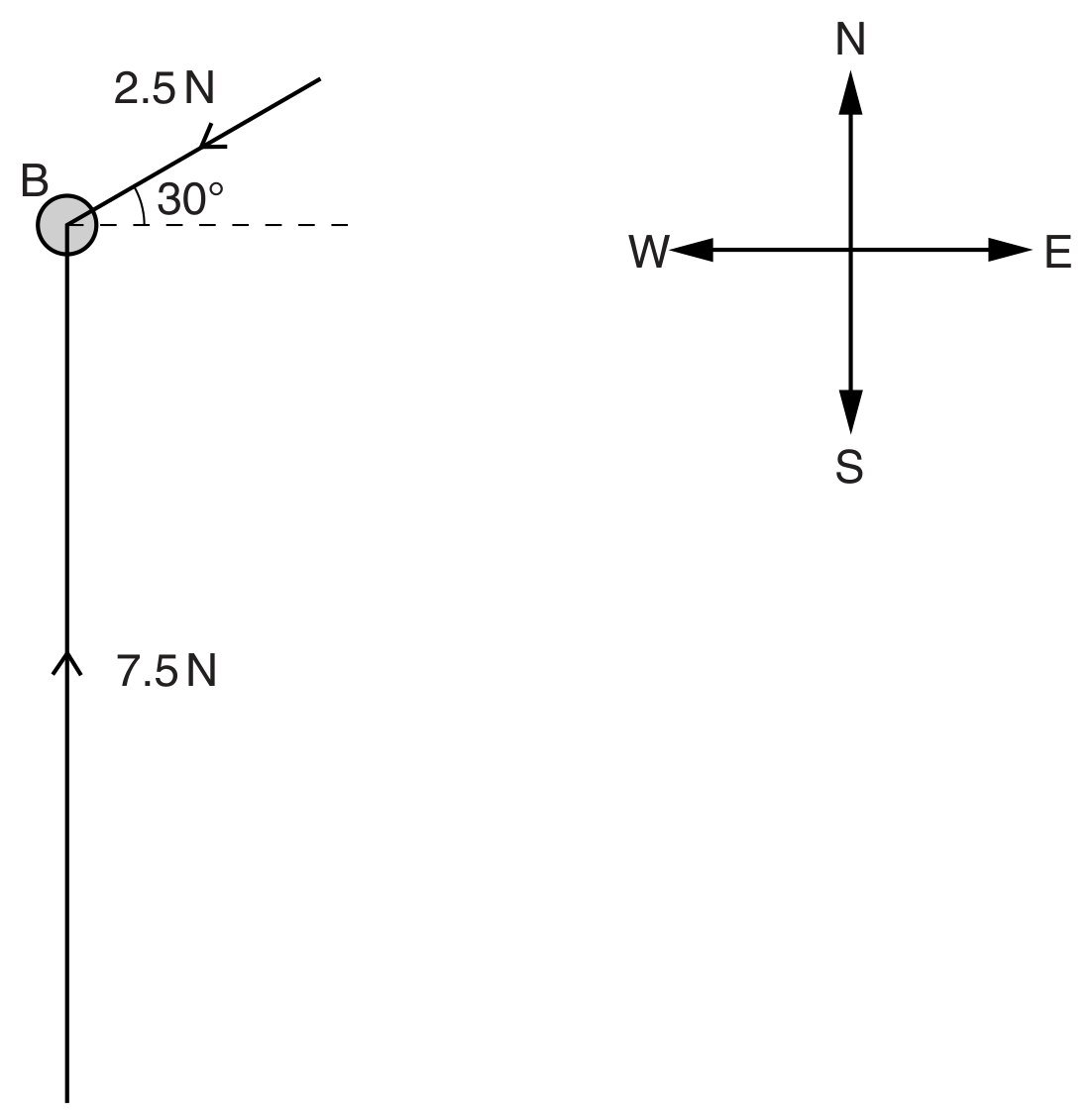
An object B is on a horizontal surface. Two forces act on B in this horizontal plane. A vector diagram for these forces is shown to scale in Fig. 1.1.

Fig. 1.1

Fig. 1.1

A force of 7.5 N towards north and a force of 2.5 N from 3030^{\circ} north of east act on B. The mass of B is 750 g .

[ 3 ]
(i)

1. Show that the magnitude of the resultant force on B is 6.6 N .
2. Calculate the magnitude of the acceleration of B produced by this resultant force. magnitude = ms2[2]\mathrm{ms}^{-2}[2]

[ 3 ]
(a)

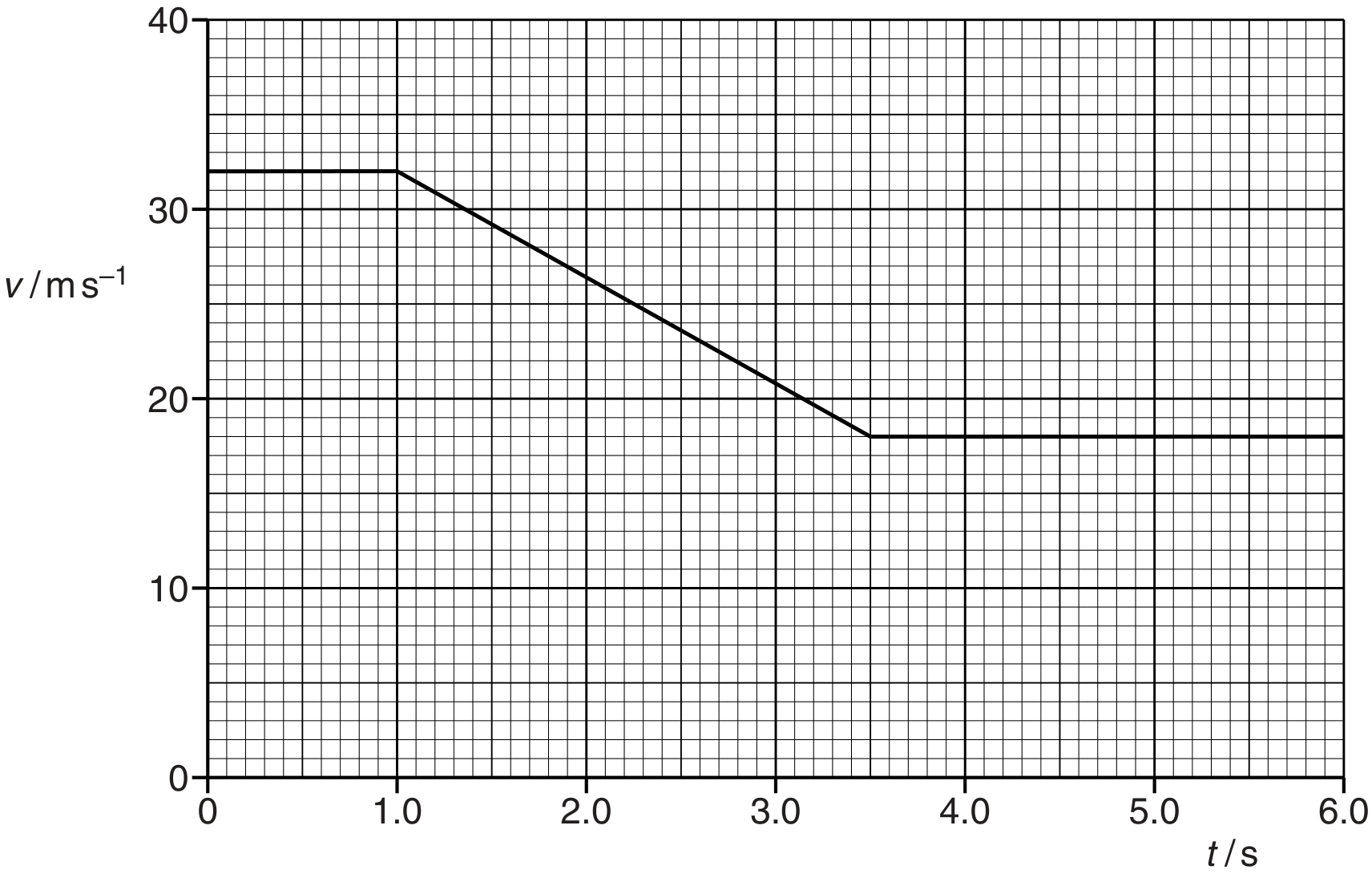
A car of mass 1500 kg moves along a straight, horizontal road. The variation with time t of the velocity v for the car is shown in Fig. 1.1.

Fig. 1.1

Fig. 1.1

The brakes of the car are applied from t=1.0 st=1.0 \mathrm{~s} to t=3.5 st=3.5 \mathrm{~s}.
For the time when the brakes are applied,

[ 3 ]
(i)

calculate the magnitude of the resultant force on the car.

resultant force =N
[ 3 ]
(b)

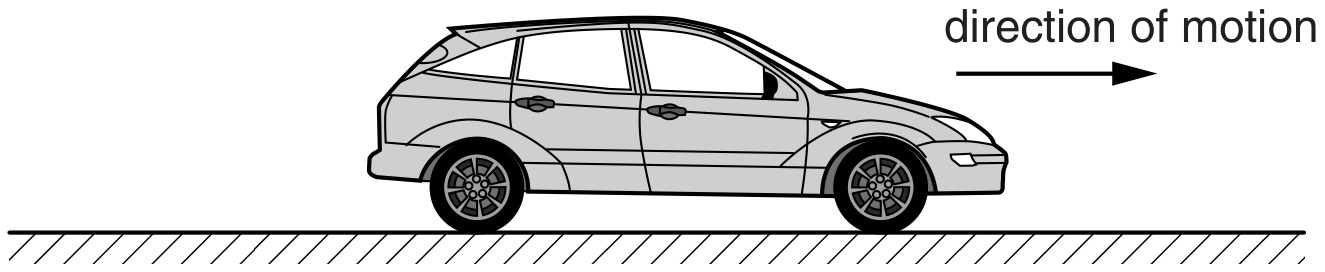
The direction of motion of the car in (b) at time t=2.0 st=2.0 \mathrm{~s} is shown in Fig. 1.2.

Fig. 1.2

Fig. 1.2

On Fig. 1.2, show with arrows the directions of the acceleration (label this arrow A) and the resultant force (label this arrow F).

[ 1 ]
[Maximum number: 1]

Show that the terminal velocity of the raindrop is about 7 ms17 \mathrm{~ms}^{-1}.

(a)

In practice, air resistance on raindrops is not negligible because there is a drag force. This drag force is given by the expression in (a).

[ 1 ]
(i)

State an equation relating the forces acting on the raindrop when it is falling at terminal velocity.

[ 1 ]
(ii)

The raindrop has mass 1.4×10⁵ kg1.4 \times 10^{-5} \mathrm{~kg} and cross-sectional area 7.1×10⁶ m27.1 \times 10^{-6} \mathrm{~m}^{2}. The density of the air is 1.2 kg m31.2 \mathrm{~kg} \mathrm{~m}^{-3} and the initial velocity of the raindrop is zero. The value of C is 0.60 .

(a)
(i)

State Newton's first law of motion.

[ 1 ]
(b)

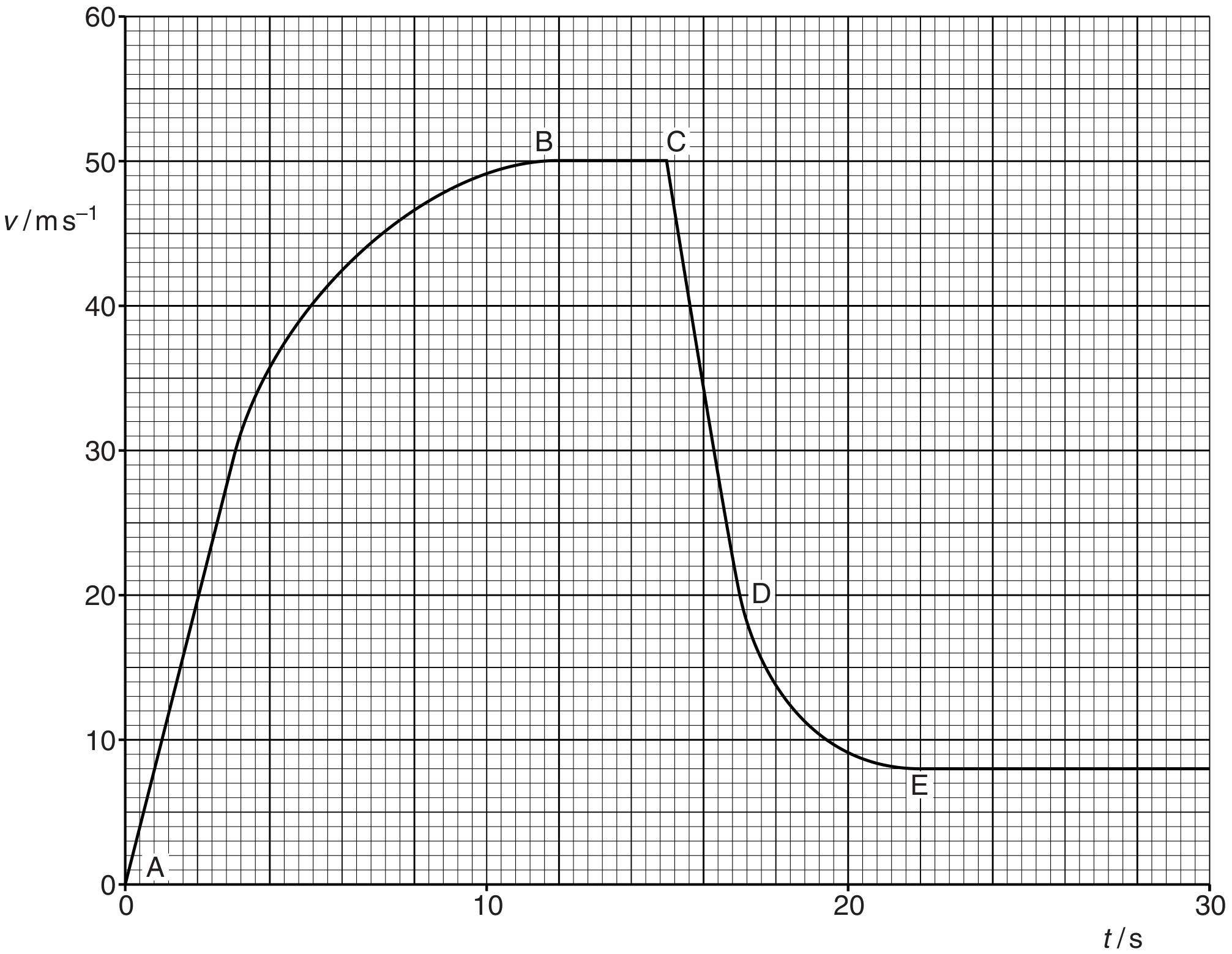
The variation with time t of vertical speed v of a parachutist falling from an aircraft is shown in Fig. 1.1.

Fig. 1.1

Fig. 1.1

[ 5 ]
(i)

The mass of the parachutist is 95 kg .

Calculate, for the parachutist between t=15 st=15 \mathrm{~s} (point C) and t=17 st=17 \mathrm{~s} (point D),
1. the average acceleration,
acceleration = ms2\mathrm{ms}^{-2} [2]
2. the average frictional force.
frictional force = N [3]

Please turn over for Question 2.

[ 5 ]
(a)

State Newton's first law.

[ 1 ]
[Maximum number: 1]

The planet Mars may be considered to be an isolated sphere of diameter 6.79×10⁶ m6.79 \times 10^{6} \mathrm{~m} with its mass of 6.42×10²³ kg6.42 \times 10^{23} \mathrm{~kg} concentrated at its centre.
A rock of mass 1.40 kg rests on the surface of Mars.
For this rock,

(a)
(i)

determine its weight,
weight =

[ 1 ]
[Maximum number: 1]

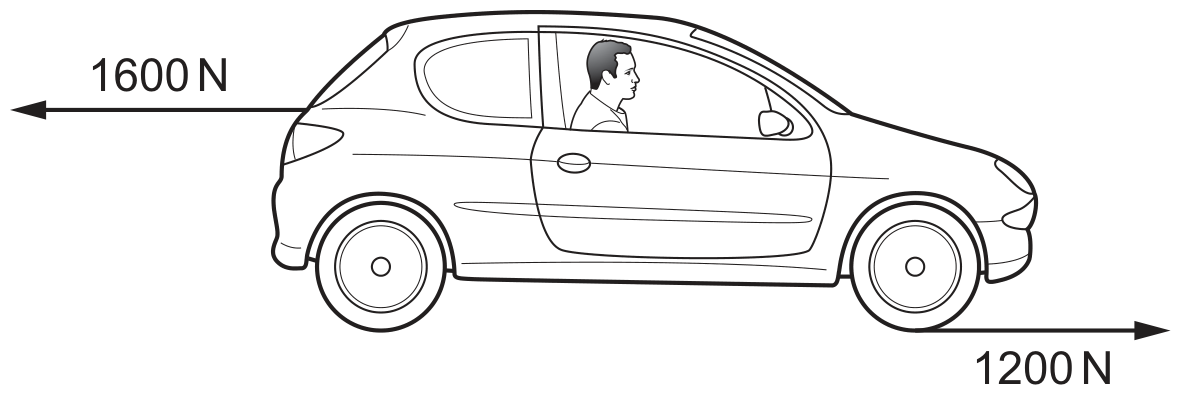
A car of mass 850 kg is travelling in a horizontal straight line. The diagram shows the two horizontal forces acting on the car in opposite directions.

Question image

One force has magnitude 1200 N , and the other force has magnitude 1600 N .
What is the magnitude of the acceleration of the car?

A

0.47 ms20.47 \mathrm{~ms}^{-2}

B

1.4 m s21.4 \mathrm{~m} \mathrm{~s}^{-2}

C

1.9 m s21.9 \mathrm{~m} \mathrm{~s}^{-2}

D

3.3 m s23.3 \mathrm{~m} \mathrm{~s}^{-2}

[Maximum number: 1]

An object of fixed mass is initially at rest at point P. The object then moves away from point P with uniform acceleration.

Which statement describes the resultant force acting on the object when it is moving?

A

It increases uniformly with respect to time.

B

It is constant but not zero.

C

It is proportional to the displacement from point P.

D

It is zero.

0