EduNinja
(a)

A metal sheet is now placed in front of the loudspeaker in (b), as shown in Fig. 4.3.
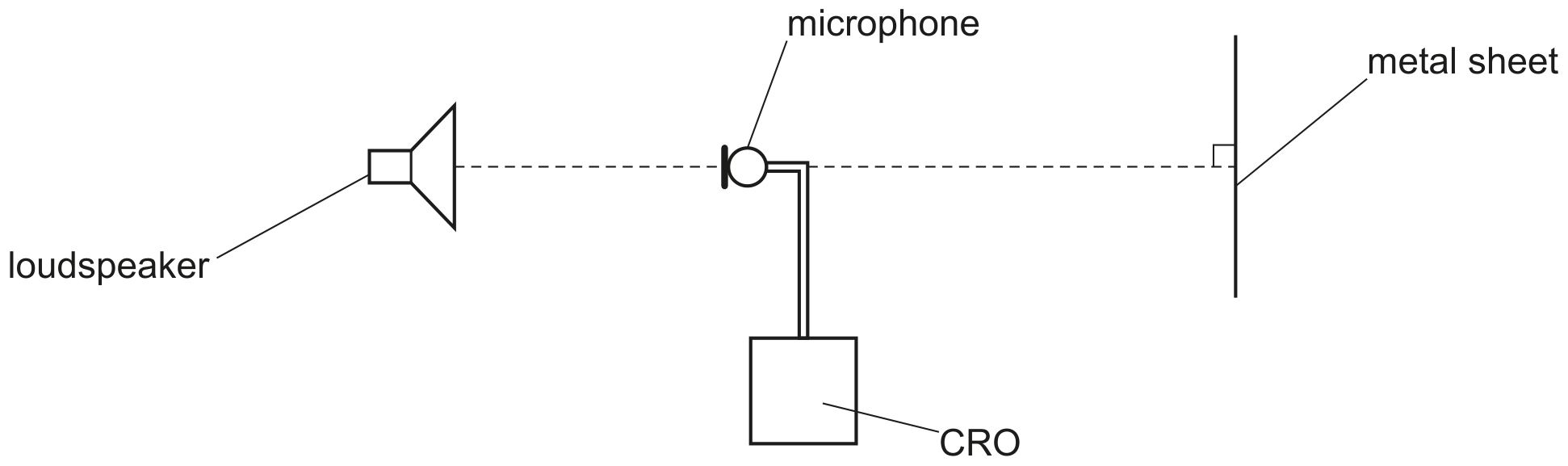
Fig. 4.3

Fig. 4.3

A stationary wave is formed between the loudspeaker and the metal sheet.

[ 4 ]
(i)

State the principle of superposition.

[ 2 ]
(ii)

The initial position of the microphone is such that the trace on the CRO has an amplitude minimum. It is now moved a distance of 1.05 m away from the loudspeaker along the line joining the loudspeaker and metal sheet.

As the microphone moves, it passes through three positions where the trace has an amplitude maximum before ending at a position where the trace has an amplitude minimum.

Determine the wavelength of the sound wave.
wavelength = m

[ 2 ]
[Maximum number: 3]

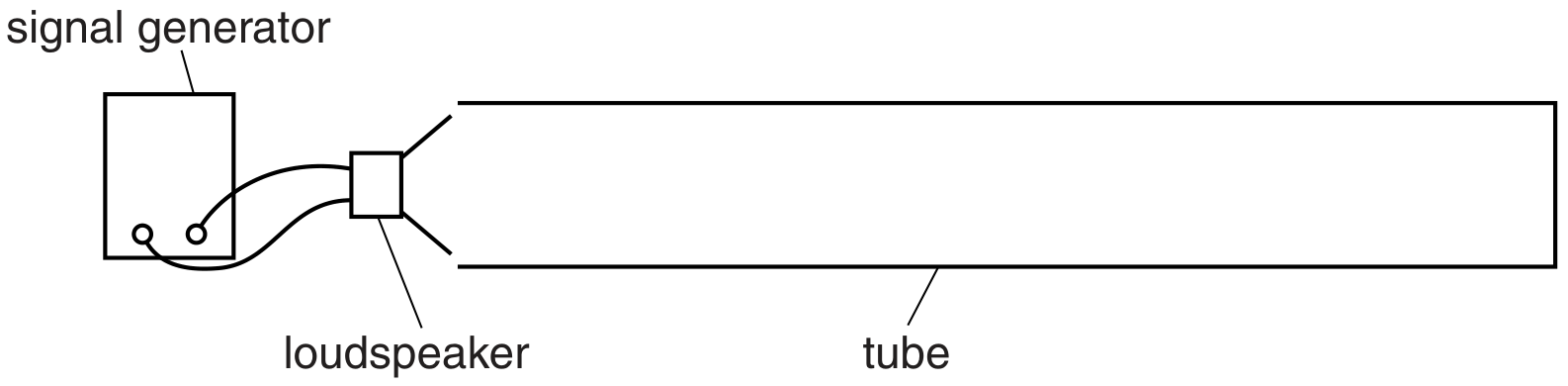
Fig. 4.1 shows an arrangement for producing stationary waves in a tube that is closed at one end.

Fig. 4.1

Fig. 4.1

(a)

Explain how waves from the loudspeaker produce stationary waves in the tube.

[ 3 ]
(a)

State two features of a stationary wave that distinguish it from a progressive wave.
1.
2.

[ 2 ]
(b)

A long tube is open at one end. It is closed at the other end by means of a piston that can be moved along the tube, as shown in Fig. 4.1.

Fig. 4.1

Fig. 4.1

A loudspeaker producing sound of frequency 550 Hz is held near the open end of the tube.
The piston is moved along the tube and a loud sound is heard when the distance L between the piston and the open end of the tube is 45 cm .
The speed of sound in the tube is 330 ms1330 \mathrm{~ms}^{-1}.

[ 4 ]
(i)

Show that the wavelength of the sound in the tube is 60 cm .

[ 1 ]
(ii)

On Fig. 4.1, mark all the positions along the tube of
1. the displacement nodes (label these with the letter N ),
2. the displacement antinodes (label these with the letter A).

[ 3 ]
(c)

The frequency of the sound produced by the loudspeaker in (b) is gradually reduced. Determine the lowest frequency at which a loud sound will be produced in the tube of Use length L=45 cmL=45 \mathrm{~cm}.
frequency = Hz

[ 3 ]
(a)

State the principle of superposition.

(a)

State the principle of superposition.

[ 2 ]
(a)

The sound wave in (c) now meets another sound wave travelling in the opposite direction.

[ 3 ]
(i)

State a condition necessary for these two waves to form a stationary wave.

[ 1 ]
(ii)

State two ways in which a stationary wave differs from a progressive wave.

1

2

[ 2 ]
[Maximum number: 5]

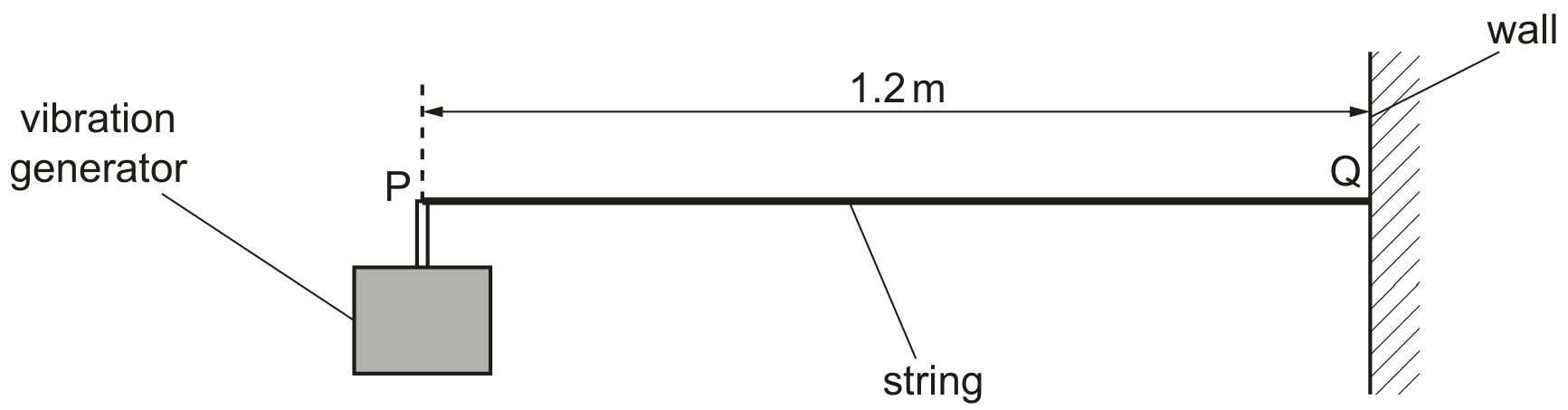
A stretched string PQ has length 1.2 m . One end of the string is attached to a vibration generator and the other end is attached to a wall, as shown in Fig. 5.1.

Fig. 5.1

Fig. 5.1

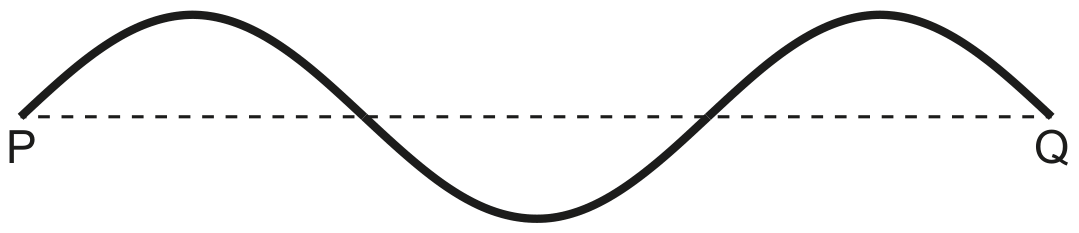
The vibration generator is switched on and a stationary wave is formed on the string. The string is shown at one instant of time in Fig. 5.2.

Fig. 5.2

Fig. 5.2

(a)

Explain how a stationary wave is formed between the vibration generator and the wall.

[ 2 ]
(b)

Calculate the wavelength of the stationary wave shown in Fig. 5.2.
wavelength = m

[ 1 ]
(c)

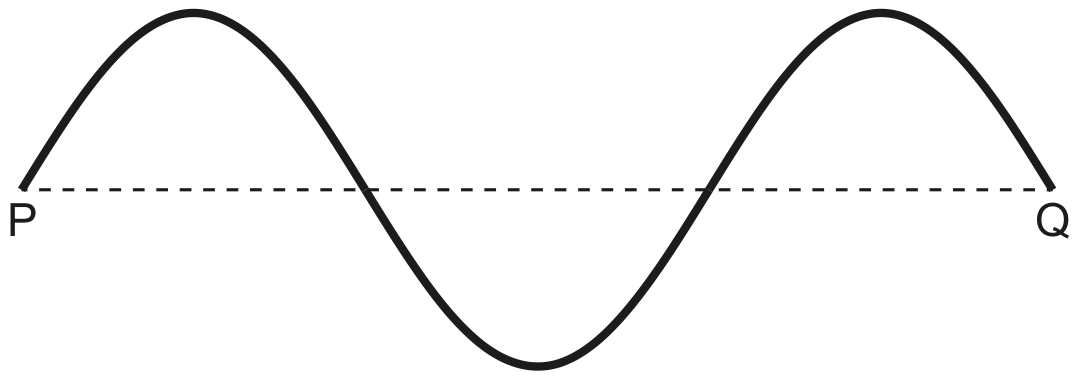
Fig. 5.3 shows the stationary wave at time t=0 when all points on the wave are at their maximum displacements.

Fig. 5.3

Fig. 5.3

The period of the wave is 0.16 s .
On Fig. 5.3 , sketch the shape of the stationary wave at time t=0.24 st=0.24 \mathrm{~s}.

[ 2 ]
[Maximum number: 1]

A stationary sound wave is set up between a loudspeaker and a wall.
A microphone is connected to a cathode-ray oscilloscope (CRO) and is moved along a line directly between the loudspeaker and the wall. The amplitude of the trace on the CRO rises to a maximum at a position X , falls to a minimum and then rises once again to a maximum at a position Y.

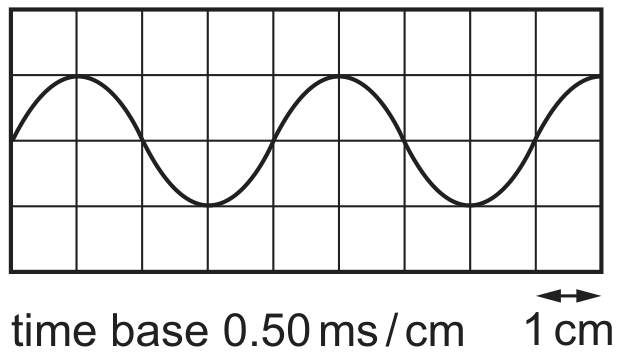
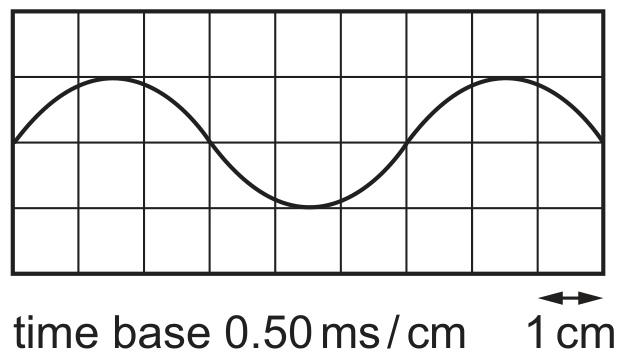
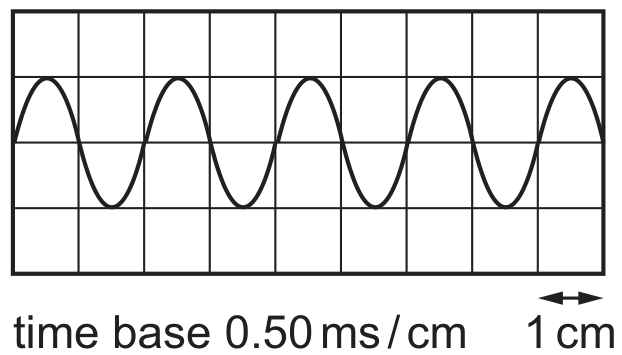
The distance between X and Y is 33 cm . The speed of sound in air is 330 m s1330 \mathrm{~m} \mathrm{~s}^{-1}.
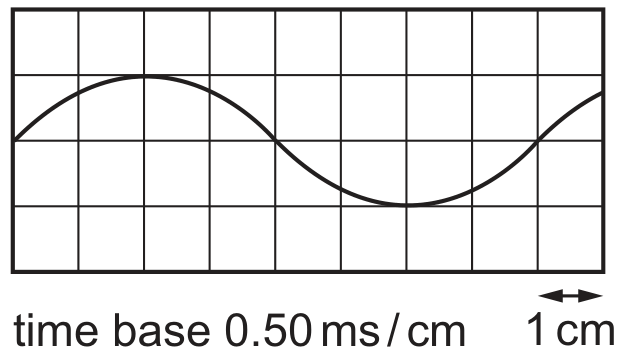
Which diagram could represent the CRO trace of the sound received at X?

A
Question image
B
Question image
C
Question image
D
Question image
[Maximum number: 1]

A stationary wave is produced by two loudspeakers emitting sound of the same frequency.

Question image

When a microphone is moved between X and Y , a distance of 1.5 m , six nodes and seven antinodes are detected.
What is the wavelength of the sound?

A

0.50 m

B

0.43 m

C

0.25 m

D

0.21 m0.21 \mathrm{~m}

[Maximum number: 8]

Fig. 5.1 shows a string stretched between two fixed points P and Q.

A vibrator is attached near end P of the string. End Q is fixed to a wall. The vibrator has a frequency of 50 Hz and causes a transverse wave to travel along the string at a speed of 40 ms140 \mathrm{~ms}^{-1}.

(a)
(i)

Explain how this arrangement may produce a stationary wave on the string.

[ 2 ]
(b)

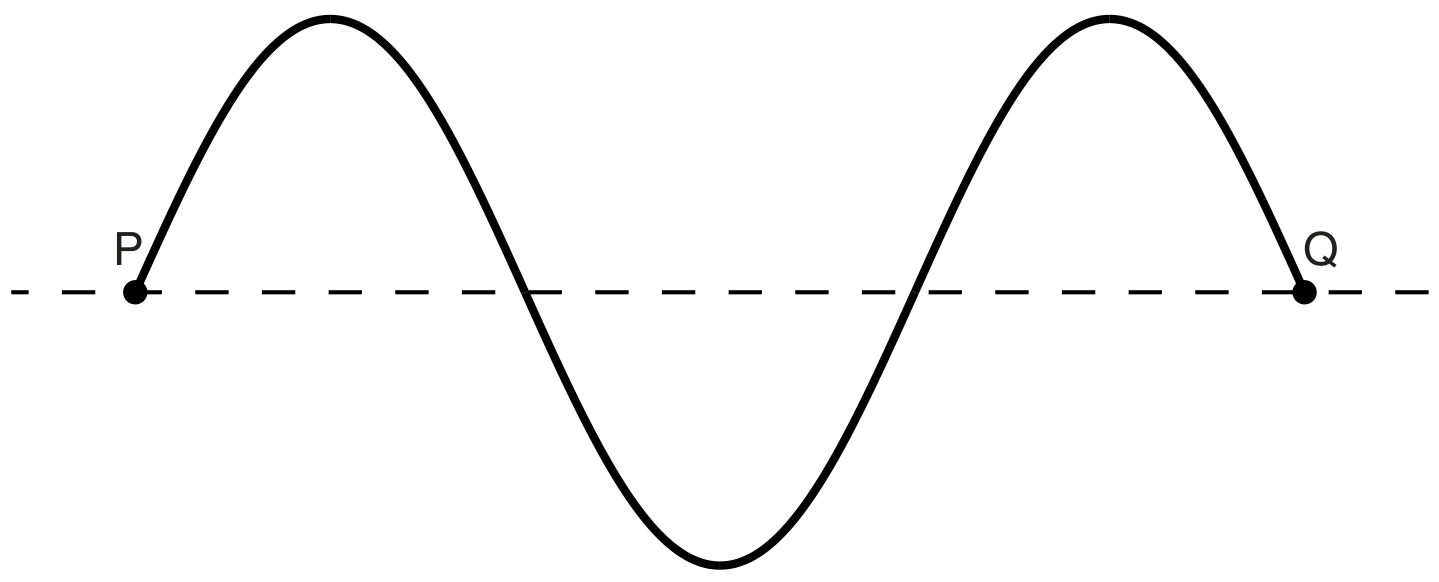
The stationary wave produced on PQ at one instant of time t is shown on Fig. 5.2. Each point on the string is at its maximum displacement.

Fig. 5.2 (not to scale)

Fig. 5.2 (not to scale)

[ 6 ]
(i)

On Fig. 5.2, label all the nodes with the letter N and all the antinodes with the letter A.

[ 2 ]
(ii)

Use your answer in (a)(i) to calculate the length of string PQ .
length = m

[ 1 ]
(iii)

On Fig. 5.2, draw the stationary wave at time (t+5.0 ms)(t+5.0 \mathrm{~ms}). Explain your answer.

[ 3 ]
0