EduNinja
(a)

A laser produces a narrow beam of coherent light of wavelength 632 nm . The beam is incident normally on a diffraction grating, as shown in Fig. 4.1.
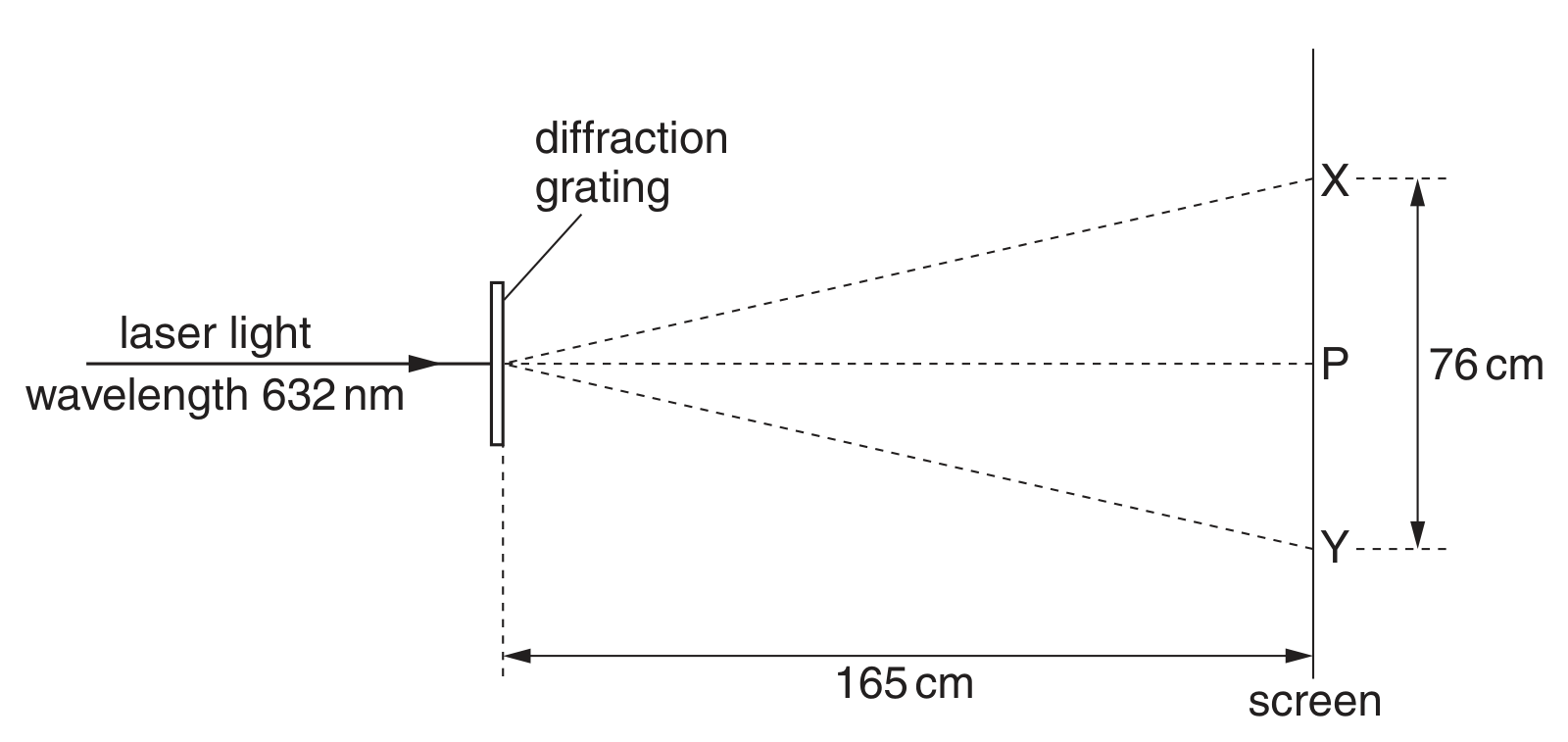
Fig. 4.1

Fig. 4.1

Spots of light are observed on a screen placed parallel to the grating. The distance between the grating and the screen is 165 cm .
The brightest spot is P . The spots formed closest to P and on each side of P are X and Y .
X and Y are separated by a distance of 76 cm .
Calculate the number of lines per metre on the grating.
number per metre =

[ 4 ]
(b)

The grating in (b) is now rotated about an axis parallel to the incident laser beam, as shown in Fig. 4.2.
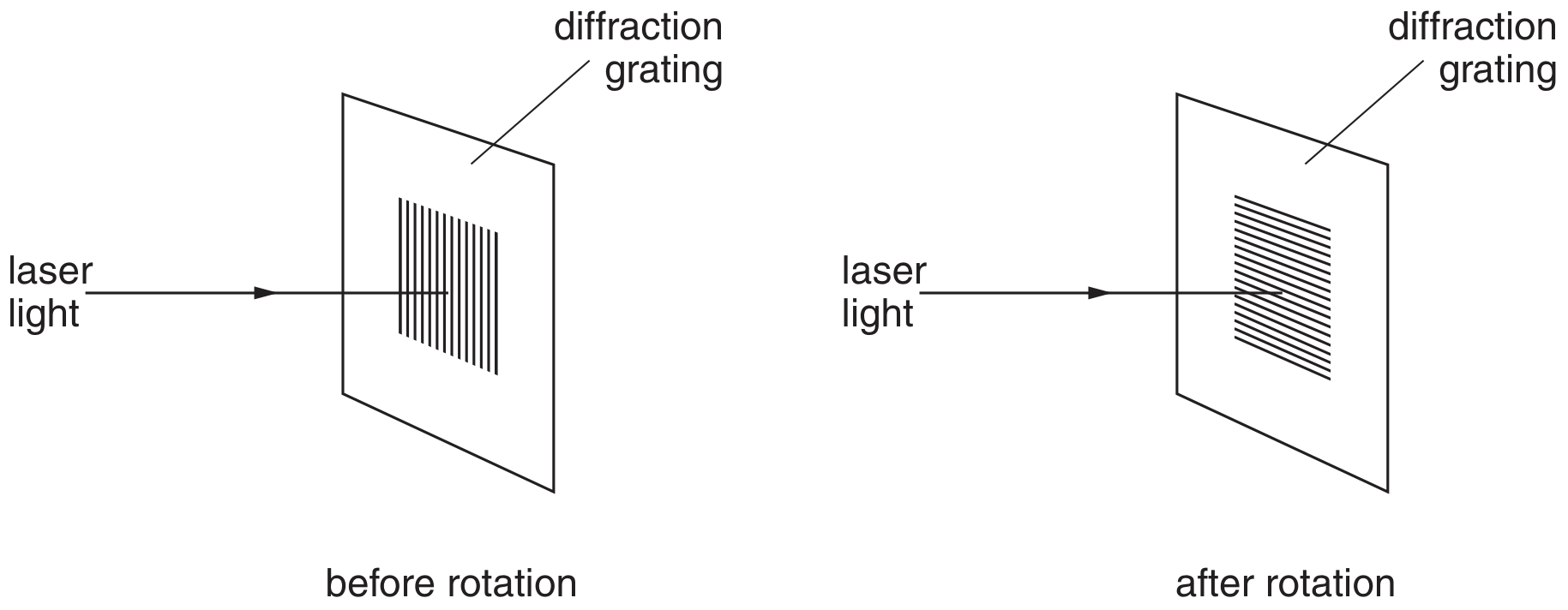
Fig. 4.2

Fig. 4.2

State what effect, if any, this rotation will have on the positions of the spots P, X and Y .

[ 2 ]
(c)

In another experiment using the apparatus in (b), a student notices that the distances XP and PY , as shown in Fig. 4.1, are not equal. Suggest a reason for this difference.
[ 1 ]
(a)

A laser emits a beam of electromagnetic waves of frequency 3.7×10¹⁵ Hz3.7 \times 10^{15} \mathrm{~Hz} in a vacuum.

[ 6 ]
(i)

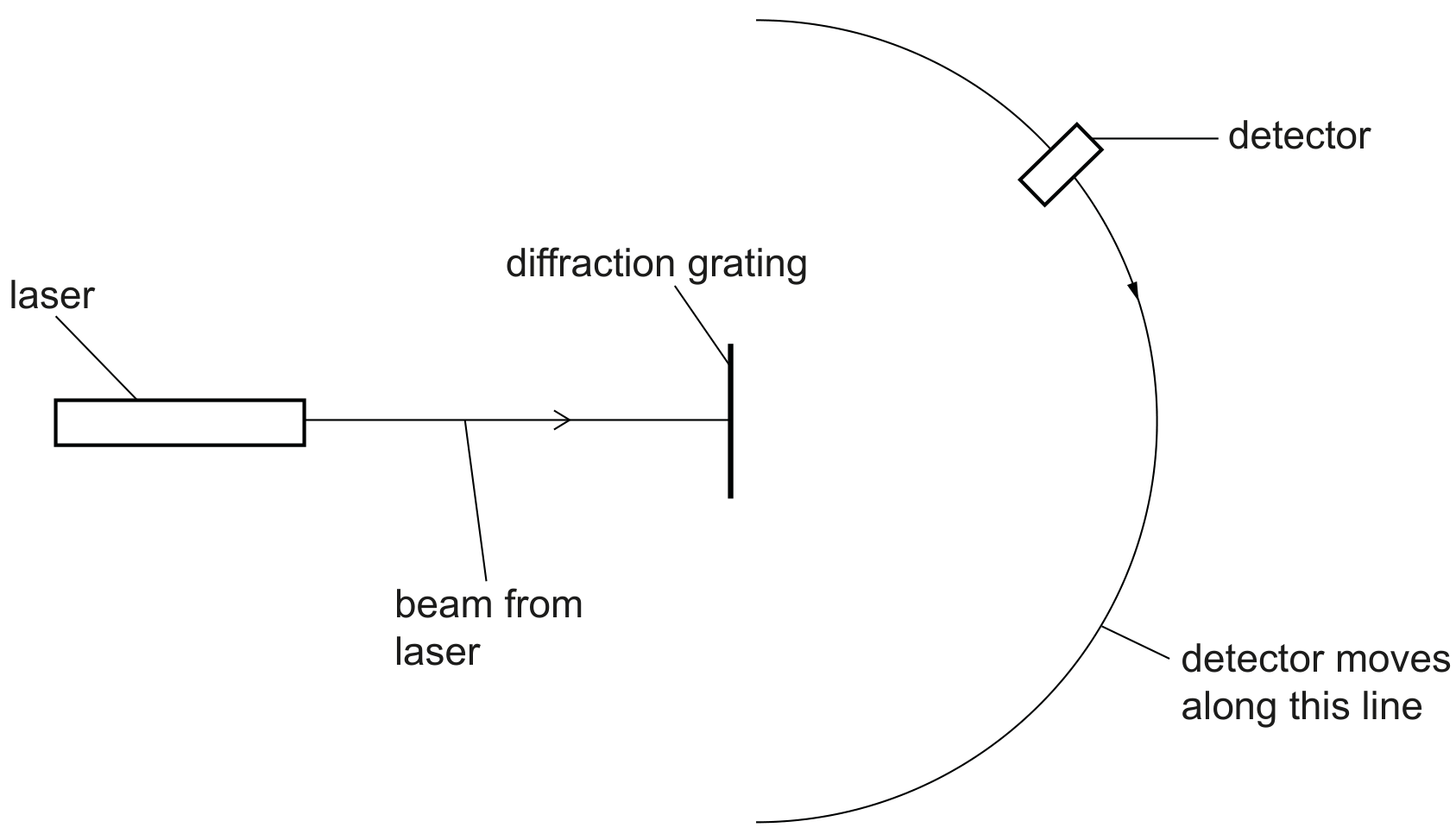
The beam from the laser now passes through a diffraction grating with 2400 lines per millimetre. A detector sensitive to the waves emitted by the laser is moved through an arc of 180180^{\circ} in order to detect the maxima produced by the waves passing through the grating, as shown in Fig. 5.2.

Fig. 5.2

Fig. 5.2

Calculate the number of maxima detected as the detector moves through 180180^{\circ} along the line shown in Fig. 5.2. Show your working.

number of maxima detected =
[ 4 ]
(ii)

The laser is now replaced with one that emits electromagnetic waves with a wavelength of 300 nm .

Explain, without calculation, what happens to the number of maxima now detected. Assume that the detector is also sensitive to this wavelength of electromagnetic waves.

[ 2 ]
[Maximum number: 1]

Which electromagnetic wave phenomenon is needed to explain the spectrum produced when white light falls on a diffraction grating?

A

coherence

B

interference

C

polarisation

D

refraction

(a)

Describe the diffraction of monochromatic light as it passes through a diffraction grating.

[ 2 ]
(b)

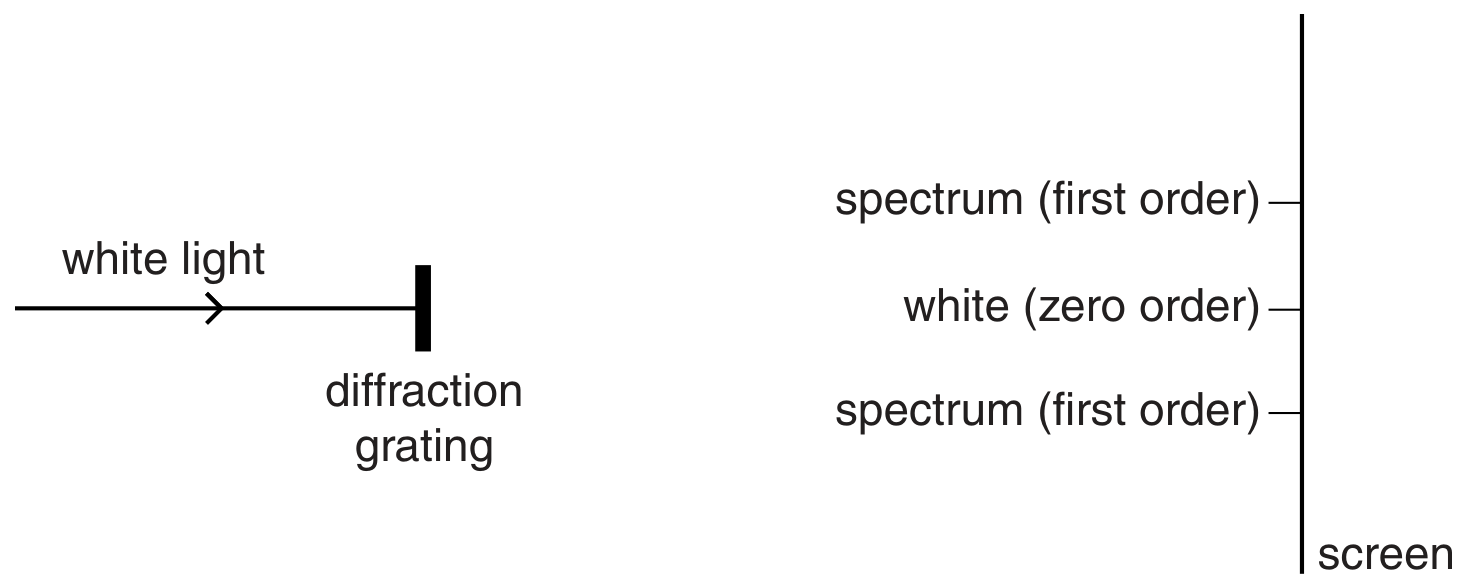
White light is incident on a diffraction grating, as shown in Fig. 4.1.

Fig. 4.1 (not to scale)

Fig. 4.1 (not to scale)

The diffraction pattern formed on the screen has white light, called zero order, and coloured spectra in other orders.

[ 4 ]
(i)

Light of wavelength 625 nm produces a second-order maximum at an angle of 61.061.0^{\circ} For to the incident direction.

Determine the number of lines per metre of the diffraction grating.

 number of lines =.......................... m1\text { number of lines }=\ldots \ldots \ldots \ldots \ldots \ldots . . . . . . . . . . . . . . . . . . . . . . . . . . ~ m^{-1}
[ 2 ]
(ii)

Calculate the wavelength of another part of the visible spectrum that gives a maximum for a different order at the same angle as in (ii).
wavelength = nm

[ 2 ]
[Maximum number: 1]

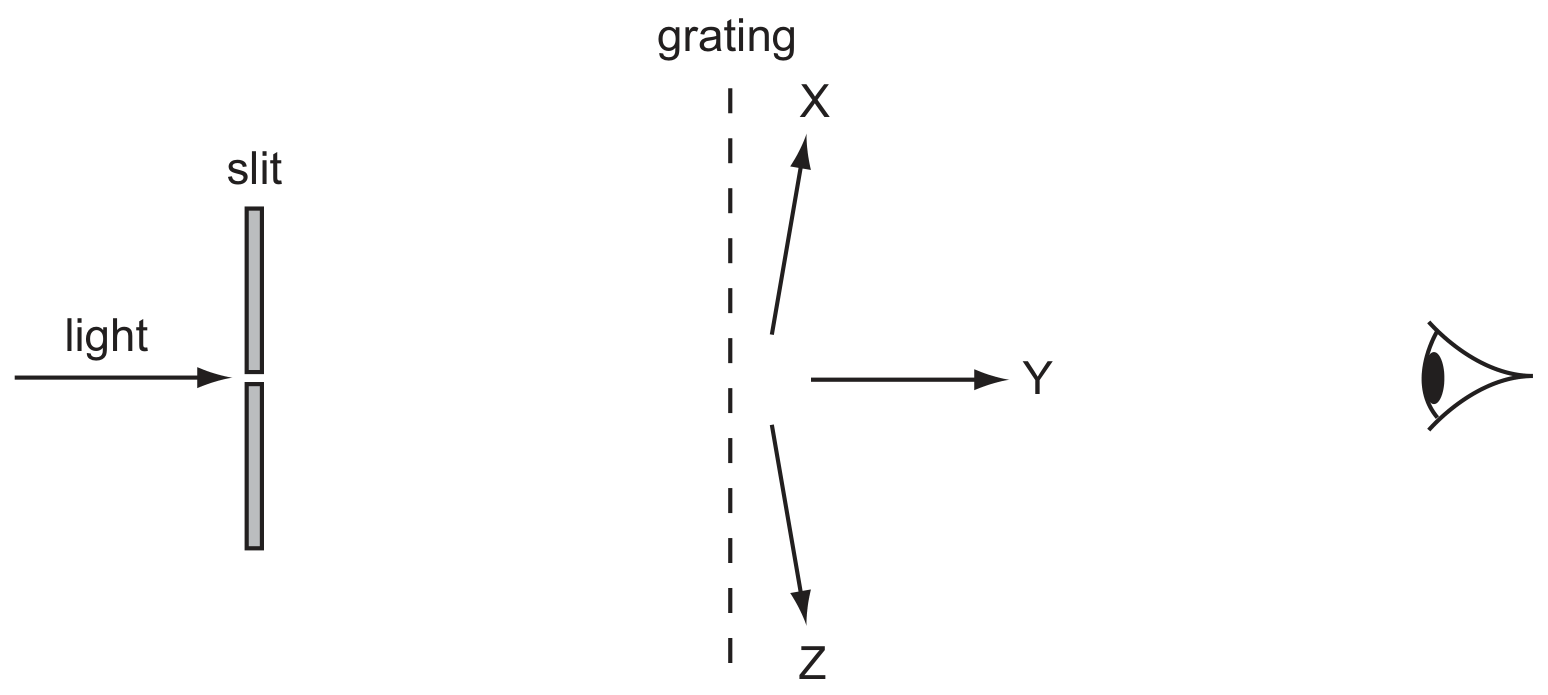
A diffraction grating with 500 lines per mm is used to observe diffraction of monochromatic light of wavelength 600 nm .
The light is passed through a narrow slit and the grating is placed so that its lines are parallel to the slit. Light passes through the slit and then the grating.

Question image

An observer views the slit through the grating at different angles, moving his head from X parallel to the grating, through Y , opposite the slit, to Z parallel to the grating on the opposite side.
How many images of the slit does he see?

A

3

B

4

C

6

D

7

[Maximum number: 1]

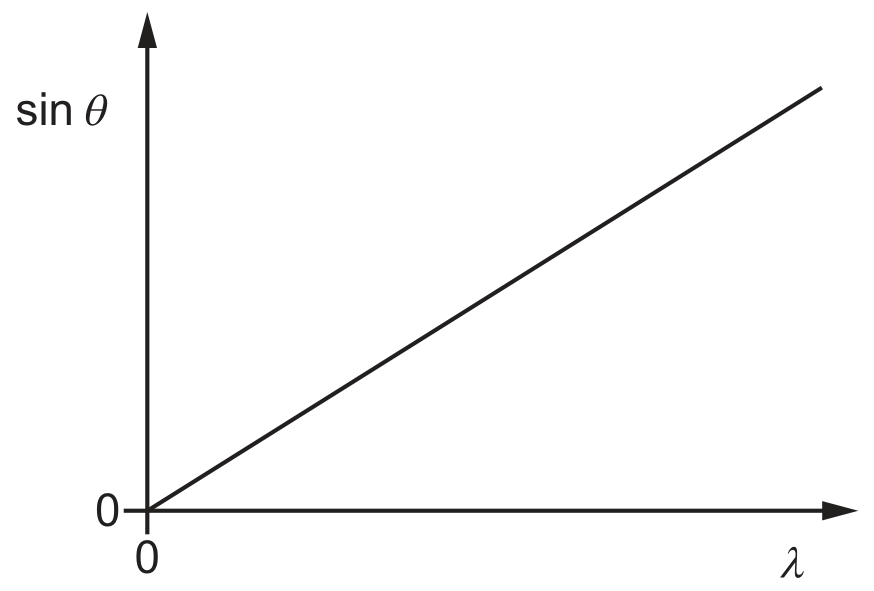
A diffraction grating with N lines per metre is used to diffract light of various wavelengths λ\lambda.
The graph shows the relation between the diffraction angle θ\theta and λ\lambda for different wavelengths in the nth n^{\text {th }} order interference pattern.

Question image

What is the gradient of the graph?

A

N n

B

Nn\frac{N}{n}

C

nN\frac{n}{N}

D

1Nn\frac{1}{N n}

[Maximum number: 1]

Light of frequency 6.7×10¹⁴ Hz6.7 \times 10^{14} \mathrm{~Hz} in a vacuum is incident normally on a diffraction grating that contains 4.0×1054.0 \times 10^{5} lines m1\mathrm{m}^{-1}.

What is the angle between the adjacent second and third order intensity maxima?

A

1212^{\circ}

B

2121^{\circ}

C

3333^{\circ}

D

5454^{\circ}

[Maximum number: 1]

Light passes through a diffraction grating ruled at 1000 lines per cm and the same wavelength of light also passes through two narrow slits 0.5 mm apart. Both situations produce intensity maxima and minima on a screen.
Which statement about the separation of the maxima on the screen and the sharpness of the maxima is correct?

A

The diffraction grating maxima are less widely spaced and are less sharp than the two-slit maxima.

B

The diffraction grating maxima are less widely spaced and are sharper than the two-slit maxima.

C

The diffraction grating maxima are more widely spaced and are less sharp than the two-slit maxima.

D

The diffraction grating maxima are more widely spaced and are sharper than the two-slit maxima.

[Maximum number: 1]

A parallel beam of white light passes through a diffraction grating. Orange light of wavelength 600 nm in the fourth order diffraction maximum coincides with blue light in the fifth order diffraction maximum.

What is the wavelength of the blue light?

A

450 nm

B

480 nm

C

500 nm

D

750 nm

[Maximum number: 1]

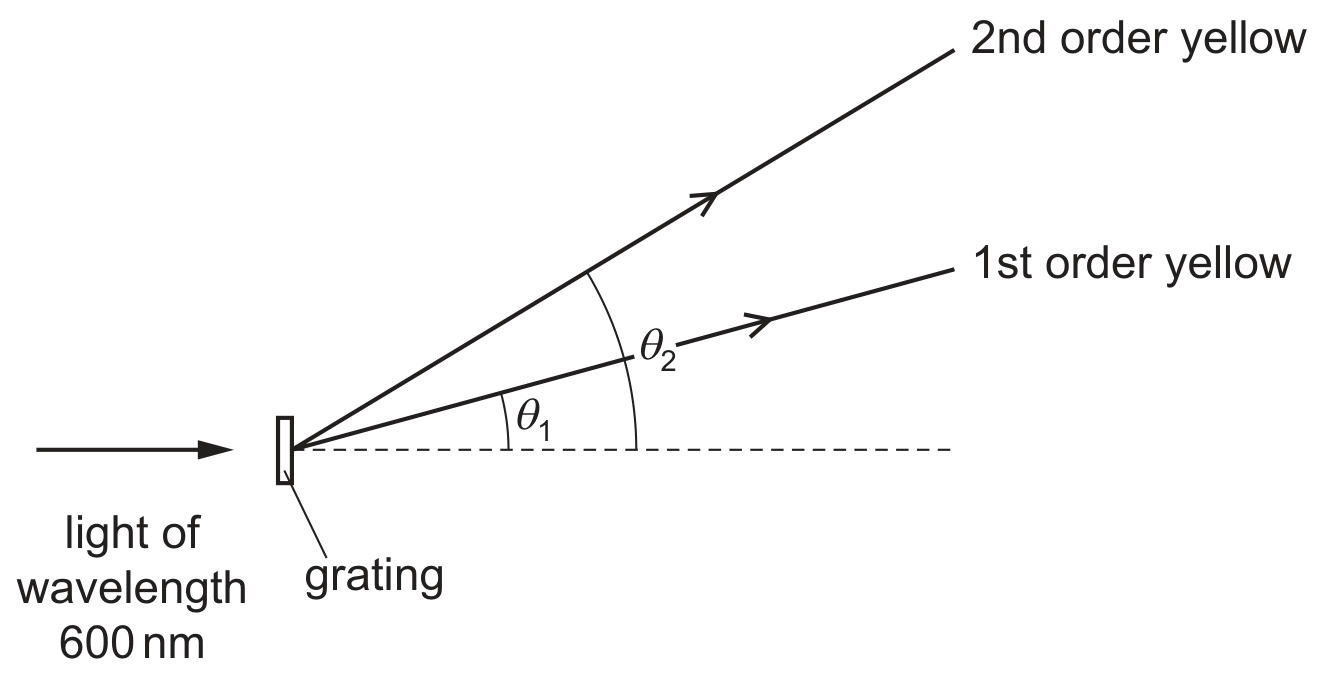
A diffraction grating experiment is set up using yellow light of wavelength 600 nm . The grating has a slit separation of 2.00μ m2.00 \mu \mathrm{~m}.

Question image

What is the angular separation ( θ2θ1\theta_{2}-\theta_{1} ) between the first and second order maxima of the yellow light?

A

17.517.5^{\circ}

B

19.419.4^{\circ}

C

36.936.9^{\circ}

D

54.354.3^{\circ}

0