
EduNinja
[Maximum number: 4]

The Zika virus is a pathogen that can infect human cells.

(a)

Zika virus vaccines have been developed by scientists.

One of the vaccines contains small proteins from the Zika virus.

[ 4 ]
(i)

Explain how giving this vaccine to a person can lead to the development of long-term immunity against Zika virus disease.

[ 4 ]
[Maximum number: 1]

The infectious disease cholera is caused by a bacterium.

(a)

Using genetic engineering, it is possible to produce a form of choleragen consisting of only subunit B . This can be combined with inactivated bacterial cells to produce a vaccine against cholera.

[ 1 ]
(i)

Suggest why subunit B , rather than subunit A , is used in the vaccine.

[ 1 ]
[Maximum number: 2]

Globally, measles is an important disease that mainly affects children. Many deaths from measles occur in children under five years of age.

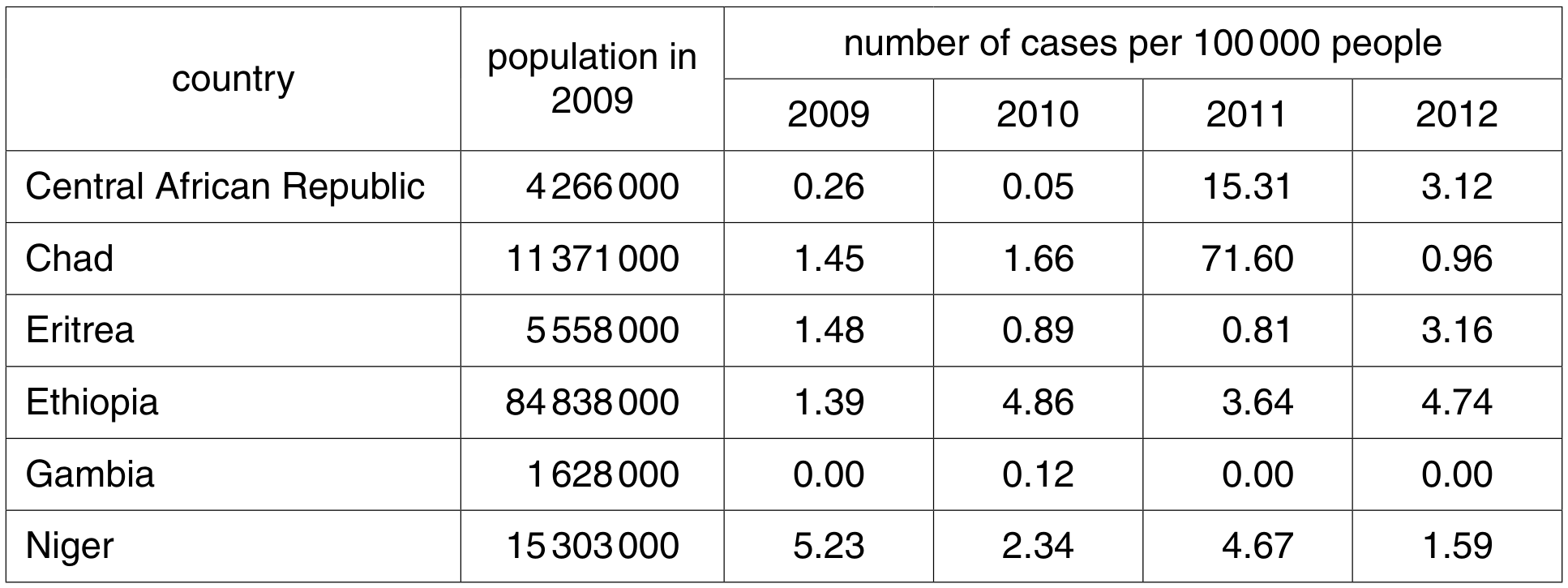
Table 3.1 shows the population of six countries in Africa in 2009 and the number of cases of measles per 100000 people for the four years 2009 to 2012.
All six countries are classified as low-income countries.

Table 3.1

Table 3.1

(a)

The successful eradication of smallpox involved an intensive global vaccination programme. It is hoped that the same can be achieved with measles.

Outline two features, apart from cost, of the smallpox eradication programme that may have made it easier to eradicate than measles.

[ 2 ]
[Maximum number: 5]


Chronic bronchitis is one of the conditions that contributes to chronic obstructive pulmonary disease (COPD).

(a)

In 1980, it was announced that the highly infectious viral disease, smallpox, had been eradicated. This was mainly due to a worldwide vaccination programme planned by the World Health Organization (WHO).

Attempts have been made to control other diseases, such as measles, sickle cell anaemia and cholera, without the same success as smallpox.

[ 5 ]
(i)

Discuss the reasons why vaccination has not eradicated cholera and sickle cell anaemia.
cholera
sickle cell anaemia

[ 5 ]
[Maximum number: 4]

Countries that have a high number of cases of malaria also have problems with diseases caused by bacteria. This means that many people in these countries are prescribed antibiotics, such as penicillin, for the treatment of bacterial infections.

(a)

After many years of intense research and development, WHO reported in 2016 that a pilot vaccination programme would be trialled between 2017 and 2020.

The programme uses a vaccine acting against the most widespread species of Plasmodium.
Explain the difficulties faced by researchers in developing a malaria vaccine.

[ 4 ]
[Maximum number: 3]

Tuberculosis (TB), influenza and polio are examples of infectious diseases.

(a)

The influenza virus can mutate frequently to produce different strains of the virus. A new vaccine is often necessary to stimulate the production of new antibodies to these new strains.

Explain why different antibodies need to be produced to give immunity to these new strains.

[ 3 ]
[Maximum number: 2]

Measles is a highly infectious disease.

(a)

Explain why countries that have established vaccination programmes still have cases of measles.

[ 2 ]
[Maximum number: 1]

Which development in vaccine production would be most important in the fight to eradicate measles in developing countries?

A

a combined vaccine to combat it and other diseases

B

a single vaccine, without the need for boosters

C

a vaccine containing only live measles viruses

D

a vaccine produced by genetic engineering techniques

[Maximum number: 1]

Whooping cough is a highly infectious disease of the gas exchange system, caused by the bacterium Bordetella pertussis.

Which method provides protection to infants against whooping cough and reduces the chance of developing this disease later?

A

a short course of more than one type of antibiotic

B

a six-month course of one type of antibiotic

C

injections of antibodies specific to Bordetella pertussis

D

injections of antigens from Bordetella pertussis bacteria

[Maximum number: 1]

Some of the facts about a pathogen, P , are that:
1 it is transmitted in food and water
2 it lives in human intestines
3 it has many genes coding for surface proteins
4 it changes its surface antigens
5 it may or may not trigger an immune response.
Which explains why it is difficult to develop an effective vaccine for P ?

A

P can mutate to produce different antigens.

B

P is a eukaryotic cell with many genes.

C

P is found in contaminated food and water and affects the gut.

D

People can be infected with P and may not show symptoms.

0