EduNinja
[Maximum number: 1]

Fig. 1.1 is a photomicrograph of a low power image of part of the common sunflower, Helianthus annuus. Fig. 1.1 is a transverse section.
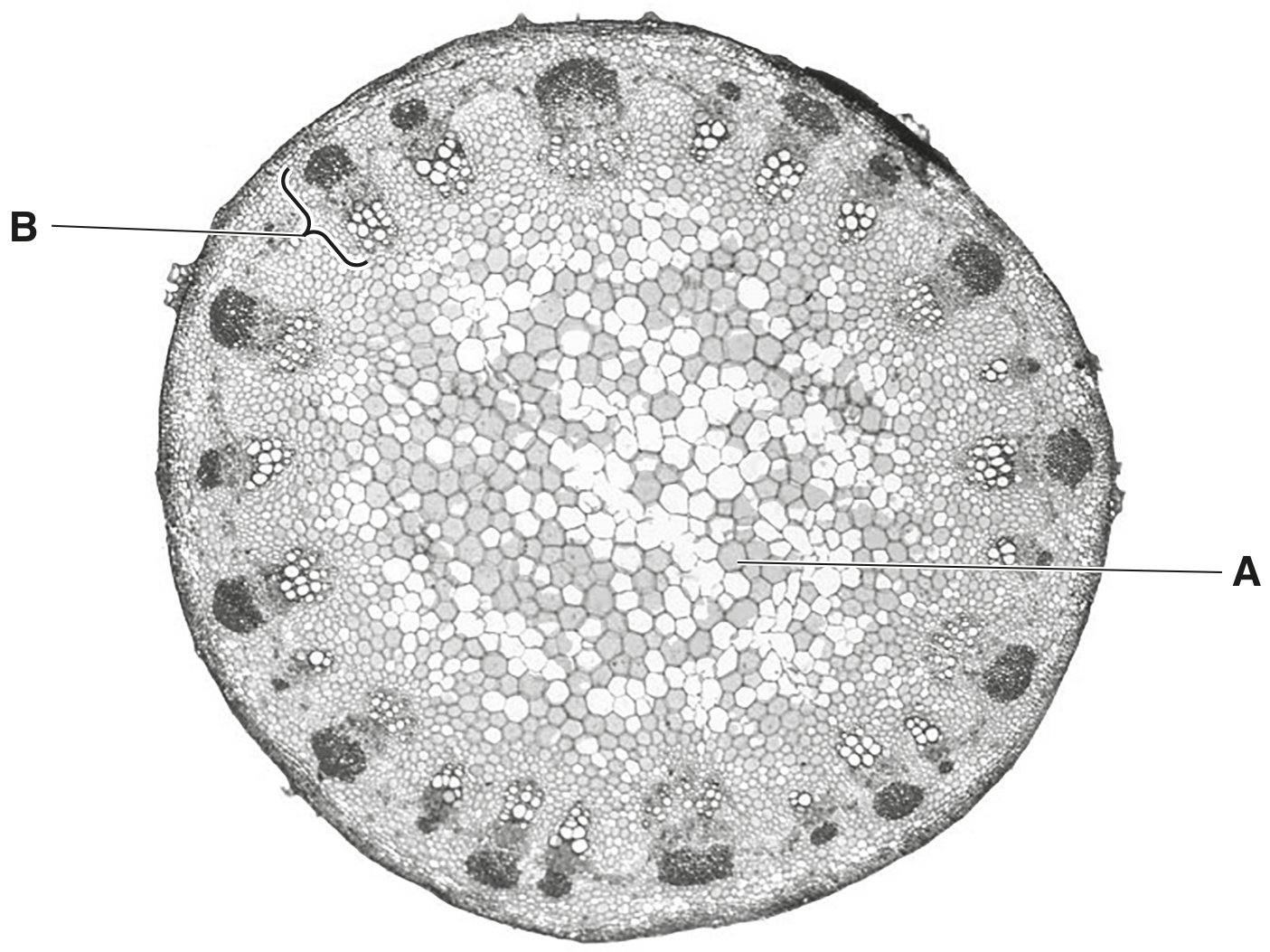
Fig. 1.1

Fig. 1.1

(a)

Structure B in Fig. 1.1 contains phloem tissue and xylem tissue and other tissues that provide support.

[ 1 ]
(i)

Name structure B.

[ 1 ]
[Maximum number: 1]

Water and mineral ions are transported up the stem of a plant to the leaves within xylem vessels.
Some water and mineral ions can pass out of xylem vessel elements to supply parenchyma tissue in the stem.

(a)

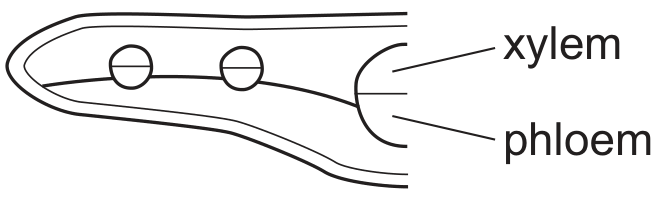
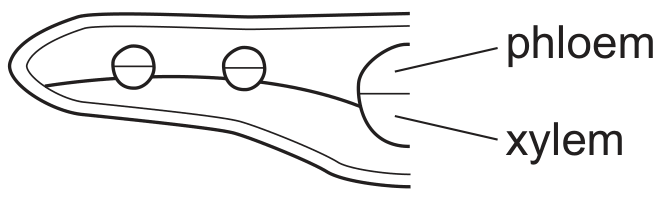
Fig. 1.1 is a plan diagram of a section through a stem.

Fig. 1.1

Fig. 1.1

Identify one location where xylem tissue occurs in the stem by drawing a label line and the letter X on Fig. 1.1.

[ 1 ]
[Maximum number: 1]

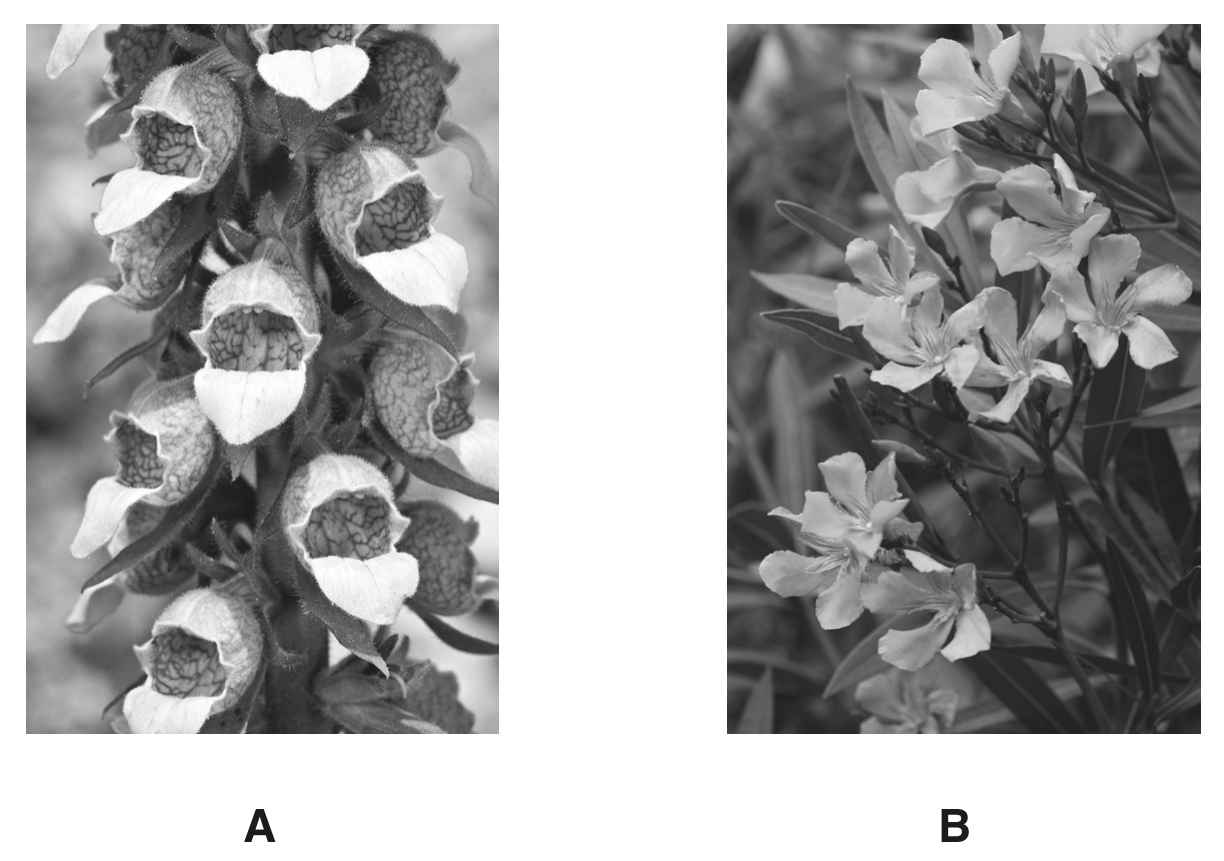
Woolly foxglove, Digitalis lanata, shown in Fig. 2.1A, and common oleander, Nerium oleander, shown in Fig. 2.1B, are plants grown for the attractive flowers that they produce.

Both plants are poisonous, as their leaves produce toxic organic compounds known as cardiac glycosides. Cardiac glycosides have a powerful effect on the action of cardiac muscle.

Fig. 2.1

Fig. 2.1

(a)

Aphids are small insects that feed on plant fluids using piercing and sucking mouthparts. When aphids feed on the sap present in vascular tissue of leaves and stems, a sugary liquid called honeydew is passed out of the gut. The honeydew can be analysed to find out what is present in the sap.

[ 1 ]
(i)

State the name of the vascular tissue from which the aphids feed.

[ 1 ]
[Maximum number: 1]

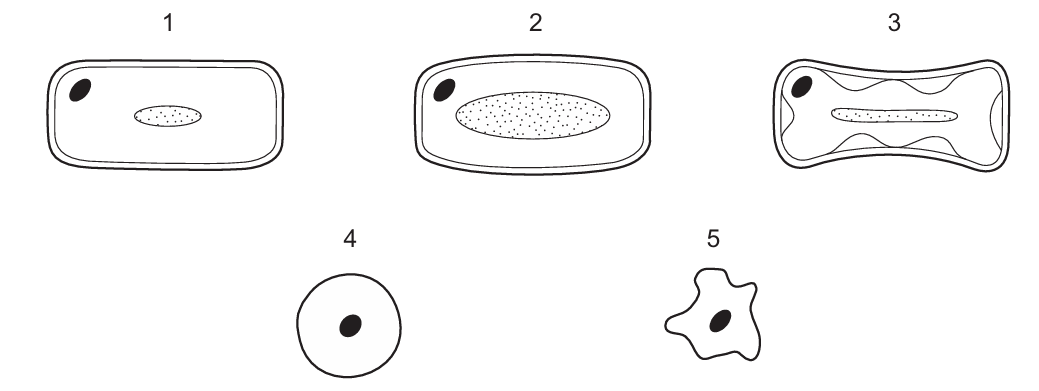
Some plant and animal cells were placed in different solutions and the results are shown.

Question image

Which cells were placed in which solution?

1.0 moldm31.0 \mathrm{~mol} \mathrm{dm}^{-3} sucrose

0.1 moldm30.1 \mathrm{~mol} \mathrm{dm}^{-3} salt solution

1 and 2

3 and 5

1 and 4

3

2 and 4

1 and 3

3 and 5

2 and 4

[Maximum number: 1]

Which plan diagram of a transverse section of a dicotyledonous leaf correctly shows the position of xylem and phloem in a palisade mesophyll layer that is twice as thick as the spongy mesophyll layer?

A
Question image
B
Question image
C
Question image
D
Question image
[Maximum number: 1]

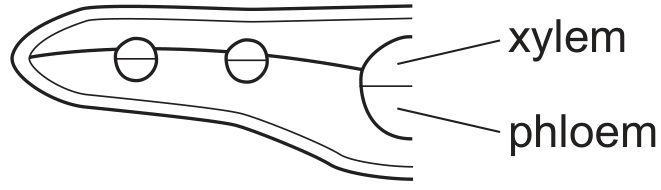
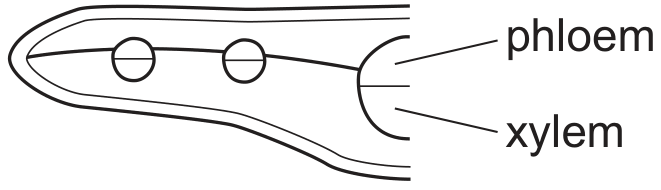
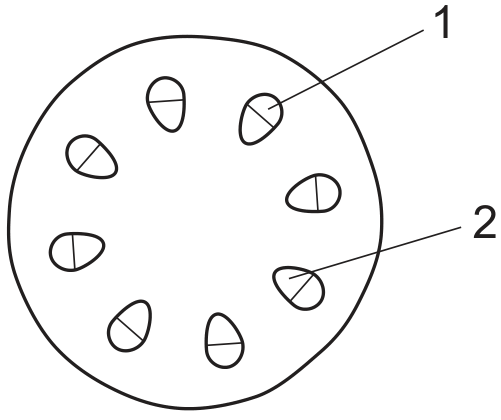
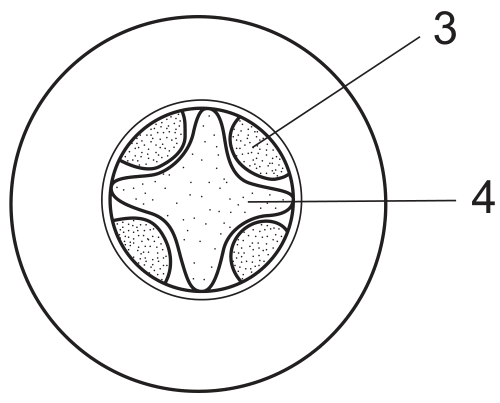
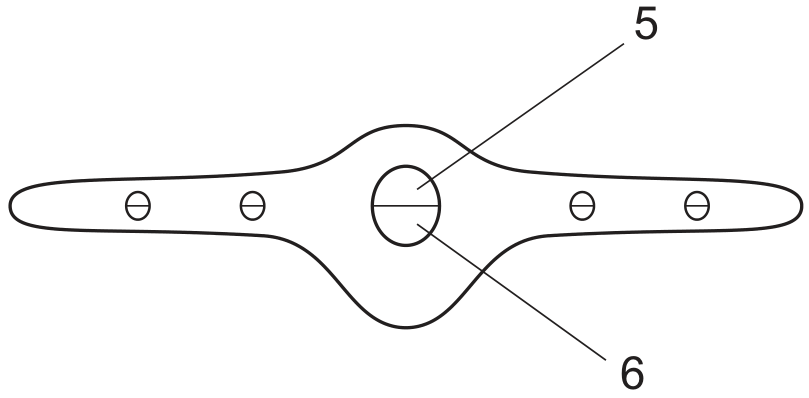
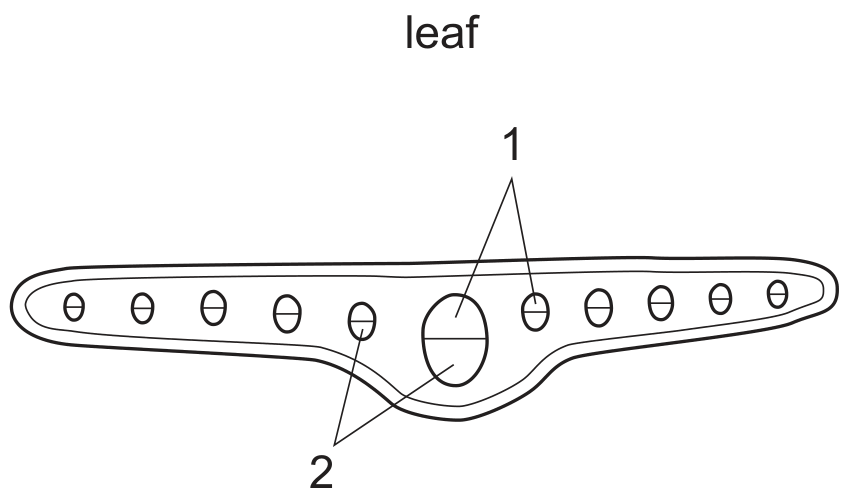
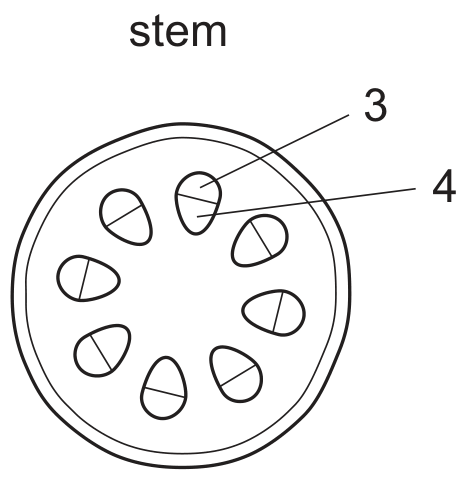
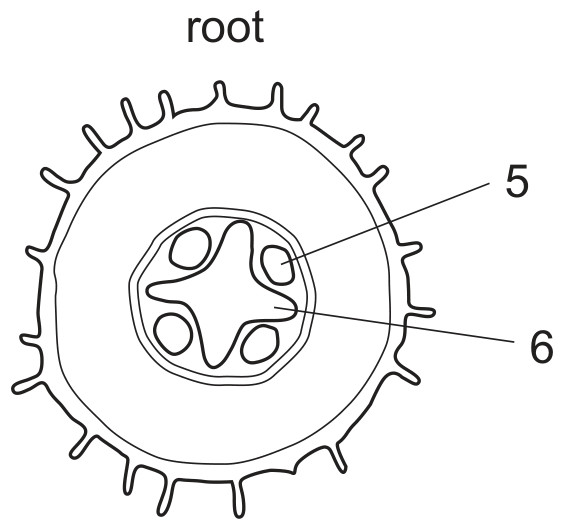
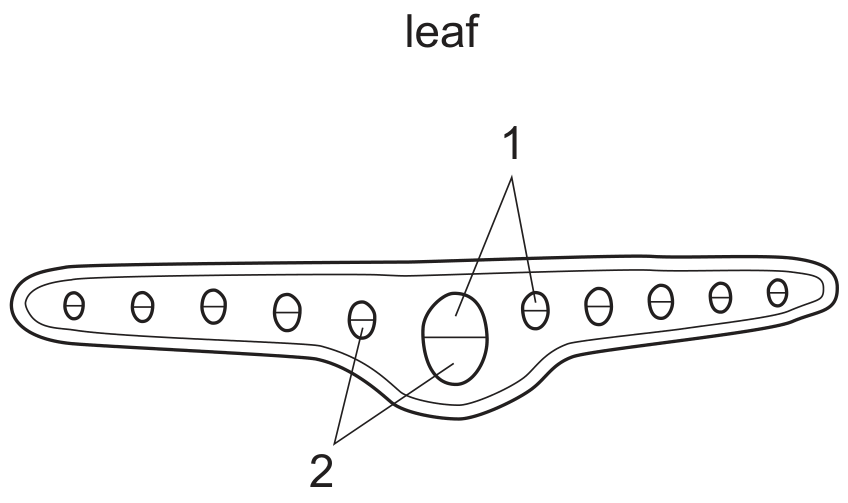
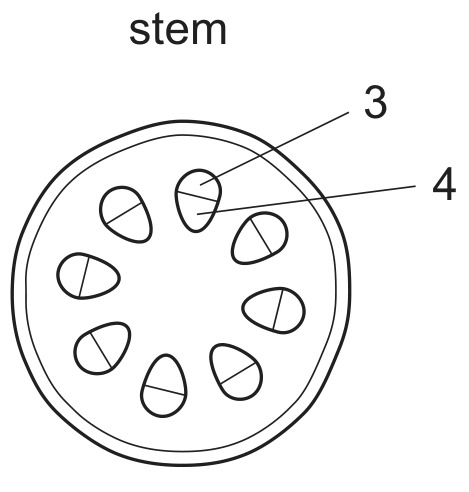
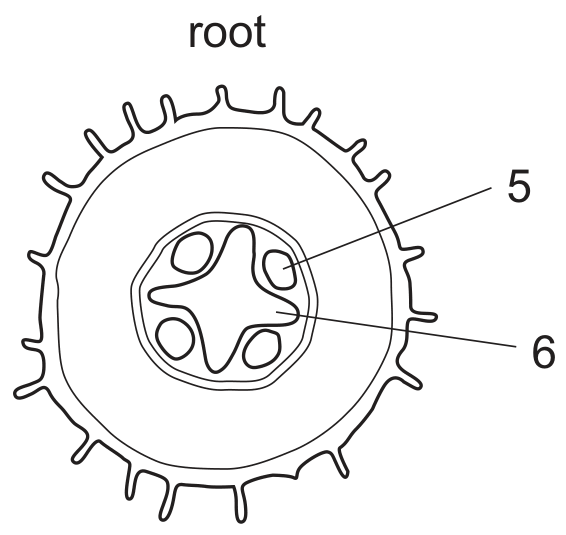
The diagrams represent the cross section of the stem, root and leaf of a non-woody dicotyledonous plant. In each section the distribution of the tissues is shown.

Question image
Question image
Question image

Which sequence of numbers correctly identifies the distribution of xylem and phloem in the stem, root and leaf?

xylem

phloem

1

3

5

2

4

6

1

4

6

2

4

5

2

3

6

1

3

5

2

4

5

1

3

6

(a)
(i)

Write the letter W on Fig. 3.1 in the area where cells are specialised for the transport of water and mineral ions.

[ 1 ]
[Maximum number: 1]

The diagrams show transverse sections of parts of a plant.

Question image
Question image
Question image

In the transverse sections, which tissues transport most amino acids?

1

2

3

4

5

6

key

χ\boldsymbol{\chi}

χ\boldsymbol{\chi}

χ\boldsymbol{\chi}

χ\boldsymbol{\chi}

χ\boldsymbol{\chi}

χ\boldsymbol{\chi}

✓ = transports most amino acids

χ\boldsymbol{\chi}

×

χ\boldsymbol{\chi}

χ=\boldsymbol{\chi}= does not transport most amino acids

χ\boldsymbol{\chi}

χ\boldsymbol{\chi}

×

[Maximum number: 1]

The diagrams show transverse sections of parts of a plant.
Transport tissues are labelled 1 to 6.

Question image
Question image
Question image

Which combination shows the tissues that have a main function of transporting water?

1

2

3

4

5

6

\checkmark

\checkmark

x

x

\checkmark

\checkmark

\checkmark

x

x

\checkmark

x

\checkmark

x

\checkmark

\checkmark

x

\checkmark

x

x

\checkmark

x

\checkmark

\checkmark

x

key
✓ = transporting water is a main function
χ=\boldsymbol{\chi}= transporting water is not a main function

0