EduNinja
[Maximum number: 3]

Fig. 1.1 is an electron micrograph of a transverse section of palisade mesophyll tissue in the leaf of the flowering plant, Zinnia elegans.
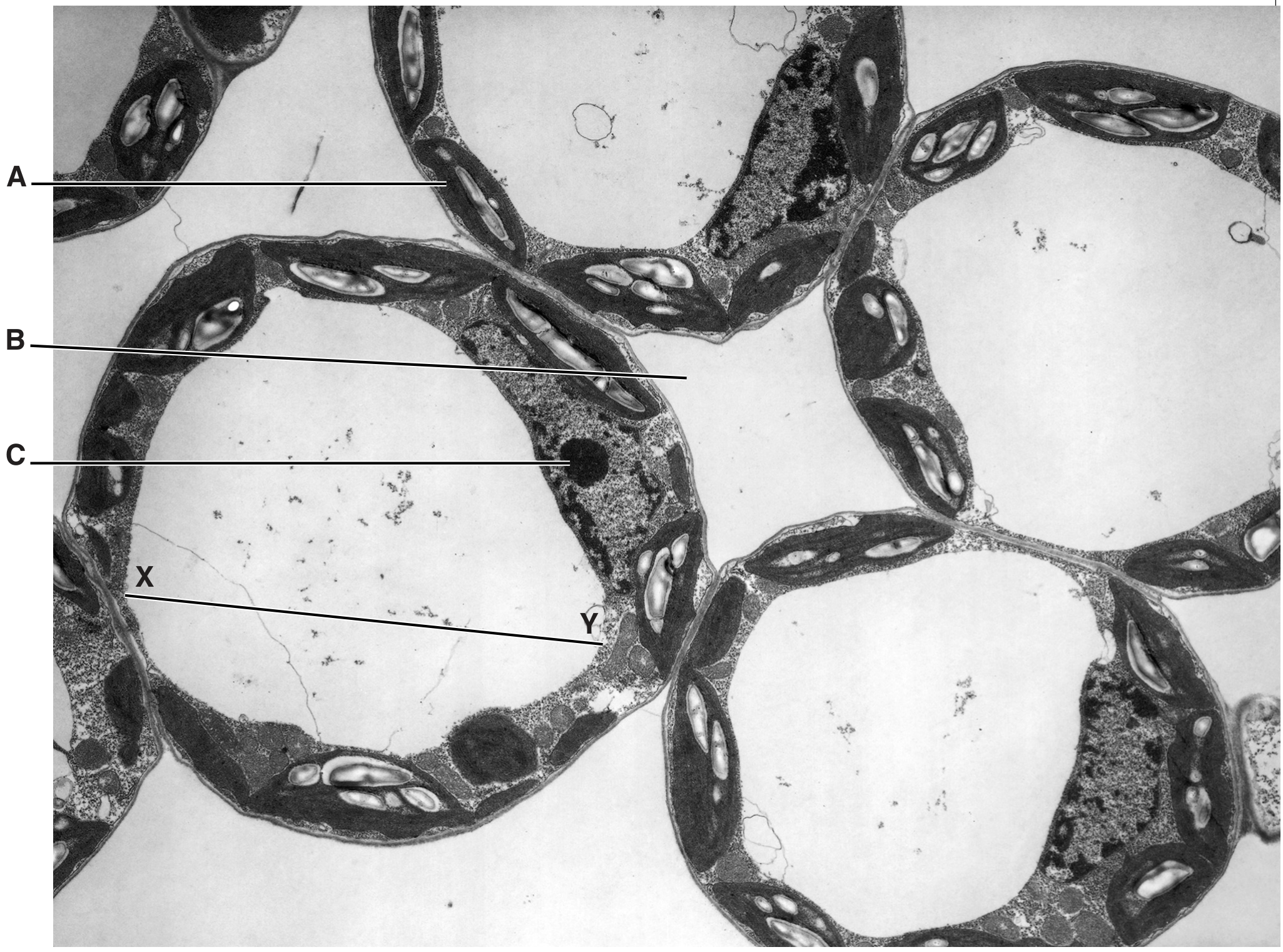
Fig. 1.1

Fig. 1.1

magnification ×7000\times 7000

(a)

Palisade mesophyll cells have very large vacuoles.

Explain how water moves from the xylem in the leaf into these vacuoles.

[ 3 ]
[Maximum number: 3]

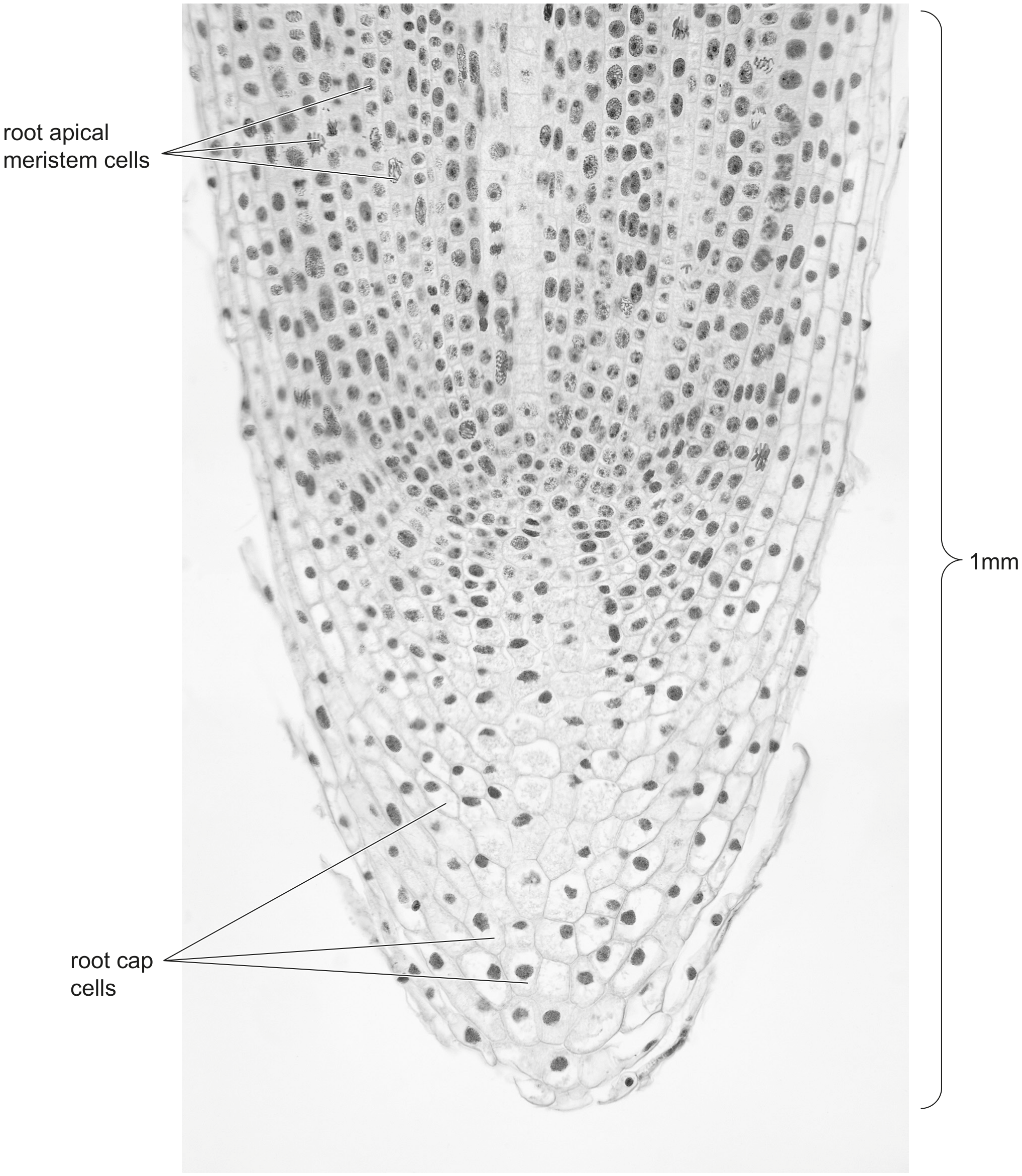
Fig. 2.1 is a photomicrograph of a longitudinal section (LS) through a root tip. Two different regions are visible:
- the root apical meristem
- the root cap.

Cells in the root cap synthesise a gel-like, sticky secretion known as mucilage, which is important in reducing friction between soil and the growing root. It is composed mainly of polysaccharides and also contains some amino acids and enzymes.

Fig. 2.1

Fig. 2.1

(a)

The polysaccharides and amino acids present in the mucilage are a source of nutrients for soil microorganisms that live in the area surrounding the root. Some of these microorganisms can break down soil compounds to release mineral ions.

[ 3 ]
(i)

Mineral ions are usually present in the soil in very low concentrations. The action of mucilage enzymes and soil microorganisms can help to increase the presence of mineral ions.

Root hair cells are specialised for the uptake of these mineral ions and for the absorption of water from the soil.

Suggest and explain how the presence of mineral ions in the root hair cell can increase the absorption of water by the root hair cells.

[ 3 ]
[Maximum number: 1]

Many single-celled animals, living in fresh water, possess vacuoles which contract regularly, expelling excess water.

Why do the cells of plants living in fresh water not require such vacuoles?

A

Plant cells have a higher concentration of dissolved solutes than animal cells.

B

Plant cell walls are impermeable to water.

C

Plant cell walls limit cell size.

D

Water movement into plants is controlled by their roots.

[Maximum number: 2]

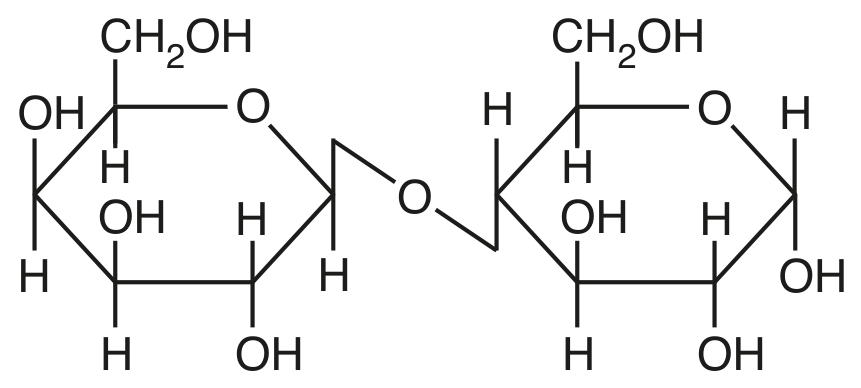
Fig. 2.1 shows the disaccharide lactose, which is found in milk.

Fig. 2.1

Fig. 2.1

(a)

The enzyme lactase catalyses the breakage of the bond between the two monosaccharides in lactose.

[ 2 ]
(i)

Some people do not produce the enzyme lactase, so cannot digest lactose.

The presence of lactose in the lumen of the intestine reduces the volume of water absorbed into the blood, resulting in diarrhoea.

Suggest why the presence of lactose in the intestine reduces the volume of water absorbed.

[ 2 ]
[Maximum number: 2]

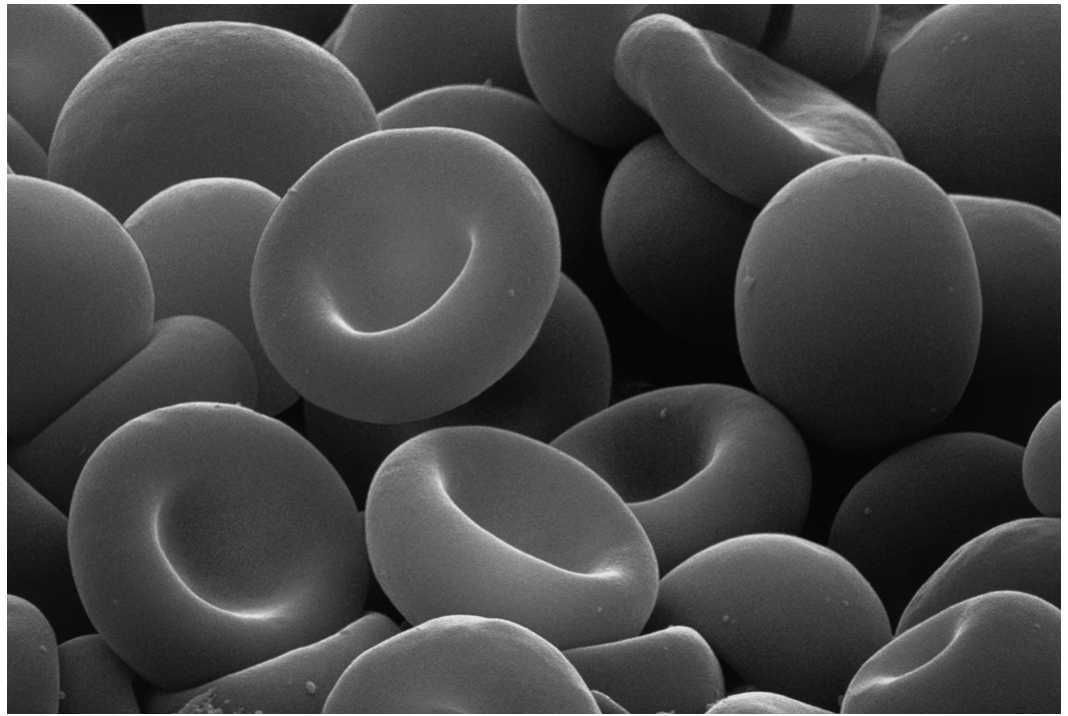
Outside the body, red blood cells can be maintained in an intact state by keeping the cells in a 0.9 % solution of sodium chloride. This is known as a normal saline solution.

Fig. 3.1 shows intact red blood cells.

Fig. 3.1

Fig. 3.1

(a)

Explain why red blood cells can be maintained in an intact state by keeping them in a normal saline solution.

[ 2 ]
[Maximum number: 3]

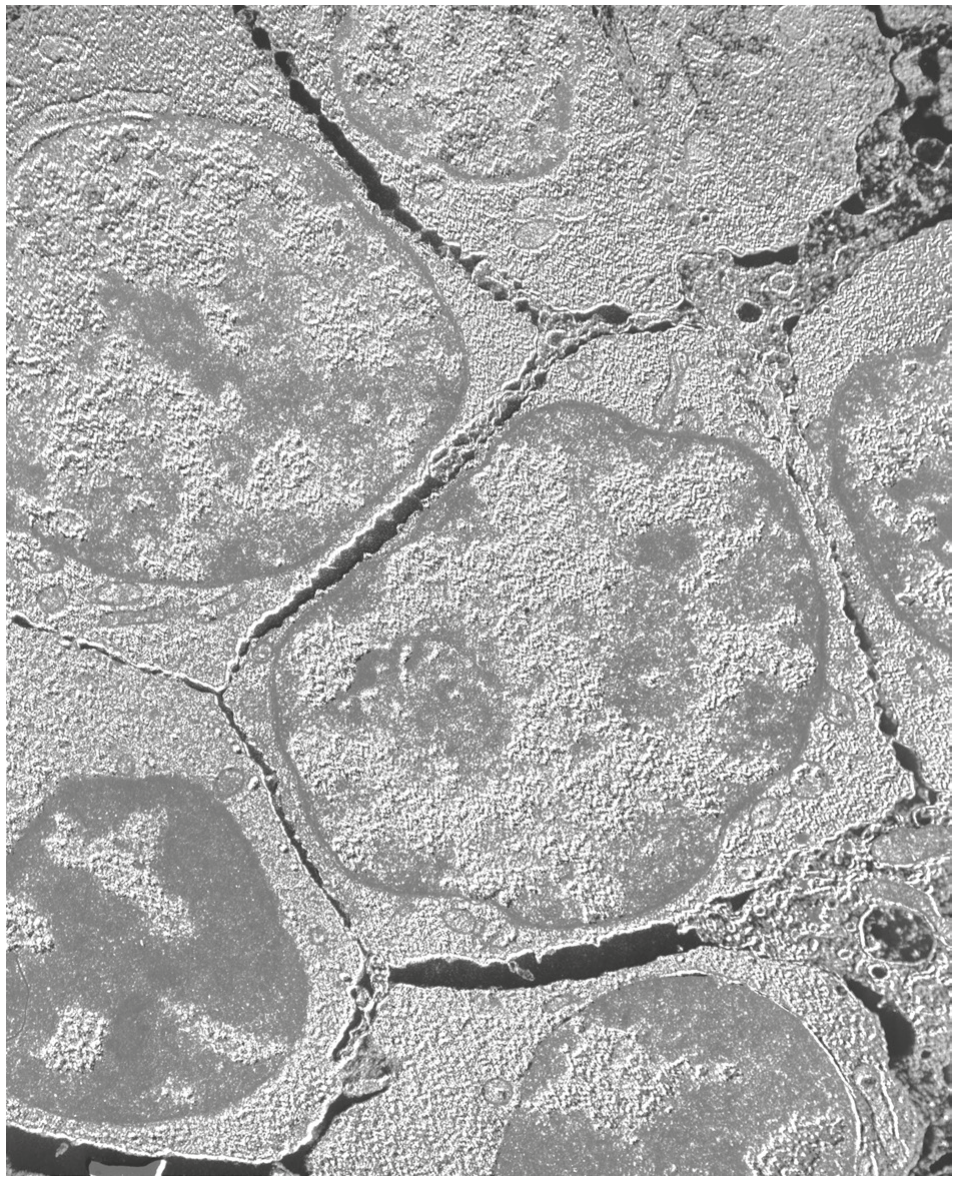
A red blood cell goes through a number of stages in the bone marrow before it is released into the circulation to carry out its role of oxygen transport.

Fig. 3.1 is a transmission electron micrograph of developing red blood cells in the bone marrow. Each cell is known as an erythroblast.

Fig. 3.1

Fig. 3.1

(a)

Increases in the water potential of the blood plasma have greater effects on red blood cells in people with spherocytosis type 2 than on normal red blood cells.

Compare and explain the effects of an increase in the water potential of blood plasma on spherocytosis type 2 red blood cells and normal red blood cells.

[ 3 ]
[Maximum number: 1]

Which statements about the fluid mosaic model of a membrane are correct?
1 The movement of phospholipids in the membrane is reduced if the fatty acid tails are saturated.

2 Glycoproteins in the outer layer of the membrane can move.
3 Channel proteins are fixed in position.

A

1,2 and 3

B

1 and 2 only

C

1 and 3 only

D

2 and 3 only

[Maximum number: 1]

When animal cells are cultured, salt solution is added to keep the cells alive.
What is the purpose of the salt solution?

A

to allow facilitated diffusion of salts into the cells

B

to prevent diffusion of other ions in or out of the cells

C

to prevent net movement of water into or out of the cells

D

to provide a source of energy for active transport

[Maximum number: 4]

Visking tubing can be used to investigate the properties of cell membranes.
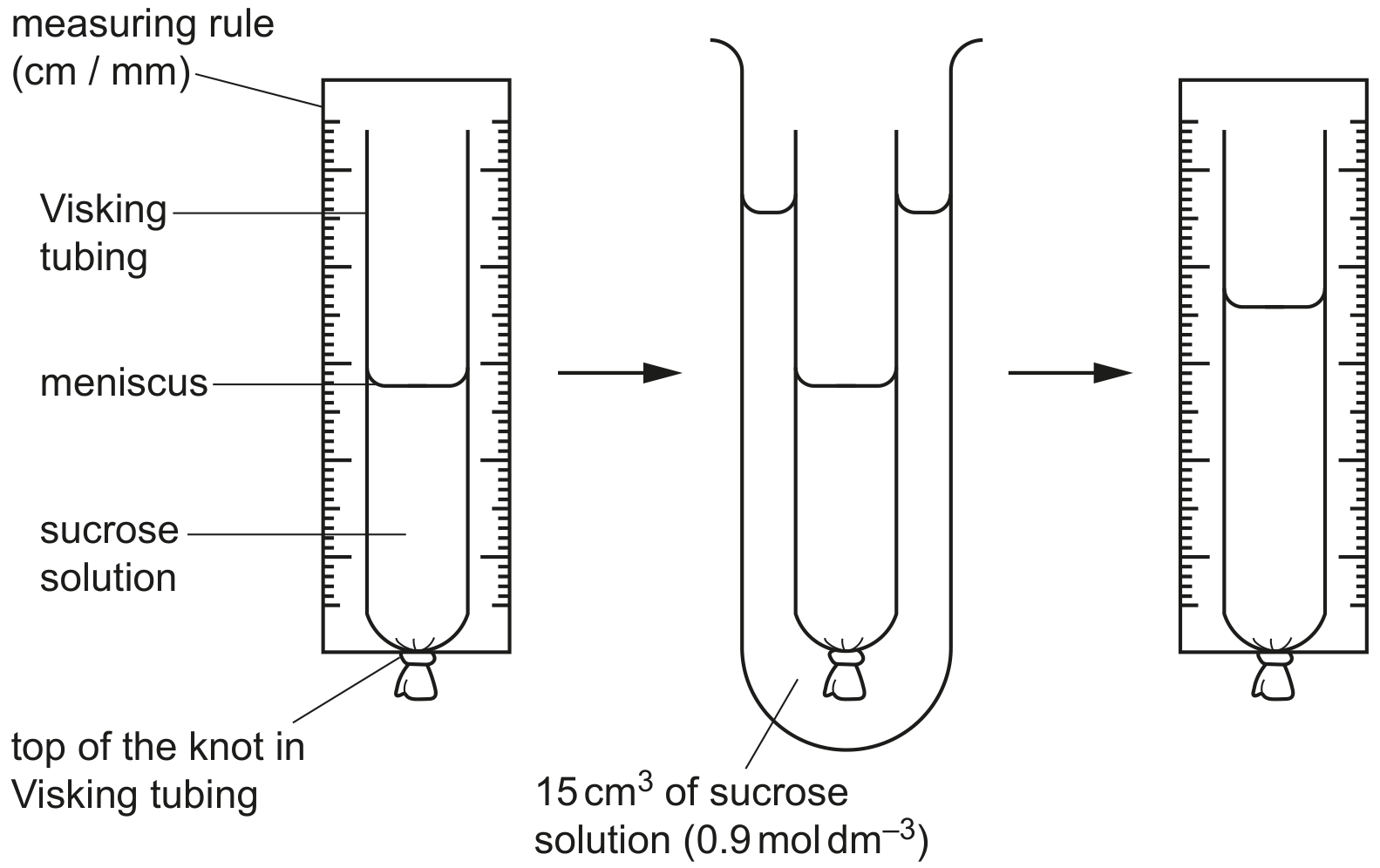
A student carried out an experiment to investigate osmosis using Visking tubing. An outline of the investigation is shown in Fig. 3.1.

Fig. 3.1

Fig. 3.1

- Six pieces of Visking tubing were filled with 10 cm310 \mathrm{~cm}^{3} of different concentrations of sucrose solution: 0.0,0.4,0.8,1.2,1.6 and 2.0 moldm32.0 \mathrm{~mol} \mathrm{dm}^{-3}.
- The height of the meniscus of each solution in the Visking tubing was measured.
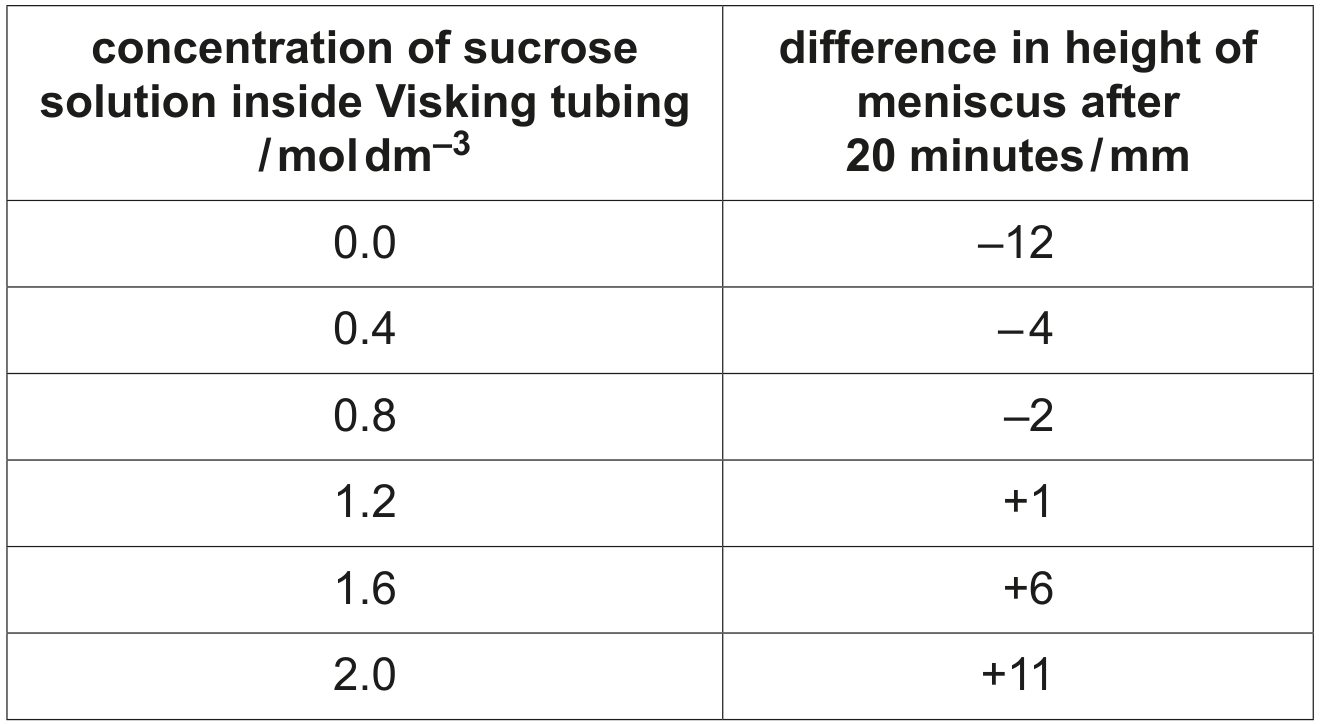
- The pieces of Visking tubing were put into test-tubes containing 15 cm315 \mathrm{~cm}^{3} of 0.9moldm30.9 \mathrm{moldm}^{-3} sucrose solution.
- After 20 minutes, the pieces of Visking tubing were removed from the test-tubes and the height of the meniscus in each was measured.

The results are shown in Table 3.1.

Table 3.1

Table 3.1

(a)

When red blood cells are placed in water they are destroyed by bursting.

The student also investigated how red blood cells are affected by immersion in solutions of sodium chloride of different concentration. Blood samples of the same volume were added to solutions of sodium chloride in separate test-tubes.

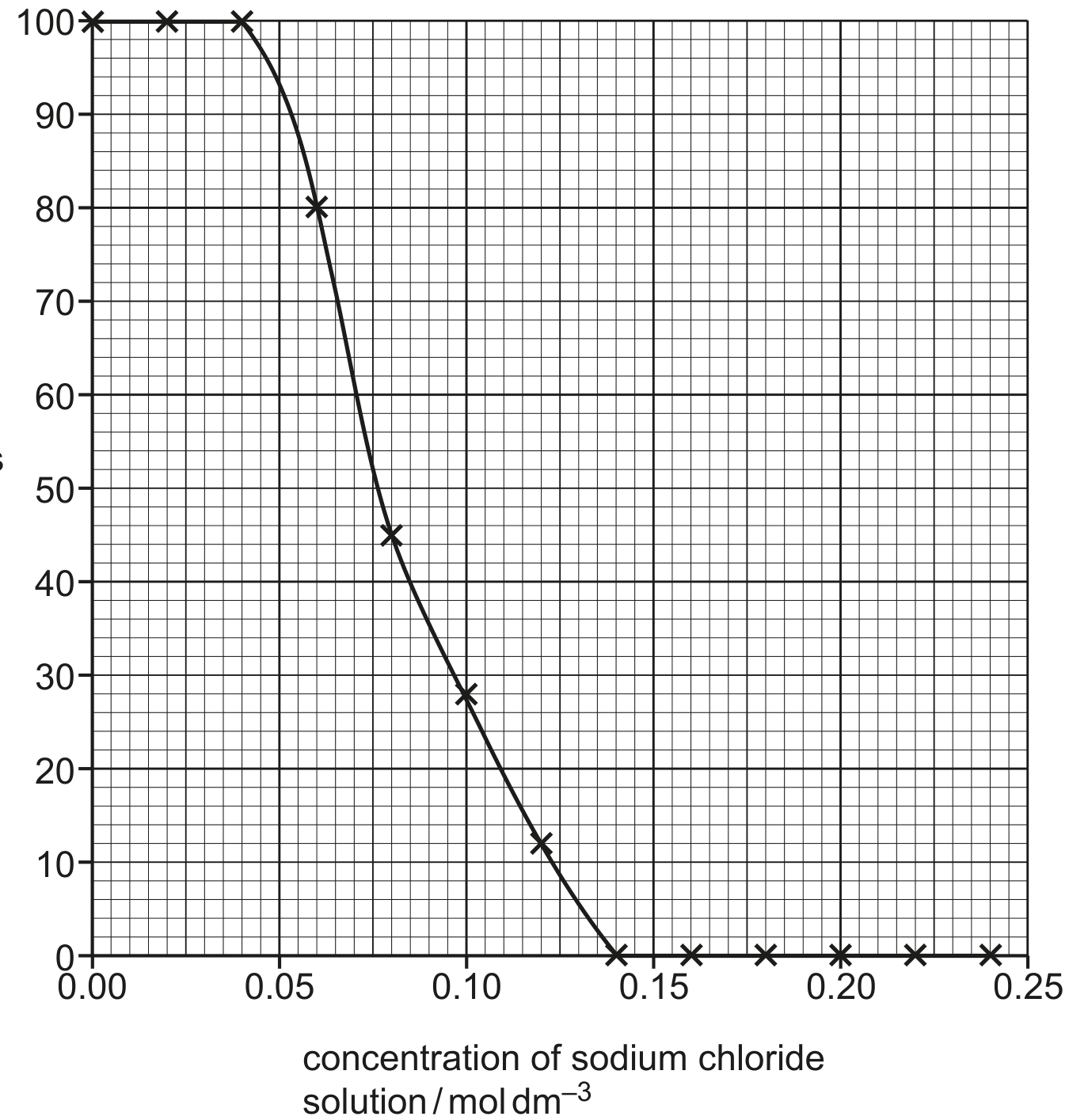
After 10 minutes, the student took 0.1 cm30.1 \mathrm{~cm}^{3} of the blood samples from the test-tubes and estimated the percentage of red blood cells that had burst in each blood sample.

Fig. 3.2 shows the student's results.
percentage of red blood cells destroyed by bursting

Fig. 3.2

Fig. 3.2

Describe and explain the effects on red blood cells of immersion in different concentrations of sodium chloride as shown in Fig. 3.2.

[ 4 ]
0