(a)
When a muscle cell is stimulated, calcium ions are released from the sarcoplasmic reticulum.
With reference to Fig. 1.1, describe the role of calcium ions in the contraction of the sarcomere.
[ 4 ]
 EduNinja
When a muscle cell is stimulated, calcium ions are released from the sarcoplasmic reticulum.
With reference to Fig. 1.1, describe the role of calcium ions in the contraction of the sarcomere.
Fig. 3.1 shows a diagram of two sarcomeres of relaxed striated muscle.
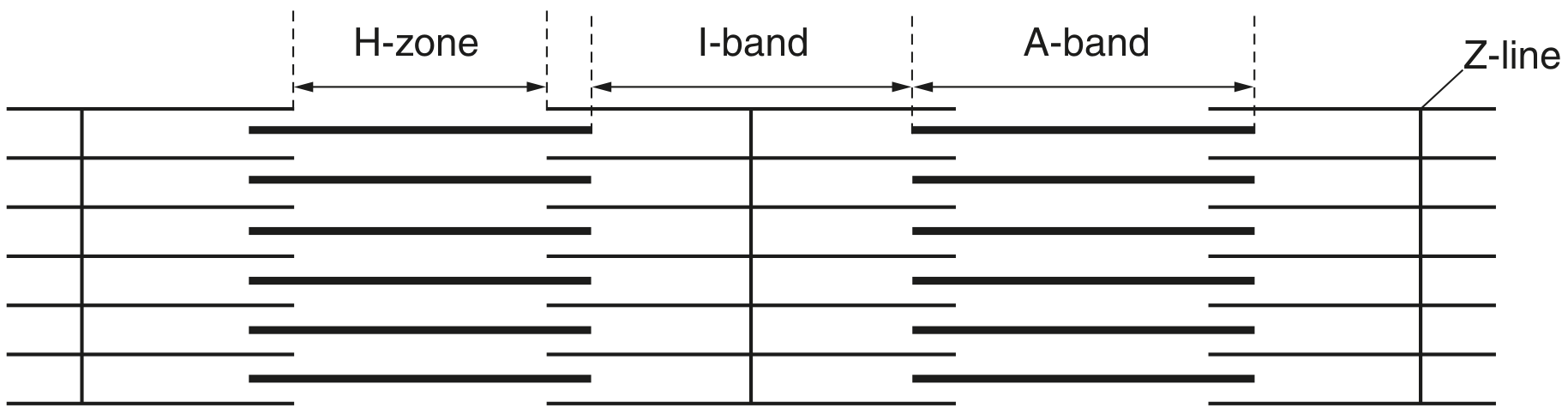
Fig. 3.1
Glycogen storage disease type V (GSDV) is a metabolic disorder where stored glycogen cannot be broken down to release glucose, resulting in the production of only small quantities of ATP. People with GSDV are unable to exercise normally, as the lack of ATP affects the functioning of striated muscle.
With reference to the sliding filament model of muscular contraction, suggest why a lack of ATP affects the functioning of striated muscle.
Myofibrils in striated muscle consist of contractile units called sarcomeres.
When an impulse stimulates striated muscles to contract, calcium ions are released from the sarcoplasmic reticulum.
Describe how the release of calcium ions leads to the contraction of a sarcomere.
Striated muscle is composed of myofibrils. Myofibrils contain several structural proteins including troponin, tropomyosin, actin and myosin.
Outline the roles of these four structural proteins in the contraction of a sarcomere.
(b) Drugs that cause muscle paralysis (paralytic drugs) are used during surgery to stop the patient moving. One commonly used paralytic drug is succinylcholine, which works by preventing contraction of muscles. Succinylcholine is able to prevent muscles contracting because it has a similar shape to acetylcholine.
Suggest how succinylcholine is able to prevent muscles contracting.
(c) Duchenne muscular dystrophy (DMD) is a genetic disease that is caused by a single gene. DMD affects striated muscle, and symptoms of the disease first appear at an early age.
A fibrous protein, dystrophin, stabilises muscle fibres during contraction. A person with DMD produces non-functioning dystrophin or no dystrophin at all. The disease occurs in about four in 100000 people and mainly affects boys.
Suggest and explain why boys are more likely to have DMD than girls.
Explain the role of ATP in the contraction of striated muscle.
Sarcomeres are the functioning units of the myofibrils of the muscle fibres (muscle cells) of striated muscle.
The arrival of an action potential at the sarcoplasmic reticulum of a striated muscle fibre can lead to the shortening of a sarcomere. This shortening occurs by the sliding filament model.
Outline the sequence of events occurring after stimulation of the sarcoplasmic reticulum that results in the shortening of a sarcomere.
Scientists compared the diameter of samples of striated muscle fibres taken from young mice and adult mice.
The results are shown in Fig. 7.1.
number of muscle fibres
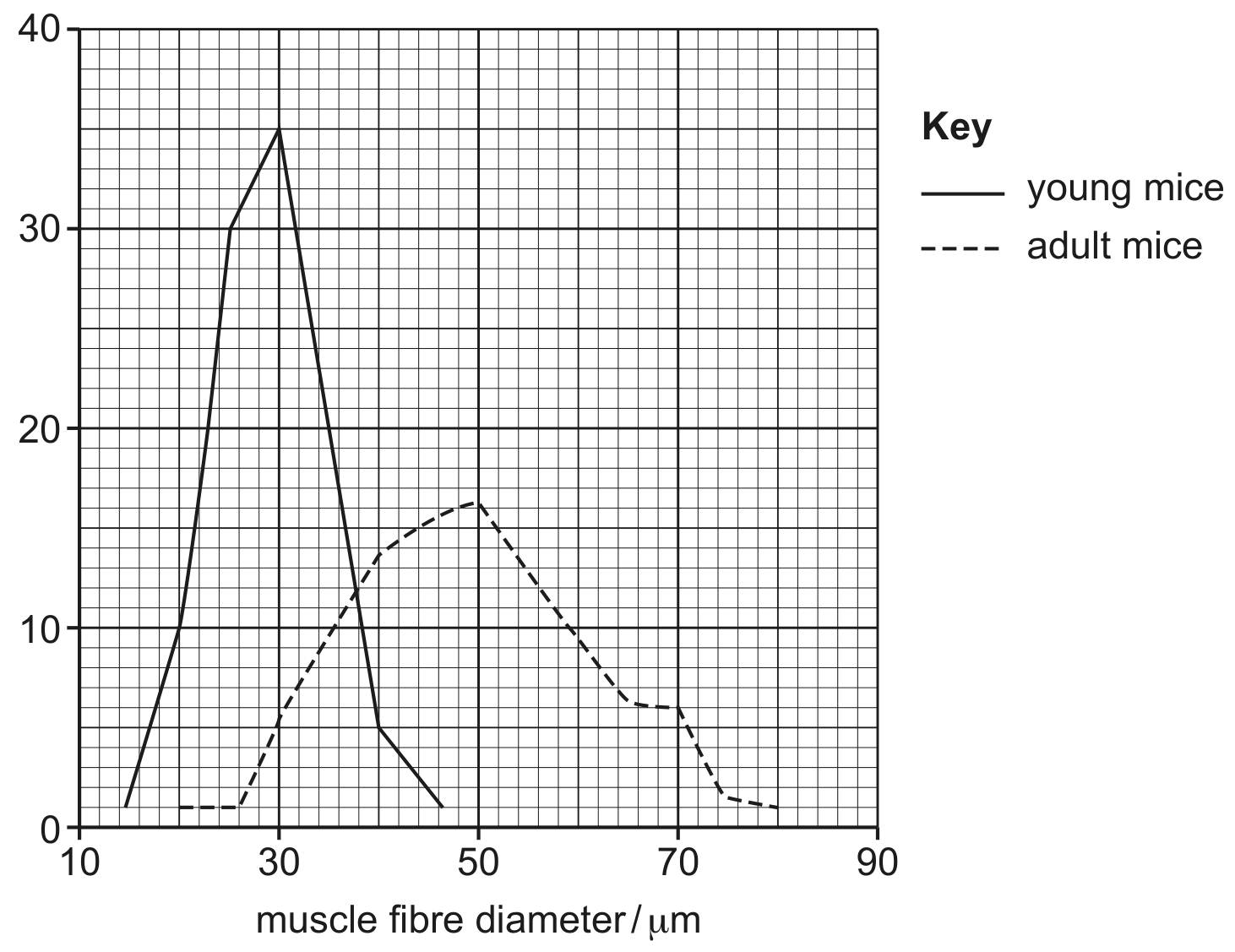
Fig. 7.1
With reference to Fig. 7.1:
- describe two differences between the muscle fibres of young mice and adult mice
- suggest how these differences may affect the sliding filament model.
The contraction of striated muscle is explained by the sliding filament model.
Describe what happens in the sarcomere when the myosin head releases ADP and inorganic phosphate (Pi).
Explain the precise function of ATP in the sliding filament model.
Describe how tropomyosin and myosin are each involved in the sliding filament model of muscle contraction.
tropomyosin
myosin
Striated muscle is made up of many specialised muscle cells known as muscle fibres or myocytes.
There are two different types of muscle fibre in striated muscle:
- fast twitch muscle fibres that contract quickly, but rapidly fatigue (get tired)
- slow twitch muscle fibres that contract slowly and continue to contract for a long time.
Table 6.1 shows some features of fast twitch and slow twitch muscle fibres.
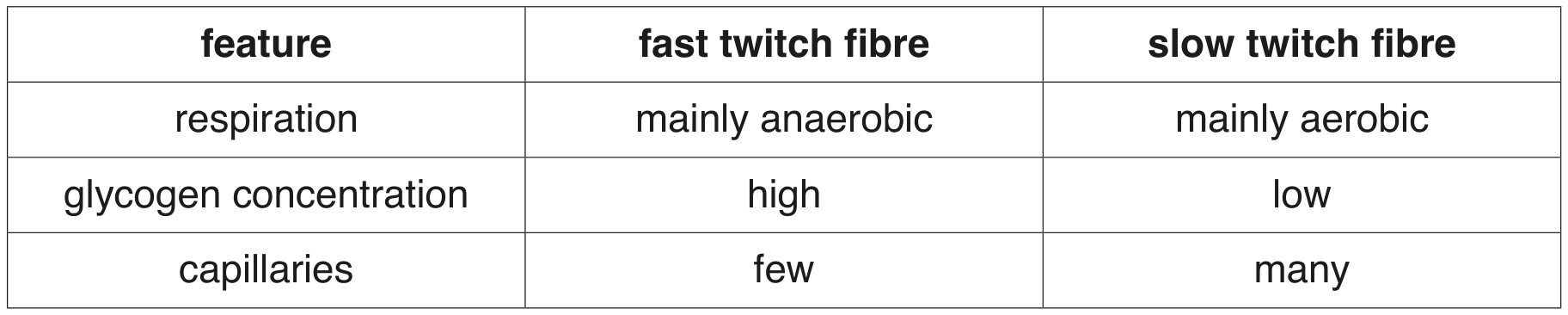
Table 6.1
Use the information in Table 6.1 to suggest and explain one advantage of:
the high glycogen concentration in fast twitch fibres
many capillaries supplying slow twitch fibres.
The contraction of striated muscle is explained by the sliding filament model.
Describe what happens in the sarcomere when the myosin head releases ADP and inorganic phosphate (Pi).
Explain the precise function of ATP in the sliding filament model.
A striated muscle cell (muscle fibre) will contract when stimulated by a motor neurone at a neuromuscular junction.
Air temperature can affect the temperature of striated muscle cells.
Investigations have shown that the efficiency of contraction of striated muscle cells decreases when the air temperature decreases.
Suggest reasons why a reduction in temperature can decrease the efficiency of contraction of striated muscle cells.