EduNinja
(a)

Fig. 7.1 is a diagram representing a synapse between a chemoreceptor cell from a human taste bud and a dendrite of a sensory neurone.
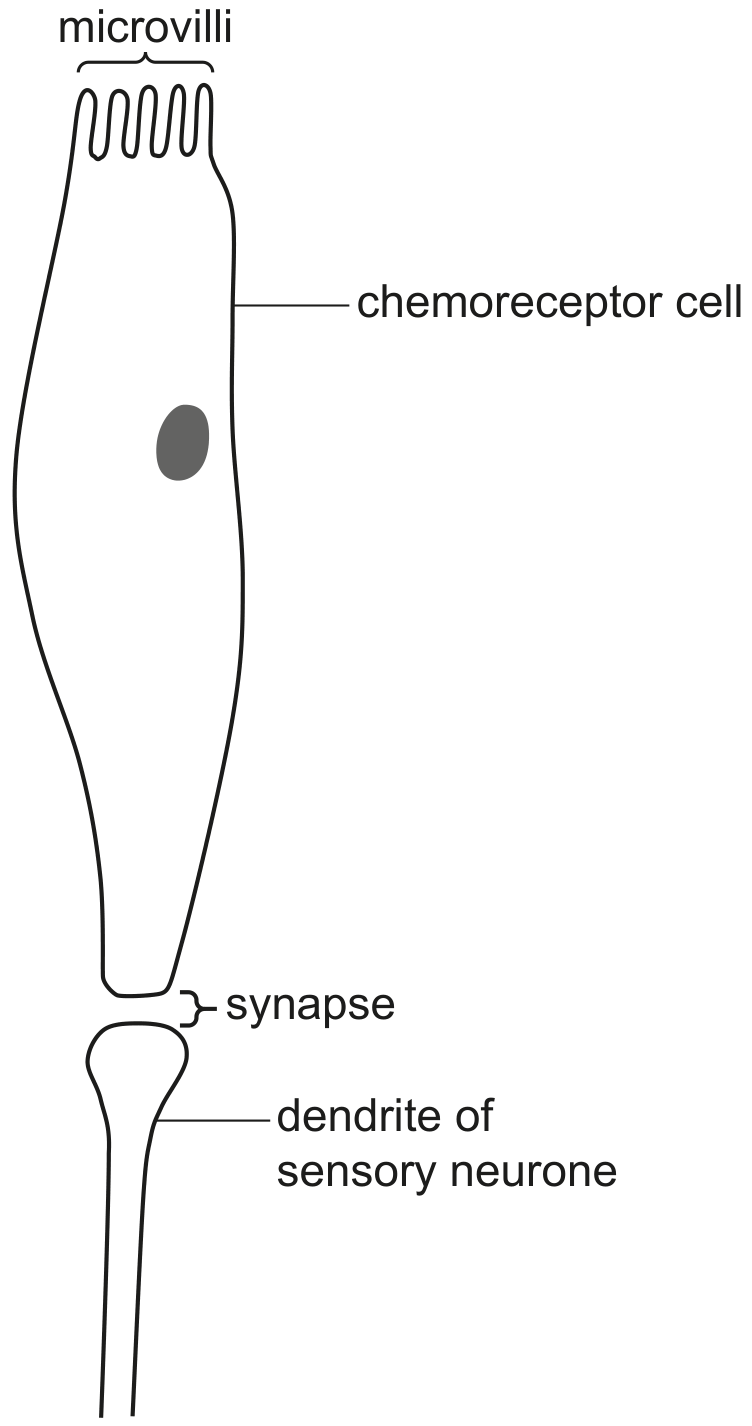
Fig. 7.1

Fig. 7.1

In an experiment, different concentrations of sodium chloride solution were applied to the microvilli of the chemoreceptor cell. The membrane potential of the chemoreceptor cell and the membrane potential of the dendrite of the sensory neurone were recorded for each concentration.

The resting potential of this chemoreceptor cell is -50 mV and the resting potential of the dendrite of this sensory neurone is -70 mV .

The results are shown in Table 7.1.
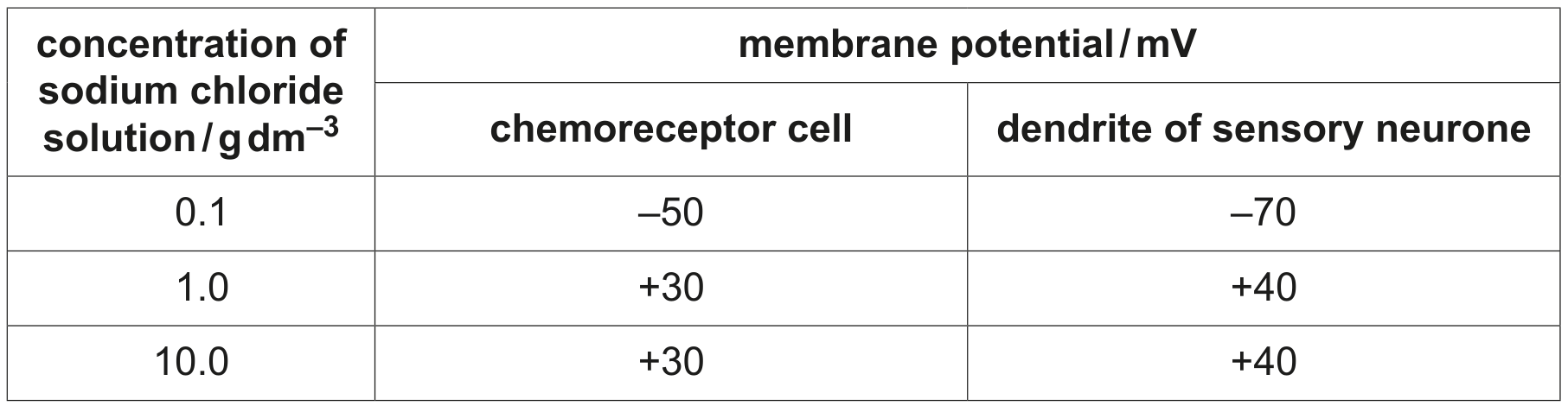
Table 7.1

Table 7.1

Explain the results shown in Table 7.1.

[ 4 ]
[Maximum number: 5]

Dogs have an exceptionally good sense of smell. They can detect molecules in the air with a concentration of one part per trillion (1012)\left(10^{12}\right).

(a)

Olfactory receptor cells are the sensory receptors in the nasal cavity that respond to chemicals in the air. They function in a similar way to the chemoreceptor cells in the taste buds of the tongue.

Describe how olfactory receptor cells in the nasal cavity of dogs respond to chemicals to generate an action potential.

[ 5 ]
[Maximum number: 5]

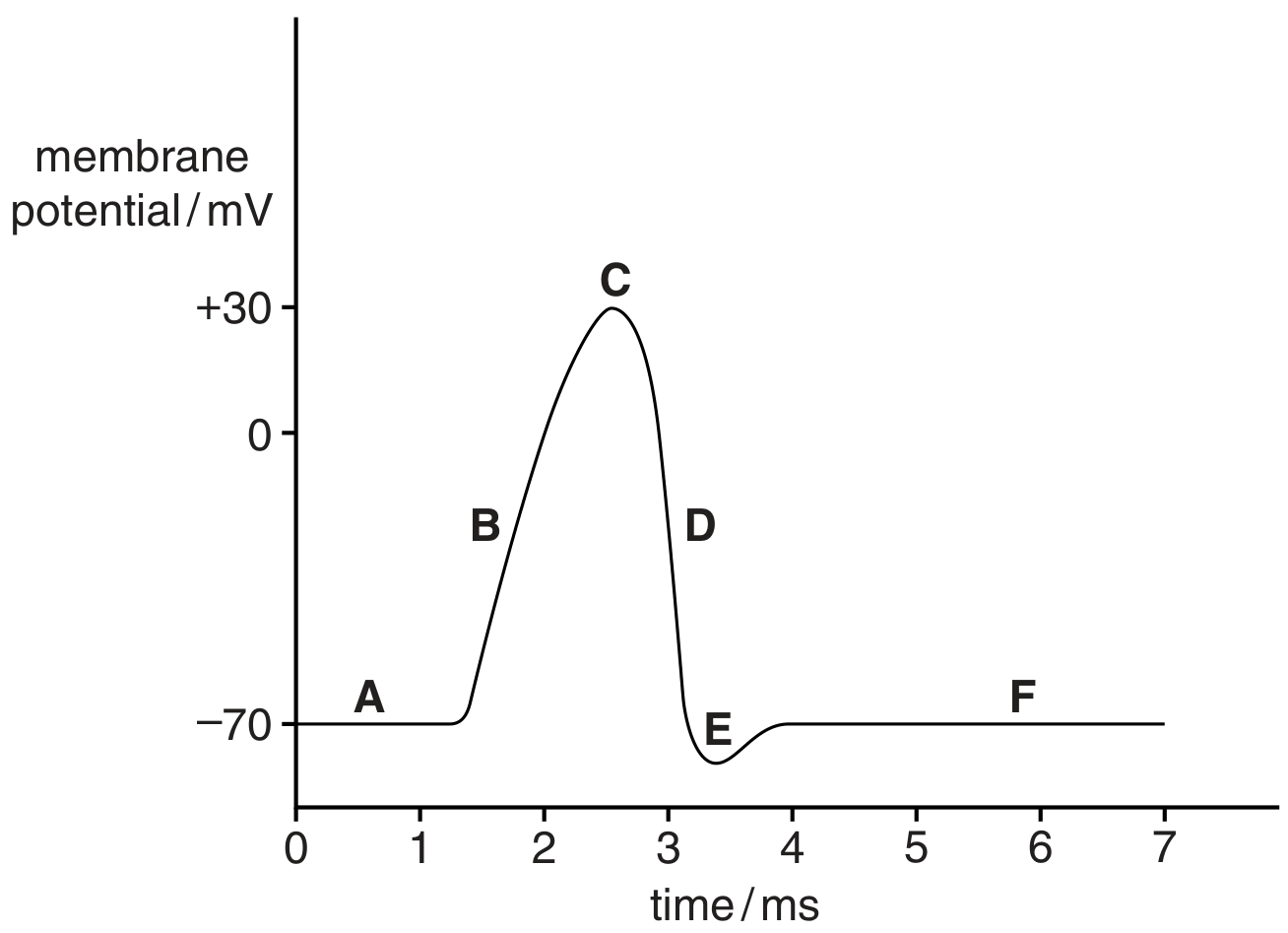
Fig. 6.1 is a trace that shows the changes that occur in the membrane potential of a neurone during an action potential.

Fig. 6.1

Fig. 6.1

(a)

Saxitoxin is a powerful poison produced naturally by single-celled, eukaryotic, photosynthetic, marine organisms. Shellfish may consume organisms containing saxitoxin but are unaffected. If humans were to eat shellfish containing saxitoxin they would become very ill and may die.

[ 5 ]
(i)

Saxitoxin blocks sodium ion channels in the cell surface membranes of neurones. Describe the role of sodium ion channels in the transmission of a nerve impulse.

[ 3 ]
(ii)

Suggest why saxitoxin may be fatal to humans.

[ 2 ]
[Maximum number: 7]

The role of sensory receptor cells in mammals is to detect stimuli and generate action potentials in sensory neurones.

Human taste buds on the tongue contain chemoreceptor cells. Different chemoreceptor cells respond to different chemical stimuli.

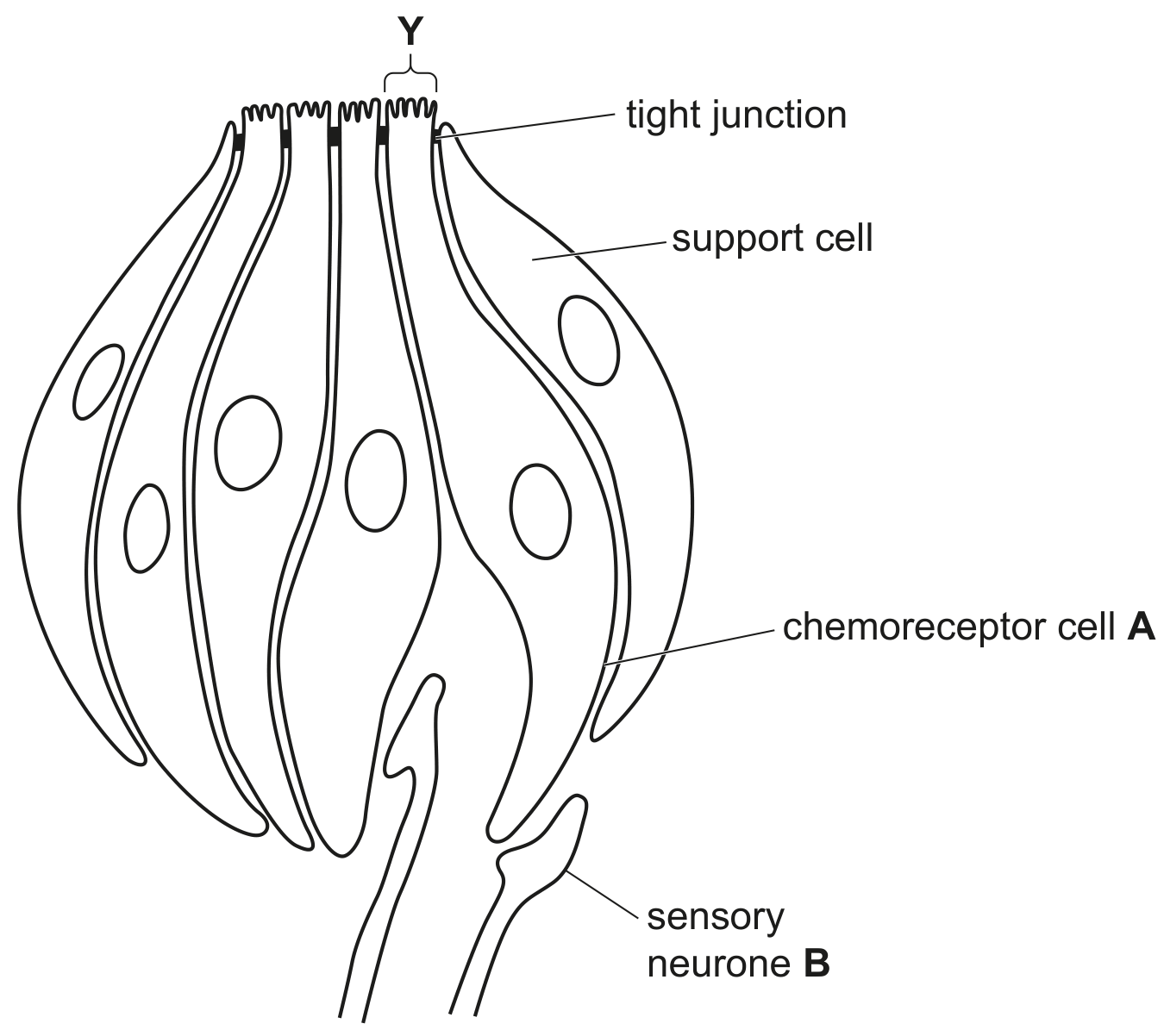
Fig. 8.1 is a diagram of chemoreceptor cells in a taste bud.

Fig. 8.1

Fig. 8.1

(a)

Chemoreceptor cell A responds to sodium ions (Na+)\left(\mathrm{Na}^{+}\right)in salt.

Describe how the contact of cell A with Na+\mathrm{Na}^{+}can result in an action potential in sensory neurone B.

[ 7 ]
(a)

Describe the sequence of events that occur during an action potential.

[ 4 ]
(a)

Describe, using named examples, how sensory receptors in mammals generate action potentials.

[ 6 ]
(a)

Explain how an action potential is transmitted along a sensory neurone.

[ 8 ]
[Maximum number: 6]

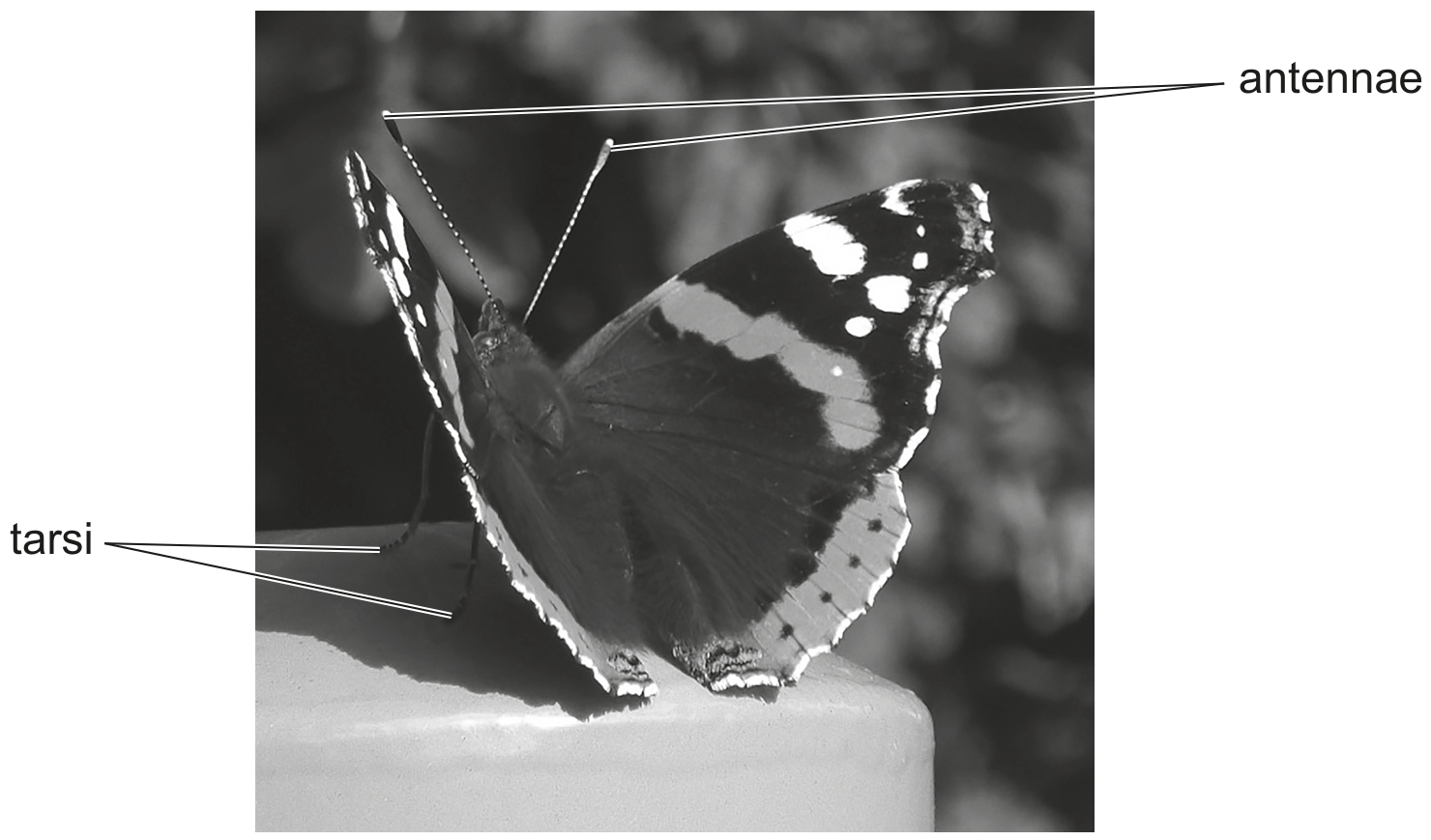
Humans detect the sweet taste of sucrose sugar using chemoreceptor cells in taste buds on the tongue. The red admiral butterfly, Vanessa atalanta, detects sucrose using chemoreceptor cells located on its antennae and on its tarsi (feet). The mode of action of the chemoreceptors in V. atalanta is similar to that in humans.

Fig. 10.1 shows the locations of the chemoreceptor cells on V. atalanta.

Fig. 10.1

Fig. 10.1

Describe how the presence of sucrose causes an action potential in the sensory neurone associated with a chemoreceptor cell in V. atalanta.

0