EduNinja
(a)

The leaves of C. sinensis have a large surface area and are thin.

Explain how each of these two features help the leaf to carry out photosynthesis.

[ 2 ]
(b)

The lower epidermis contains stomata.

[ 4 ]
(i)

State one structural difference between a guard cell and other lower epidermal cells.

[ 1 ]
(ii)

Abscisic acid has an important role in the closure of a stoma. It promotes the loss of potassium ions from guard cells.

Outline how the loss of potassium ions from guard cells will lead to the closure of a stoma.

[ 3 ]
(a)

With reference to Fig. 1.1, outline the events that occur in a guard cell during times of water stress.

[ 5 ]
(a)

The leaves of C. sinensis have a large surface area and are thin.

Explain how each of these two features help the leaf to carry out photosynthesis.

[ 2 ]
(b)

The lower epidermis contains stomata.

[ 4 ]
(i)

State one structural difference between a guard cell and other lower epidermal cells.

[ 1 ]
(ii)

Abscisic acid has an important role in the closure of a stoma. It promotes the loss of potassium ions from guard cells.

Outline how the loss of potassium ions from guard cells will lead to the closure of a stoma.

[ 3 ]
(a)

Photosynthesis is affected by many environmental factors.

[ 3 ]
(i)

In very dry conditions, CO2\mathrm{CO}_{2} concentration can become the main limiting factor of photosynthesis in plants.

Explain how very dry conditions cause CO2\mathrm{CO}_{2} concentration to become the main limiting factor of photosynthesis in plants.

[ 3 ]
[Maximum number: 10]

Stomata in leaves respond to changes in environmental conditions by opening and closing. This regulates carbon dioxide uptake and water loss.

(a)

Describe the mechanism by which stomata open in sunlight.

[ 4 ]
(b)

Stomatal conductance is a measure of the rate of water vapour loss from the intercellular air spaces of leaves to the atmosphere through the stomata.

A student investigated the effect of different concentrations of abscisic acid (ABA) on stomatal conductance in Helianthus annuus, the common sunflower.

The student treated the roots of 15 sunflower plants with different concentrations of ABA solution. The plants were left in standardised conditions for 24 hours.

After 24 hours, the student measured:
- the concentration of ABA in the xylem sap of each plant
- the stomatal conductance of the leaves of each plant.

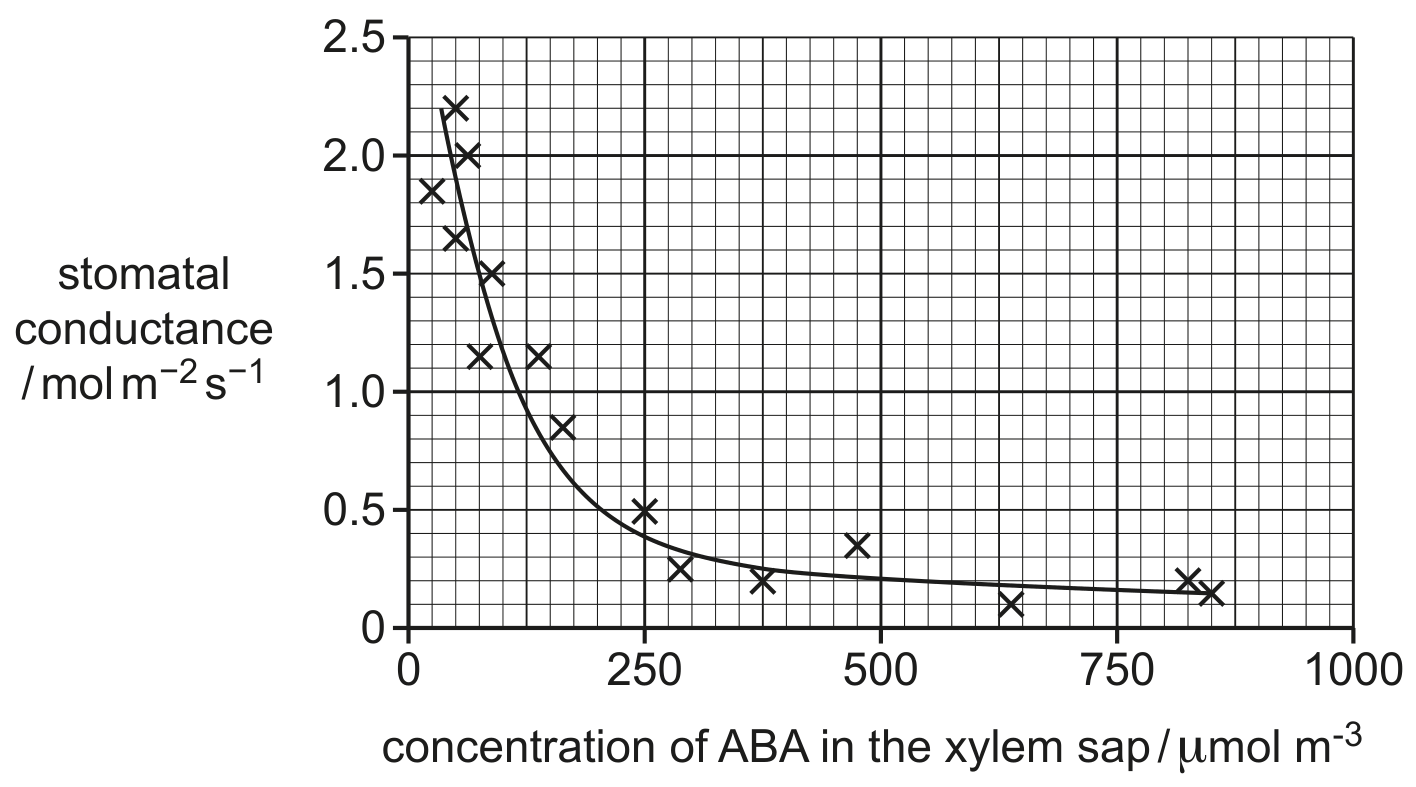
The results are shown in Fig. 3.1.

Fig. 3.1

Fig. 3.1

[ 6 ]
(i)

With reference to Fig. 3.1, describe the relationship between the concentration of A B A in the xylem sap and stomatal conductance.

[ 2 ]
(ii)

Suggest explanations for the results shown in Fig. 3.1.

[ 4 ]
[Maximum number: 2]

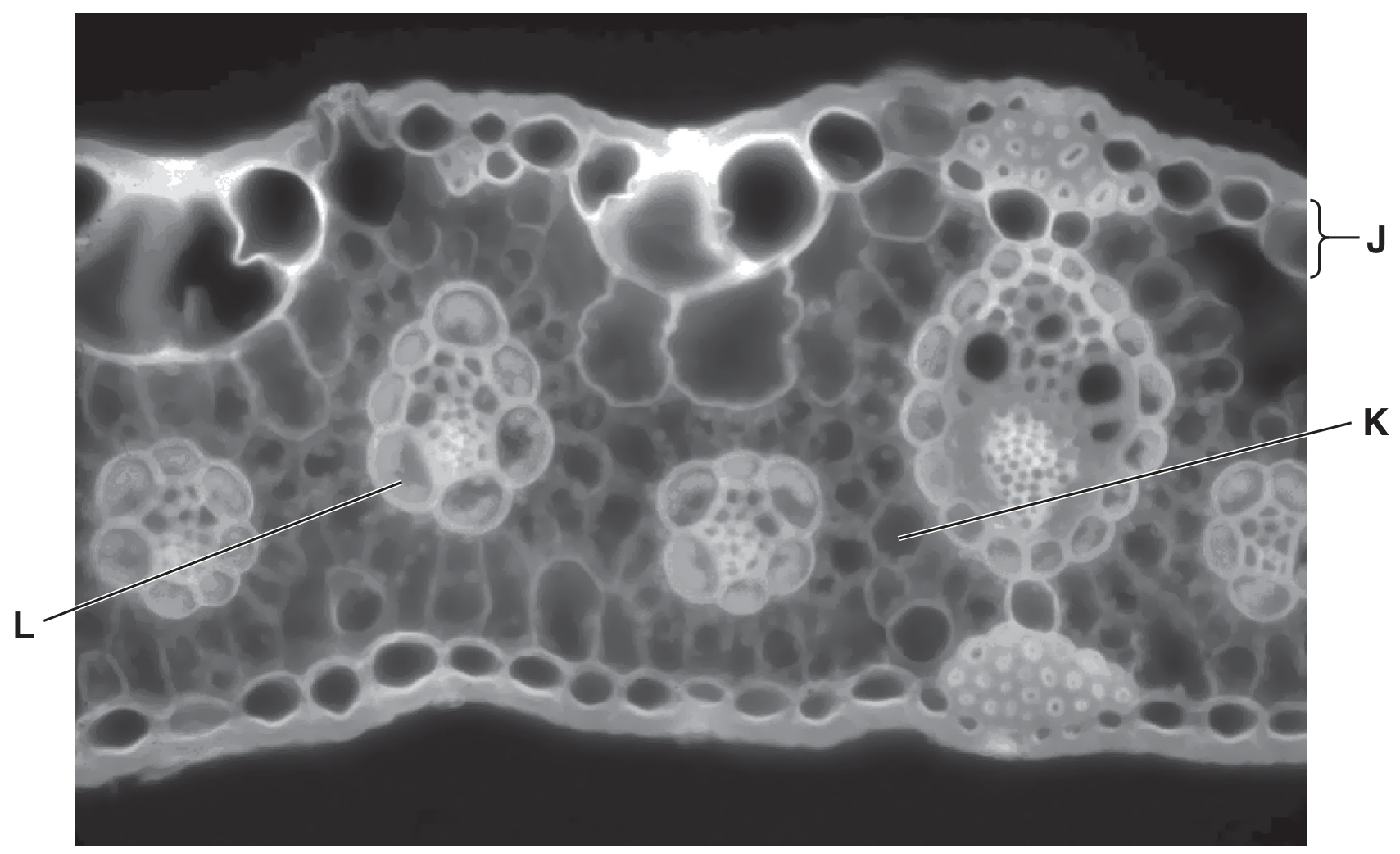
Fig. 4.1 is a photomicrograph of a transverse section through the leaf of a C4 plant.

Fig. 4.1

Fig. 4.1

(a)

Sorghum is a C4 plant and Sorghum bicolor is a major food crop in dry tropical regions. The leaves of S. bicolor are covered with a layer of wax made up of a mixture of esters and free fatty acids, with a melting point of 7785C77-85^{\circ} \mathrm{C}. Waxes from the leaves of non- tropical plants tend to have melting points lower than this. For example, wax from the bayberry, Myrica sp., has a melting point of 45C45^{\circ} \mathrm{C}.

Suggest how the wax on sorghum leaves helps the plant to survive in dry, tropical regions.

[ 2 ]
[Maximum number: 1]

The monkey flower, Mimulus guttatus, is cross-pollinated by bumblebees. It does not normally self-pollinate.

Since the number of bumblebees in many parts of the world is falling, an experiment was carried out in Kansas to investigate the effects on these plants of the loss of pollinators.
- 1600 Mimulus plants were grown in a field.
- 1600 Mimulus plants were grown in a glasshouse which bumblebees could not enter.

Seeds were repeatedly collected and sown for several generations at each site.
At first, the plants in the glasshouse produced few seeds, but after five generations the plants were able to self-pollinate and the number of seeds produced was almost the same as that of the plants in the field.

After five generations, the flowers of the plants in the glasshouse were significantly smaller than those of the plants in the field.

(a)

Suggest how smaller flowers could lead to an increase in self-pollination.

[ 1 ]
(a)

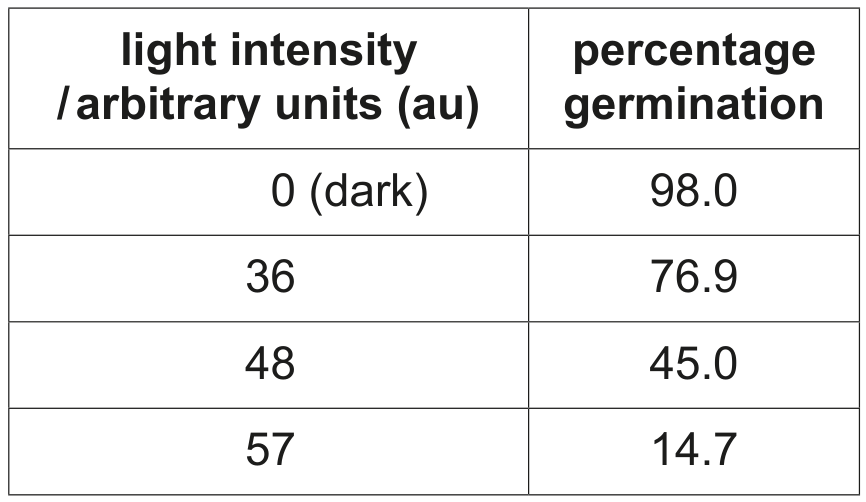
An investigation was carried out to study the effect of different intensities of blue light on the percentage germination of barley seeds. Barley seeds were exposed to blue light for a period of seven days. All other variables were kept constant.

The results are shown in Table 9.1.

Table 9.1

Table 9.1

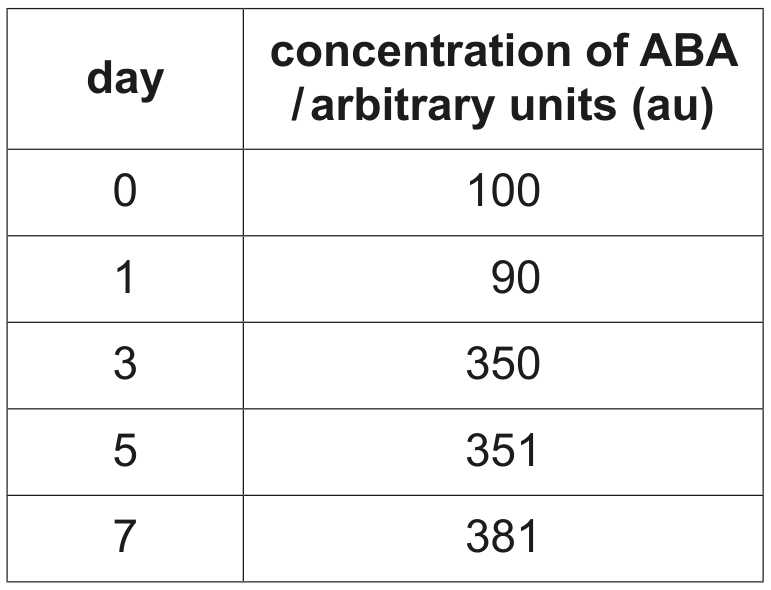
The effect of blue light on the concentration of abscisic acid (ABA) was also investigated. ABA concentration was measured at intervals over seven days in barley seeds exposed to blue light at an intensity of 57 arbitrary units.

The results are shown in Table 9.2.

Table 9.2

Table 9.2

For comparison, in the dark the concentration of ABA in barley seeds fell from 100 au at the start (day 0 ) to 45 au on day 1 and did not increase from day 1 to day 7.

ABA is thought to affect gibberellin synthesis or activity.
Using the information in Table 9.1 and Table 9.2, describe the effect of blue light on the germination of barley seeds and suggest an explanation for this effect.
(b) After germination, auxin is important in the growth of barley plants.

Describe and explain the role of auxin in cell elongation.

[ 11 ]
[Maximum number: 2]

Maize, Zea mays, is a cereal crop that is adapted for growth at high temperatures. However, it does not cope with drought as well as some other crops, such as sorghum.

An investigation was carried out into the effect of low water availability on the activity of mitochondria taken from maize seedlings.

Young seedlings were uprooted and left in dry air for varying periods of time to reduce the water potential of their tissues.

(a)

In tissues where water potential is low, the mitochondria of sorghum are affected in a very similar way to those of maize.

Describe two ways in which sorghum plants are adapted to prevent the development of low water potentials in their tissues during drought conditions.

[ 2 ]
0