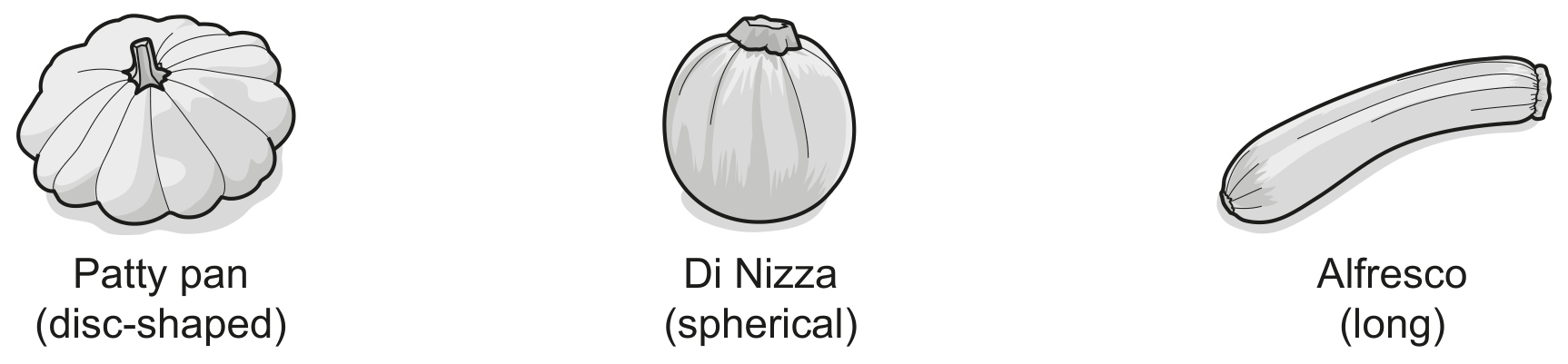
The courgette plant, Cucurbita pepo, produces edible fruits that vary in colour and shape.
Fruit colour in courgettes is controlled by the gene A / a.
Fruit shape in courgettes is controlled by the gene B/b.
- A yellow fruit is produced when the dominant allele A is present.
- A round fruit is produced when the dominant allele B is present.
Genes A / a and B/b occur on different chromosomes.
Table 1.1 shows the genotypes and phenotypes of four different varieties of courgette with respect to their fruit colour and shape.
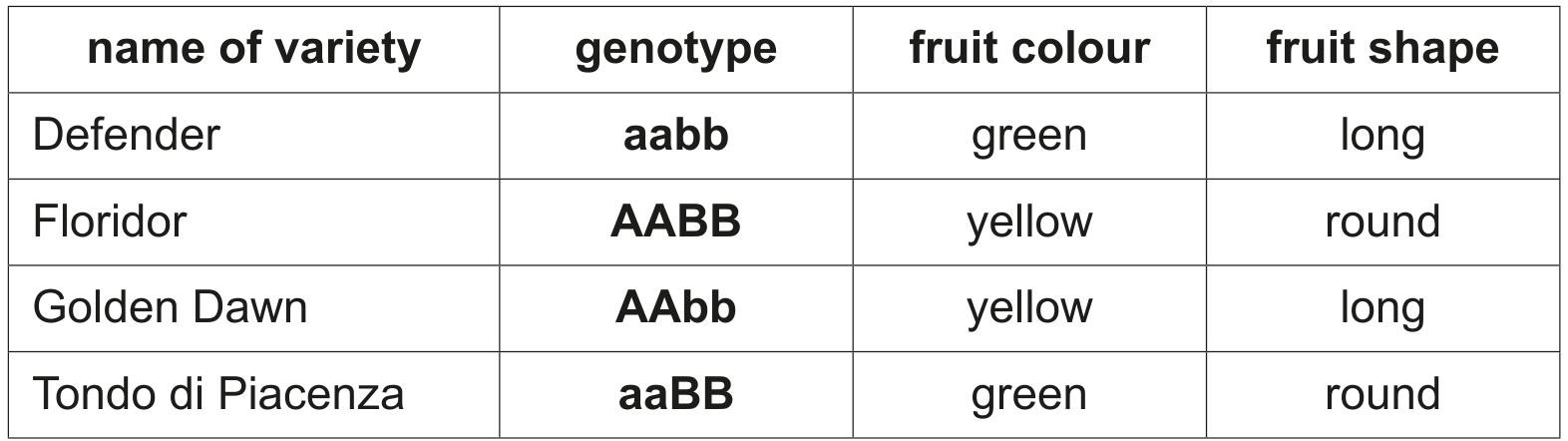
Table 1.1
Watermelons, Citrullus lanatus, are plants in the same family as courgettes. They produce large round edible fruits that usually contain many hard seeds. Seeds are the structures formed when the male and female gametes fuse at fertilisation.
In the 1990s a triploid (3 n) watermelon plant was developed. To produce the triploid watermelon plant, a normal diploid parent plant ( 2 n=22 ) was crossed with an artificially created tetraploid plant (4 n=44).
Triploid watermelon plants develop edible fruits but these are sterile and do not contain seeds, making them more enjoyable to eat.
Explain why the fruits of the triploid plants are sterile and do not contain seeds.