EduNinja
[Maximum number: 5]

Gold ions ( Au3+\mathrm{Au}^{3+} ) are toxic to most microorganisms. However, the bacterium Delftia acidovorans is frequently found in sticky layers, called biofilms, that form on the surface of gold deposits.
D. acidovorans produces a peptide synthase that catalyses the synthesis of a small peptide called delftibactin. When isolated, delftibactin can precipitate Au3+\mathrm{Au}^{3+} ions as small particles of metallic gold. Delftibactin is a secondary metabolite.

(a)

The secondary metabolite, delftibactin, could be used to remove the toxic Au3+\mathrm{Au}^{3+} ions that are present in the waste produced by gold mining.

Describe how delftibactin could be produced on a large scale.

[ 5 ]
(a)

One goal of genetic engineering is to make crops that are heat tolerant. This means that crops can grow and produce a good yield at high environmental temperatures.

Use the information given in Question 2 to suggest and explain a way to improve the tolerance of a crop to high temperatures.

[ 2 ]
[Maximum number: 4]

The patty pan squash plant, Cucurbita pepo, produces edible fruits that vary in colour.

(a)

In 1994, two new varieties of squash were grown in the USA. Both varieties showed resistance to two viral diseases of squash plants.
- The variety 'Tigress' was developed by selective breeding.
- The variety 'Freedom II' was developed by adding genes for viral coat proteins to the squash genome.

[ 4 ]
(i)

Identify, with reasons, the variety of squash that can be described as recombinant.

[ 2 ]
(ii)

Outline one social advantage and one social disadvantage of the recombinant squash variety compared to non-resistant squash varieties.
advantage
disadvantage

[ 2 ]
[Maximum number: 5]

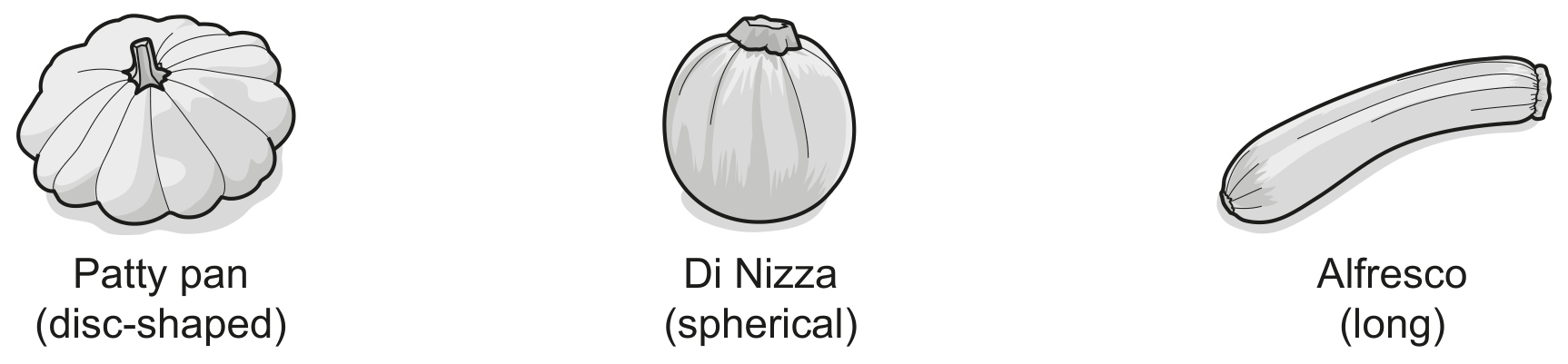
The summer squash plant, Cucurbita pepo, produces edible fruits that vary in shape. Fig. 2.1 shows the fruits of three different varieties of squash plants.

Fig. 2.1

Fig. 2.1

Fruit shape in squashes is controlled by two genes, A / a and B / b, that are located on different chromosomes.
- A disc-shaped fruit is produced when both dominant alleles, A and B, are present.
- A spherical fruit is produced when either allele A or allele B is present, but not if both A and B are present.
- A long fruit is produced when both allele A and allele B are absent.

(a)
(i)

Genetically modified (GM) summer squash plants with resistance to viral diseases have been grown in the USA since 1995.

Scientists have been concerned that viral resistance genes pass easily from GM squash plants to their wild relative, the Texas gourd, Cucurbita texana.

Explain why the possibility of gene flow from GM squash plants to the Texas gourd is a cause of social and environmental concern.
social
environmental

[ 2 ]
(ii)

A study compared the survival of two different types of hybrids that were formed by cross-pollination between GM virus-resistant squash plants and wild Texas gourd plants:
- virus-resistant hybrids that had inherited the viral resistance gene
- non-resistant hybrids that had not inherited the viral resistance gene.

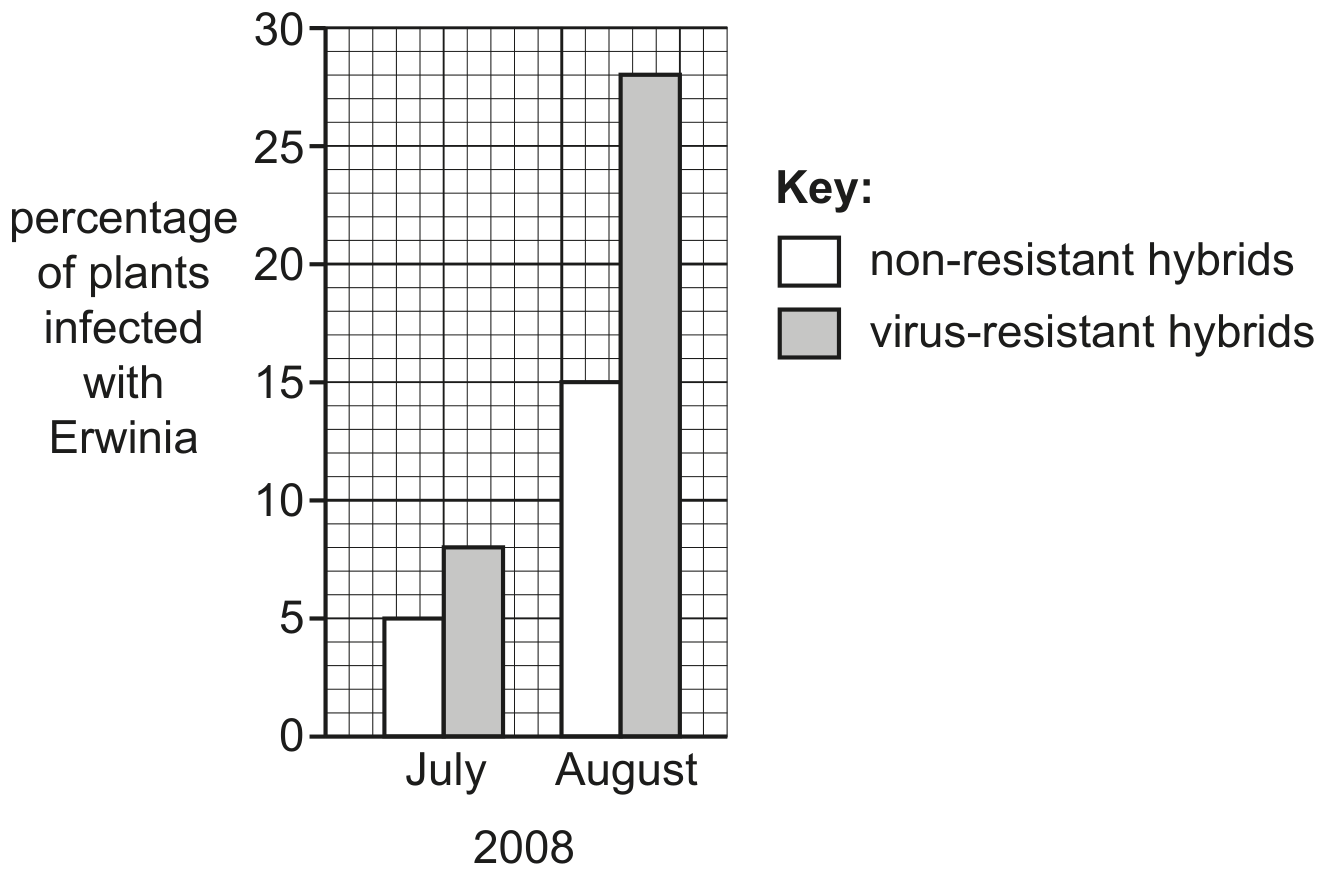
Viral disease outbreaks caused many of the non-resistant hybrids to die. Leaf-eating beetles then moved in larger numbers to the surviving healthy virus-resistant hybrids. The beetles carried a pathogenic bacterium Erwinia which was capable of killing the plants.

Fig. 2.2 compares infection with Erwinia in the virus-resistant hybrids and the non-resistant hybrids.

Fig. 2.2

Fig. 2.2

Discuss whether these results provide support for the use of genetically modified organisms (GMOs) in food production.

[ 2 ]
(iii)

Suggest why the GM virus-resistant squashes grown by farmers rarely suffer infection by Erwinia.

[ 1 ]
[Maximum number: 4]

The pink bollworm moth, Pectinophora gossypiella, is a pest of cotton crops. The size of its population can be reduced by releasing large numbers of sterile male moths into cotton fields. The sterile male moths mate with wild females from the cotton fields, but no offspring are produced.

Over a period of three years, 20 million genetically modified (GM) sterile male moths were released in the USA. Each insect contained a gene coding for a red fluorescent protein (DsRed) taken from a species of reef coral. The added DNA also included a promoter.

(a)

DsRed allows sterile male moths to be distinguished from wild moths when caught in an insect trap in a field of cotton plants.

Suggest why it is important to be sure whether a moth caught in such a trap is a released sterile male or a wild insect.

[ 2 ]
(b)

The United States Department of Agriculture has ruled that the release of sterile males to control insect pest numbers is environmentally preferable to all other alternatives.

Suggest what information would be needed to determine whether the release of the sterile male moths, carrying the gene for DsRed, has a damaging effect on the environment.

Question 3 starts on page 8

[ 2 ]
[Maximum number: 2]

Domestic goats are small, herbivorous animals that provide milk for human use. This is an important source of food for people in rural South Africa.

Three Northern European goat varieties (breeds) have been imported to South Africa because they have higher milk yields than the native South African goats.

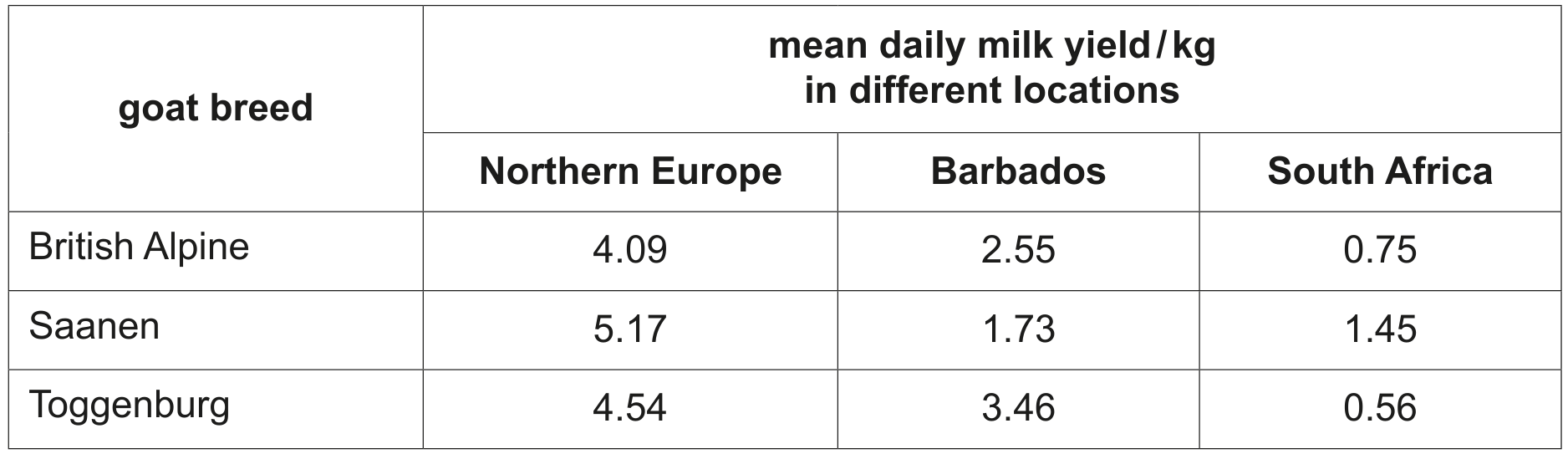
Table 2.1 compares the mean daily milk yields of these three breeds of Northern European goat in three locations, Northern Europe, Barbados and South Africa.

Table 2.1

Table 2.1

(a)

Children in developing countries may drink unpasteurised goats' milk. Some may develop diarrhoea caused by live bacteria ingested in the milk.

Scientists have used genetic engineering to develop goats that produce human lysozyme in their milk. Lysozyme is an enzyme that kills bacteria and so reduces the number of bacteria in the milk.

State a social advantage and a social disadvantage of making these GM goats available in developing countries.
advantage
disadvantage

[ 2 ]
[Maximum number: 2]

Domestic goats are small, herbivorous animals that provide milk for human use. Goats' milk is an important source of food for people living in rural China. Xinong Saanen and Guanzhong are the names of two varieties (breeds) of goat common in China.

In these breeds, there is genetic variation at nucleotide position 5752 of a gene coding for a growth factor. At this position there is either a cytosine (C) or a guanine (G) nucleotide. Some individuals are homozygous for the allele containing C at this position (CC), some are homozygous for the allele containing G at this position (GG) and some are heterozygous (CG).

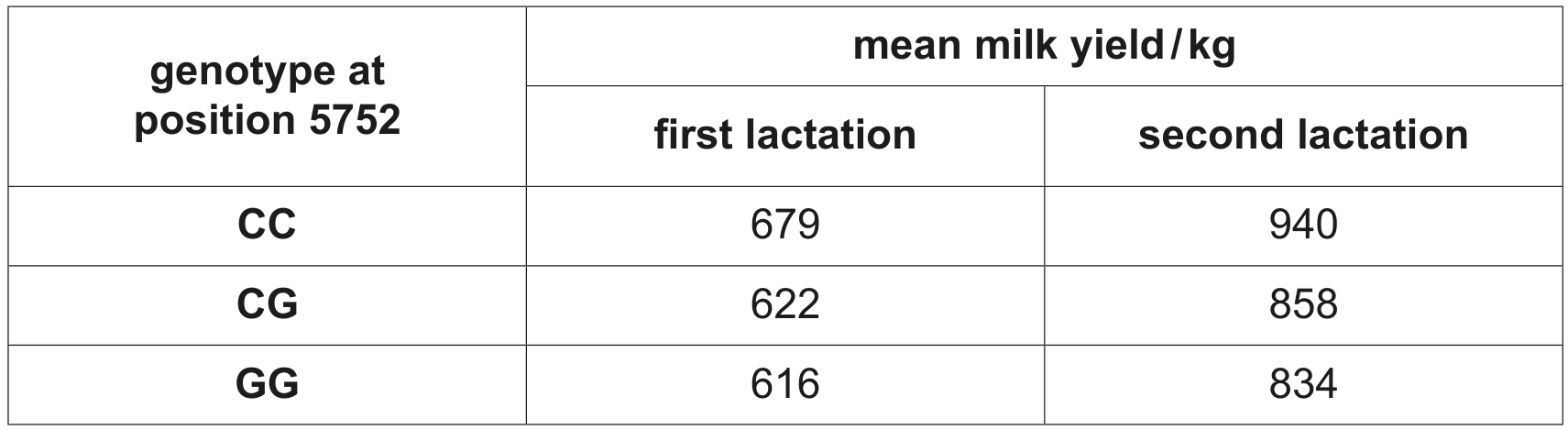
Table 2.1 compares the mean milk yield of the first milk-producing period (first lactation) and the next milk-producing period (second lactation) for Xinong Saanen goats of each genotype.

Table 2.1

Table 2.1

(a)

Goats can be genetically modified to produce human proteins in their milk.

In 2009, an anti-clotting protein produced in this way was approved for use as a drug in people who lack the protein.

State one ethical advantage and one ethical problem of producing medicinal drugs from the milk of genetically modified goats.
advantage
problem

[ 2 ]
(a)

In 2012, permission was granted for a field trial in the UK of genetically modified T. aestivum. The wheat carries a gene, taken from peppermint plants, that results in the wheat leaves releasing a volatile, non-toxic chemical, (E)- β\beta-farnesene (E βf\beta \mathrm{f} ), into the atmosphere.
Eβf\mathrm{E} \beta \mathrm{f} is not only produced by various species of plants. It is also secreted by aphids when they are disturbed by a predator.
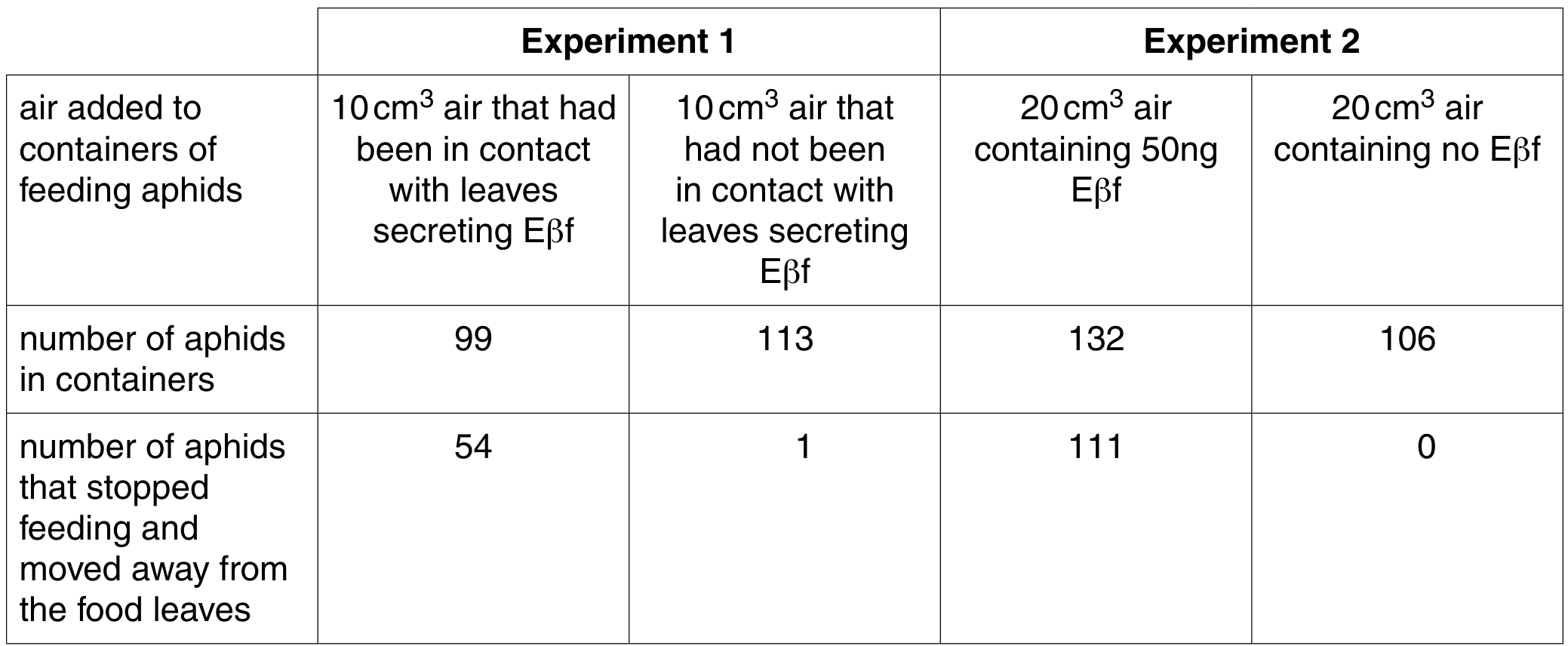
Two experiments have been performed into the effect of Eβf\mathrm{E} \beta \mathrm{f} on the behaviour of aphids feeding on leaves in closed containers.
Experiment 1
Either 10 cm310 \mathrm{~cm}^{3} of air from a syringe that contained plant leaves that secrete Eβf\mathrm{E} \beta \mathrm{f} or 10 cm3\quad 10 \mathrm{~cm}^{3} of air from a syringe with no such leaves
was added to the containers of feeding aphids.
Experiment 2
Either 20 cm320 \mathrm{~cm}^{3} of air containing 50 ng of Eβf\mathrm{E} \beta \mathrm{f}
or 20 cm320 \mathrm{~cm}^{3} of air containing no Eβf\mathrm{E} \beta \mathrm{f}
was added to the containers of feeding aphids.
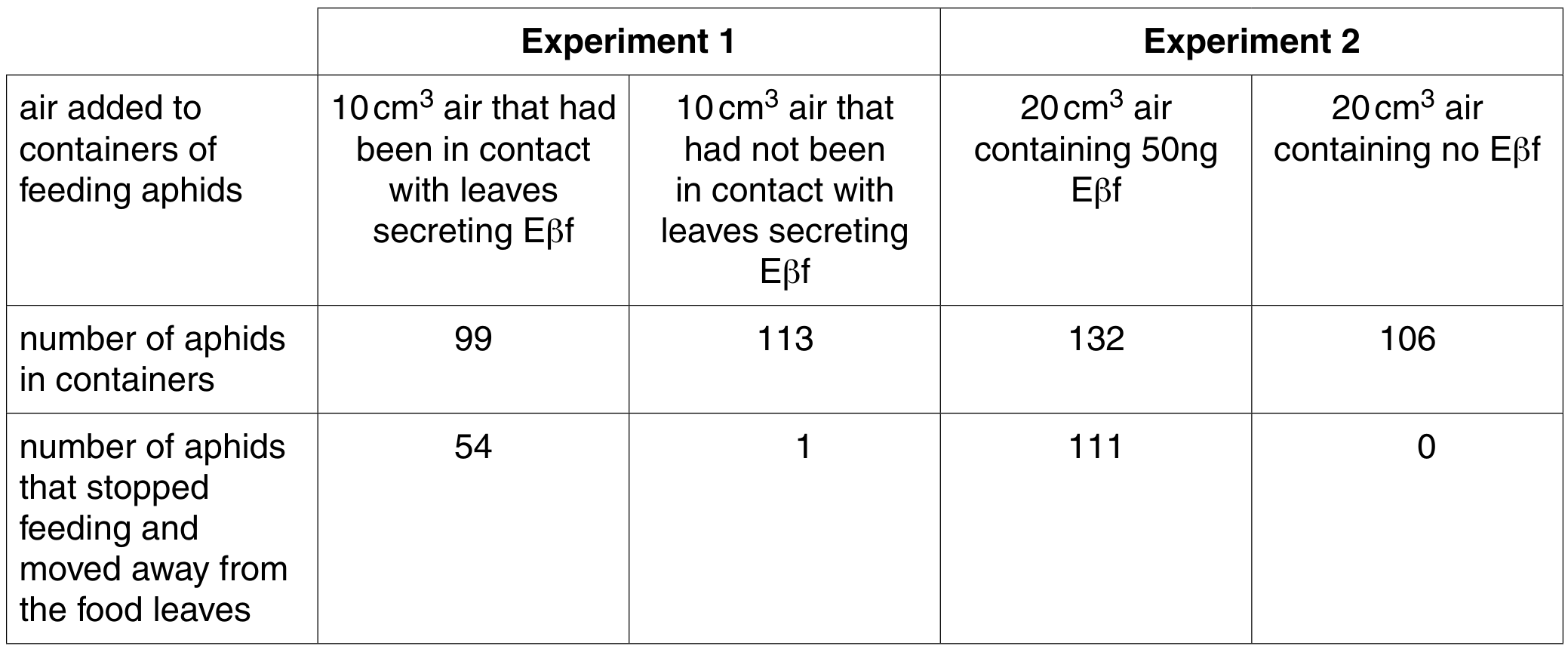
In both experiments, the number of aphids that stopped feeding and moved away from the food leaves was counted. The results are shown in Table 3.1.

Table 3.1

Table 3.1

[ 3 ]
(i)

Other experiments show that Eβf\mathrm{E} \beta \mathrm{f} attracts predators of aphids, such as ladybirds.

Explain how growing genetically modified wheat secreting Eβf\mathrm{E} \beta \mathrm{f} could increase the yield of wheat.

[ 3 ]
(ii)

Suggest why growing this genetically modified wheat might be acceptable to people who object to the growth of genetically modified insect-resistant maize or cotton.

(a)

In 2012, permission was granted for a field trial in the UK of genetically modified T. aestivum. The wheat carries a gene, taken from peppermint plants, that results in the wheat leaves releasing a volatile, non-toxic chemical, (E)- β\beta-farnesene (E βf\beta \mathrm{f} ), into the atmosphere.
Eβf\mathrm{E} \beta \mathrm{f} is not only produced by various species of plants. It is also secreted by aphids when they are disturbed by a predator.
Two experiments have been performed into the effect of Eβf\mathrm{E} \beta \mathrm{f} on the behaviour of aphids feeding on leaves in closed containers.
Experiment 1
Either 10 cm310 \mathrm{~cm}^{3} of air from a syringe that contained plant leaves that secrete Eβf\mathrm{E} \beta \mathrm{f} or 10 cm3\quad 10 \mathrm{~cm}^{3} of air from a syringe with no such leaves
was added to the containers of feeding aphids.
Experiment 2
Either 20 cm320 \mathrm{~cm}^{3} of air containing 50 ng of Eβf\mathrm{E} \beta \mathrm{f}
or 20 cm320 \mathrm{~cm}^{3} of air containing no Eβf\mathrm{E} \beta \mathrm{f}
was added to the containers of feeding aphids.
In both experiments, the number of aphids that stopped feeding and moved away from the food leaves was counted. The results are shown in Table 3.1.

Table 3.1

Table 3.1

[ 3 ]
(i)

Other experiments show that Eβf\mathrm{E} \beta \mathrm{f} attracts predators of aphids, such as ladybirds.

Explain how growing genetically modified wheat secreting Eβf\mathrm{E} \beta \mathrm{f} could increase the yield of wheat.

[ 3 ]
(ii)

Suggest why growing this genetically modified wheat might be acceptable to people who object to the growth of genetically modified insect-resistant maize or cotton.

0