EduNinja
[Maximum number: 2]

The courgette plant, Cucurbita pepo, produces edible fruits that vary in colour and shape.
Fruit colour in courgettes is controlled by the gene A / a.
Fruit shape in courgettes is controlled by the gene B/b.
- A yellow fruit is produced when the dominant allele A is present.
- A round fruit is produced when the dominant allele B is present.

Genes A / a and B/b occur on different chromosomes.
Table 1.1 shows the genotypes and phenotypes of four different varieties of courgette with respect to their fruit colour and shape.
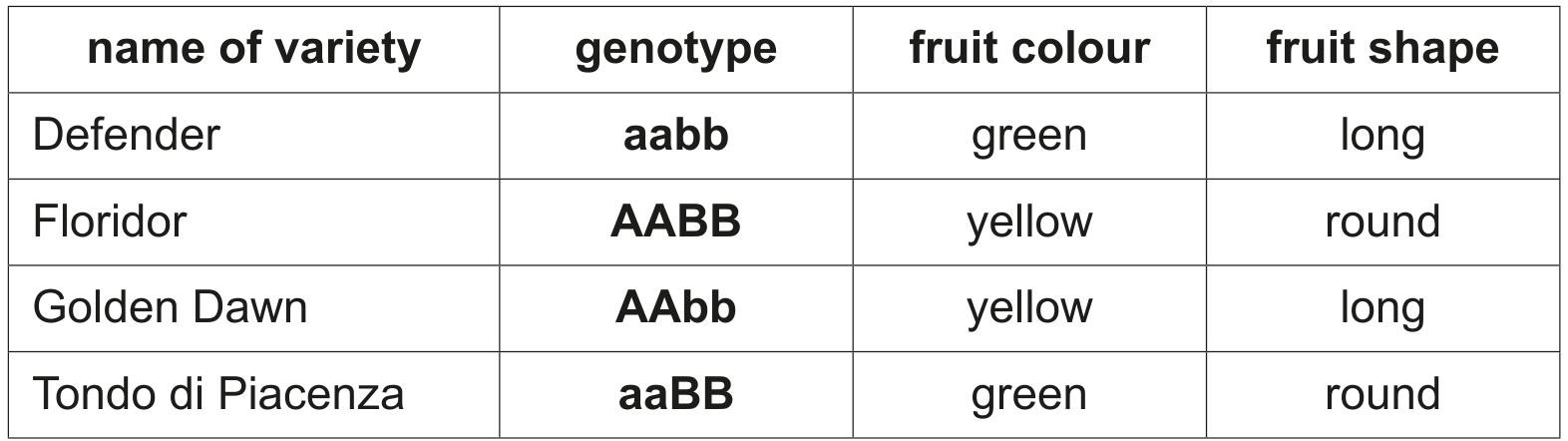
Table 1.1

Table 1.1

(a)
(i)

Outline how the WMV-resistant trait of Cucurbita ecuadorensis could be transferred to watermelon plants.

[ 2 ]
[Maximum number: 1]

Interferon-alpha (IFN- α\alpha ) can be produced as a recombinant human protein to treat some types of cancer. The gene IFNA2 codes for IFN- α\alpha.

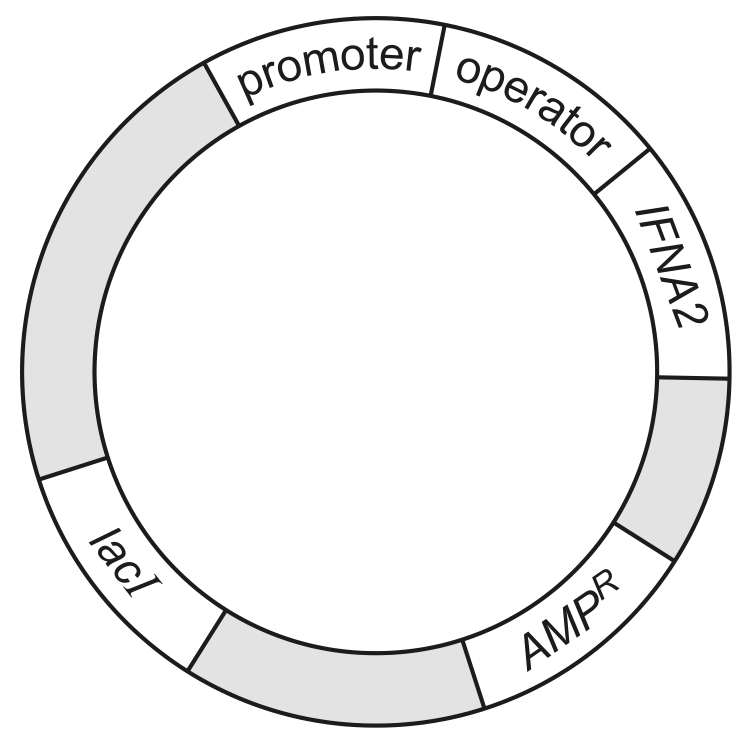
One method of producing recombinant IFN- α\alpha uses genetically engineered Escherichia coli bacteria that contain recombinant plasmids. Each recombinant plasmid contains:
- the gene IFNA2
- three regulatory sequences of the lac operon (promoter, operator and lacl)
- a gene for antibiotic resistance, AMPRA M P^{R}.

Each of the sequences for the lacI gene and AMPRA M P^{R} gene contains its own promoter. As a result, these genes are always expressed in E. coli bacteria that contain this recombinant plasmid.

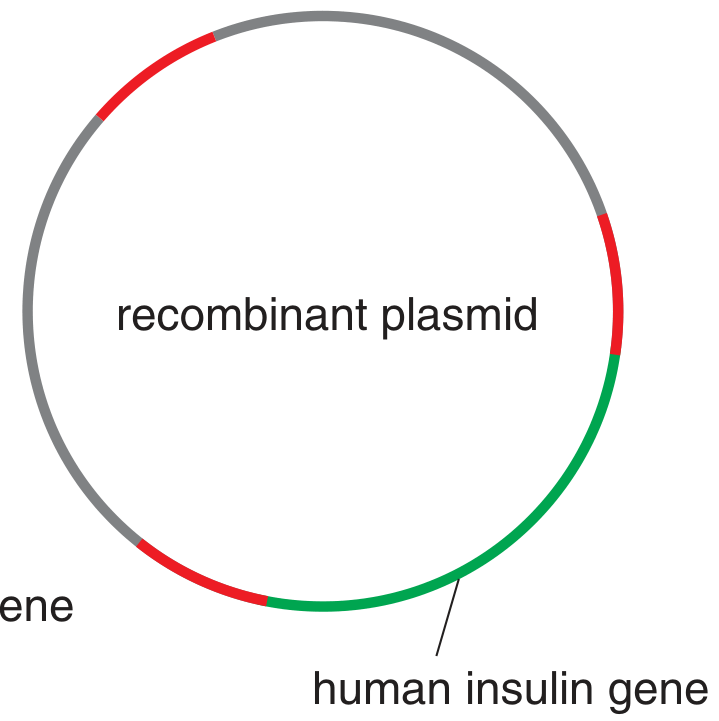
Fig. 2.1 is a diagram of the recombinant plasmid. The promoter regions of the lacI gene and AMPRA M P^{R} gene are not shown.

Fig. 2.1

Fig. 2.1

(a)

The gene AMPRA M P^{R} in the plasmid shown in Fig. 2.1 codes for a protein that provides resistance to the antibiotic ampicillin.

Suggest how AMPRA M P^{R} allows genetically engineered E. coli containing the recombinant plasmid to be identified.

[ 1 ]
[Maximum number: 5]

Steelhead trout, Oncorhynchus mykiss, are fish that live in streams in North America.
To increase the number of steelhead trout, captive breeding has occurred since 1992. Fish eggs and sperm are mixed and the young fish grow in large tanks of aerated water for the first year of their lives. Most are then released into the wild, however a few male and female fish are kept to become the parents of the next generation of captive-bred fish.

Each tank may hold up to 50000 fish. The young captive fish are fed processed food. Some young fish are unable to survive these conditions and a proportion die. Death is usually the result of poor wound-healing after accidents due to overcrowding and due to the spread of diseases.

(a)
(i)

Describe how microarray analysis can detect differences in the expression of many genes when comparing two samples, such as the offspring of wild and captive-bred fish.

[ 5 ]
(a)

In preparation for ICSI, infertile women are injected at daily intervals with human follicle stimulating hormone (hFSH) to stimulate the growth and maturation of a number of ovarian follicles. Women may be treated with hFSH extracted from urine (u-hFSH) or with recombinant hFSH ( r -hFSH) produced by genetically modified mammalian cells.

Each molecule of hFSH consists of two different polypeptide chains, α\alpha and β\beta.
The genes for the α\alpha and β\beta chains of hFSH, together with their promoters, have been inserted into mammalian ovary cells.

Explain why promoters need to be transferred with desired genes when producing a genetically modified cell.

[ 2 ]
[Maximum number: 13]

The artificial plasmid, pBR322, was constructed to act as a vector. It has often been used to insert human genes, such as the human insulin gene, into the bacterium, Escherichia coli.

The plasmid was constructed to include two genes, each giving resistance to a different antibiotic: an ampicillin resistance gene and a tetracycline resistance gene. The plasmid also has a target site for the restriction enzyme, BamHI, in the middle of the tetracycline resistance gene.

A pBR322 plasmid was cut using BamHI and the cDNA gene for human insulin inserted into it.

Fig. 2.1 shows pBR322 and the recombinant plasmid.
ampicillin resistance gene
pBR322
etracycline resistance gene
target site for BamHI

Question image

GlG A T C C
CCTA G^G

Fig. 2.1

(a)

With reference to Fig. 2.1, describe how a cDNA human insulin gene can be inserted into pBR322 that has been cut by BamHI.

[ 4 ]
(b)

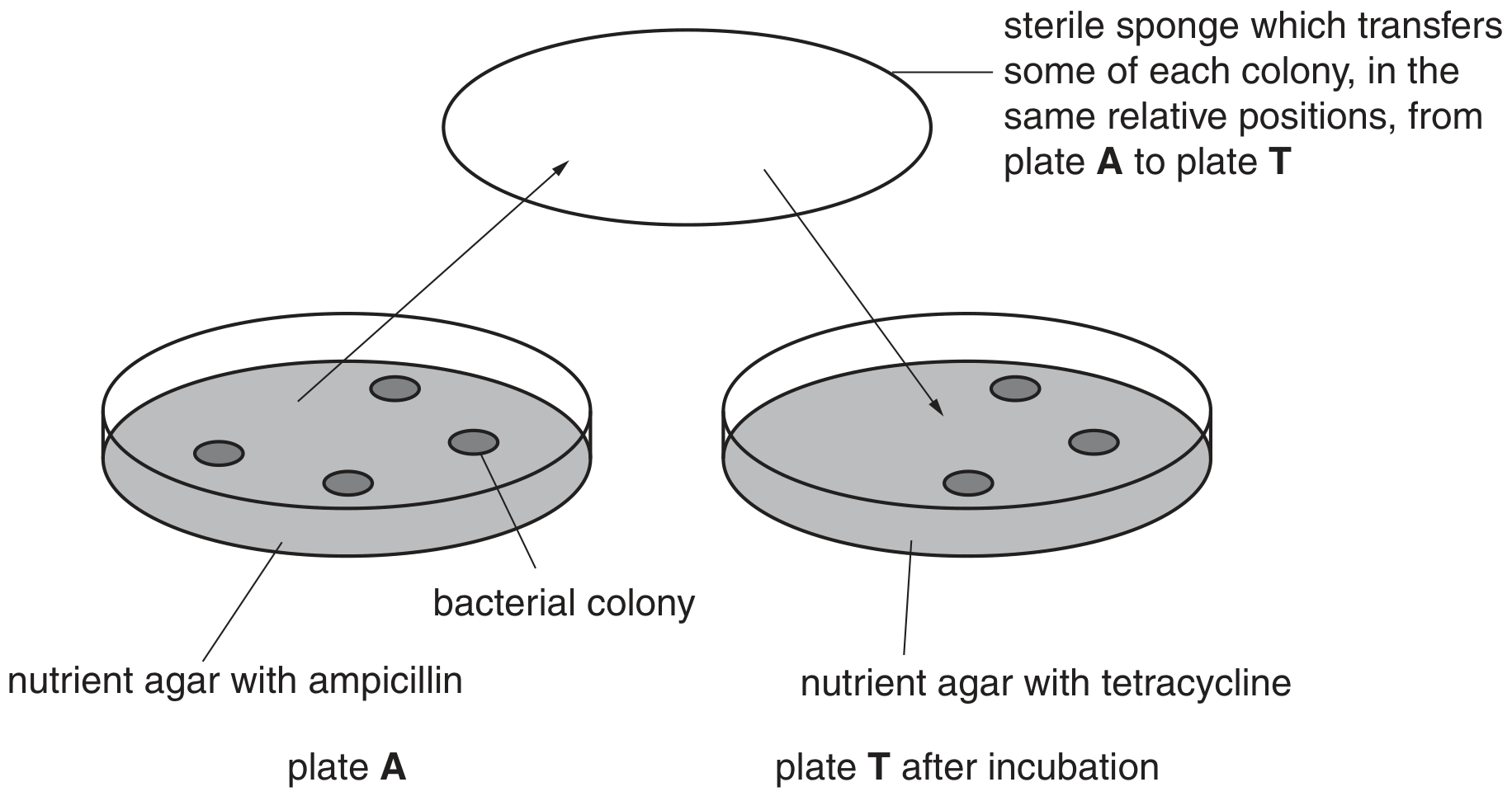
Bacteria were then mixed with the recombinant plasmids. Those bacteria which had successfully taken up recombinant plasmids were identified using the following steps:
step 1 - the bacteria were spread onto culture plates containing nutrient agar and ampicillin and incubated to allow colonies to form
step 2 - some bacteria from each of the colonies growing on these plates were transferred to plates containing nutrient agar and tetracycline, as shown in Fig. 2.2.

Fig. 2.2

Fig. 2.2

[ 7 ]
(i)

Explain why the bacteria were first spread onto plates containing ampicillin.

[ 3 ]
(ii)

Explain why it is important, for identifying bacteria that have successfully taken up the recombinant plasmid, that on pBR322 the target site for BamHI is in the middle of the tetracycline resistance gene.

[ 3 ]
(iii)

Use a label line and the letter C to identify, on Fig. 2.2, a colony of bacteria that contain the recombinant plasmid.

Put your answer onto Fig. 2.2 on page 5.

[ 1 ]
(c)

Plasmid vectors carrying antibiotic resistance genes are now rarely used in gene technology.

[ 2 ]
(i)

State one type of gene that has replaced antibiotic resistance genes in plasmid vectors and indicate how its presence can be detected.
type of gene
detection

[ 2 ]
[Maximum number: 10]

Gold ions ( Au3+\mathrm{Au}^{3+} ) are toxic to most microorganisms. However, the bacterium Delftia acidovorans is frequently found in sticky layers, called biofilms, that form on the surface of gold deposits.
D. acidovorans produces a peptide synthase that catalyses the synthesis of a small peptide called delftibactin. When isolated, delftibactin can precipitate Au3+\mathrm{Au}^{3+} ions as small particles of metallic gold. Delftibactin is a secondary metabolite.

(a)

Name another example of a secondary metabolite and explain what is meant by the term. example
explanation

[ 3 ]
(b)

A mutant strain of D. acidovorans has been identified in which the gene coding for peptide synthase is inactive.

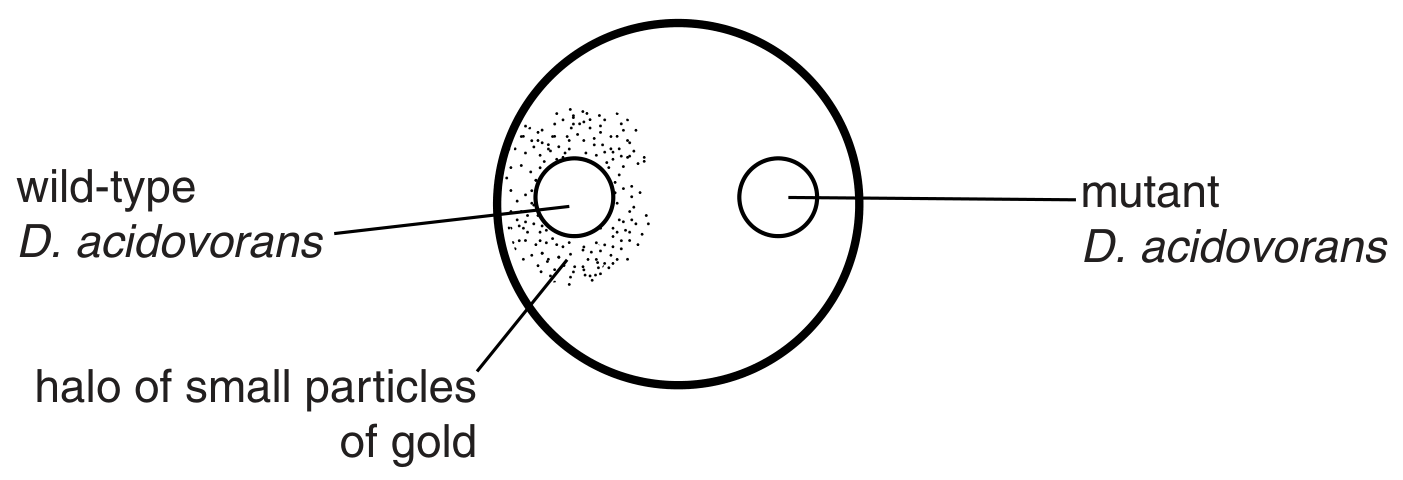
The wild-type (normal) and mutant D. acidovorans were grown on agar plates and then flooded with gold chloride solution, which contains Au3+\mathrm{Au}^{3+} ions. The appearance of such a plate after this treatment is shown in Fig. 2.1.

Fig. 2.1

Fig. 2.1

With reference to Fig. 2.1, suggest how delftibactin protects D. acidovorans from toxic Au3+\mathrm{Au}^{3+} ions.

[ 3 ]
(c)

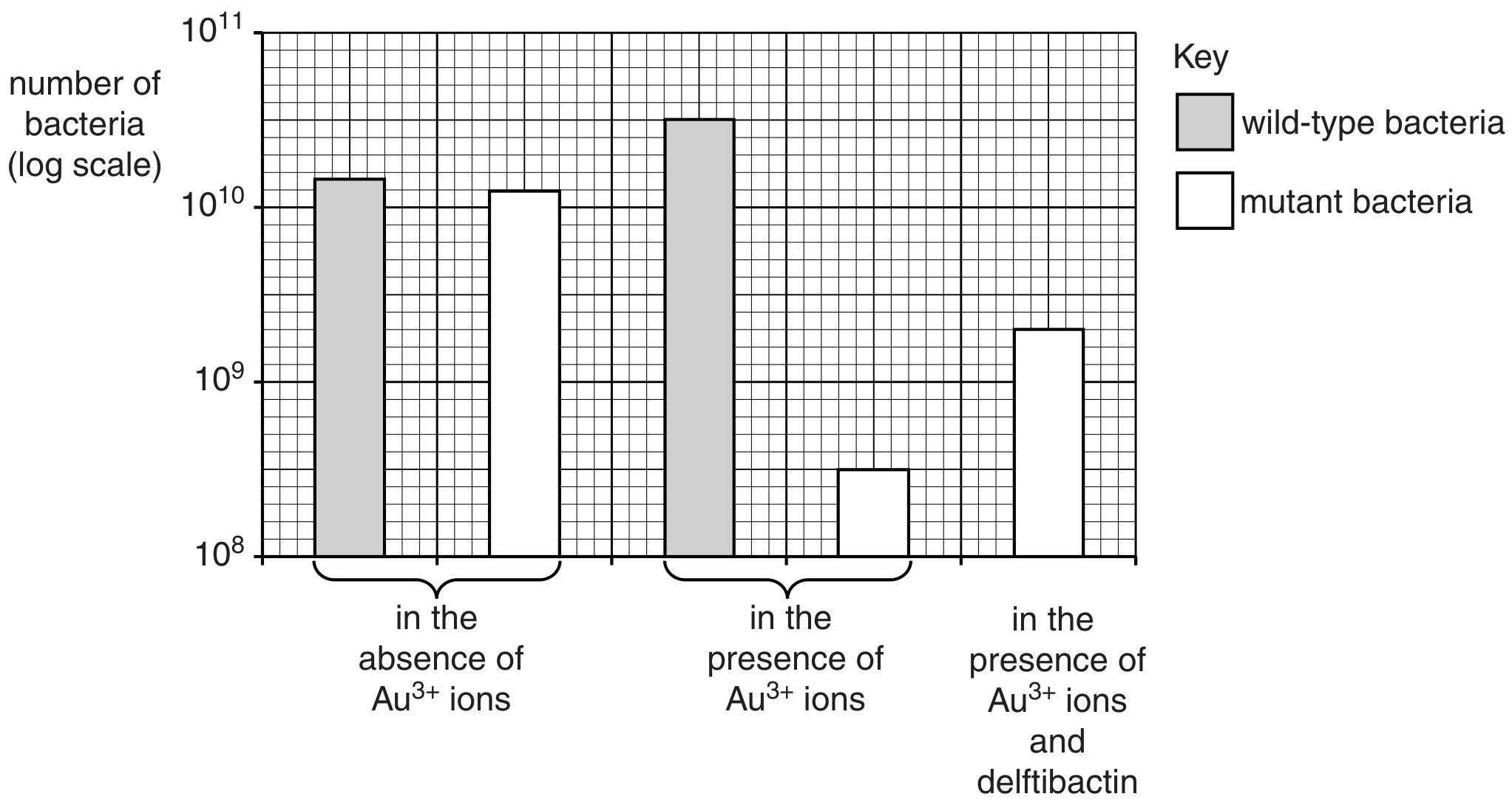
Wild-type and mutant D. acidovorans were grown in standardised conditions:
- wild-type and mutant bacteria were grown in the absence of Au3+\mathrm{Au}^{3+} ions
- wild type and mutant bacteria were grown in the presence of Au3+\mathrm{Au}^{3+} ions
- mutant bacteria were grown in the presence of Au3+\mathrm{Au}^{3+} ions and of delftibactin.

The results are shown in Fig. 2.2.

Fig. 2.2

Fig. 2.2

Explain whether or not the results shown in Fig. 2.2 support the idea that delftibactin is protective.

[ 4 ]
(a)

One of the ways in which a bacterium may be resistant to an antibiotic, such as a β\beta lactam, is by having protein pumps in its cell surface membrane which expel the antibiotic from the bacterium.

The gene coding for such an efflux pump is carried on a plasmid.
Outline how the bacterium produces an efflux pump from a gene on a plasmid.

[ 3 ]
[Maximum number: 5]

Severe combined immunodeficiency (SCID) is a group of life-threatening diseases. SCID is caused by mutations that prevent the normal function of the immune system. Infants born with SCID are at very high risk of infectious diseases.

One feature of SCID is that T-lymphocytes do not develop normally.
In the development of normal T-lymphocytes, the production of circular pieces of DNA called T-lymphocyte receptor excision circles (TRECs) is an important event.

It is possible to use the polymerase chain reaction (PCR) to detect TRECs in DNA extracted from a sample of blood. The results of this reaction can be used to identify children with SCID.

(a)
(i)

Describe the role of the primers in the PCR used for the detection of TRECs.

[ 3 ]
(ii)

Suggest and explain how the results of PCR for the detection of TRECs can be used to identify children with SCID.

[ 2 ]
[Maximum number: 5]

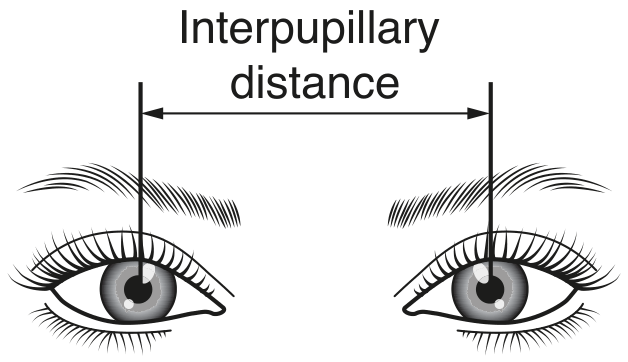
The interpupillary distance (IPD) is the distance in millimetres between the centres of the pupils of the eyes. Fig. 2.1 shows how IPD is measured.

Fig. 2.1

Fig. 2.1

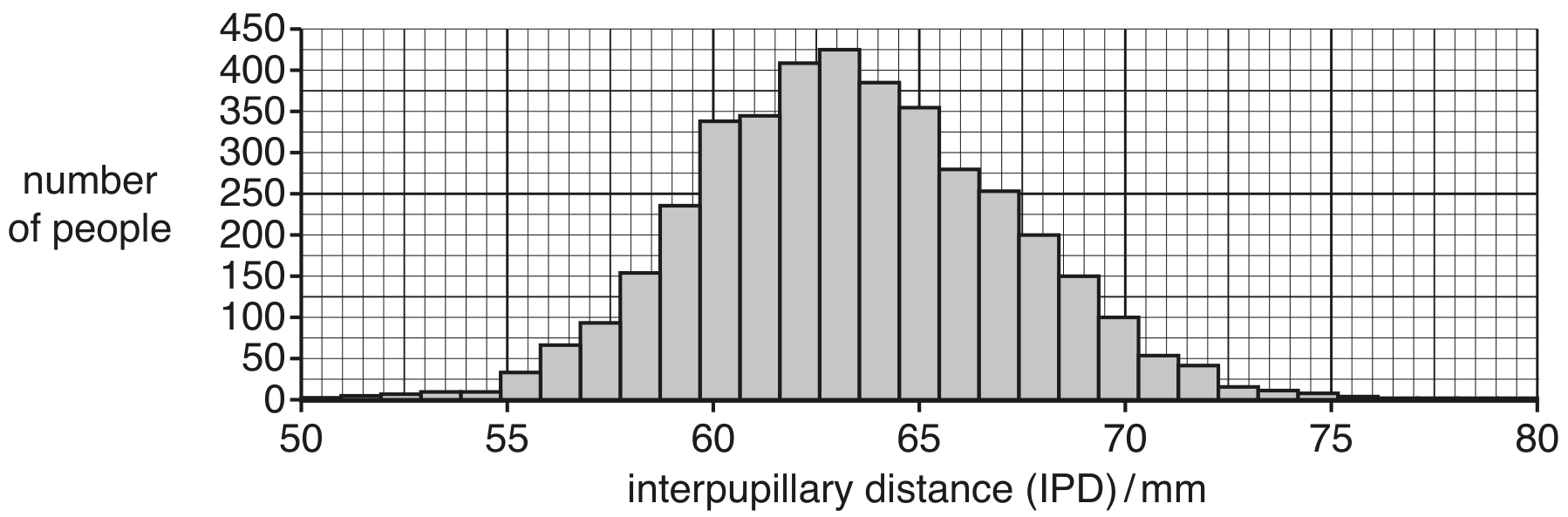
IPD is one example of a characteristic of human facial structure that shows variation.
Fig. 2.2 shows the pattern of variation in IPD in a large sample of adults.

Fig. 2.2

Fig. 2.2

(a)

Individuals with an IPD of 70 mm or more have a mutation in the PAX3 gene that results in less PAX3 protein being made.

The normal role of the PAX3 protein is to increase the expression of many other genes involved in embryonic development. These genes affect a range of phenotypic features such as facial structure, hearing and eye colour.

[ 5 ]
(i)

Describe how microarray analysis could be used to identify the genes switched on by PAX3 in embryonic cells.

[ 5 ]
0