
EduNinja

E.2 Quantum physics Topic Practice

E.2 Quantum physics Topic Practice
IB Physics syllabusPhysics SL/HLFirst assessment 2025

Solve quantum questions by applying photon and matter-wave equations to graphs, threshold conditions and scattering evidence.

Exam points

  • use `hf = Φ + E_k` with a photoelectric graph to find work function, threshold frequency, or max kinetic energy
  • calculate de Broglie wavelength with `λ = h/p` or `λ = h/mv`, using the given speed, mass, or potential
  • use the Compton equation and wavelength data table to determine photon shift, recoil, or scattering angle

Question 5

Question 5(a)

(a)

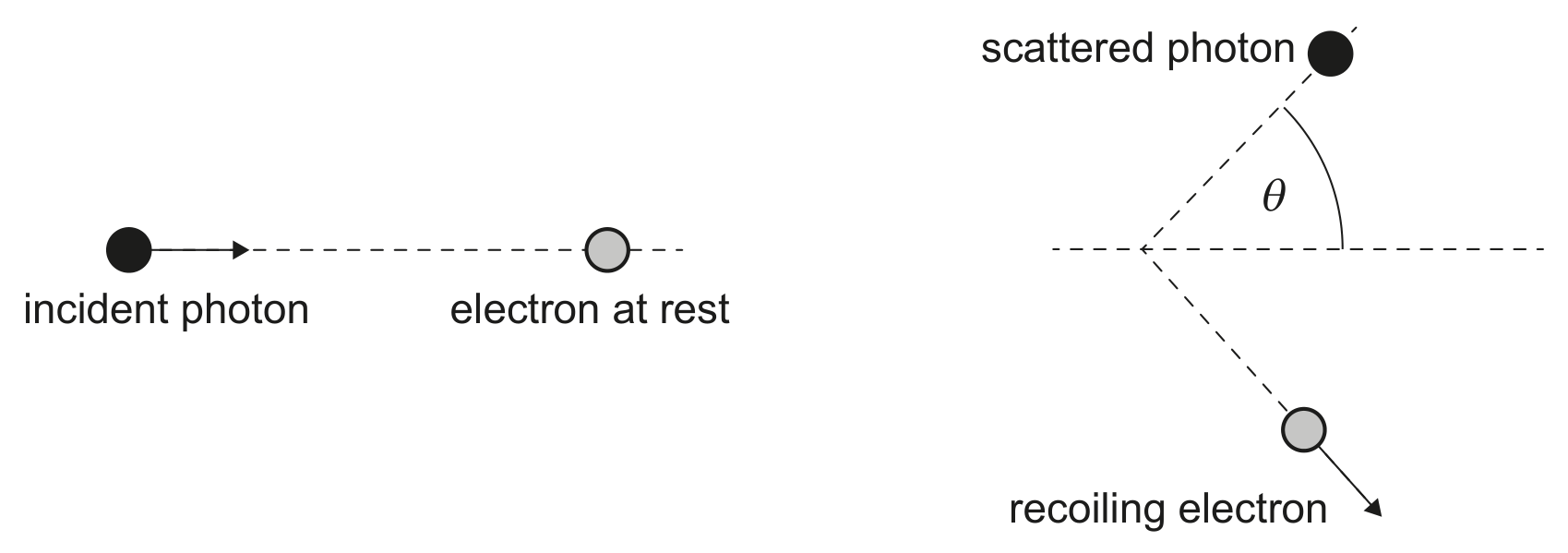
Outline why Compton scattering offers better evidence for the particle nature of light than the photoelectric effect.

A photon of wavelength 6.40×10¹² m6.40 \times 10^{-12} \mathrm{~m} and energy 0.194 MeV is incident on an electron at rest. The photon scatters at an angle θ\theta with wavelength 7.47×10¹² m7.47 \times 10^{-12} \mathrm{~m}. The electron recoils.

Question image
[ 2 ]

Question 5(b)

(b)

Outline why the wavelength of the scattered photon is longer than that of the incident photon.

[ 2 ]

Question 5(c)(i)

(c)

Show that the energy of the scattered photon is about 0.17 MeV .

[ 1 ]

Question 5(c)(ii)

(d)

Calculate the kinetic energy of the recoiling electron.

[ 1 ]

Question 5(c)(iii)

(e)

For an electron, hmec=2.43×10¹² m\frac{h}{m_{\mathrm{e}} c}=2.43 \times 10^{-12} \mathrm{~m}. Determine θ\theta.

[ 2 ]

Question 6(b)(ii)

[Maximum number: 1]

A short-range attractive force operates between nucleons.

Radioactive potassium-40 (1940 K)\left({ }_{19}^{40} \mathrm{~K}\right) undergoes β\beta^{-}decay to form a nuclide of calcium (Ca).

In one decay, a negative beta particle is emitted at a speed of 580 ms1580 \mathrm{~ms}^{-1}.

Calculate the de Broglie wavelength of the beta particle.

Question 34

[Maximum number: 1]

Monochromatic electromagnetic radiation is incident on a metal surface. Three observations about the electrons emitted from the surface are:

I. The maximum energy of the electrons does not depend on radiation intensity.
II. The number of electrons emitted in a unit time increases with radiation intensity.
III. No electrons are emitted when the frequency of radiation is less than a threshold value.

Which observations are inconsistent with the wave model of electromagnetic radiation?

A

I and II only

B

I and III only

C

II and III only

D

I, II and III

Question 35

[Maximum number: 1]

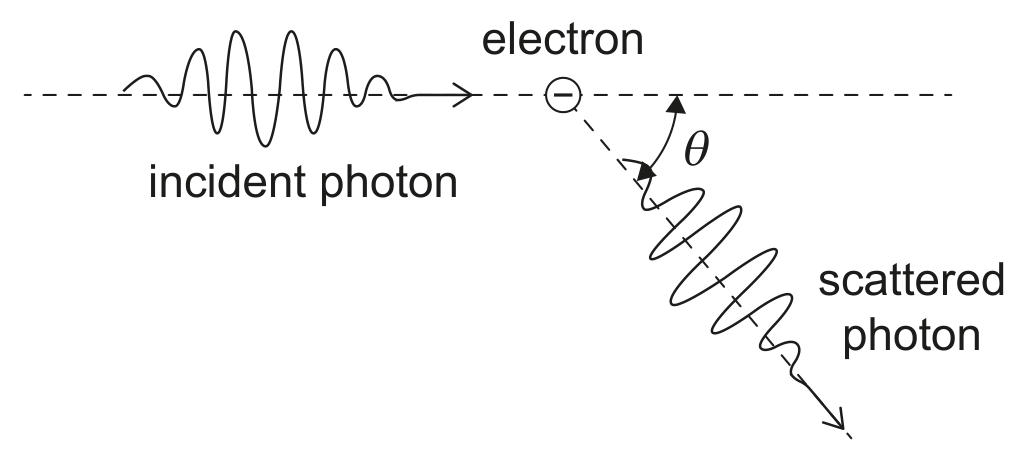
A photon scatters off an electron at an angle θ\theta, as shown. The shift in the photon wavelength after scattering is h2mec\frac{h}{2 m_{e} c}.

Question image

What is correct about the frequency of the photon after scattering and θ\theta ?

Frequency

θ\theta

increases

3030^{\circ}

increases

6060^{\circ}

decreases

3030^{\circ}

decreases

6060^{\circ}

Question 35

[Maximum number: 1]

A photon of wavelength λ0\lambda_{0} scatters off an electron at rest. The shift in photon wavelength is Δλ\Delta \lambda. What is the kinetic energy of the scattered electron?

A

hcΔλ\frac{h c}{\Delta \lambda}

B

hcλ0+Δλ\frac{h c}{\lambda_{0}+\Delta \lambda}

C

hcλ0hcΔλ\frac{h c}{\lambda_{0}}-\frac{h c}{\Delta \lambda}

D

hcλ0hcλ0+Δλ\frac{h c}{\lambda_{0}}-\frac{h c}{\lambda_{0}+\Delta \lambda}

Question 36

[Maximum number: 1]

Two particles are accelerated from rest through the same electric potential difference. The particles have the same charge and different masses. Which row correctly compares the kinetic energy and the de Broglie wavelength of the particles after the acceleration?

Kinetic energy

De Broglie wavelength

same

same

different

same

same

different

different

different

Question 36

[Maximum number: 1]

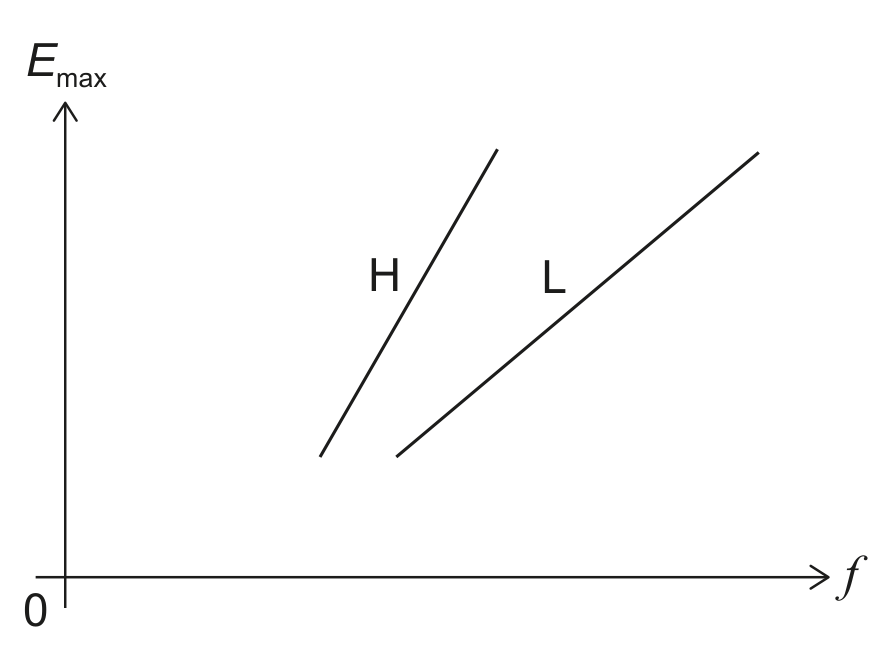
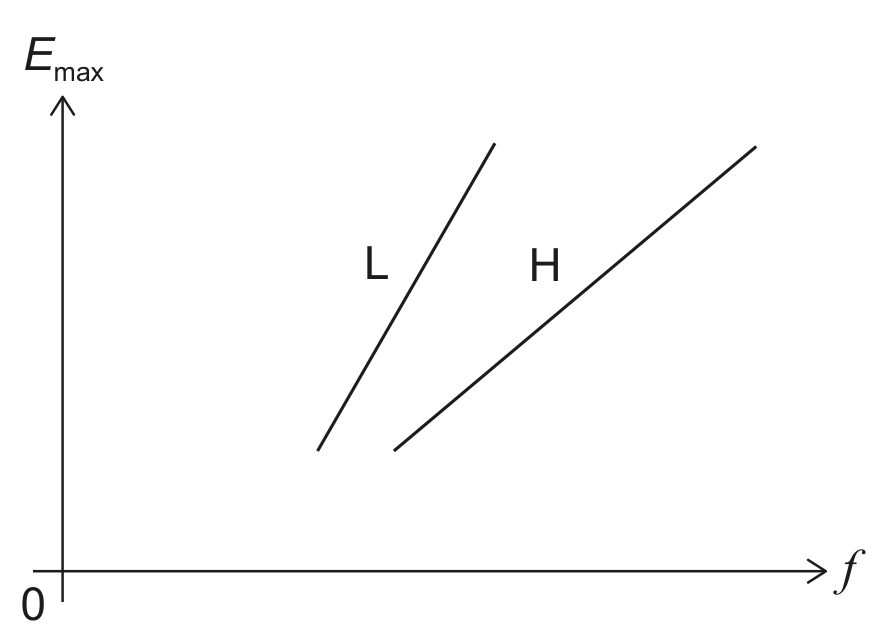
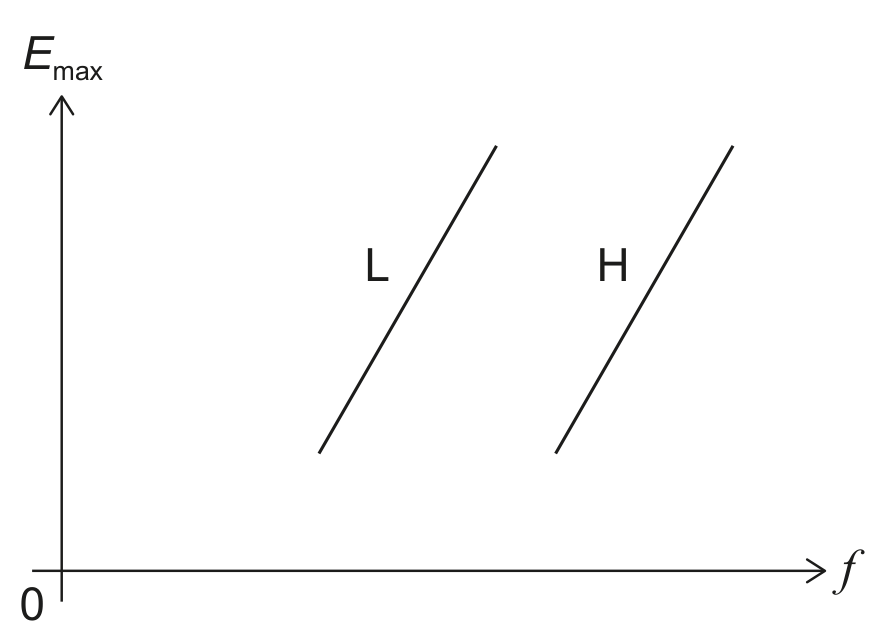
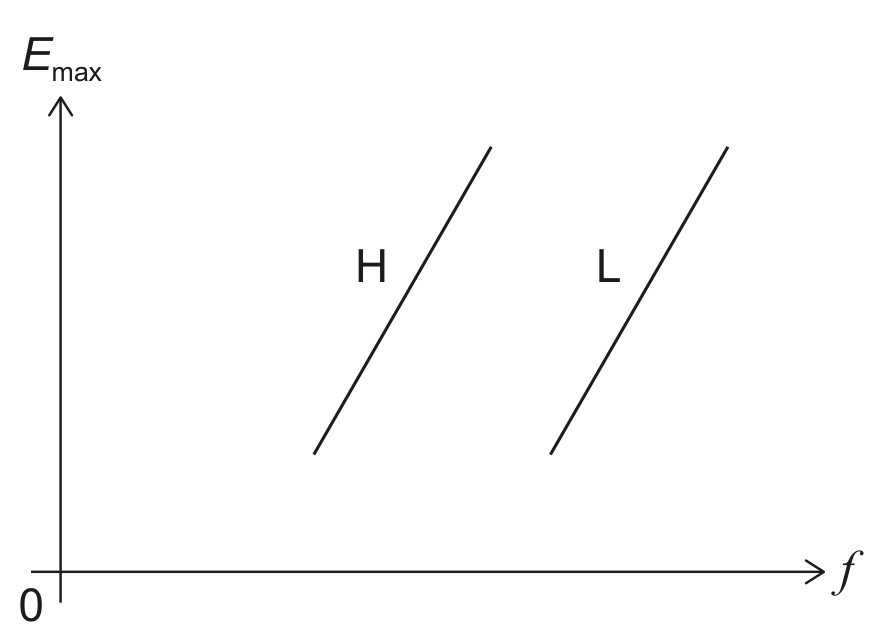
Light is incident on two different metal surfaces L and H. The minimum photon energy required to emit electrons from surface H is less than that from surface L .

Which graph shows the variation with light frequency f of the maximum kinetic energy Emax E_{\text {max }} of photoelectrons emitted from both surfaces?

A
Question image
B
Question image
C
Question image
D
Question image
0 selected