EduNinja

IB Physics HLS2.1 Exploring and designingQuestion Bank

Question 1

[Maximum number: 1]

A student determines the resistivity ρ\rho of a metal that is in the form of a cylindrical wire. The student makes the following measurements:

 Length L of the wire =(462±2)mm\text { Length } L \text { of the wire }=(462 \pm 2) \mathrm{mm}
Readings for the diameter d of the wire:

Readings for the diameter d of the wire:

 Resistance R of the wire =13.7Ω±1.5%\text { Resistance } R \text { of the wire }=13.7 \Omega \pm 1.5 \%

Question 1(a)

(a)

Outline why the measurements of d were made at different places along the wire.

[ 1 ]
Question 1

[Maximum number: 2]

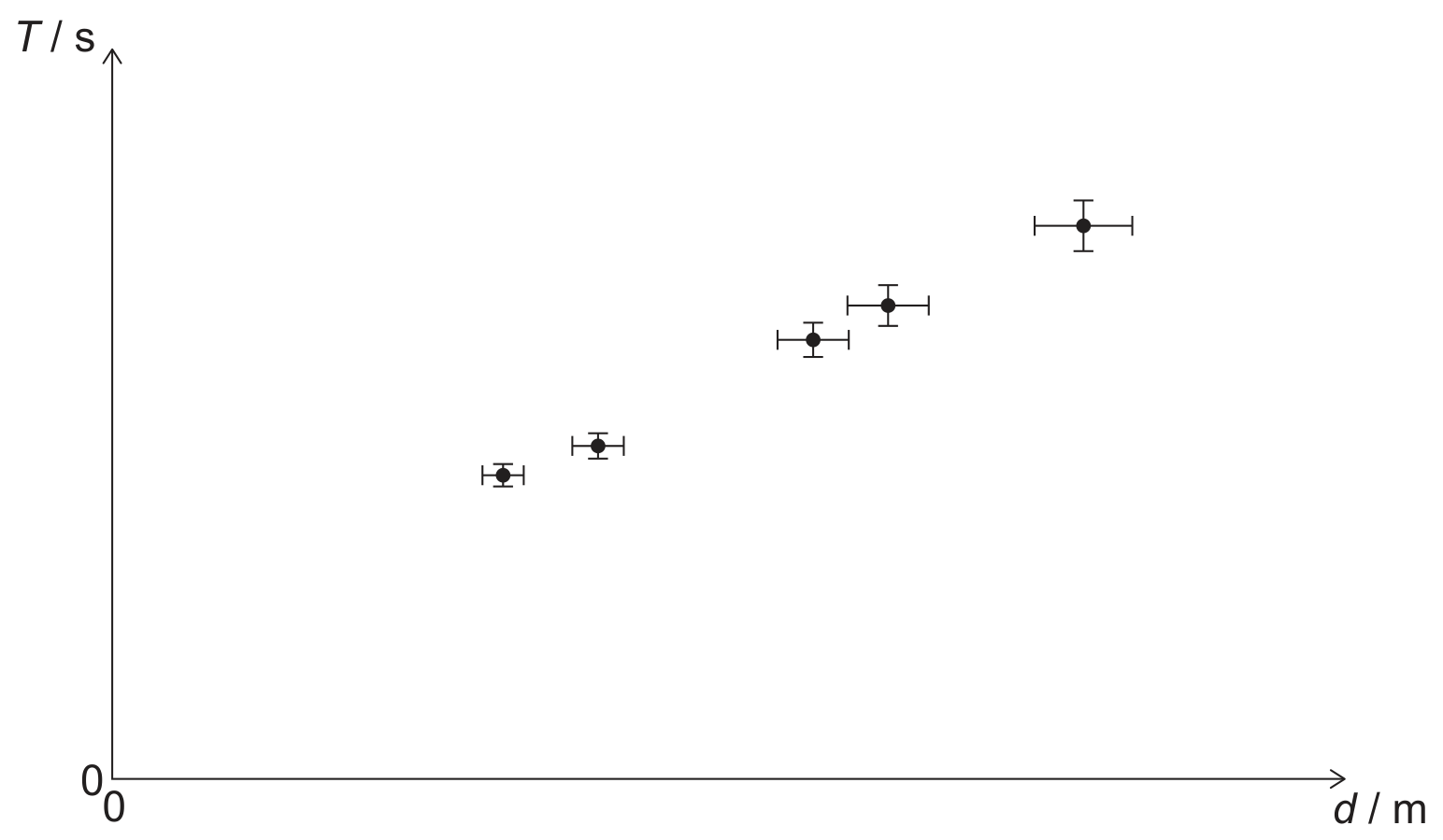
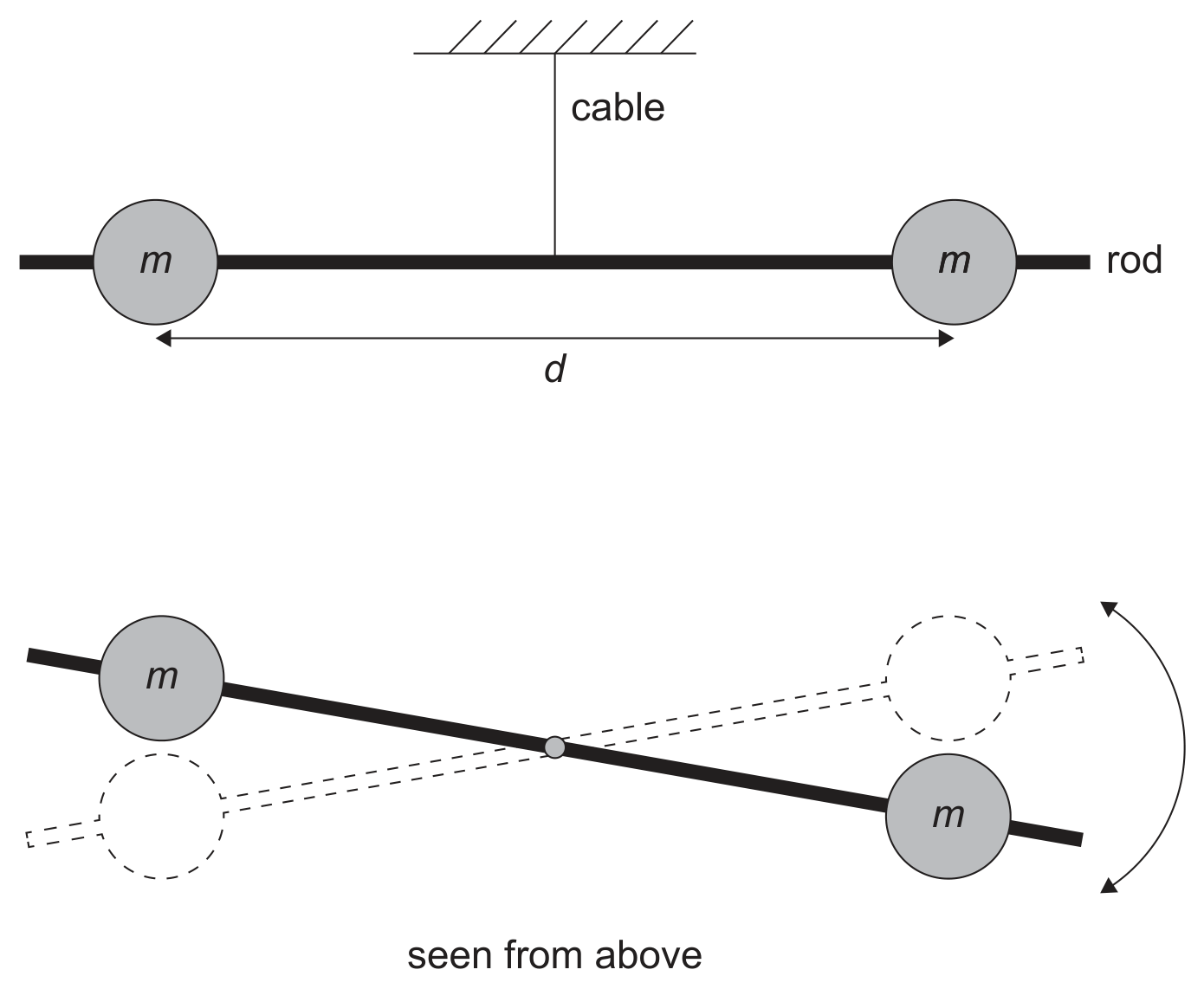
A student performs an experiment with a rod that is free to oscillate in a horizontal plane. Two identical small spheres, each of mass m, are placed at equal distances from the centre of the rod. The student records values of the period of oscillation of the rod T in seconds for different values of the distance of separation of the spheres d, in metres.

Question image

The student plots the variation with d of T, keeping m constant.

Question image

Question 1(a)

Question 1(a)(i)

(a)
(i)

Explain why m was kept constant.

[ 1 ]

Question 1(a)(iii)

(ii)

State one other feature of the experiment that the student should keep constant.

[ 1 ]

Question 2

[Maximum number: 1]

A student wants to verify the relation T=2πLgT=2 \pi \sqrt{\frac{L}{g}} between the period T of a simple pendulum and the length L of the pendulum, where g is the acceleration of free fall. The student operates a stopwatch to measure one oscillation and a millimeter ruler to measure the length of the pendulum.

Question 2(a)

(a)

State, for this experiment,

[ 1 ]

Question 2(a)(i)

(i)

one variable that must be controlled,

[ 1 ]
0 selected