EduNinja

IB Physics HLE.2 Quantum physicsQuestion Bank

Question 2

Question 2(a)

(a)

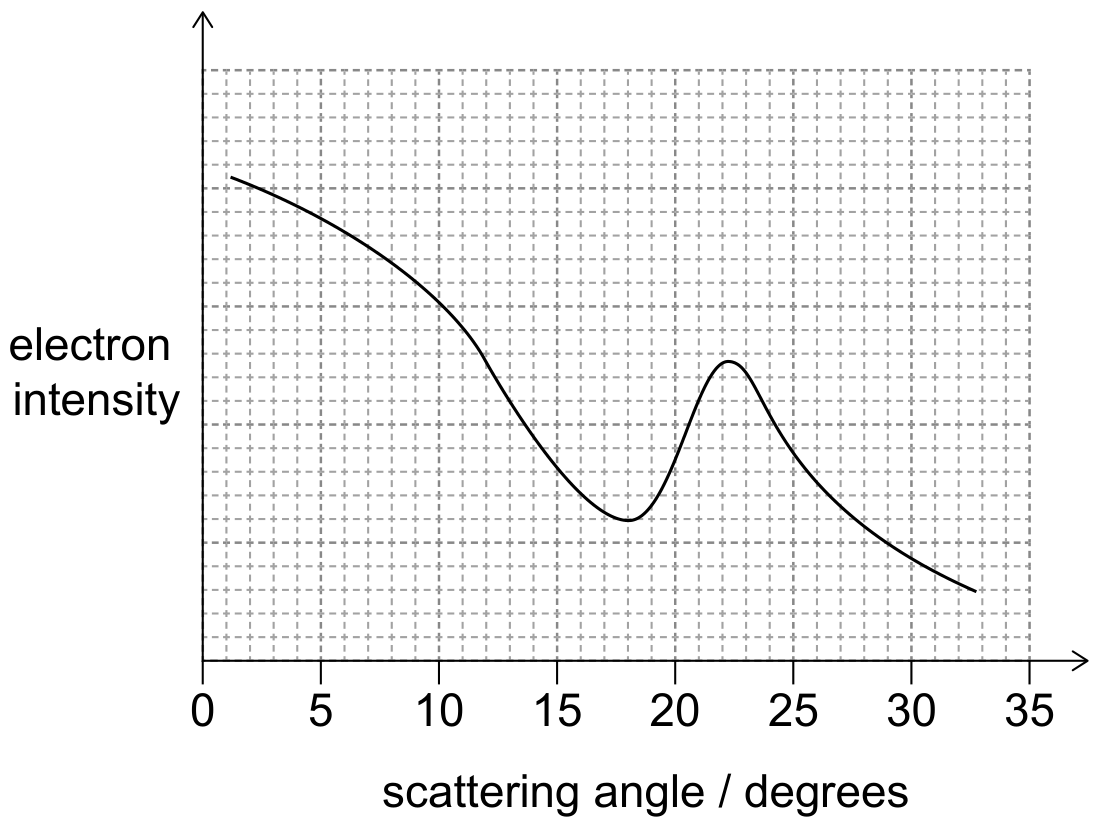
A beam of electrons each of de Broglie wavelength 2.4×10¹⁵ m2.4 \times 10^{-15} \mathrm{~m} is incident on a thin film of silicon-30 (1430Si)\left({ }_{14}^{30} \mathrm{Si}\right). The variation in the electron intensity of the beam with scattering angle is shown.
Question image
[ 1 ]

Question 2(a)(iii)

(i)

Suggest one reason why a beam of electrons is better for investigating the size of a nucleus than a beam of alpha particles of the same energy.

[ 1 ]
Question 3

Question 3(b)

(a)

Particles can be used in scattering experiments to estimate nuclear sizes.

[ 3 ]

Question 3(b)(ii)

(i)

Outline why the particles must be accelerated to high energies in scattering experiments.

[ 3 ]

Question 5

[Maximum number: 6]

This question is about the photoelectric effect.

Question 5(a)

(a)

Outline why the wave model of light cannot account for the photoelectric effect.

[ 3 ]

Question 5(b)

(b)

Monochromatic light of wavelength 420 nm is incident on a clean metal surface.

The work function of the metal is 2.6×10¹⁹ J2.6 \times 10^{-19} \mathrm{~J}.

[ 3 ]

Question 5(b)(i)

(i)

Calculate, in eV, the maximum kinetic energy of the photoelectrons emitted.

[ 3 ]

Question 28

[Maximum number: 1]

Light that is shone onto a metal surface may result in the emission of electrons from the surface. Three statements regarding the emission of the electrons are the

I. number of electrons emitted per unit time depends on the intensity of the incident light
II. energy of the electrons depends on the frequency of the incident light
III. emission of the electrons takes place instantaneously.

Which of the above statements can only be explained by assuming light consists of photons?

A

II only

B

III only

C

II and III only

D

I, II and III

Question 28

[Maximum number: 1]

When electromagnetic radiation falls on a photocell, electrons of mass mem_{e} are emitted, provided the frequency of the radiation is greater than f0f_{0}. What is the maximum speed of the electron when radiation of frequency f falls on the photocell?

A

2hfme\sqrt{\frac{2 h f}{m_{\mathrm{e}}}}

B

2h(ff0)me\sqrt{\frac{2 h\left(f-f_{0}\right)}{m_{\mathrm{e}}}}

C

hfme\sqrt{\frac{h f}{m_{\mathrm{e}}}}

D

h(ff0)me\sqrt{\frac{h\left(f-f_{0}\right)}{m_{\mathrm{e}}}}

Question 28

[Maximum number: 1]

When the cathode of a photoelectric cell is illuminated with red light, a photoelectric current is produced in the cell. The illumination is changed to blue light but the rate at which photons arrive at the cathode remains the same. Which of the following statements is/are correct under these conditions?

I. The number of electrons released is unchanged
II. The current falls to zero
III. The kinetic energy of the electron increases

A

I only

B

III only

C

I and II only

D

I and III only

Question 28

[Maximum number: 1]

Light of a particular wavelength and intensity does not cause photoelectric emission from a clean metal surface in a vacuum. Which of the following changes to the light might cause photoelectric emission?

A

Increase the intensity

B

Decrease the intensity

C

Increase the wavelength

D

Decrease the wavelength

Question 28

[Maximum number: 1]

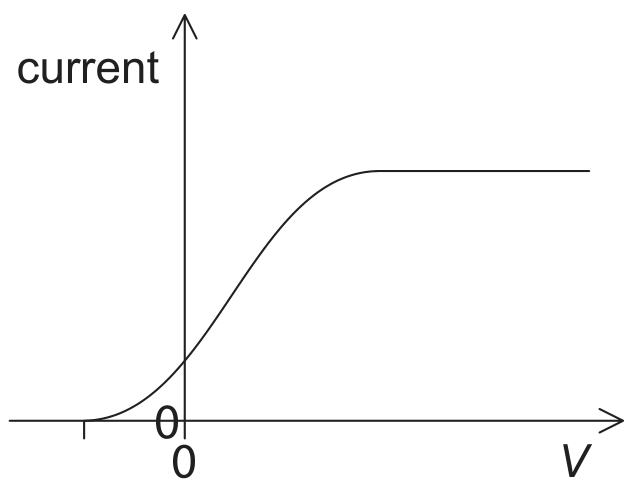
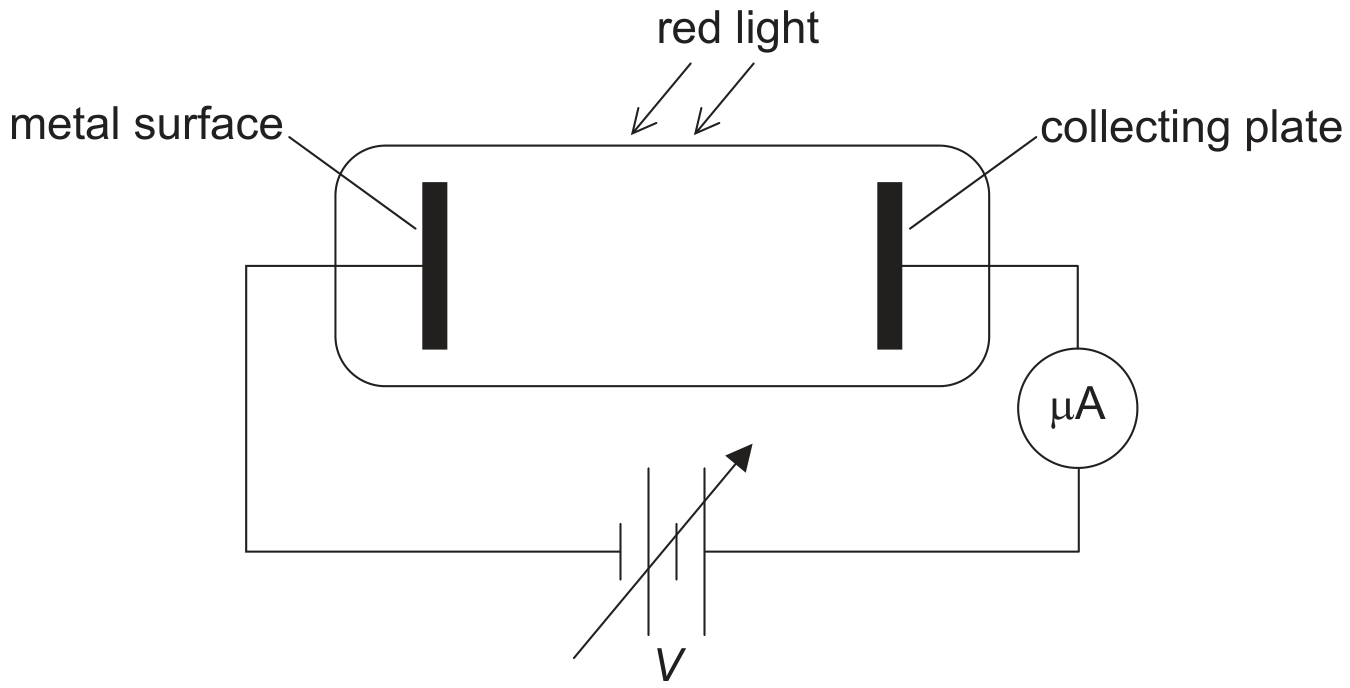
Red light incident on a metal surface produces photoelectrons.

Question image

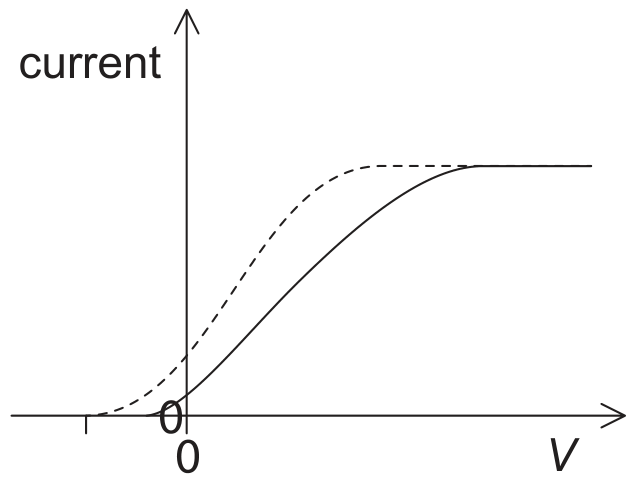
The potential V of the supply is varied and the current is measured. The results are shown on the graph.

Question image

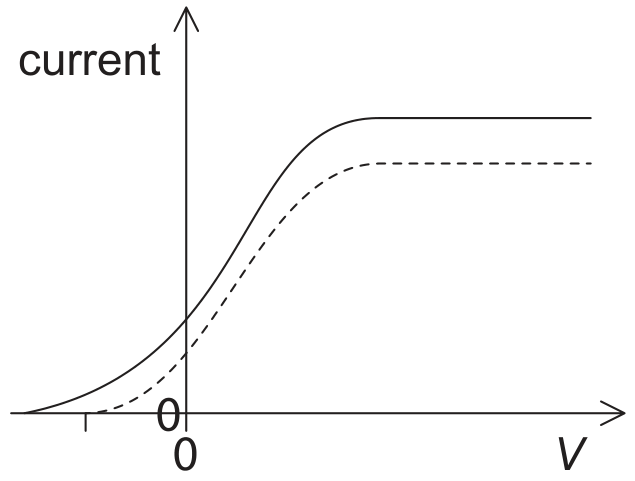
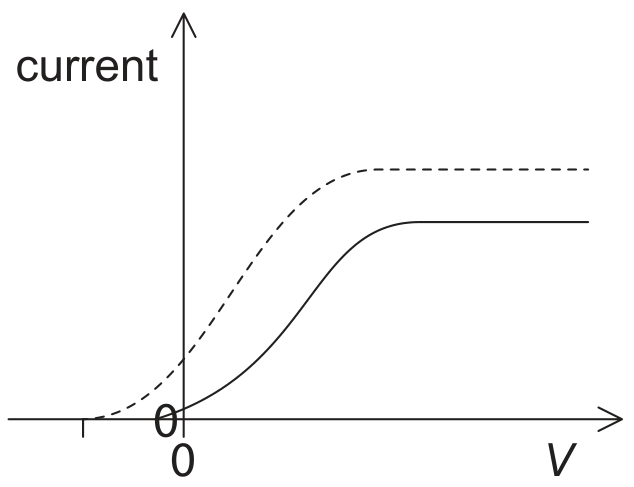
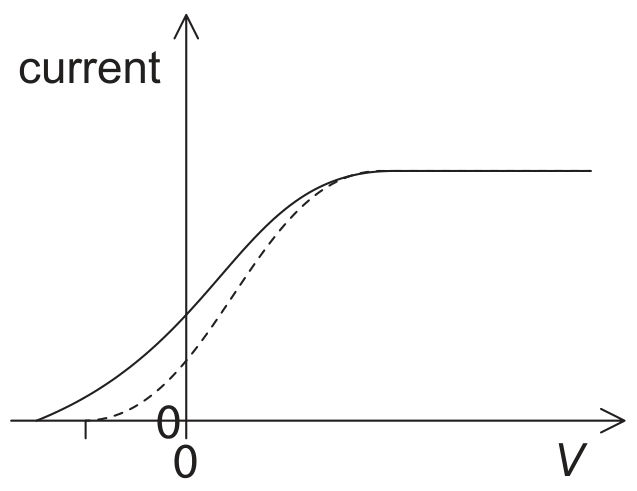
The light source is changed to blue. This blue source emits the same number of photons per second as the red source. Which graph shows the variation with potential of current for blue light? The results for the red light are shown as a dashed line.

A
Question image
B
Question image
C
Question image
D
Question image

Question 29

[Maximum number: 1]

An electron accelerated from rest through a potential difference V has de Broglie wavelength λ\lambda. What is the wavelength of an electron accelerated from rest through a potential difference of 2 V ?

A

2λ2 \lambda

B

λ2\frac{\lambda}{2}

C

2λ\sqrt{2 \lambda}

D

λ2\frac{\lambda}{\sqrt{2}}

Question 29

[Maximum number: 1]

Alpha particles of charge +2 e and mass m are accelerated from rest through a potential difference V. Planck's constant is h. Which of the following gives the de Broglie wavelength of the alpha particles as a result of the acceleration?

A

hmV\frac{h}{m V}

B

h4mVe\frac{h}{\sqrt{4 m V e}}

C

2hmVe\sqrt{2 h m V e}

D

h m V

0 selected