EduNinja

IB Physics HLC.3 Wave phenomenaQuestion Bank

Question F3

[Maximum number: 4]

This question is about an optic fibre.
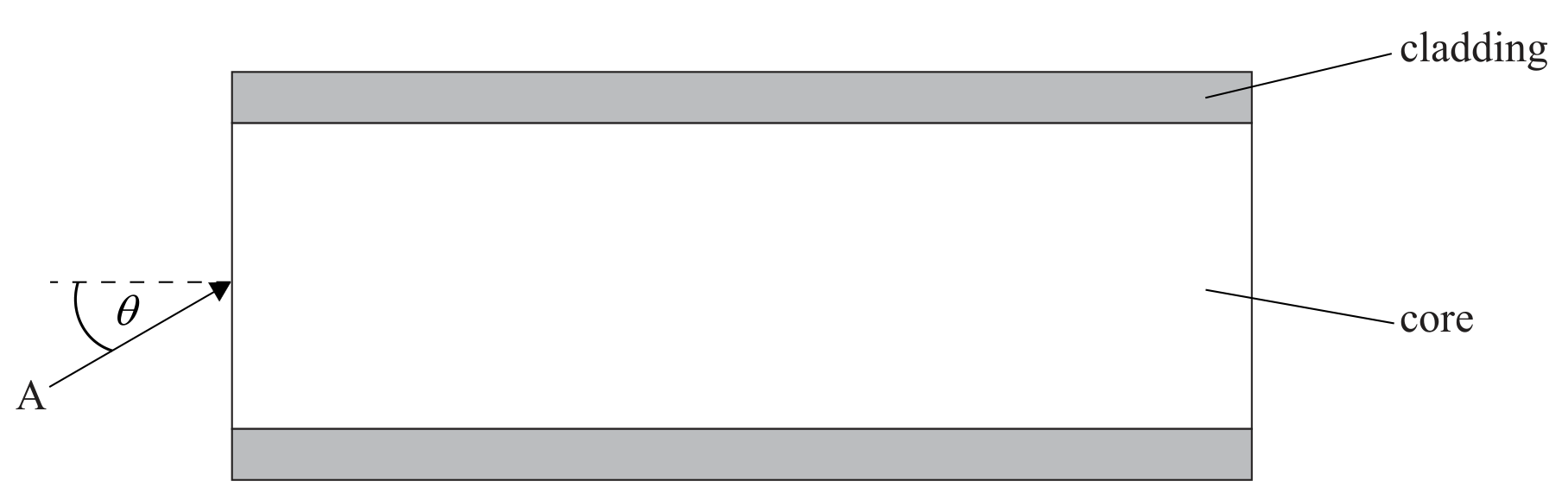
Monochromatic light enters an optic fibre, from air, along direction A that is at an angle θ\theta to the axis of the fibre.

Question image

The refractive index of the core is 1.62 and the refractive index of the cladding is 1.52 . The critical angle at the core-cladding boundary is 7070^{\circ}.
(a) Calculate the greatest angle of incidence θ\theta that can be used with this fibre.
(b) Sketch the path of the light in the core on the diagram above.
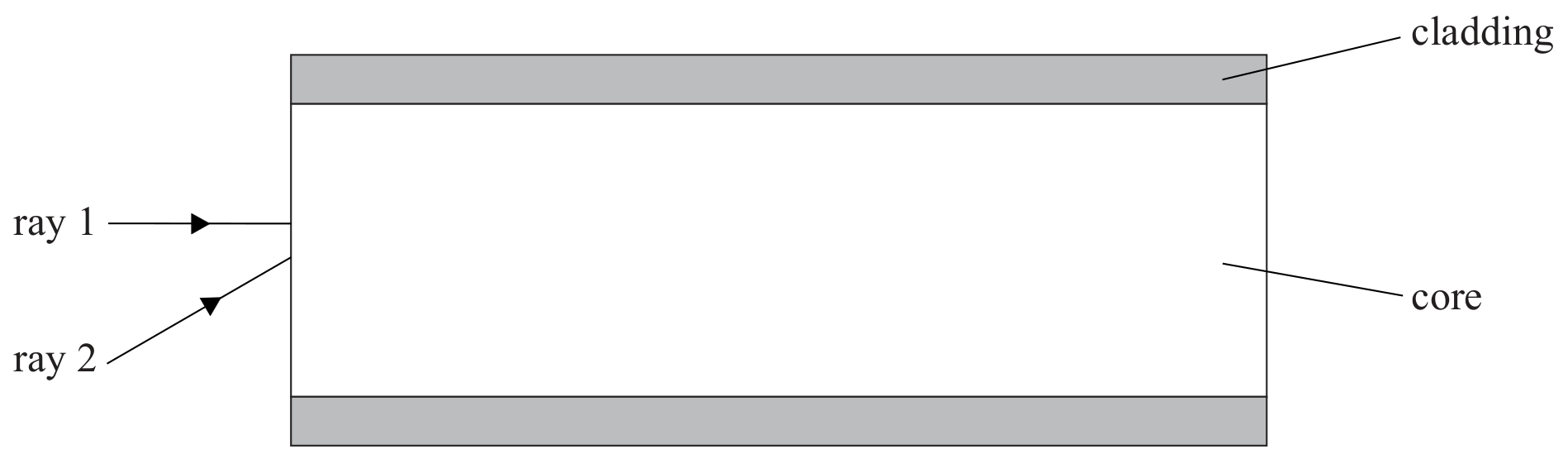
(c) Information is transmitted along the fibre in the form of pulsed light. Two rays of this light enter the core at the same instant as shown in the diagram below.
Question image

Discuss the effect of modal dispersion on the subsequent transmission of the information along the fibre.
(d) Outline two advantages in the use of optic fibres over coaxial metal cables for the transmission of data between continents.

1:

2:
Question 11

[Maximum number: 1]

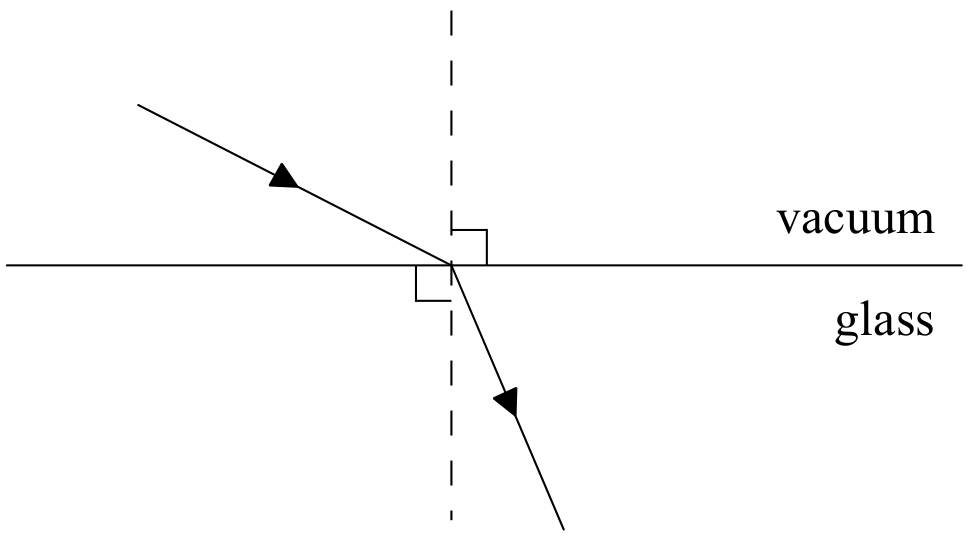
A ray of light travels from a vacuum into glass as shown below.

Question image

In glass, light has speed v. In a vacuum, light has speed c. Which of the following gives the refractive index of glass?

A

cv\frac{c}{v}

B

vc\frac{v}{c}

C

sincsinv\frac{\sin c}{\sin v}

D

sinvsinc\frac{\sin v}{\sin c}

Question 2

[Maximum number: 12]

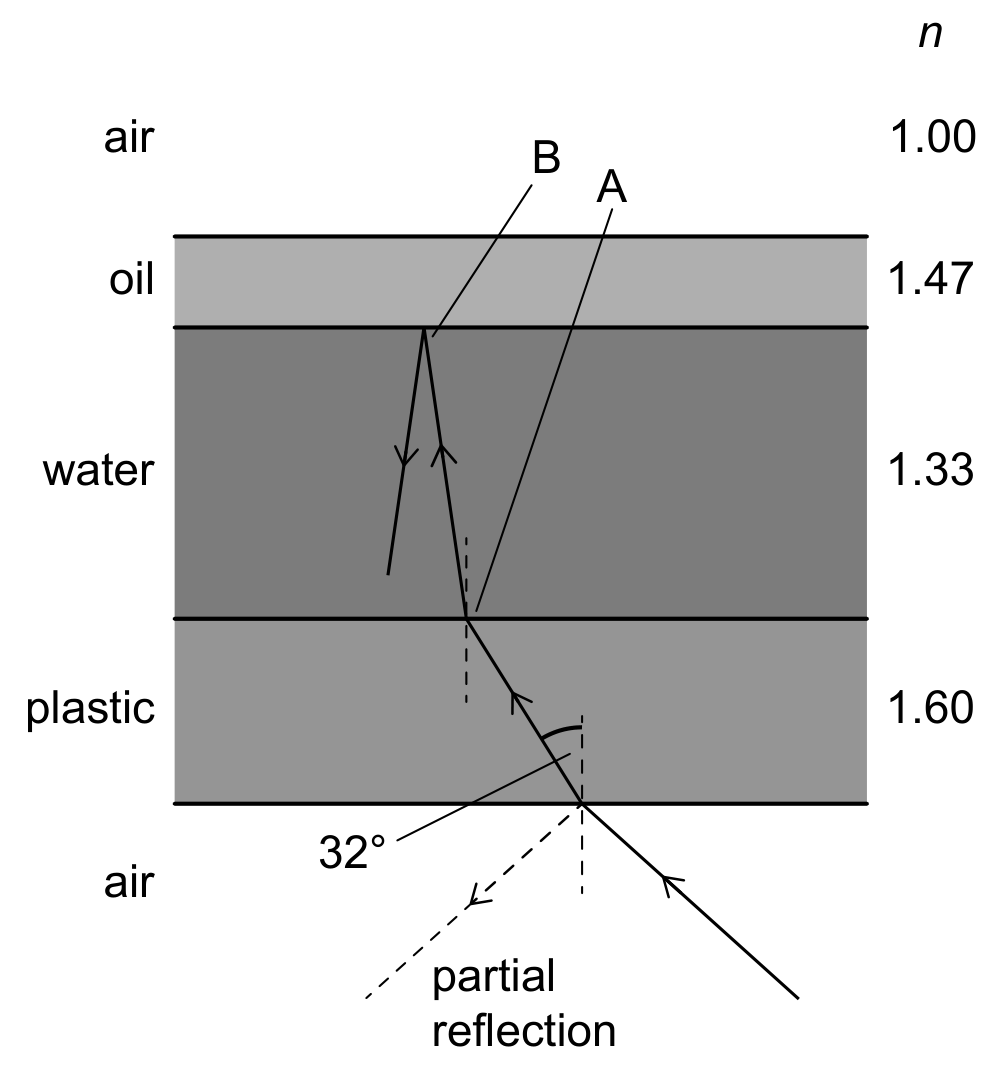
Monochromatic light enters the base of a plastic beaker that contains water with an oil layer floating on it. A student draws a diagram to show the directions the light takes as it passes through the layers. The student's diagram has one error at position A and one error at position B. The refractive indices of the materials are shown on the diagram.

Question image

The light is refracted at an angle of 3232^{\circ} when it enters the plastic layer as shown.

Question 2(a)

(a)

Identify, with a reason, the error in the student's diagram for

[ 4 ]

Question 2(a)(i)

(i)

light crossing the plastic-water interface (position A).

[ 2 ]

Question 2(a)(ii)

(ii)

light at the water-oil interface (position B).

[ 2 ]

Question 2(b)

(b)

Calculate the angle of incidence at the air-plastic interface.

[ 2 ]

Question 2(c)

(c)

Calculate the critical angle for the plastic-water interface.

[ 2 ]

Question 2(e)

(d)

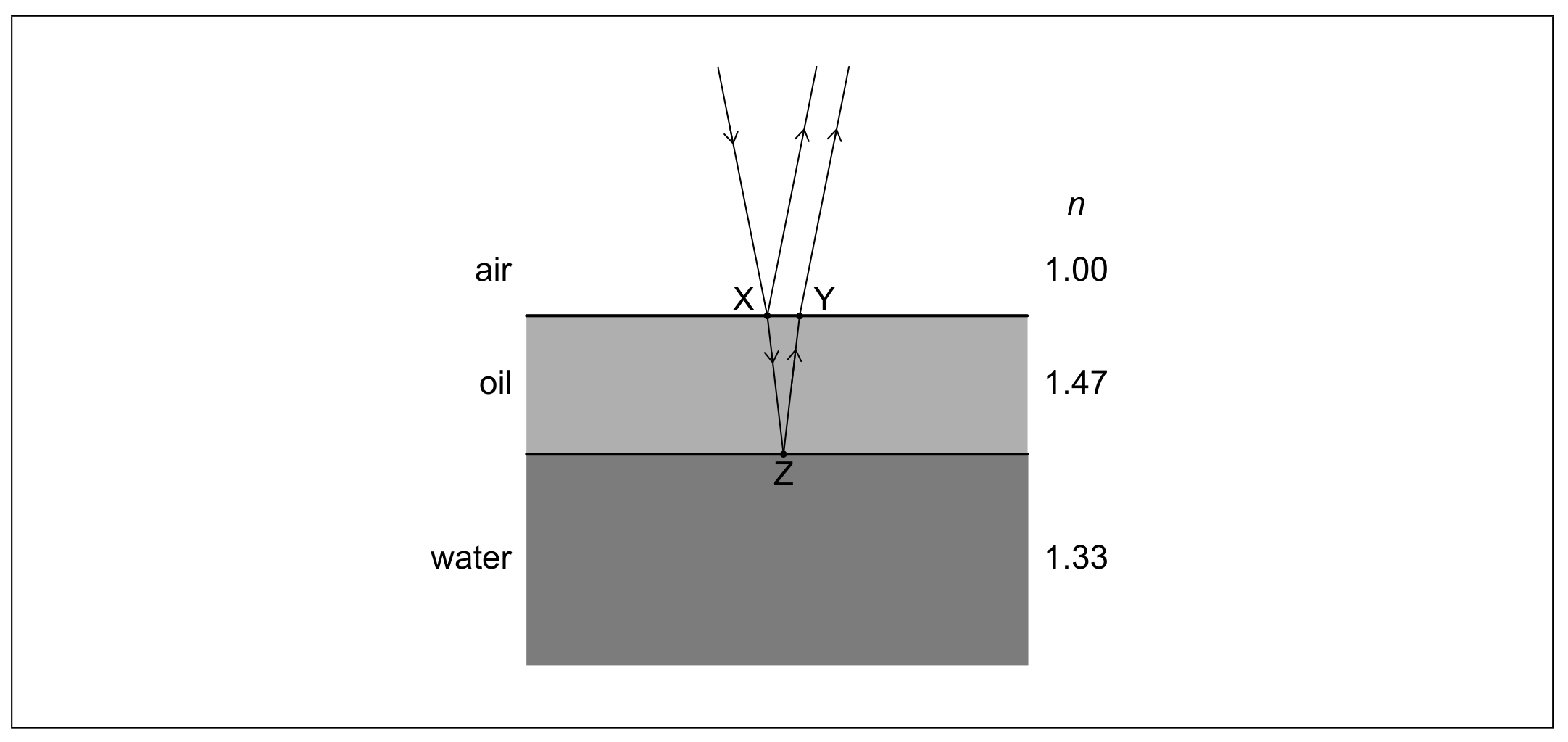
Monochromatic light of wavelength 6.3×10⁷ m6.3 \times 10^{-7} \mathrm{~m} in air is incident from above at a normal to the oil layer. Rays on the diagram are shown at near-normal incidence for clarity. Three positions X, Y and Z are shown on the diagram.

Question image
[ 4 ]

Question 2(e)(i)

(i)

Identify, with a reason, a position at which there is a phase change of 180180^{\circ}.

[ 1 ]

Question 2(e)(ii)

(ii)

Determine the minimum thickness of the oil layer for which light is not reflected. State your answer to an appropriate number of significant figures.

[ 3 ]

Question 2

[Maximum number: 2]

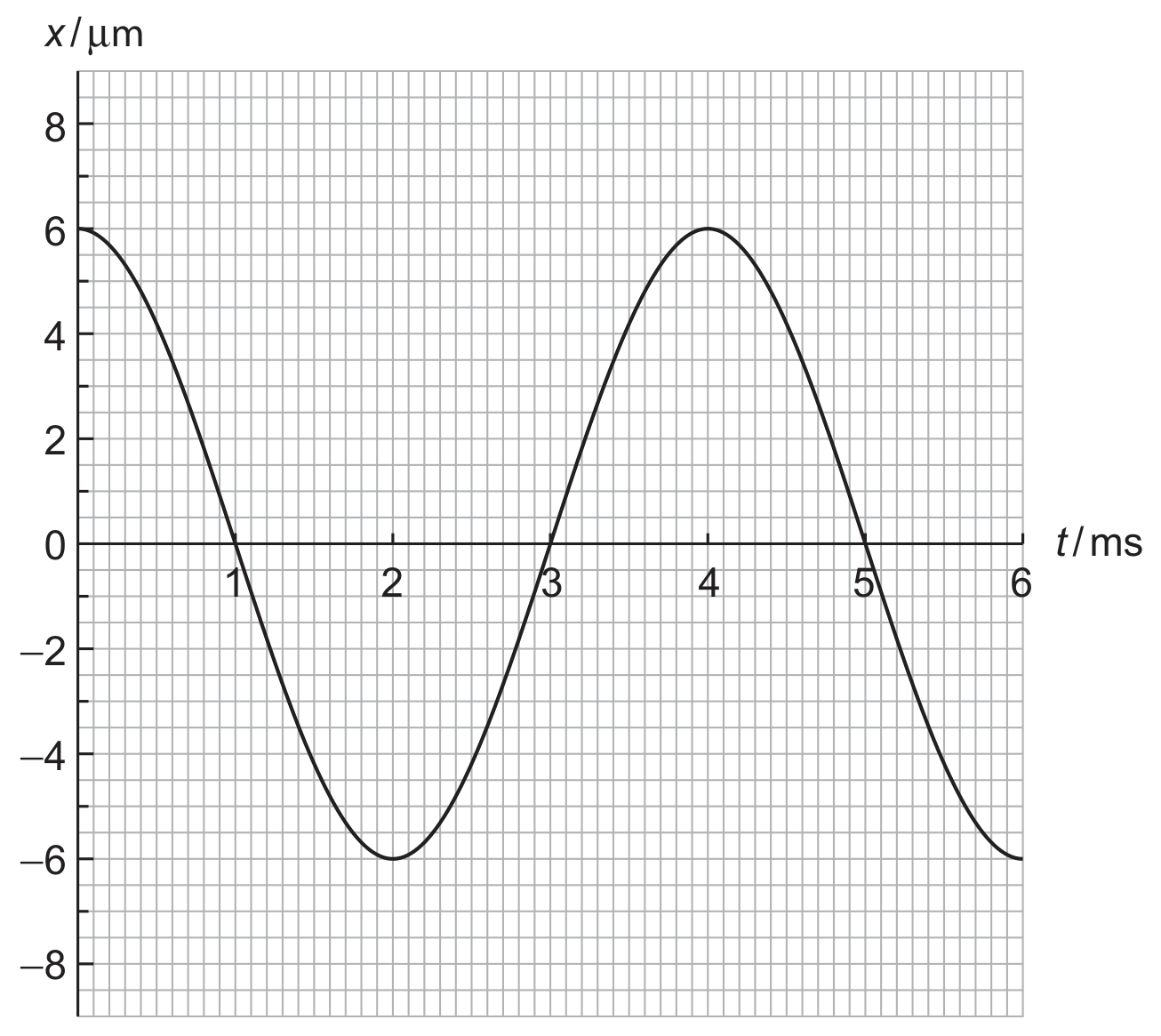
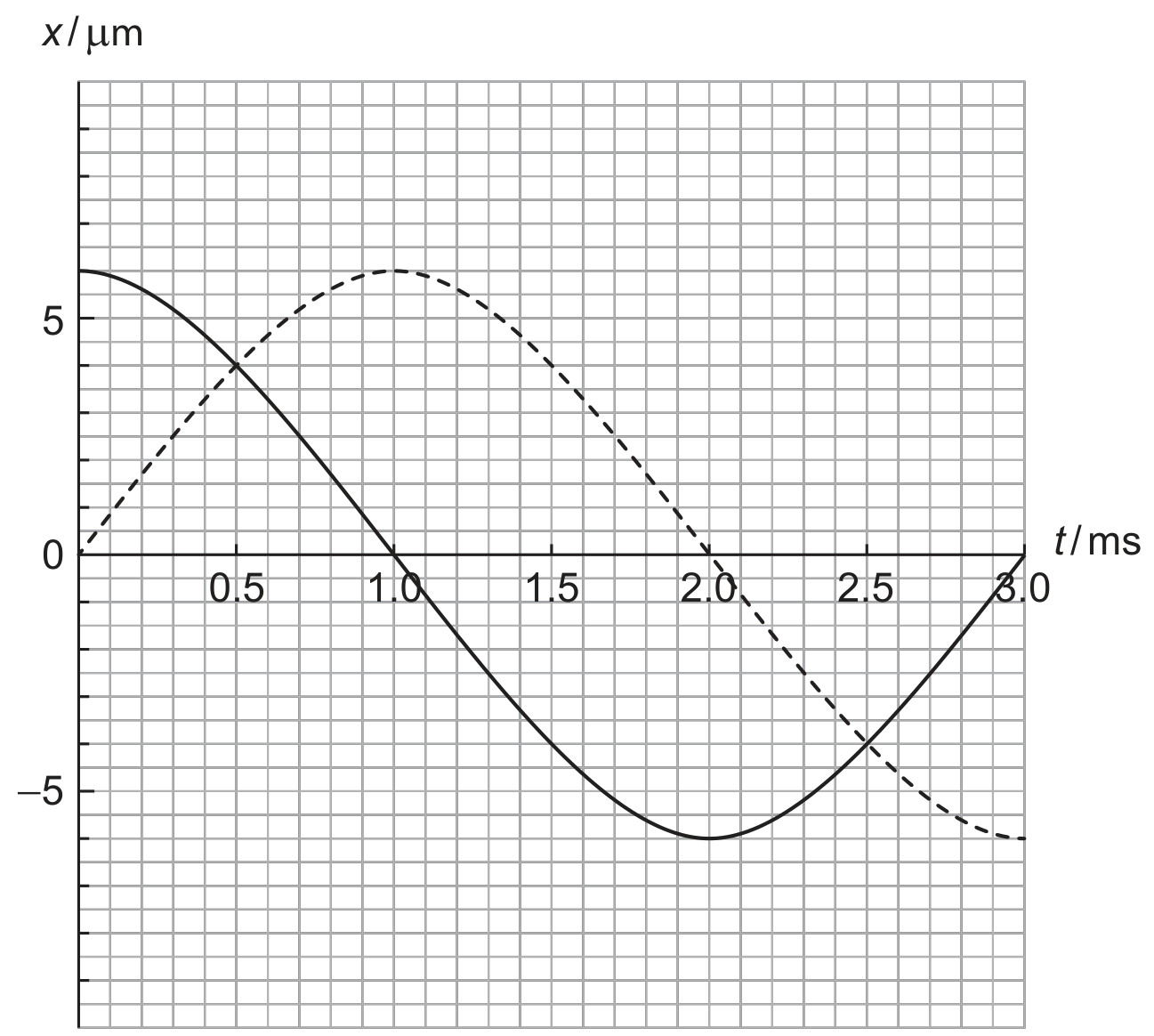
A longitudinal wave travels in a medium with speed 340 ms1340 \mathrm{~ms}^{-1}. The graph shows the variation with time t of the displacement x of a particle P in the medium. Positive displacements on the graph correspond to displacements to the right for particle P .

Question image

Question 2(c)

(a)

Another wave travels in the medium. The graph shows the variation with time t of the displacement of each wave at the position of P.

Question image
[ 2 ]

Question 2(c)(i)

(i)

State the phase difference between the two waves.

[ 1 ]

Question 2(c)(iii)

(ii)

Estimate the amplitude of the resultant wave.

[ 1 ]

Question G2

[Maximum number: 7]

G2. This question is about laser light.
(a) Laser light is monochromatic and coherent. Explain what is meant by
(i) monochromatic.
(ii) coherent.
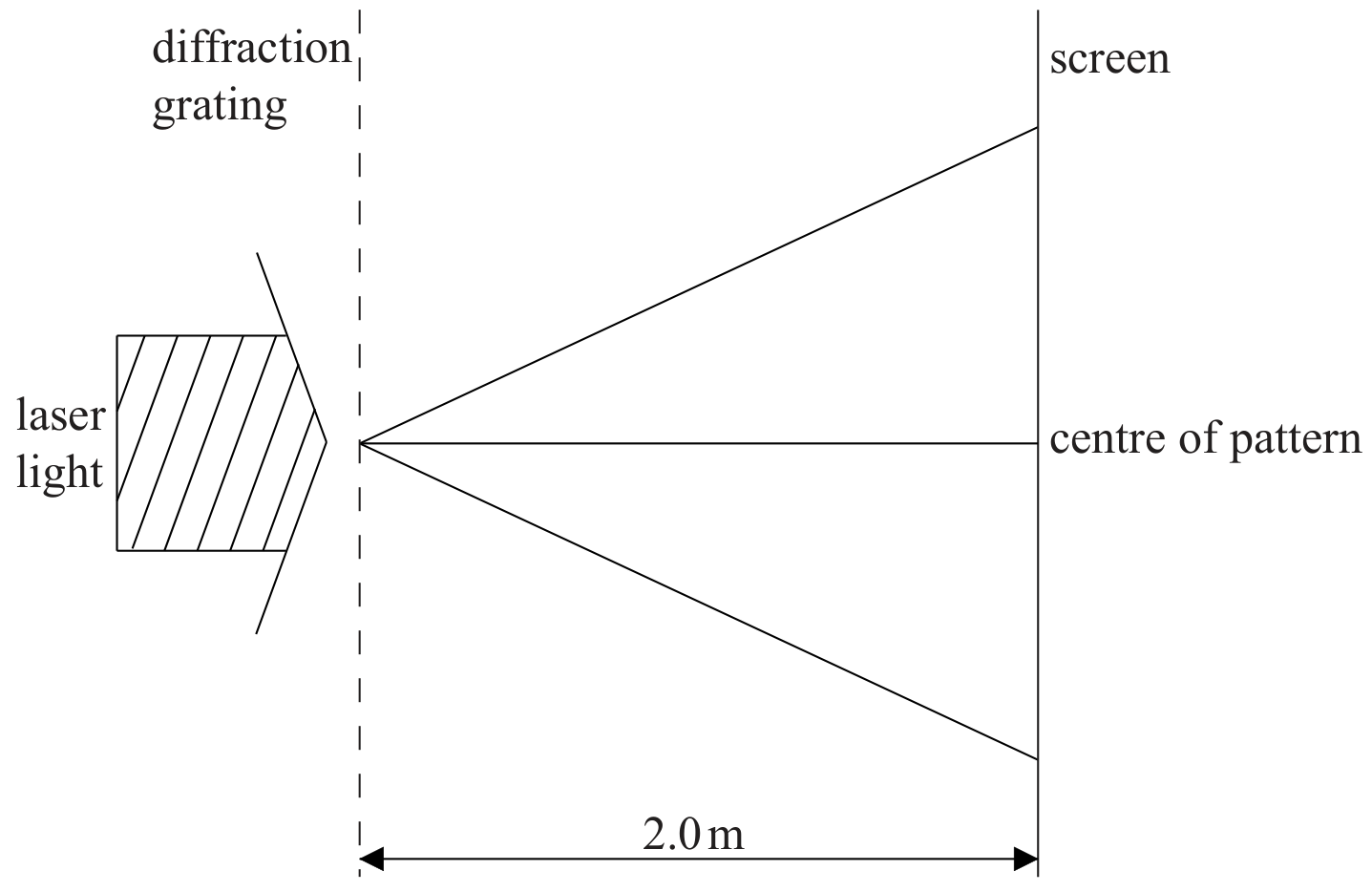
(b) A beam of laser light is incident normally on a diffraction grating which has 600 lines per millimetre. A fringe pattern is formed on a screen 2.0 m from the diffraction grating.

Question image

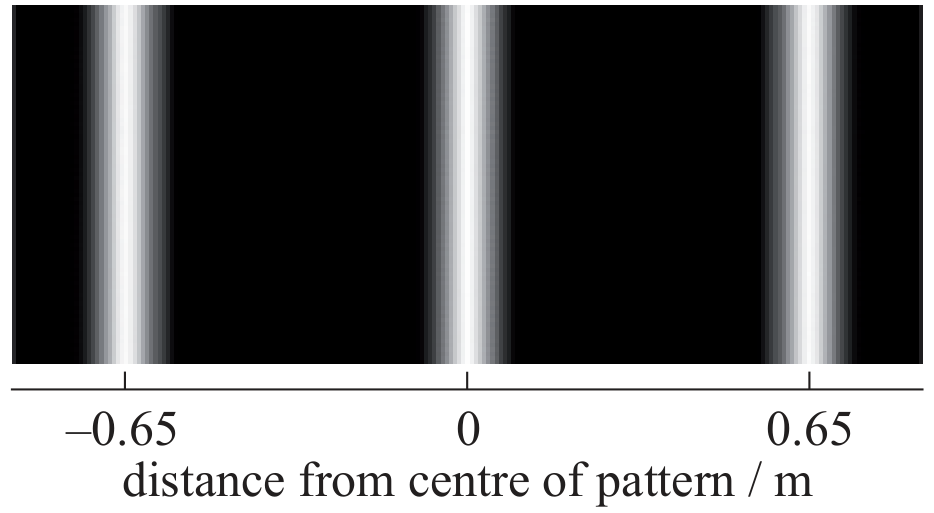
The fringe pattern formed on the screen is shown below.

Question image

Determine the wavelength of the laser light.

Question 12

[Maximum number: 1]

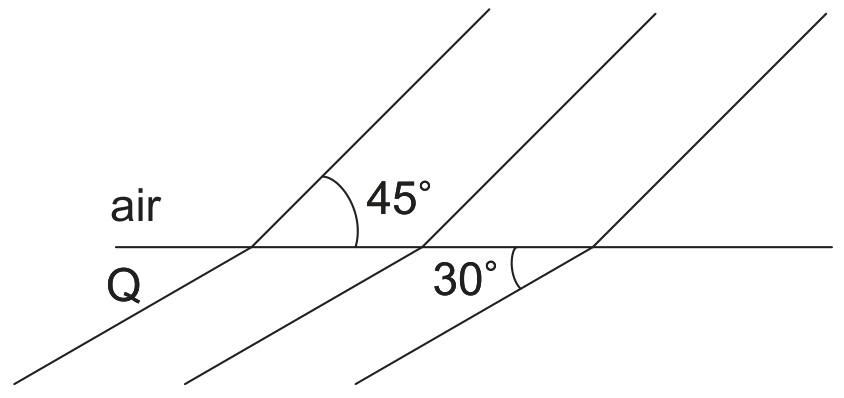
Wavefronts travel from air to medium Q as shown.

Question image

What is the refractive index of Q ?

A

sin30sin45\frac{\sin 30^{\circ}}{\sin 45^{\circ}}

B

sin45sin30\frac{\sin 45^{\circ}}{\sin 30^{\circ}}

C

sin45sin60\frac{\sin 45^{\circ}}{\sin 60^{\circ}}

D

sin60sin45\frac{\sin 60^{\circ}}{\sin 45^{\circ}}

Question 12

[Maximum number: 1]

What are the changes in the speed and in the wavelength of monochromatic light when the light passes from water to air?

Change in speed

Change in wavelength

increases

increases

increases

decreases

decreases

increases

decreases

decreases

Question 12

[Maximum number: 1]

X and Y are two sources of waves with identical amplitudes and frequencies. Waves from X and Y interfere constructively at a detector after travelling the same distance from source to detector.

At the detector, the ratio  intensity of the resultant of the two waves  intensity of one wave alone \frac{\text { intensity of the resultant of the two waves }}{\text { intensity of one wave alone }} is

A

12\frac{1}{2}.

B

1 .

C

2.

D

4 .

Question 3

[Maximum number: 9]

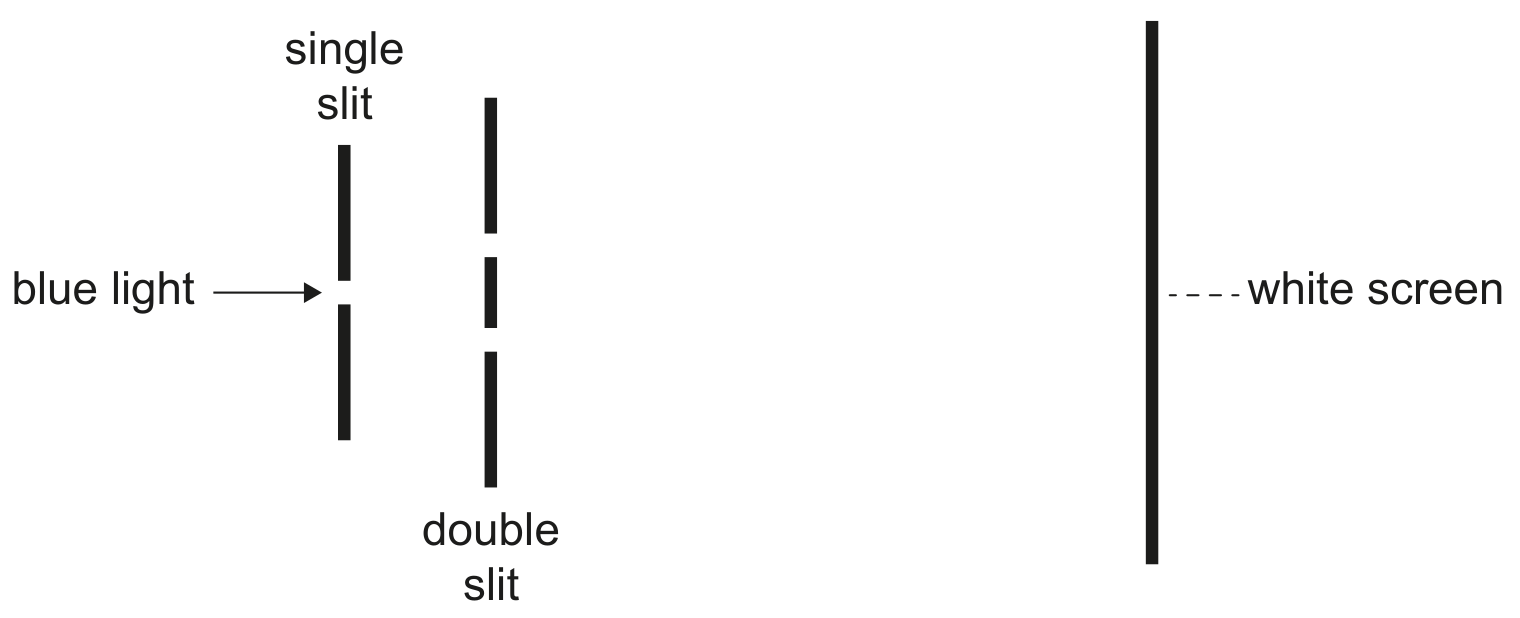
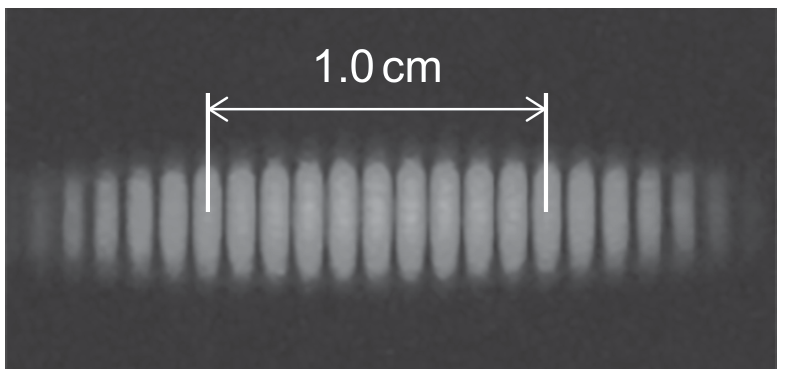
Blue light of wavelength λ\lambda is incident on a double slit. Light from the double slit falls on a screen. A student measures the distance between nine successive fringes on the screen to be 15 cm .

The separation of the double slit is 60μ m60 \mu \mathrm{~m}; the double slit is 2.5 m from the screen.

Question image

Question 3(a)

(a)

Explain the pattern seen on the screen.

[ 3 ]

Question 3(b)

Question 3(b)(i)

(b)
(i)

Calculate, in nm,λ\mathrm{nm}, \lambda.

[ 3 ]

Question 3(c)

(c)

The student changes the light source to one that emits two colours:
- blue light of wavelength λ\lambda, and
- red light of wavelength 1.5λ1.5 \lambda.

Predict the pattern that the student will see on the screen.

[ 3 ]

Question 13

[Maximum number: 1]

The diagram shows an interference pattern observed on a screen in a double-slit experiment with monochromatic light of wavelength 600 nm . The screen is 1.0 m from the slits.

Question image

What is the separation of the slits?

A

6.0×10⁷ m6.0 \times 10^{-7} \mathrm{~m}

B

6.0×10⁶ m6.0 \times 10^{-6} \mathrm{~m}

C

6.0×10⁵ m6.0 \times 10^{-5} \mathrm{~m}

D

6.0×10⁴ m6.0 \times 10^{-4} \mathrm{~m}

0 selected