EduNinja

IB Physics HLA.5 Galilean and special relativityQuestion Bank

Question 2

[Maximum number: 3]

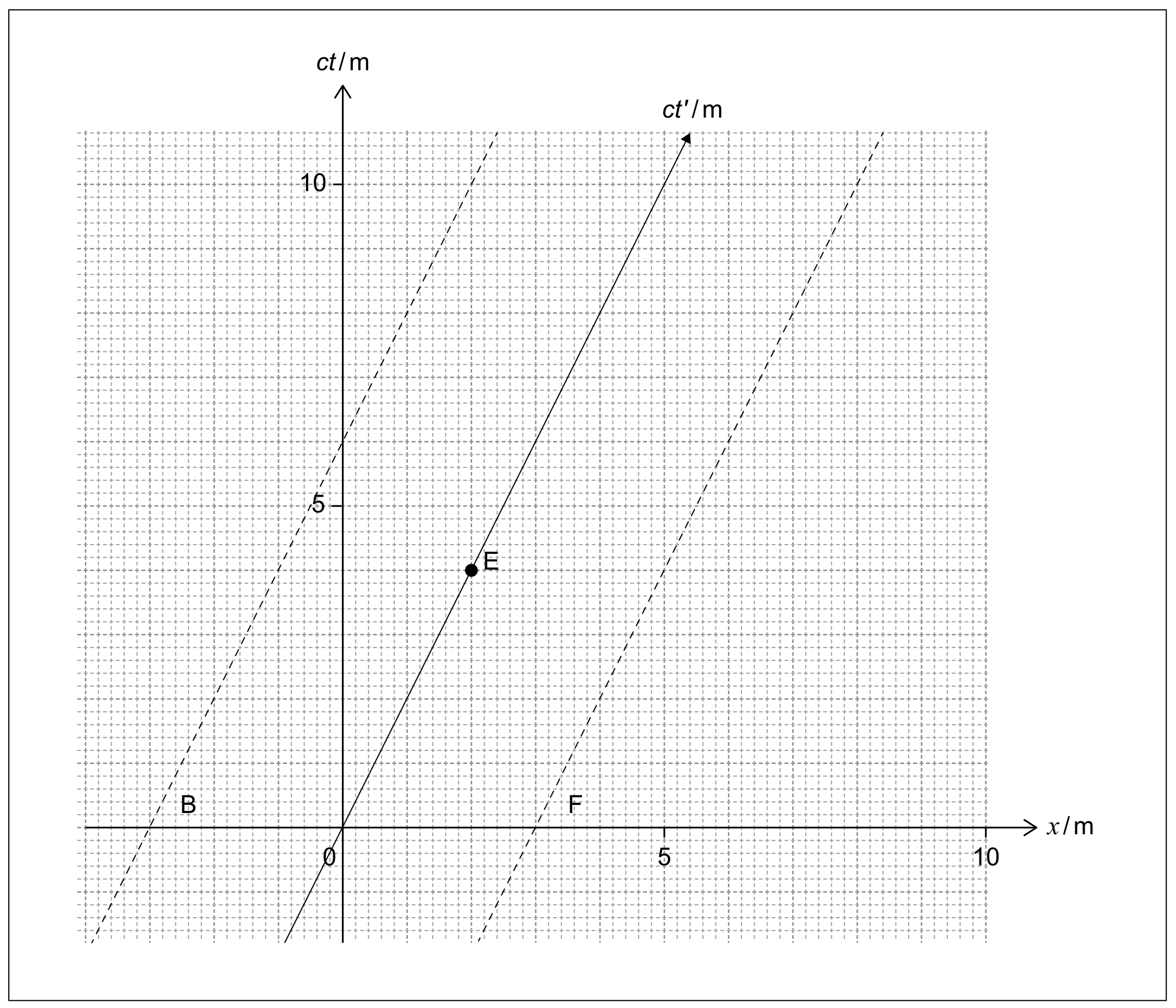
The spacetime diagram shows the x, ct axes for an observer on the ground. The ctc t^{\prime} axis for a passenger on a train moving relative to the observer and world lines for the back ( B ) and front (F) of the moving train are also shown. The observer on the ground and the passenger are opposite each other at the origin of the spacetime diagram.

The train is travelling at 0.5 c.
Question image

Event E is the lighting of a match by the passenger in the train, with coordinates x=2 mx=2 \mathrm{~m} and ct=4 mc t=4 \mathrm{~m}. The light from the match reaches two mirrors at the back and front of the train.

Question 2(b)

(a)

Draw, on the graph, the path of the light emitted from the match to show the events where the light strikes both mirrors. Label the events TBT_{B} and TFT_{F}.

[ 1 ]

Question 2(c)

(b)

Explain, with reference to TBT_{B} and TFT_{F}, which person concludes that the light reached both mirrors simultaneously.
[ 2 ]

Question 8

[Maximum number: 1]

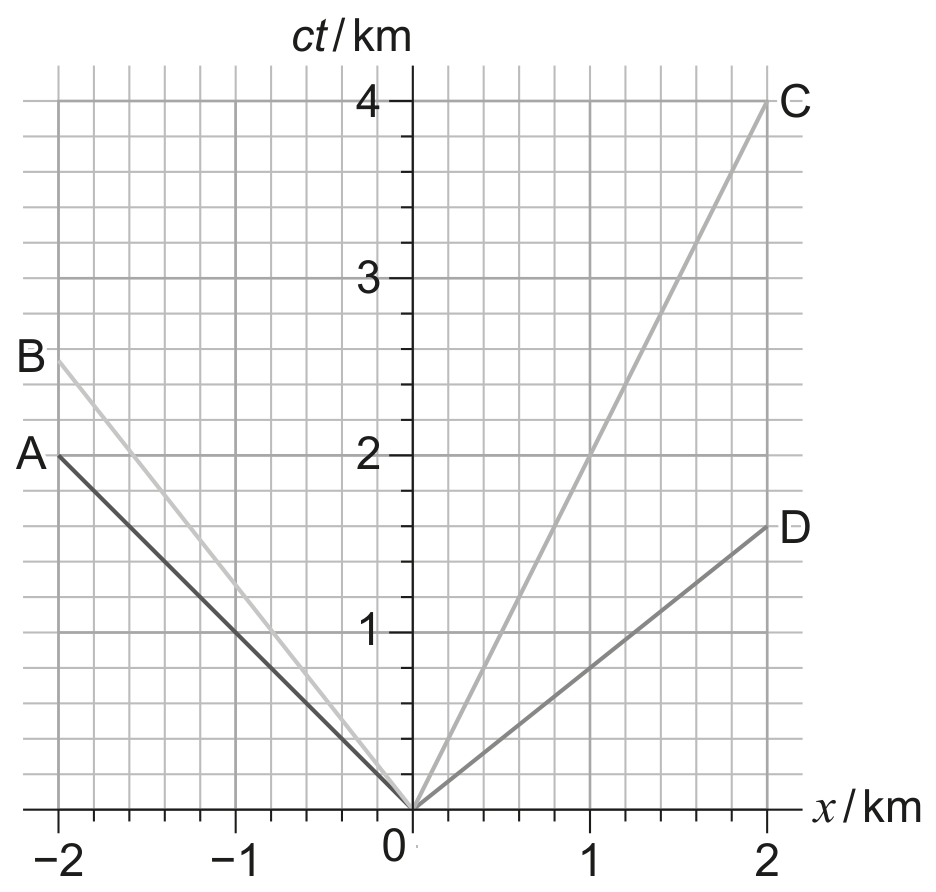
Rocket R travels away from an observer on Earth at a speed of 0.80 c . A space-time diagram shows four world lines.

What is the correct world line of R in the reference frame of Earth?

Question image

Question 8

[Maximum number: 1]

A muon of proper lifetime t is produced in the high atmosphere and travels towards Earth at a relativistic speed v. What is the distance travelled by the muon in the reference frame of Earth?

A

v t

B

vt(1v2c2)v t\left(1-\frac{v^{2}}{c^{2}}\right)

C

vt1v2c2v t \sqrt{1-\frac{v^{2}}{c^{2}}}

D

vt1v2c2\frac{v t}{\sqrt{1-\frac{v^{2}}{c^{2}}}}

Question 9

[Maximum number: 1]

Observer X sees a spacecraft moving in the positive x-direction at a speed of 0.50 c. Observer Y sees the same spacecraft moving in the negative x-direction at a speed of 0.50 c. What is the speed of Y in the frame of reference of X ?

A

0

B

0.80 c

C

c

D

1.3 c

Question 9

[Maximum number: 1]

A pendulum has a period of 3.0 s as measured in its inertial frame of reference. An observer is moving with a speed of 0.80 c with respect to the pendulum's frame.

What is the period of the pendulum measured by the observer?

A

8.3 s8.3 \mathrm{~s}

B

5.0 s5.0 \mathrm{~s}

C

1.8 s

D

1.1 s1.1 \mathrm{~s}

Question 9

[Maximum number: 1]

The fixed distance between Earth and a star measured in Earth's reference frame is dEd_{E}. A spaceship travels from Earth to the star at a constant speed of 0.8c relative to Earth. The distance between Earth and the star as measured by the spaceship is dsd_{s}.

What is dsdE\frac{d_{s}}{d_{E}} ?

A

35\frac{3}{5}

B

45\frac{4}{5}

C

54\frac{5}{4}

D

53\frac{5}{3}

Question 9

[Maximum number: 1]

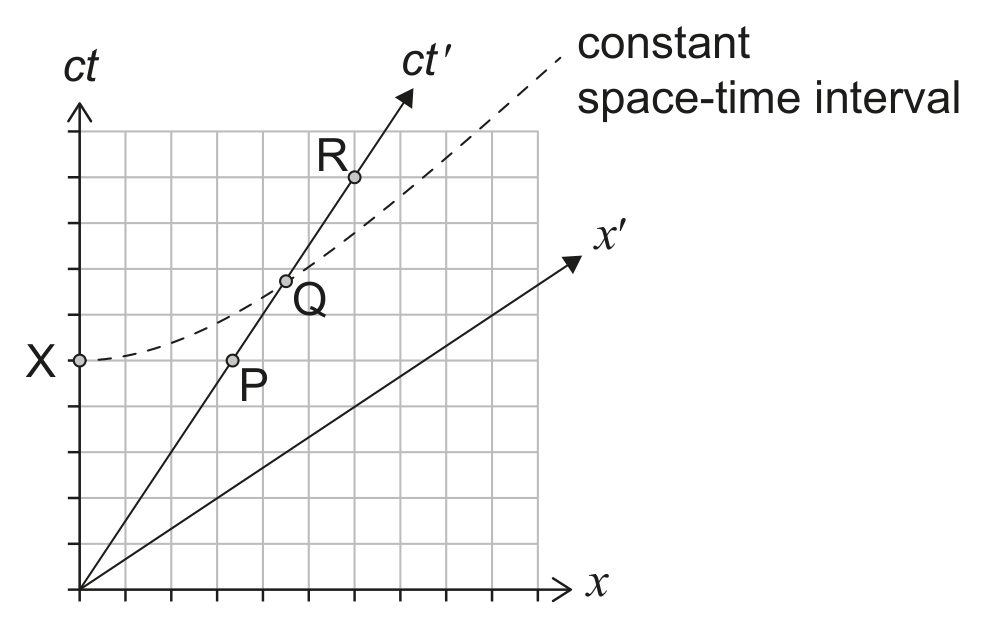
The space-time diagram shows coordinate axes of inertial reference frames S(x, c t) and S(x,ct)\mathrm{S}^{\prime}\left(x^{\prime}, c t^{\prime}\right). Event X occurs at t=1 st=1 \mathrm{~s} according to the S reference frame. A line of constant space-time interval is drawn through X .

Question image

In the SS^{\prime} reference frame, which event is simultaneous with X and which event has the time coordinate t=1 st^{\prime}=1 \mathrm{~s} ?

Simultaneous with X
in the S\mathrm{S}^{\prime} frame

t=1s\boldsymbol{t}^{\boldsymbol{\prime}}=\mathbf{1} \mathrm{s} in the S'frame

P

R

Q

R

R

P

R

Q

Question 3

[Maximum number: 4]

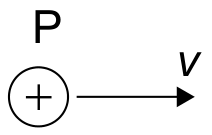
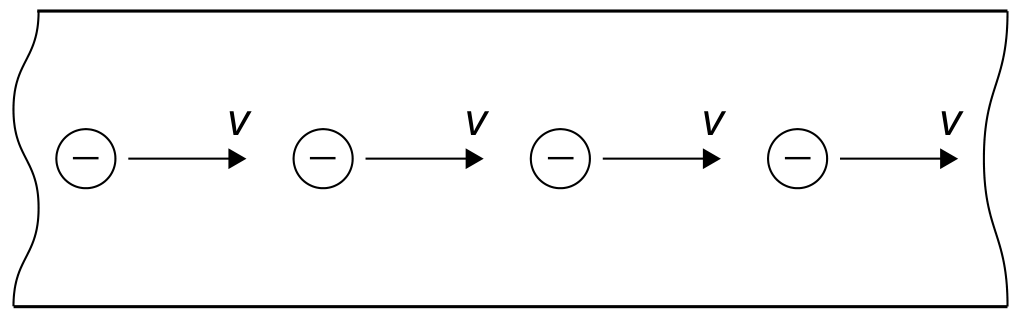
A long current-carrying wire is at rest in the reference frame S of the laboratory. A positively charged particle P outside the wire moves with velocity v relative to S . The electrons making up the current in the wire move with the same velocity v relative to S .

Question image
current-carrying wire

current-carrying wire

Question 3(a)

(a)

State what is meant by a reference frame.

[ 1 ]

Question 3(b)

(b)

State and explain whether the force experienced by P is magnetic, electric or both

[ 3 ]

Question 3(b)(ii)

(i)

in the rest frame of P .

[ 3 ]

Question H1

[Maximum number: 4]

H1. This question is about relativistic kinematics.

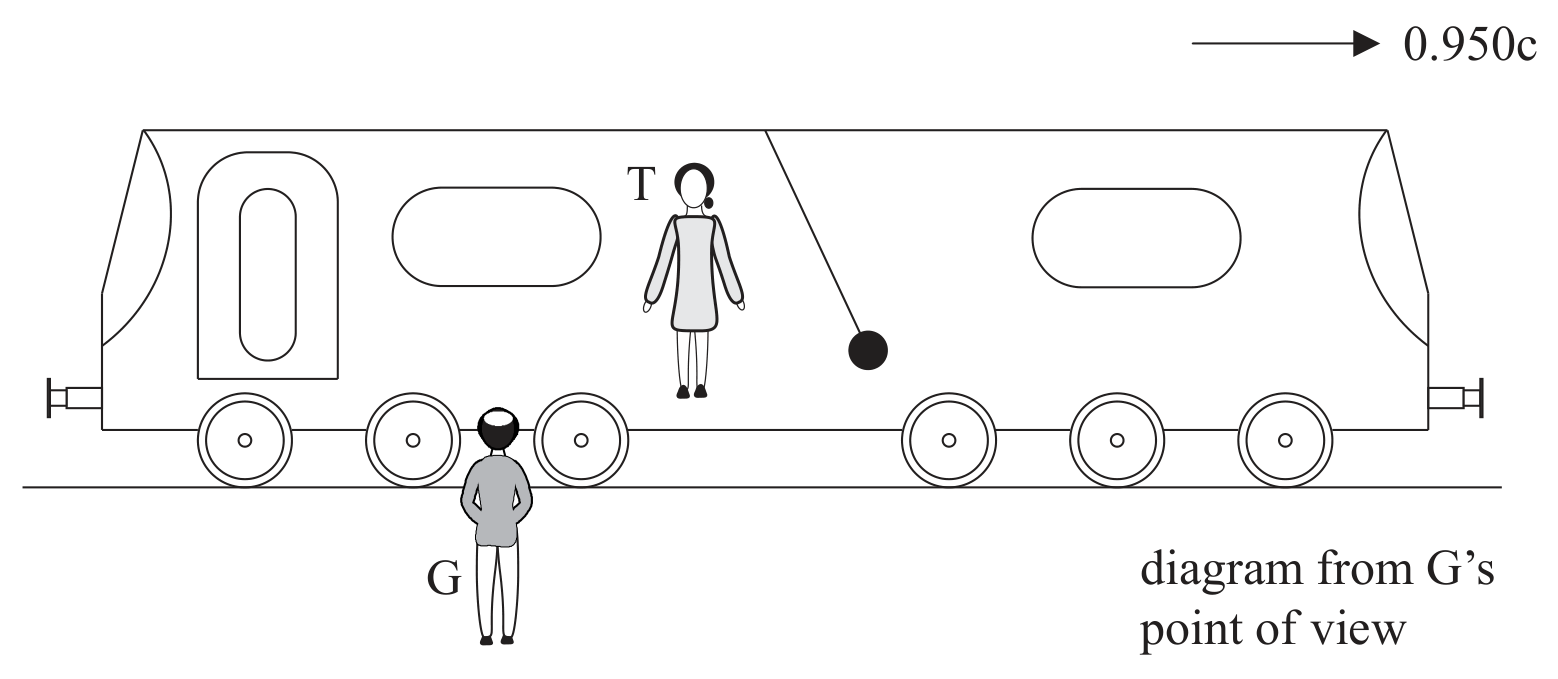
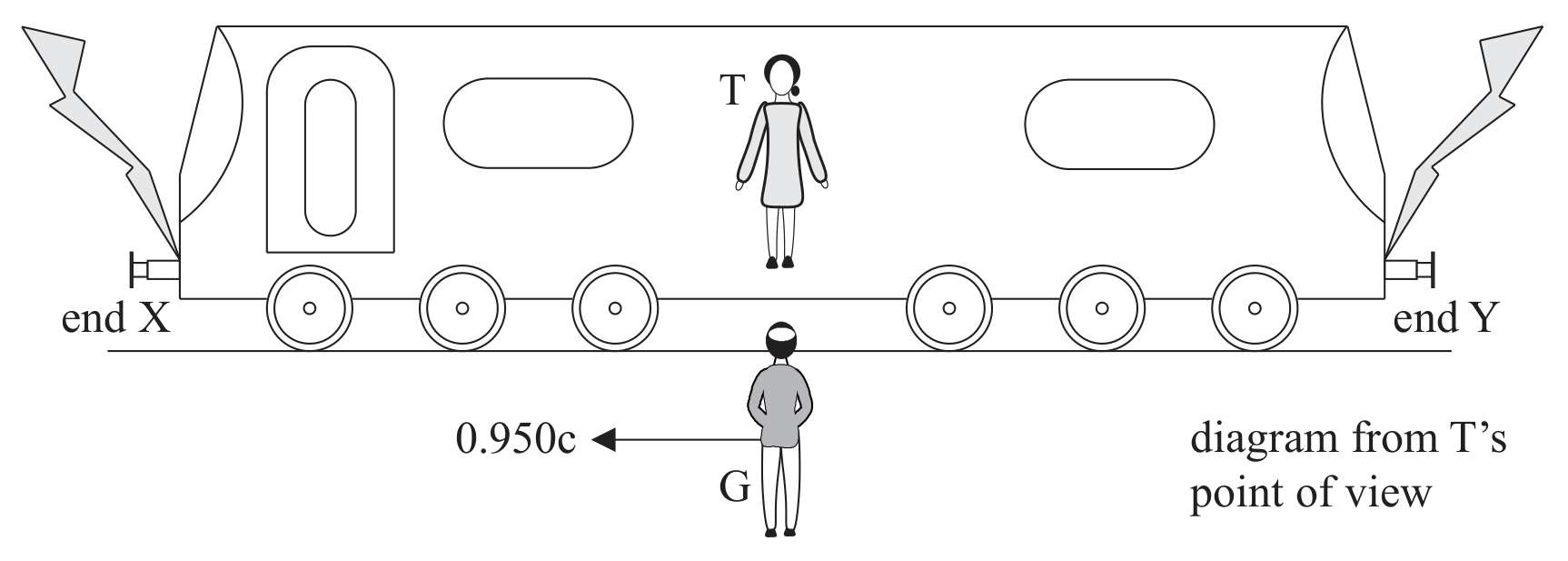
In a thought experiment, a train is moving at a speed of 0.950 c relative to the ground. A pendulum attached to the ceiling of the train is set into oscillation.

Question image

An observer T on the train and an observer G on the ground measure the period of oscillation of the pendulum.
(a) State and explain whether the pendulum period is a proper time interval for observer T , observer G or both T and G.
(b) Observer T measures the period of oscillations of the pendulum to be 0.850 s . Calculate the period of oscillations according to observer G.
(c) Observer T is standing in the middle of the train. Two lightning strikes hit the ends of the train. The strikes are simultaneous according to observer T.

Question image

Light from the strikes reaches both observers.
(i) Explain why, according to observer G, light from the two strikes reaches observer T at the same time.

(ii) Using your answer to (i), explain why, according to observer G , end X of the train was hit by lightning first.
(d) The lightning strikes in (c) make marks on both the train and the ground. The proper length of the train is 160 m .

Determine, according to observer G , the distance between the marks made
(i) on the train.
(ii) on the ground.
(e) Observer G sees a second train moving towards the first train (i.e. towards the left) at a speed of 0.950 c with respect to the ground. Calculate the relative speed of the trains.

Question 3

[Maximum number: 3]

Two muons are moving parallel to each other with the same velocity relative to the ground.

Question image

In the frame of reference in which the muons are at rest, the force between them is a repulsive electric force.

Question 3(b)

(a)

In muon decay experiments, muons produced high in the Earth's atmosphere move towards the ground at speeds close to the speed of light. Detectors on the ground record the arrival of muons. Outline how these experiments provide support for time dilation.

[ 3 ]
0 selected