EduNinja

IB Physics HLE.3 Radioactive decayQuestion Bank

Question A2

[Maximum number: 7]

A2. This question is about radioactive decay.
(a) Describe the phenomenon of natural radioactive decay.
(b) A nucleus of americium-241 (Am-241) decays into a nucleus of neptunium-237 (Np-237) in the following reaction.

95241AmX237 Np+24α{ }_{95}^{241} \mathrm{Am} \rightarrow{ }_{X}^{237} \mathrm{~Np}+{ }_{2}^{4} \alpha

(i) State the value of X.
p
(ii) Explain in terms of mass why energy is released in the reaction in (b).
(iii) Define binding energy of a nucleus.
(iv) The following data are available.
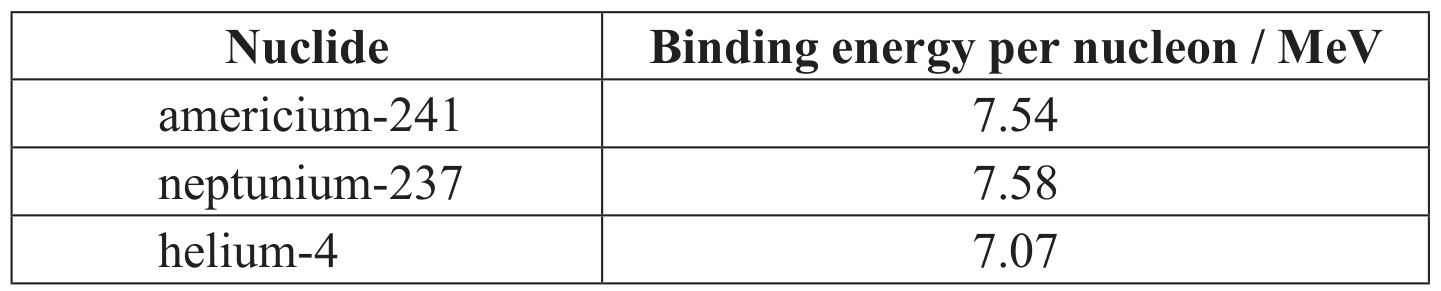
Table

Determine the energy released in the reaction in (b).
Question 13

[Maximum number: 7]

This question is about the use of radioactive isotopes in medicine.

Question 13(a)

(a)

Distinguish between the biological half-life and effective half-life of a radioactive isotope.

[ 2 ]

Question 13(b)

(b)

The radioactive isotope iodine-131 undergoes beta decay to the stable isotope xenon-131 with a physical half-life of 8.0 days. Gamma radiation is also emitted in this decay. Iodine-131 is readily absorbed by the thyroid gland. The biological half-life is 21 days.

[ 2 ]

Question 13(b)(i)

(i)

Calculate the effective half-life of iodine-131.

[ 2 ]

Question 13(c)

(c)

Iodine-131 can be used to estimate the total blood volume of a patient.

A small amount of the isotope is dissolved in 8.0 cm38.0 \mathrm{~cm}^{3} of a solution. 4.0 cm34.0 \mathrm{~cm}^{3} of this solution is injected into the patient. After a few minutes a 5.0 cm35.0 \mathrm{~cm}^{3} blood sample is taken. The activity of this sample is measured to be 96 Bq .

The remaining 4.0 cm34.0 \mathrm{~cm}^{3} of the solution is mixed with 1000 cm31000 \mathrm{~cm}^{3} of water. The activity of 5.0 cm35.0 \mathrm{~cm}^{3} of this solution is measured to be 510 Bq .

Estimate the total volume of blood in the patient.

J1. This question is about quarks.

[ 3 ]

Question 3

[Maximum number: 7]

This question is about binding energy and mass defect.

Question 3(a)

(a)

State what is meant by mass defect.

[ 1 ]

Question 3(b)

Question 3(b)(i)

(b)
(i)

The nuclear mass of the nuclide helium- 3(23He)3\left({ }_{2}^{3} \mathrm{He}\right) is 3.014931 u . Show that the binding energy per nucleon for the nuclide is about 2.6 MeV .

[ 2 ]

Question 3(b)(ii)

(ii)

The binding energy per nucleon for deuterium (12H)\left({ }_{1}^{2} \mathrm{H}\right) is 1.11 MeV . Calculate the energy change in the following reaction.

12H+11H23He+γ{ }_{1}^{2} \mathrm{H}+{ }_{1}^{1} \mathrm{H} \rightarrow{ }_{2}^{3} \mathrm{He}+\gamma
[ 2 ]

Question 3(b)(iii)

(iii)

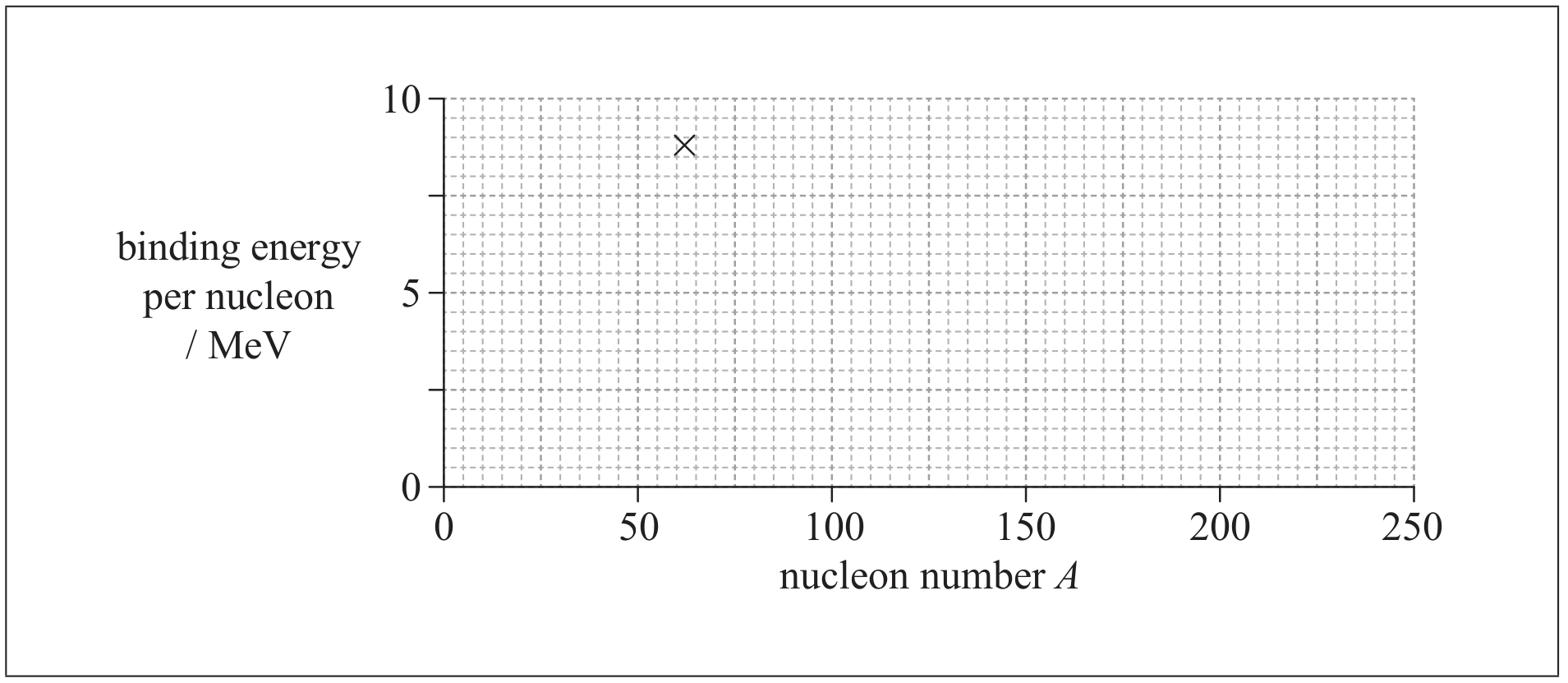
The cross on the grid shows the binding energy per nucleon and nucleon number A of the nuclide nickel-62.

Question image

On the grid, sketch a graph to show how the average binding energy per nucleon varies with nucleon number A.

[ 2 ]

Question 2

[Maximum number: 7]

This question is about nuclear energy.

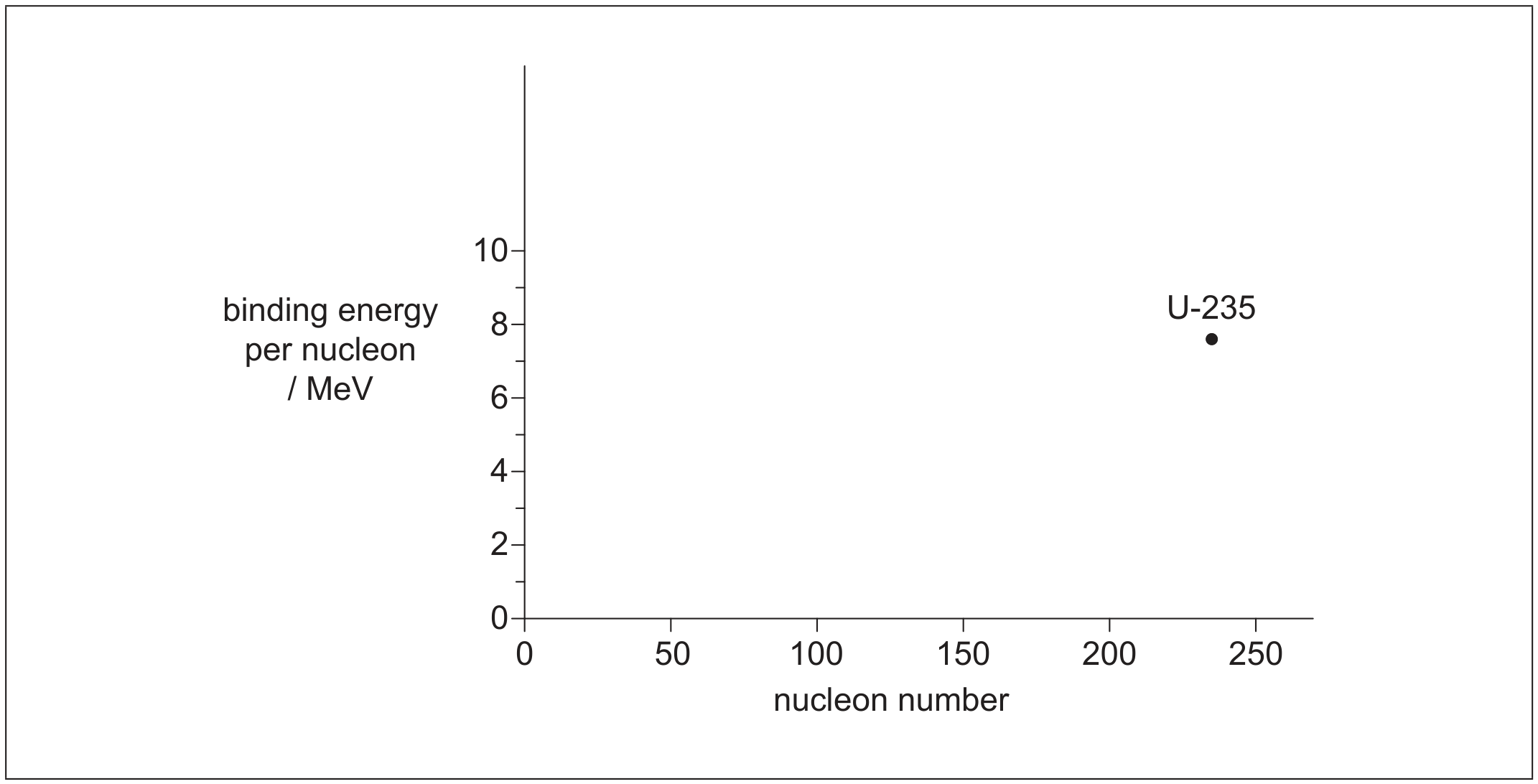
The graph shows the variation of binding energy per nucleon with nucleon number. The position for uranium-235 (U-235) is shown.

Question image

Question 2(a)

(a)

State what is meant by the binding energy of a nucleus.

[ 1 ]

Question 2(b)

Question 2(b)(i)

(b)
(i)

On the axes, sketch a graph showing the variation of nucleon number with the binding energy per nucleon.

[ 2 ]

Question 2(c)

(c)

U-235 (92235U)\left({ }_{92}^{235} \mathrm{U}\right) can undergo alpha decay to form an isotope of thorium (Th).

[ 4 ]

Question 2(c)(i)

(i)

State the nuclear equation for this decay.

[ 1 ]

Question 2(c)(ii)

(ii)

A sample of rock contains a mass of 5.6 mg of U-235 at the present day.

The half-life of U-235 is 7.0×1087.0 \times 10^{8} years. Determine the initial mass of the U-235 if the rock sample was formed 3.9×1093.9 \times 10^{9} years ago.

[ 3 ]

Question 3

Question 3(b)

Question 3(b)(i)

(a)
(i)

Calculate, in s1\mathrm{s}^{-1}, the decay constant of Au-198.

[ 1 ]

Question 3(b)(ii)

(ii)

A sample contains 5.0 mg of pure Au-198. Determine the mass of Hg-198 present in the sample after one week.

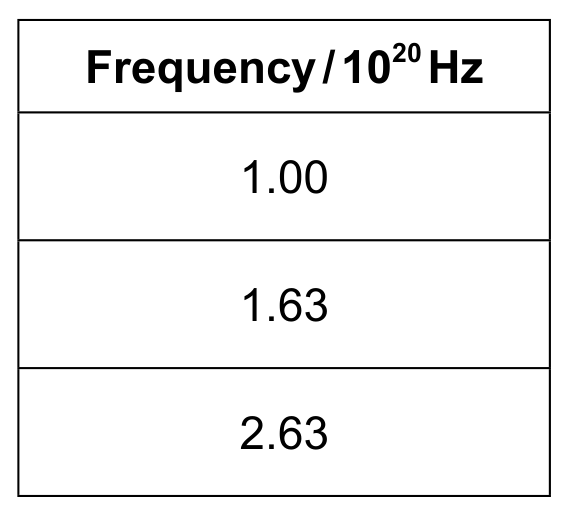
Gamma photons of the following frequencies are emitted in the decay of Au-198:

Table
[ 2 ]

Question 3(c)

(b)

Explain how this observation provides evidence that nuclear energy levels are discrete.

[ 2 ]

Question 2

[Maximum number: 4]

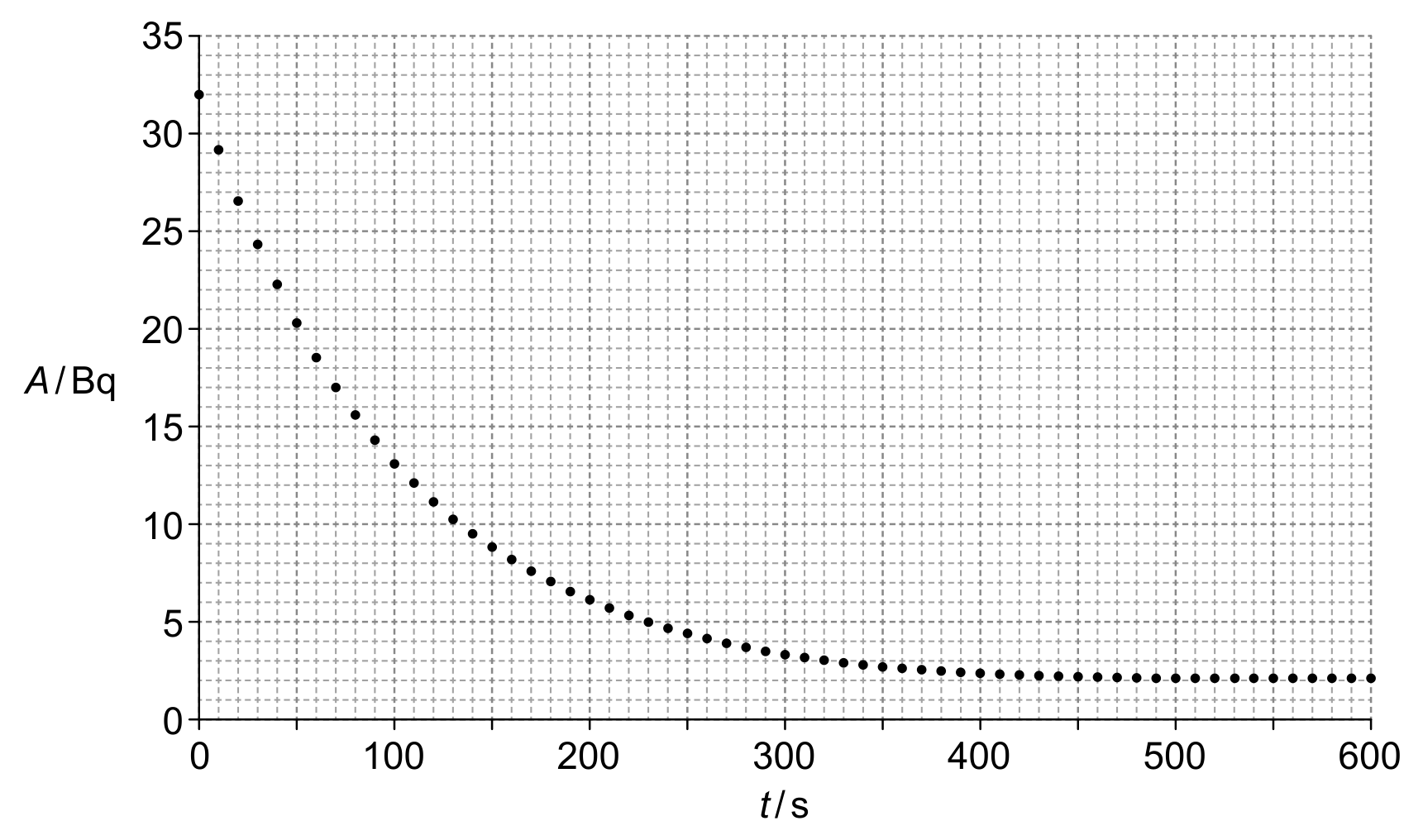
The graph shows the variation with time t of the activity A of a sample of protactinium-234.

Question image

Question 2(a)

(a)

Suggest why the activity approaches a non-zero constant value.

[ 1 ]

Question 2(b)

(b)

Estimate the half-life of protactinium-234 explaining your work. provided.

[ 3 ]

Question 2

[Maximum number: 4]

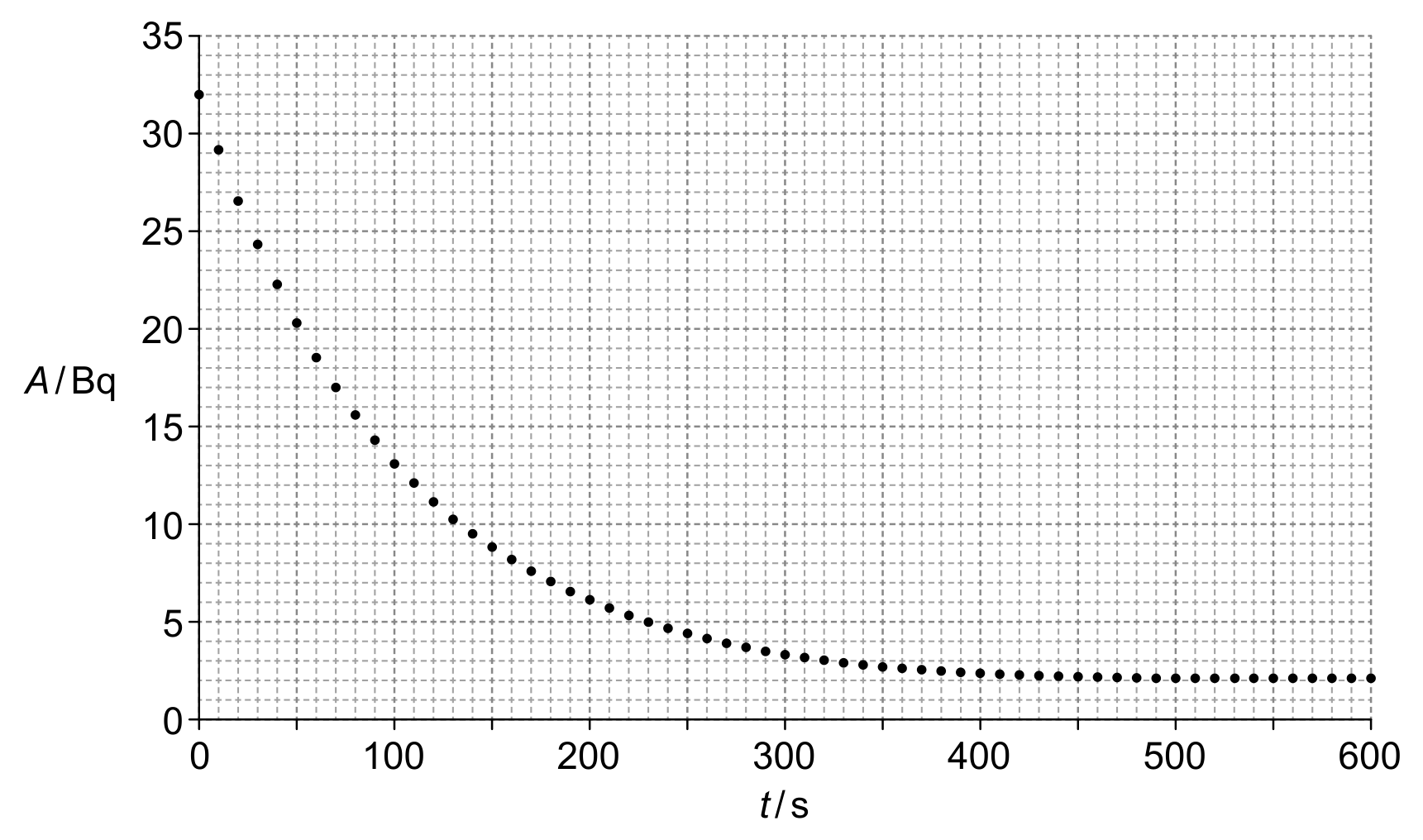
The graph shows the variation with time t of the activity A of a sample of protactinium-234.

Question image

Question 2(a)

(a)

Suggest why the activity approaches a non-zero constant value.

[ 1 ]

Question 2(b)

(b)

Estimate the half-life of protactinium-234 explaining your work. provided.

[ 3 ]

Question 2

Question 2(b)

(a)

Silicon-30 (1430Si)\left({ }_{14}^{30} \mathrm{Si}\right) can be formed from phosphorus-30 (1530P)\left({ }_{15}^{30} \mathrm{P}\right) by a process of beta-plus decay.

[ 2 ]

Question 2(b)(i)

(i)

Write down the nuclear equation that represents this reaction.

[ 2 ]

Question 3

[Maximum number: 3]

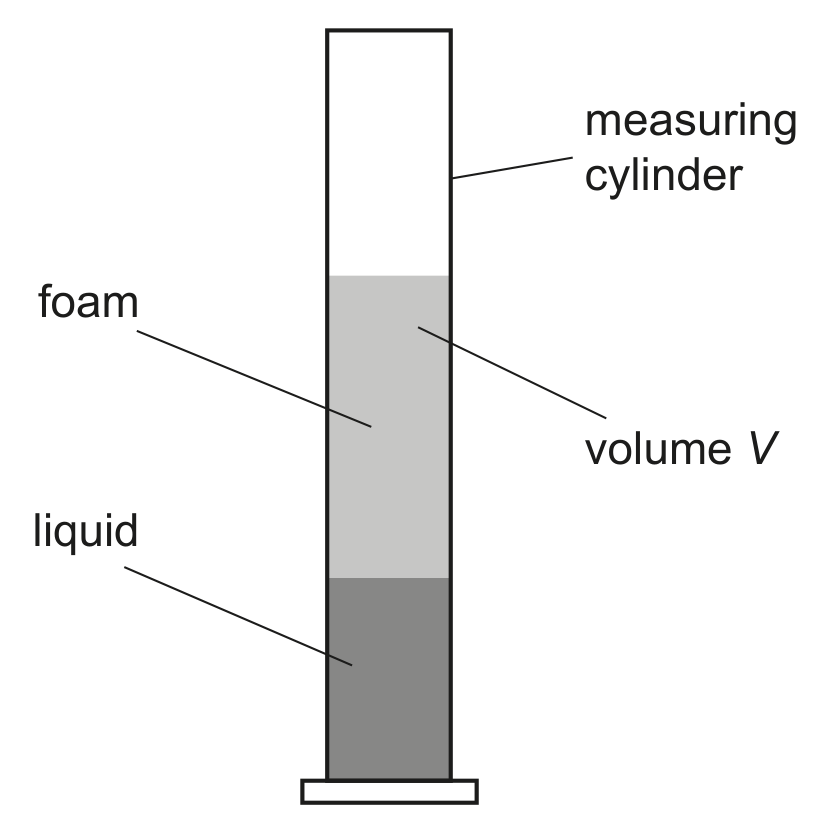
A foam forms above a liquid when the liquid is stirred or poured.

A student investigates the change in volume of a foam with time.
At time t=0, the liquid is poured quickly into a measuring cylinder and a foam forms above the liquid. The student waits one minute for the foam to settle and then records the volume V of the foam and the time t.

The student repeats the measurement every minute.

Question image

Question 3(b)

(a)

The student suggests that the foam experiment can model radioactive decay.

For this to be true, the V-t graph must have similar properties to those of a graph of corrected count rate against time for the decay of a radioactive nuclide.

[ 1 ]

Question 3(b)(i)

(i)

Explain how data from the V-t graph can be tested to decide whether the foam experiment can model radioactive decay.

[ 1 ]

Question 3(c)

(b)

The student decides to stop the experiment when the volume of the foam has decreased by 78th \frac{7}{8}^{\text {th }} of its original volume.
Predict the time at which the student will stop the experiment.

[ 2 ]

Question A3

[Maximum number: 6]

This question is about nuclear reactions.

Question A3(a)

(a)

The nuclide U-235 is an isotope of uranium. A nucleus of U-235 undergoes radioactive decay to a nucleus of thorium-231 (Th-231). The proton number of uranium is 92.

[ 3 ]

Question A3(a)(i)

(i)

State what is meant by the terms nuclide and isotope.

Nuclide:
Isotope:

[ 2 ]

Question A3(a)(ii)

(ii)

One of the particles produced in the decay of a nucleus of U-235 is a gamma photon. State the name of another particle that is also produced.

[ 1 ]

Question A3(b)

(b)

The daughter nuclei of U-235 undergo radioactive decay until eventually a stable isotope of lead is reached.

Explain why the nuclei of U-235 are unstable whereas the nuclei of the lead are stable.

[ 3 ]
0 selected