EduNinja

IB Physics HLD.1 Gravitational fieldsQuestion Bank

Question 1

[Maximum number: 3]

A space probe of mass 95 kg is designed to land on the surface of an asteroid. The gravitational field strength g of the asteroid at its surface is 2.7×10³ ms22.7 \times 10^{-3} \mathrm{~ms}^{-2}.

Question 1(a)

(a)

The radius r of the asteroid is 230 km . Calculate the mass of the asteroid.

[ 2 ]

Question 1(d)

Question 1(d)(i)

(b)
(i)

Show that the escape speed vescv_{e s c} of the asteroid is given by

vesc=2grv_{\mathrm{esc}}=\sqrt{2 g r}

Question 1(d)(ii)

(ii)

Calculate the escape speed of the asteroid.

[ 1 ]
Question 2

[Maximum number: 6]

Venus is a planet in the Solar System. The following data are given:

Orbital period of Venus =225 days
Orbital period of Earth =365 days

Question 2(a)

(a)

Calculate the ratio orbital radius of Venus

[ 2 ]

Question 2(b)

(b)

Explain how observations of the motion of the planets allow scientists to determine the mass of the Sun.

[ 2 ]

Question 2(c)

(c)

The difference between the maximum and minimum Earth-Sun distances is 5.0×10⁹ m5.0 \times 10^{9} \mathrm{~m}. The difference in gravitational potential due to the Sun between these positions is 3.0×10⁷Jkg13.0 \times 10^{7} \mathrm{Jkg}^{-1}.

Estimate the average gravitational field strength due to the Sun at the position of Earth.

[ 2 ]

Question 6

[Maximum number: 1]

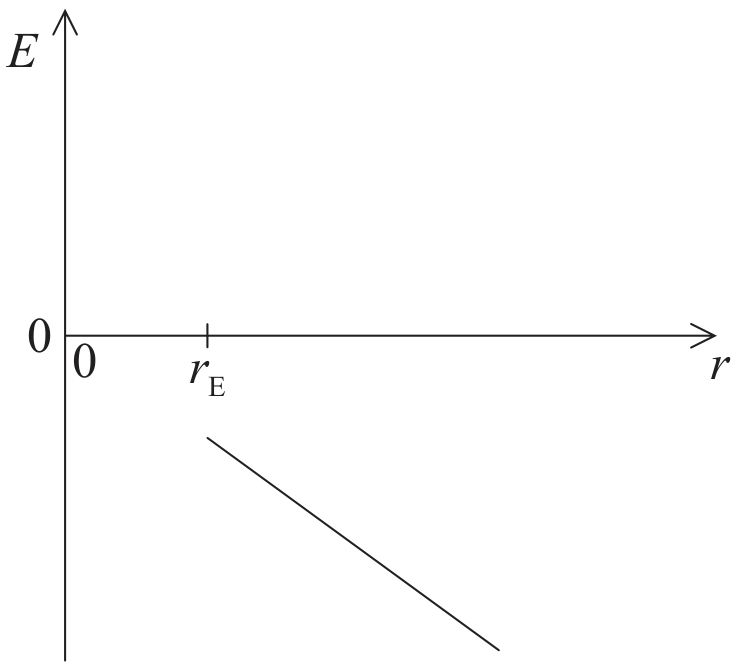
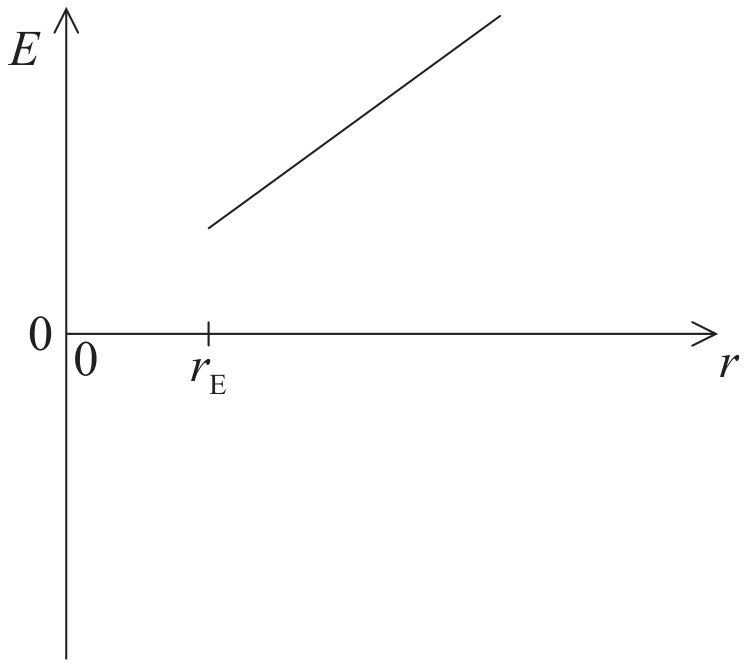
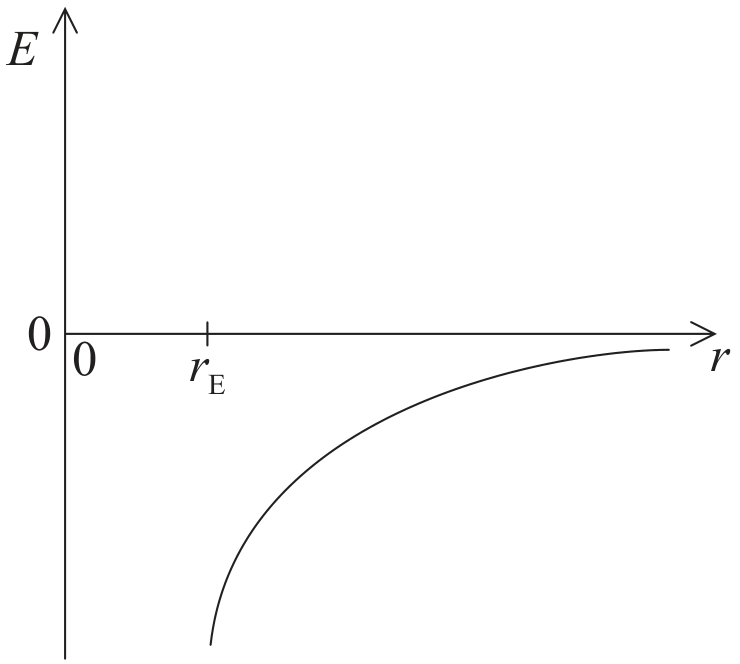
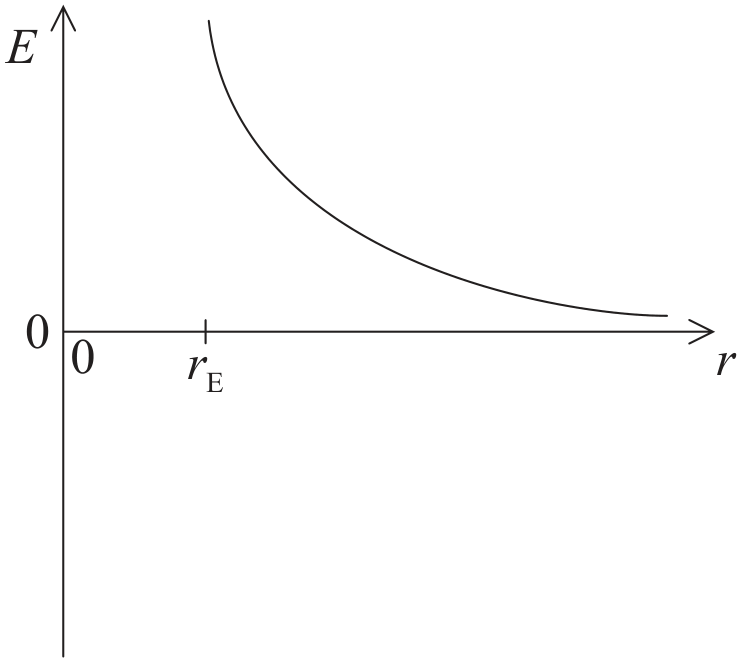
Which graph shows how the total energy E of an orbiting satellite varies with distance r from the centre of the Earth, where rEr_{\mathrm{E}} is the radius of the Earth?

A
Question image
B
Question image
C
Question image
D
Question image

Question 7

[Maximum number: 1]

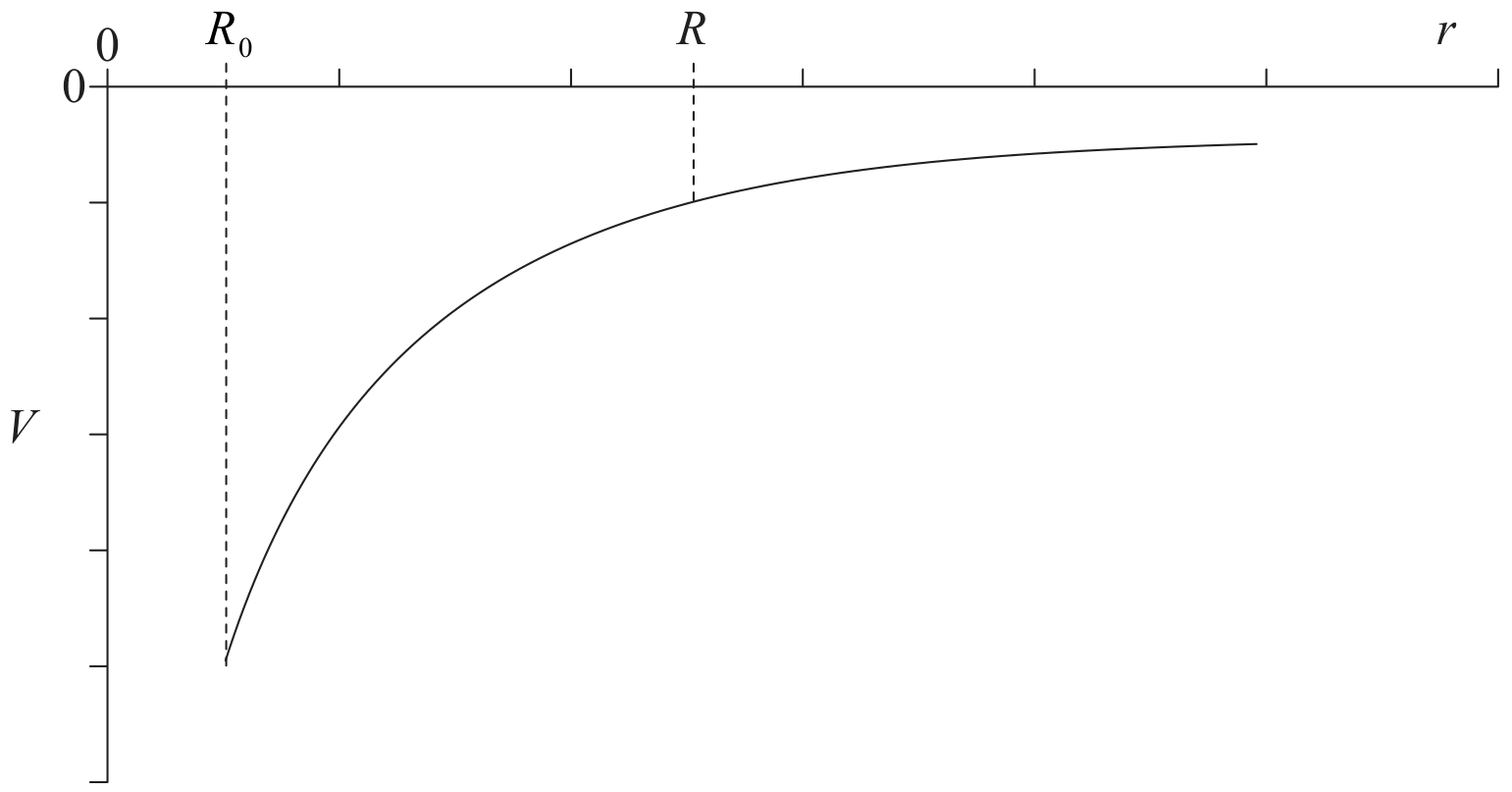
The sketch graph shows how the gravitational potential V of a planet varies with distance r from the centre of the planet of radius R0R_{0}.

Question image

The magnitude of the gravitational field strength at the point r=R equals the

A

area between the graph and the r-axis between r=R and r=R0r=R_{0}.

B

gradient of the graph at r=R.

C

inverse of the gradient of the graph at r=R.

D

value of V at r=R divided by R2R^{2}.

Question 2

[Maximum number: 6]

A planet is in a circular orbit around a star. The speed of the planet is constant. The following data are given:

Table

Question 2(b)

(a)

Calculate the value of the centripetal force.

[ 1 ]

Question 2(c)

(b)

A spacecraft is to be launched from the surface of the planet to escape from the star system. The radius of the planet is 9.1×10³ km9.1 \times 10^{3} \mathrm{~km}.

[ 5 ]

Question 2(c)(i)

(i)

Show that the gravitational potential due to the planet and the star at the surface of the planet is about 5×10⁹Jkg1-5 \times 10^{9} \mathrm{Jkg}^{-1}.

[ 3 ]

Question 2(c)(ii)

(ii)

Estimate the escape speed of the spacecraft from the planet-star system.

[ 2 ]

Question 8

[Maximum number: 1]

A satellite in close-Earth orbit moves to an orbit further from the Earth's surface. Which of the following concerning the speed of the satellite and its gravitational potential energy in the new orbit is correct?

Speed of the satellite

Gravitational potential energy

increases

decreases

increases

increases

decreases

decreases

decreases

increases

Question 8

[Maximum number: 1]

A field line is normal to an equipotential surface

A

for both electric and gravitational fields.

B

for electric but not gravitational fields.

C

for gravitational but not electric fields.

D

for neither electric nor gravitational fields.

Question 9

[Maximum number: 1]

The magnitude of the potential at the surface of a planet is V. What is the escape speed from the surface of the planet?

A

V\sqrt{V}

B

2V\sqrt{2 V}

C

VR\sqrt{V R}

D

2VR\sqrt{2 V R}

Question 2

[Maximum number: 5]

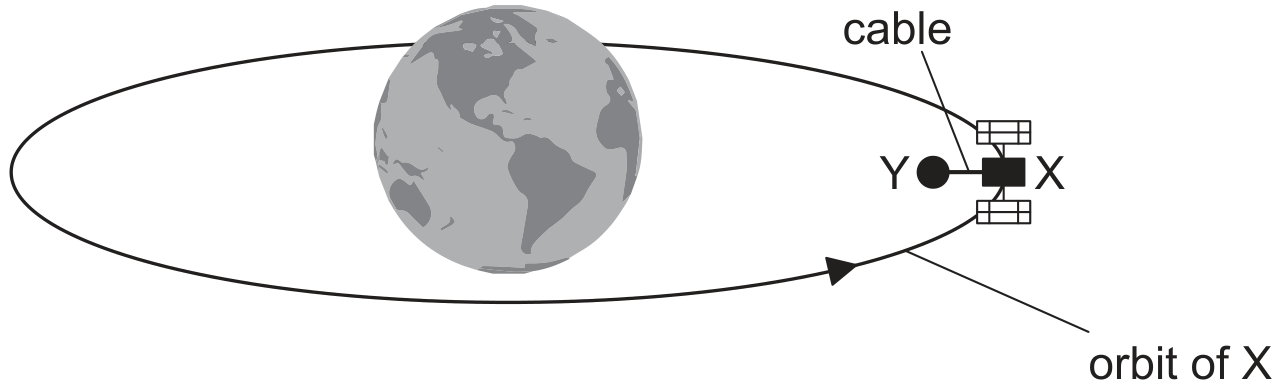
There is a proposal to power a space satellite X as it orbits the Earth. In this model, X is connected by an electronically-conducting cable to another smaller satellite Y .

not to scale

not to scale

Question 2(a)

(a)

Satellite X orbits 6600 km from the centre of the Earth.

Mass of the Earth =6.0×1024 kg=6.0 \times 10^{24} \mathrm{~kg}

Show that the orbital speed of satellite X is about 8 km s18 \mathrm{~km} \mathrm{~s}^{-1}.

[ 2 ]

Question 2(b)

(b)

Satellite Y orbits closer to the centre of Earth than satellite X. Outline why

[ 3 ]

Question 2(b)(i)

(i)

the orbital times for X and Y are different.

[ 1 ]

Question 2(b)(ii)

(ii)

satellite Y requires a propulsion system.

[ 2 ]

Question B4

[Maximum number: 18]

B4. This question is in three parts. Part 1 is about gravitational fields. Part 2 is about electric current and resistance. Part 3 is about atomic energy levels.

Part 1 Gravitational fields
(a) State Newton's universal law of gravitation.
(b) Deduce that the gravitational field strength g at the surface of a spherical planet of uniform density is given by

g=GMR2g=\frac{G M}{R^{2}}

where M is the mass of the planet, R is its radius and G is the gravitational constant. You can assume that spherical objects of uniform density act as point masses.
(c) The gravitational field strength at the surface of Mars gMg_{\mathrm{M}} is related to the gravitational field strength at the surface of the Earth gEg_{\mathrm{E}} by

gM=0.38×gEg_{\mathrm{M}}=0.38 \times g_{\mathrm{E}}

The radius of Mars RMR_{\mathrm{M}} is related to the radius of the Earth RER_{\mathrm{E}} by

RM=0.53×RER_{\mathrm{M}}=0.53 \times R_{\mathrm{E}}

Determine the mass of Mars MMM_{\mathrm{M}} in terms of the mass of the Earth MEM_{\mathrm{E}}.
Part 2 Electric current and resistance

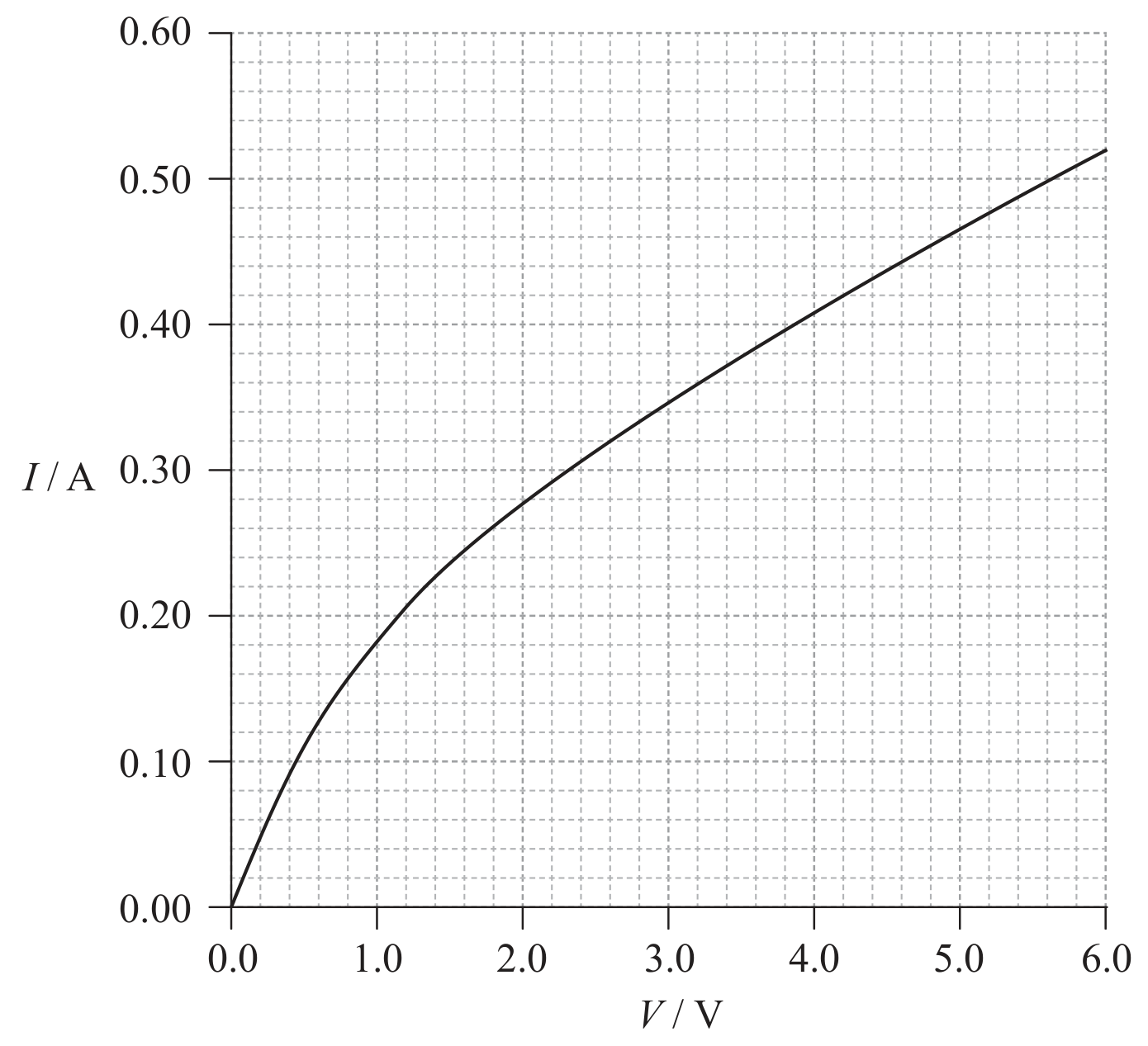
The graph below shows how the current I in a tungsten filament lamp varies with potential difference V across the lamp.

Question image

(a) (i) Define the electrical resistance of a component.
(ii) Explain whether or not the filament obeys Ohm's law.

Question image

(b) Calculate the resistance of the filament lamp when the potential difference across it is 2.8 V .
(c) Two identical filament lamps are connected in series with a cell of emf 6.0 V and negligible internal resistance. Using the graph opposite, calculate the total power dissipated in the circuit.
Part 3 Atomic energy levels
(a) Describe the de Broglie hypothesis.

(b) Outline how atomic emission spectra provide evidence for the quantization of energy in atoms.
(c) Consider an electron confined in a one-dimensional "box" of length L. The de Broglie waves associated with the electron are standing waves with wavelengths given by 2Ln\frac{2 L}{n}, where n=1,2,3n=1,2,3 \ldots

Show that the energy EnE_{n} of the electron is given by

En=n2h28meL2E_{n}=\frac{n^{2} h^{2}}{8 m_{\mathrm{e}} L^{2}}

where h is Planck's constant and mem_{\mathrm{e}} is the mass of the electron.
(d) An electron is confined in a "box" of length L=1.0×10¹⁰ mL=1.0 \times 10^{-10} \mathrm{~m} in the n=1 energy level. Its position as measured from one end of the box is (0.5±0.5)×1010 m(0.5 \pm 0.5) \times 10^{-10} \mathrm{~m}. Determine
(i) the momentum of the electron.
(ii) the uncertainty in the momentum.

0 selected