EduNinja

IB Physics HLA.2 Forces and momentumQuestion Bank

Question 1

[Maximum number: 5]

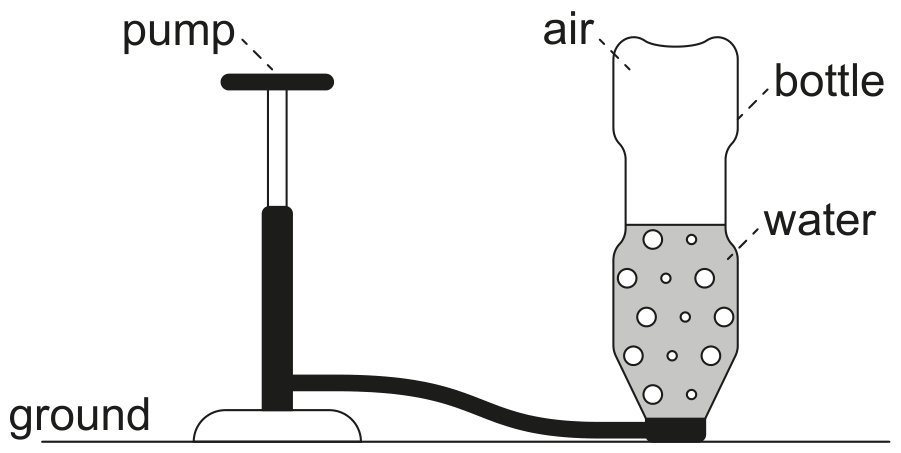
A toy rocket is made from a plastic bottle that contains some water.

Air is pumped into the vertical bottle until the pressure inside forces water and air out of the bottle. The bottle then travels vertically upwards.
Question image

The air-water mixture is called the propellant.
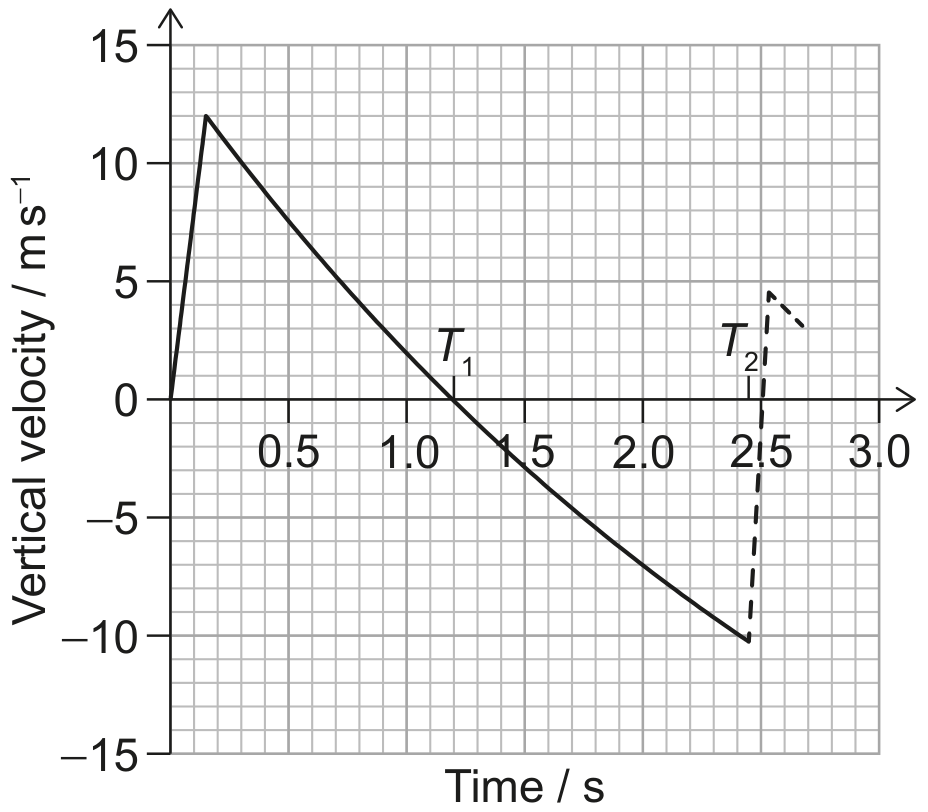
The variation with time of the vertical velocity of the bottle is shown.
Question image

The bottle reaches its highest point at time T1T_{1} on the graph and returns to the ground at time T2T_{2}. The bottle then bounces. The motion of the bottle after the bounce is shown as a dashed line.

Question 1(c)

(a)

The bottle bounces when it returns to the ground.

[ 3 ]

Question 1(c)(ii)

(i)

The mass of the bottle is 27 g and it is in contact with the ground for 85 ms .

Determine the average force exerted by the ground on the bottle. Give your answer to an appropriate number of significant figures.

[ 3 ]

Question 1(d)

(b)

The maximum height reached by the bottle is greater with an air-water mixture than with only high-pressure air in the bottle.

Assume that the speed at which the propellant leaves the bottle is the same in both cases.

Explain why the bottle reaches a greater maximum height with an air-water mixture.
[ 2 ]

Question 1

[Maximum number: 6]

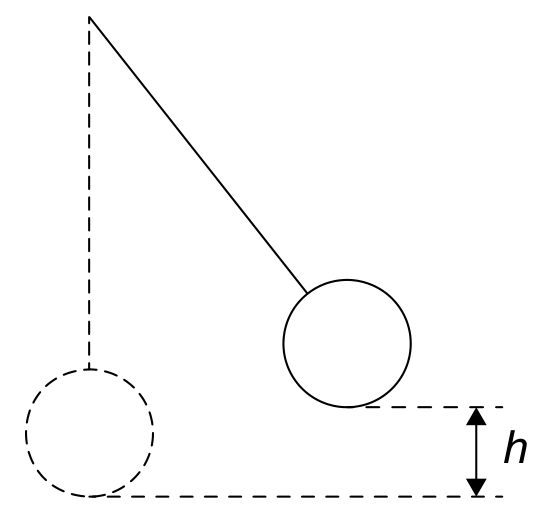
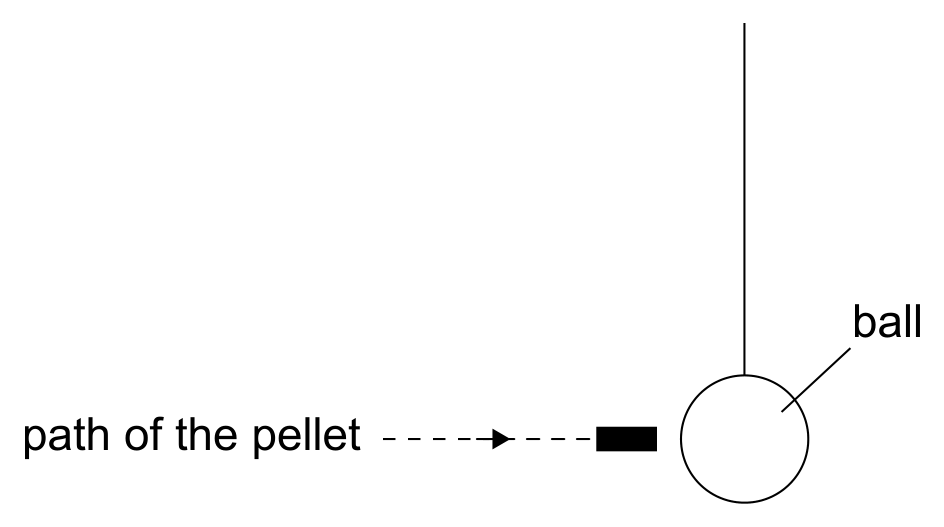
A stationary ball is hanging from a light string. A pellet from an air rifle is travelling horizontally and becomes embedded in the ball. The velocity of the pellet when it strikes the ball is 160 ms1160 \mathrm{~ms}^{-1}.

Question image

The following data are given.

 Mass of the ball =250 g Mass of the pellet =2.0 g\begin{aligned} \text { Mass of the ball } & =250 \mathrm{~g} \\ \text { Mass of the pellet } & =2.0 \mathrm{~g} \end{aligned}

Question 1(a)

(a)

Calculate the speed of the ball and the pellet immediately after the impact.

[ 2 ]

Question 1(b)

(b)

Suggest why the combined kinetic energy of the ball and the pellet after the impact is less than the initial kinetic energy of the pellet.

[ 2 ]

Question 1(c)

(c)

The ball with the embedded pellet rises to a maximum vertical height h.

Question image

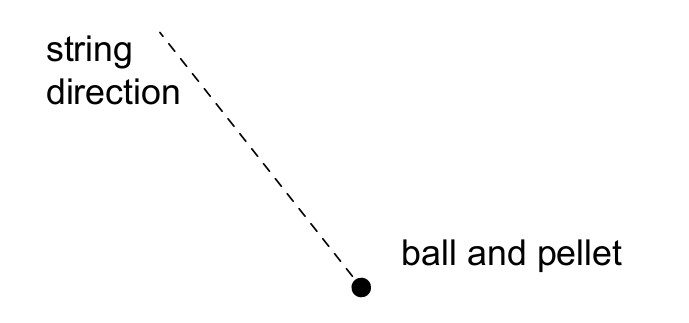
Draw and label the free-body diagram for the ball at height h.

Question image
[ 2 ]

Question 1

[Maximum number: 4]

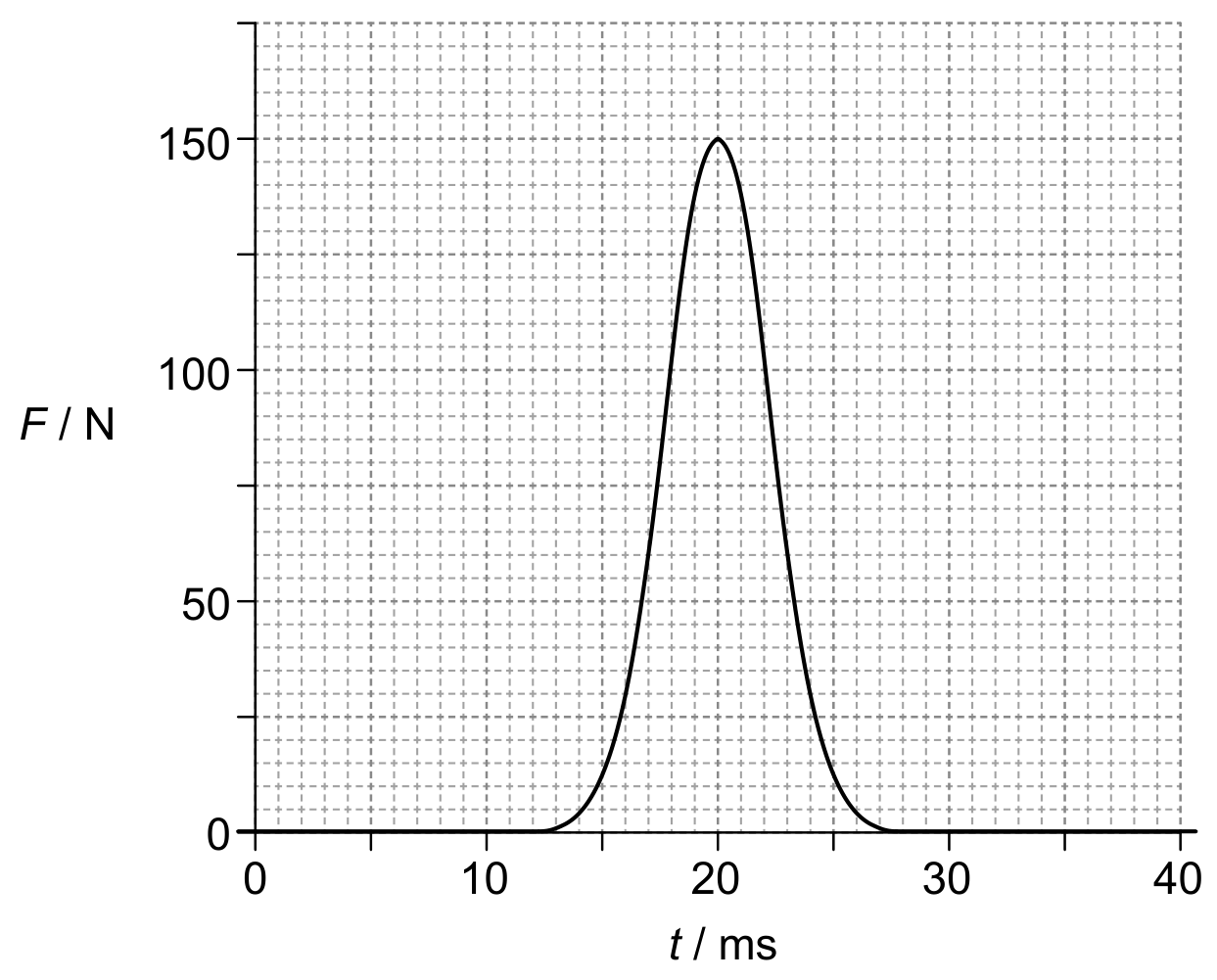
The graph shows the variation with time t of the horizontal force F exerted on a tennis ball by a racket.

Question image

The tennis ball was stationary at the instant when it was hit. The mass of the tennis ball is 5.8×10² kg5.8 \times 10^{-2} \mathrm{~kg}. The area under the curve is 0.84 Ns .

Question 1(a)

(a)

Calculate the speed of the ball as it leaves the racket.

[ 2 ]

Question 1(b)

(b)

Show that the average force exerted on the ball by the racket is about 50 N .

[ 2 ]

Question 1

[Maximum number: 2]

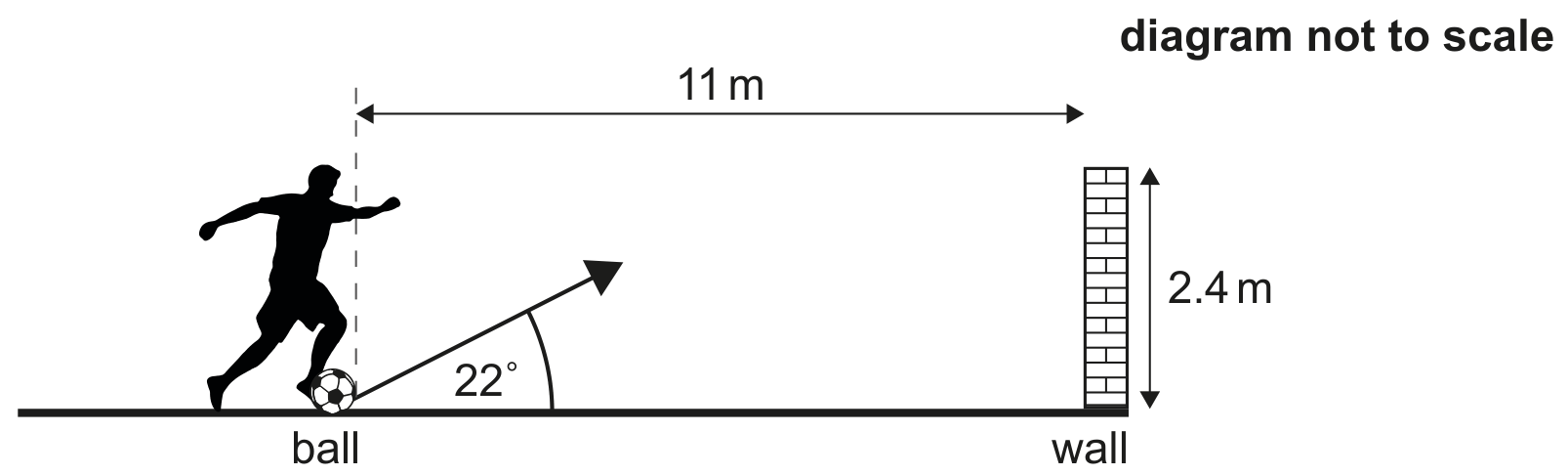
A football player kicks a stationary ball of mass 0.45 kg towards a wall. The initial speed of the ball after the kick is 19 m s119 \mathrm{~m} \mathrm{~s}^{-1} and the ball does not rotate. Air resistance is negligible and there is no wind.

Question image

Question 1(a)

(a)

The player's foot is in contact with the ball for 55 ms . Calculate the average force that acts on the ball due to the football player.

[ 2 ]

Question 1

[Maximum number: 3]

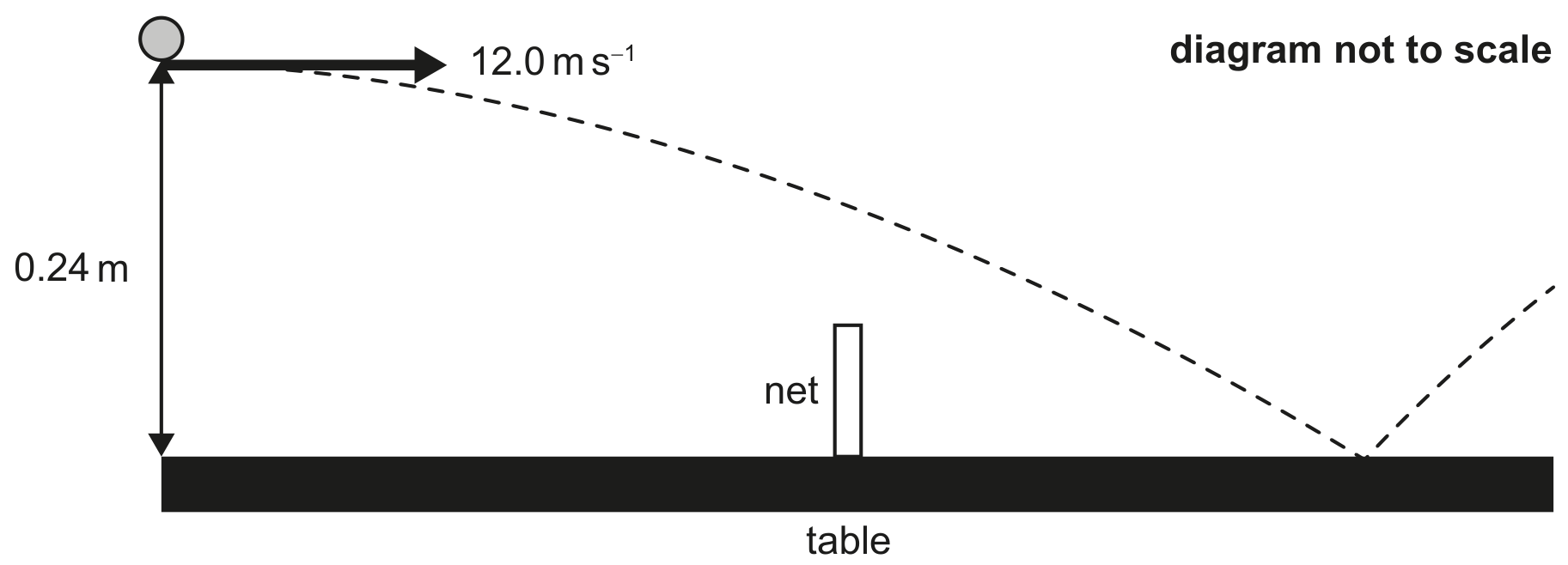
Two players are playing table tennis. Player A hits the ball at a height of 0.24 m above the edge of the table, measured from the top of the table to the bottom of the ball. The initial speed of the ball is 12.0 ms112.0 \mathrm{~ms}^{-1} horizontally. Assume that air resistance is negligible.

Question image

Question 1(d)

(a)

The ball bounces and then reaches a peak height of 0.18 m above the table with a horizontal speed of 10.5 ms110.5 \mathrm{~ms}^{-1}. The mass of the ball is 2.7 g .

[ 3 ]

Question 1(d)(ii)

(i)

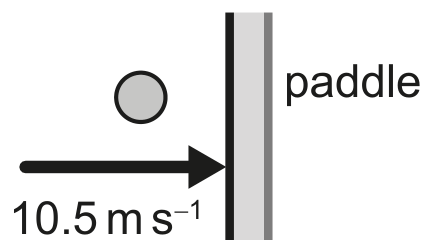
Player B intercepts the ball when it is at its peak height. Player B holds a paddle (racket) stationary and vertical. The ball is in contact with the paddle for 0.010 s . Assume the collision is elastic.

Question image

Calculate the average force exerted by the ball on the paddle. State your answer to an appropriate number of significant figures.

[ 3 ]

Question 1

[Maximum number: 11]

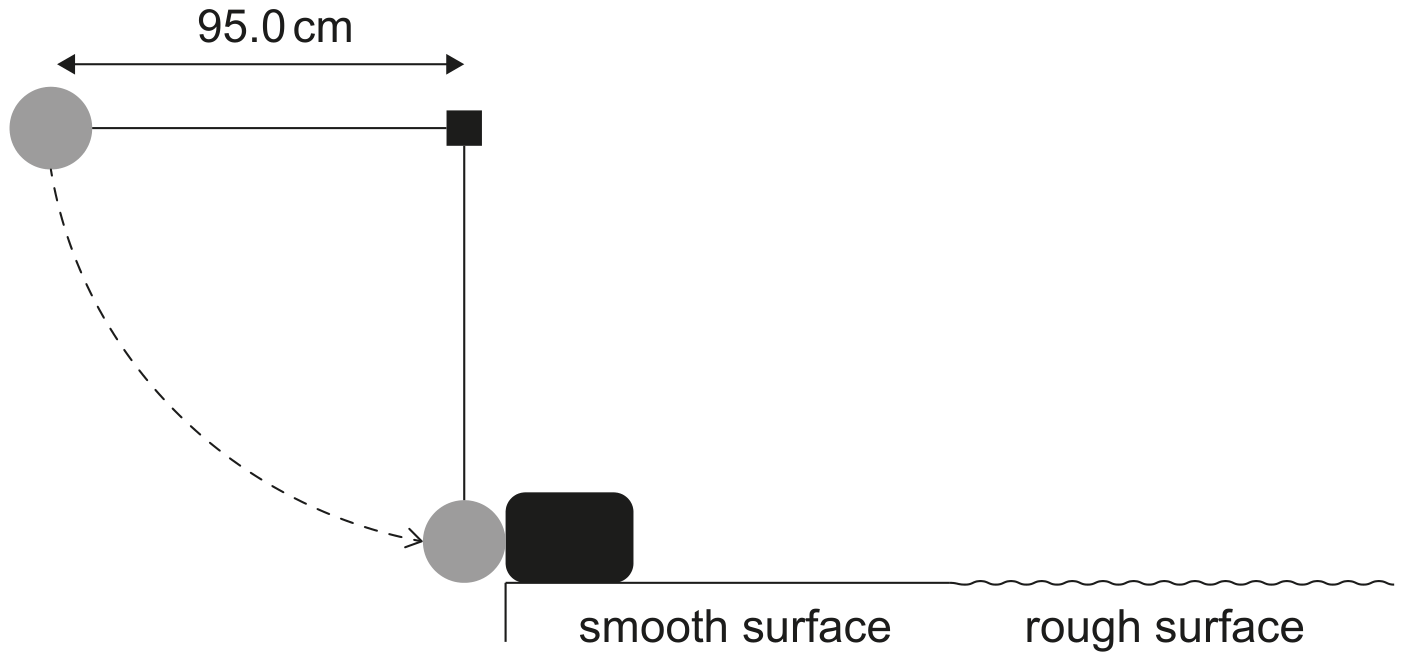
A ball of mass 0.800 kg is attached to a string. The distance to the centre of the mass of the ball from the point of support is 95.0 cm . The ball is released from rest when the string is horizontal. When the string becomes vertical the ball collides with a block of mass 2.40 kg that is at rest on a horizontal surface.

Question image

Question 1(a)

(a)

Just before the collision of the ball with the block,

[ 4 ]

Question 1(a)(i)

(i)

draw a free-body diagram for the ball.

[ 2 ]

Question 1(a)(iii)

(ii)

determine the tension in the string.

[ 2 ]

Question 1(b)

(b)

After the collision, the ball rebounds and the block moves with speed 2.16 ms12.16 \mathrm{~ms}^{-1}.

[ 4 ]

Question 1(b)(i)

(i)

Show that the collision is elastic.

[ 4 ]

Question 1(c)

(c)

The coefficient of dynamic friction between the block and the rough surface is 0.400 .

Estimate the distance travelled by the block on the rough surface until it stops.

[ 3 ]

Question 1

Question 1(a)

(a)

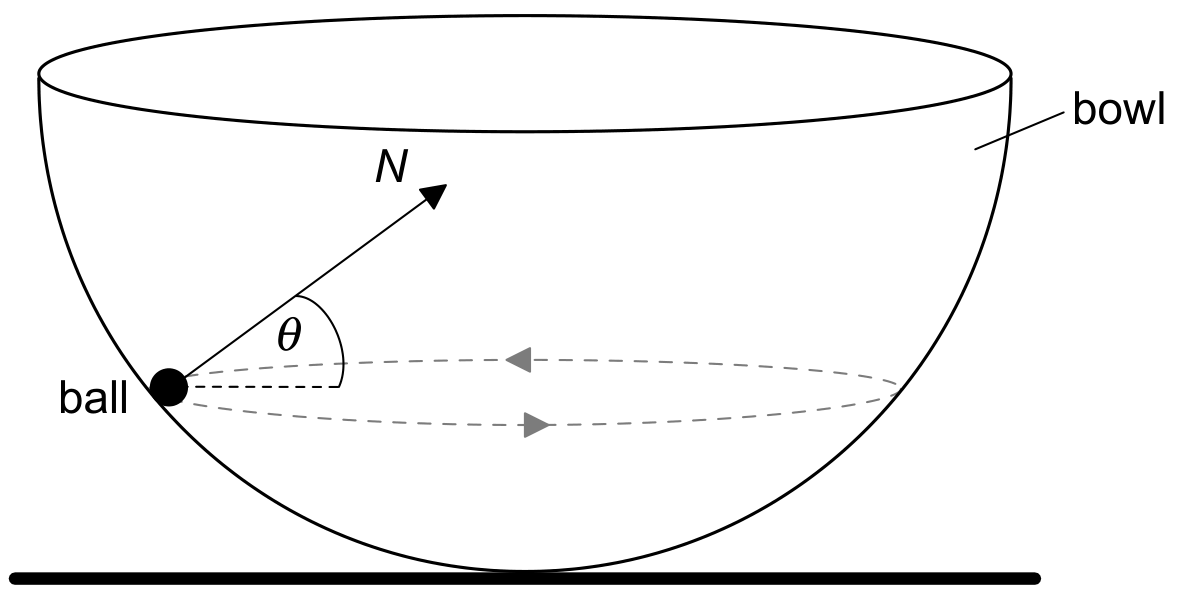
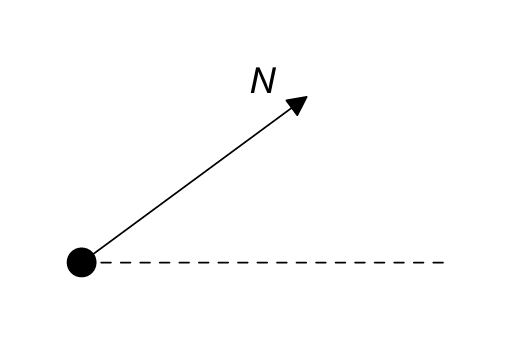
A small ball of mass m is moving in a horizontal circle on the inside surface of a frictionless hemispherical bowl.

Question image

The normal reaction force N makes an angle θ\theta to the horizontal.

[ 6 ]

Question 1(a)(i)

(i)

State the direction of the resultant force on the ball.

[ 1 ]

Question 1(a)(ii)

(ii)

On the diagram, construct an arrow of the correct length to represent the weight of the ball.

Question image
[ 2 ]

Question 1(a)(iii)

(iii)

Show that the magnitude of the net force F on the ball is given by the following equation.

F=mgtanθF=\frac{m g}{\tan \theta}
[ 3 ]

Question 1(b)

(b)

The radius of the bowl is 8.0 m and θ=22\theta=22^{\circ}. Determine the speed of the ball.

[ 4 ]

Question 1(c)

(c)

Outline whether this ball can move on a horizontal circular path of radius equal to the radius of the bowl.

[ 2 ]

Question 1(e)

(d)

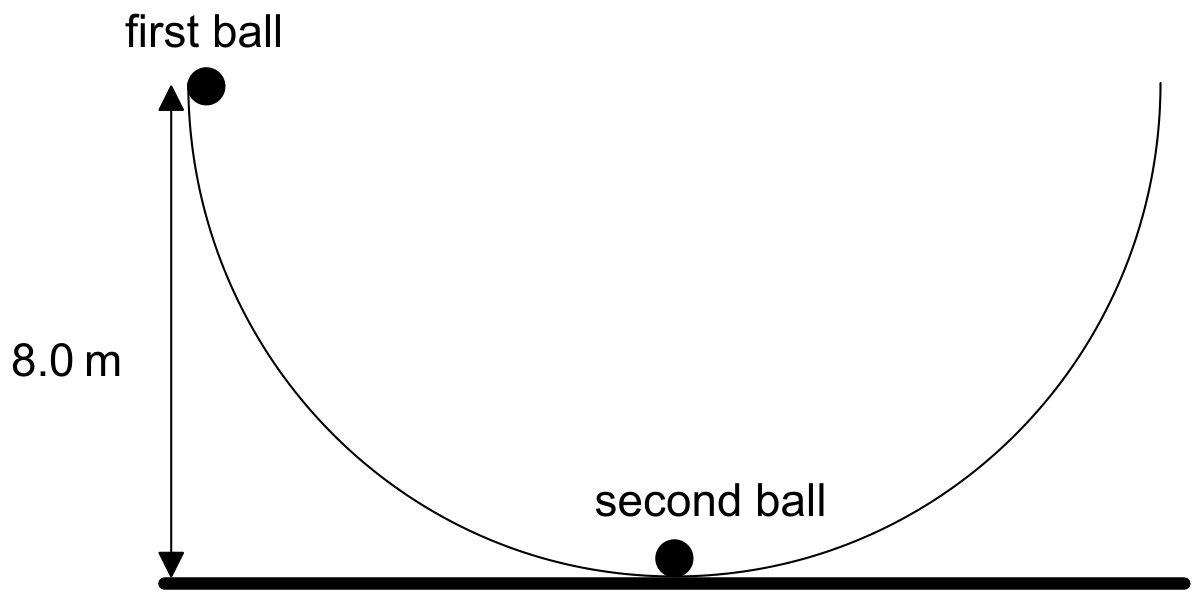
A second identical ball is placed at the bottom of the bowl and the first ball is displaced so that its height from the horizontal is equal to 8.0 m .

Question image

The first ball is released and eventually strikes the second ball. The two balls remain in contact. Calculate, in m , the maximum height reached by the two balls.

[ 3 ]

Question 1

[Maximum number: 12]

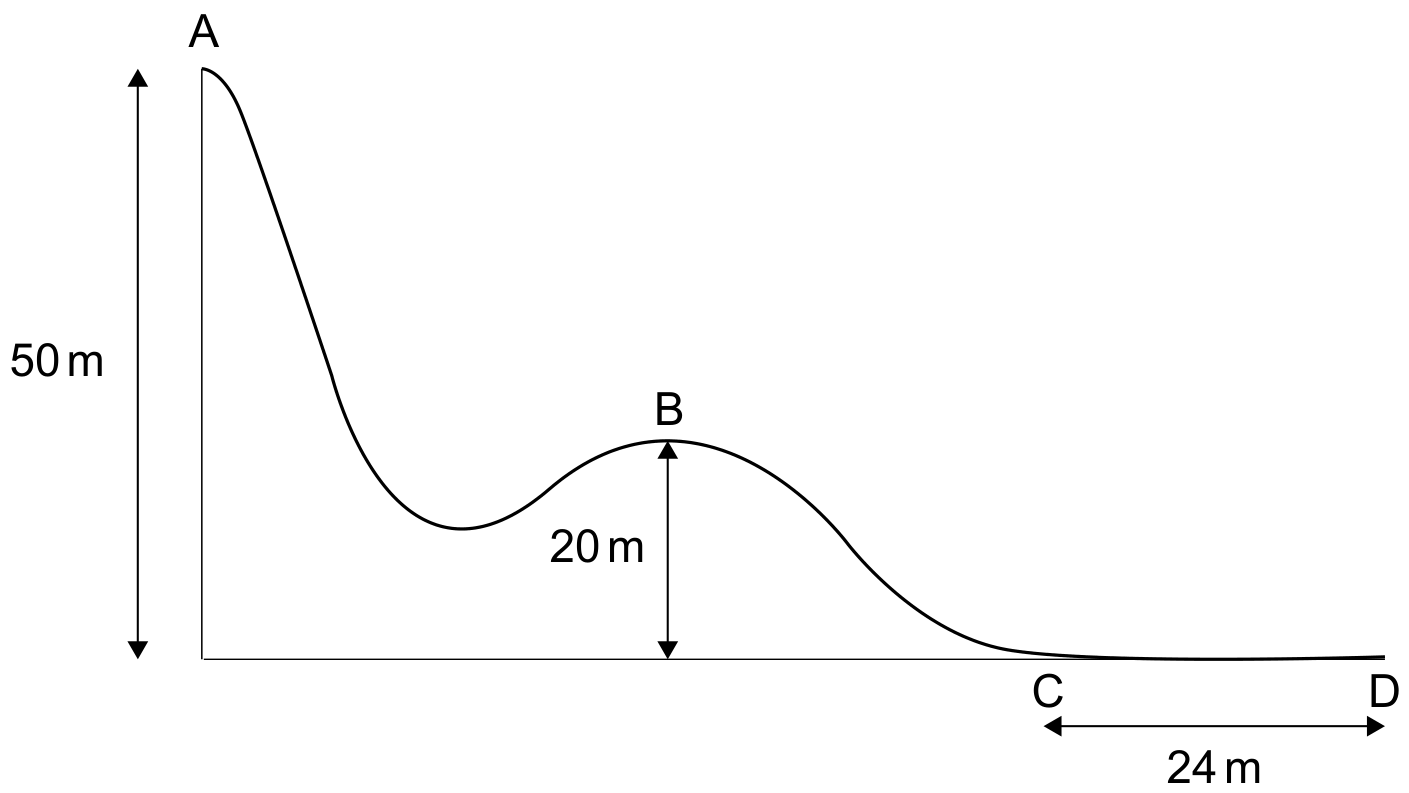
The diagram below shows part of a downhill ski course which starts at point A,50 m\mathrm{A}, 50 \mathrm{~m} above level ground. Point B is 20 m above level ground.

Question image

Question 1(b)

Question 1(b)(i)

(a)
(i)

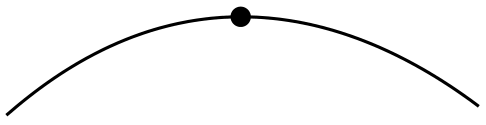
The dot on the following diagram represents the skier as she passes point B . Draw and label the vertical forces acting on the skier.

Question image
[ 2 ]

Question 1(b)(ii)

(ii)

The hill at point B has a circular shape with a radius of 20 m . Determine whether the skier will lose contact with the ground at point B .

[ 3 ]

Question 1(c)

(b)

The skier reaches point C with a speed of 8.2 m s18.2 \mathrm{~m} \mathrm{~s}^{-1}. She stops after a distance of 24 m at point D .

Determine the coefficient of dynamic friction between the base of the skis and the snow. Assume that the frictional force is constant and that air resistance can be neglected.

[ 3 ]

Question 1(d)

(c)

At the side of the course flexible safety nets are used. Another skier of mass 76 kg falls normally into the safety net with speed 9.6 ms19.6 \mathrm{~ms}^{-1}.

[ 4 ]

Question 1(d)(i)

(i)

Calculate the impulse required from the net to stop the skier and state an appropriate unit for your answer.

[ 2 ]

Question 1(d)(ii)

(ii)

Explain, with reference to change in momentum, why a flexible safety net is less likely to harm the skier than a rigid barrier.

[ 2 ]

Question 1

[Maximum number: 1]

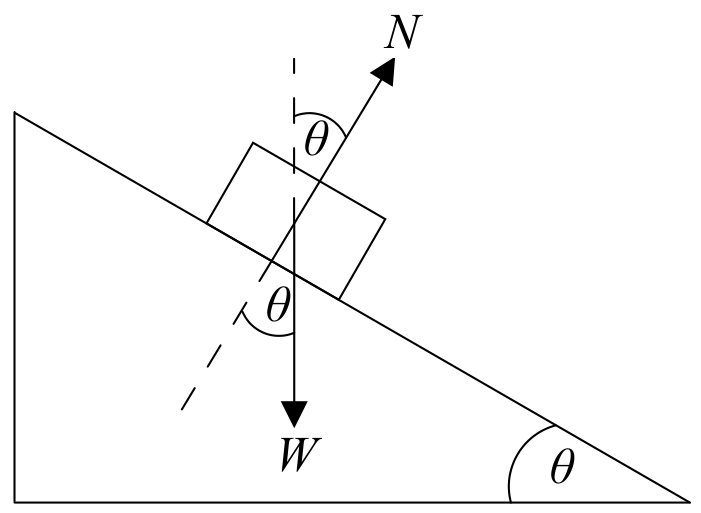
The diagram below shows the forces acting on a block of weight W as it slides down a slope. The angle between the slope and the horizontal is θ\theta, the normal reaction force on the block from the slope is N and friction is negligible.

Question image

Which of the following gives the resultant force on the block?

A

WsinθW \sin \theta

B

WcosθW \cos \theta

C

NsinθN \sin \theta

D

NcosθN \cos \theta

Question 1

[Maximum number: 1]

What is the definition of the SI unit for a force?

A

The force required to accelerate, in the direction of the force, a mass of 1 kg at 1 ms21 \mathrm{~ms}^{-2}

B

The force required to accelerate, in the direction of the force, a mass at 1 ms21 \mathrm{~ms}^{-2}

C

The weight of a mass of 0.1 kg

D

The change in momentum per second

0 selected