EduNinja

IB Physics HLA.3 Work, energy and powerQuestion Bank

Question 1

[Maximum number: 2]

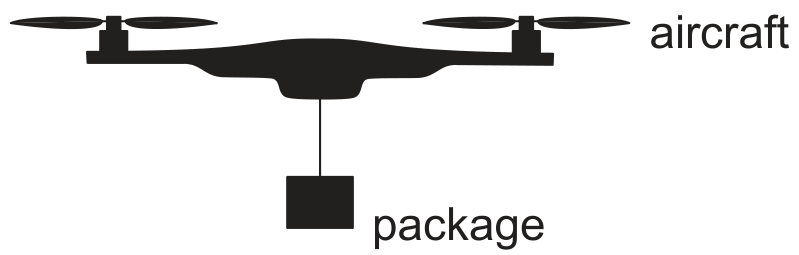
A company delivers packages to customers using a small unmanned aircraft. Rotating horizontal blades exert a force on the surrounding air. The air above the aircraft is initially stationary.
ground

ground

The air is propelled vertically downwards with speed v. The aircraft hovers motionless above the ground. A package is suspended from the aircraft on a string. The mass of the aircraft is 0.95 kg and the combined mass of the package and string is 0.45 kg . The mass of air pushed downwards by the blades in one second is 1.7 kg .

Question 1(a)

Question 1(a)(iv)

(a)
(i)

Calculate the power transferred to the air by the aircraft.

[ 2 ]
Question 1

[Maximum number: 2]

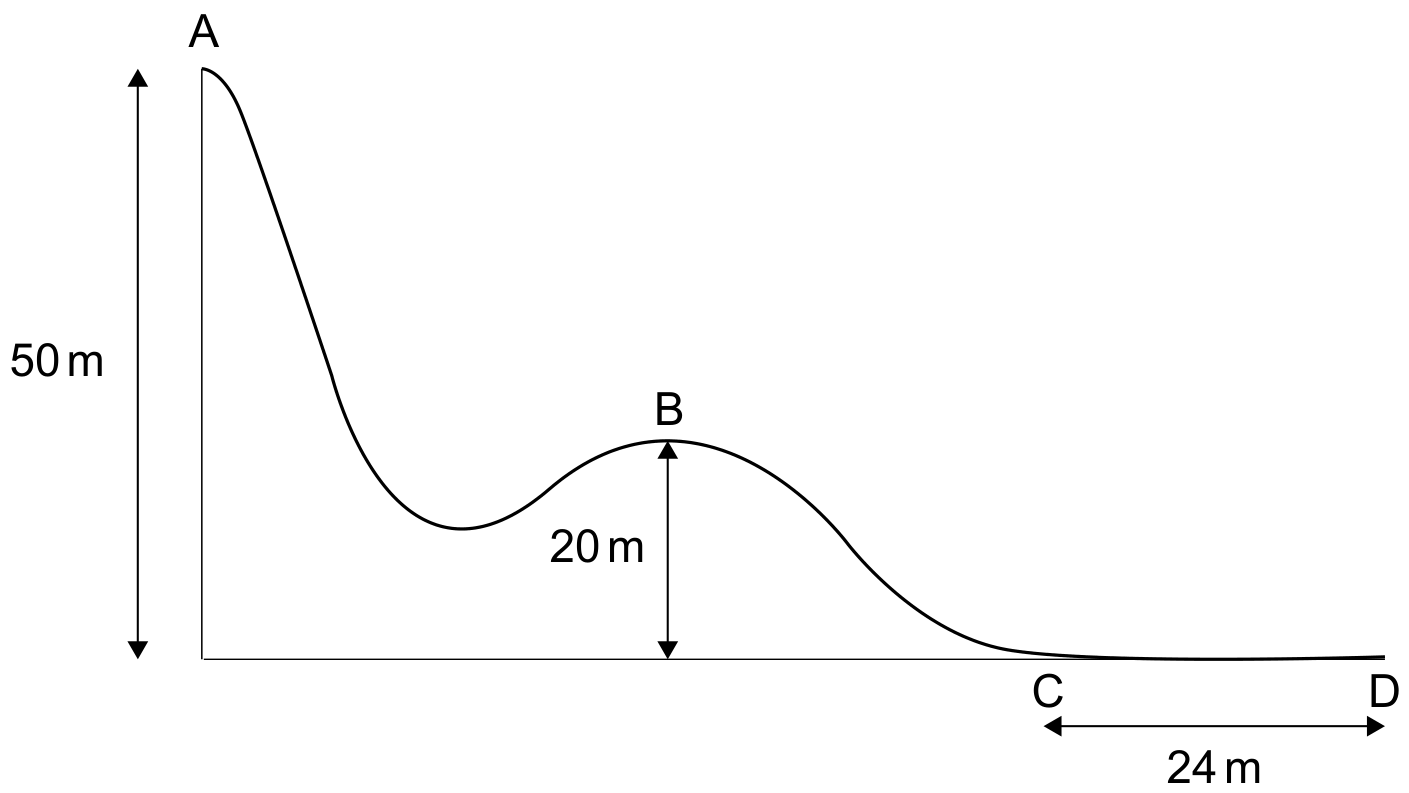
The diagram below shows part of a downhill ski course which starts at point A,50 m\mathrm{A}, 50 \mathrm{~m} above level ground. Point B is 20 m above level ground.

Question image

Question 1(a)

(a)

A skier of mass 65 kg starts from rest at point A and during the ski course some of the gravitational potential energy transferred to kinetic energy.

[ 2 ]

Question 1(a)(i)

(i)

From A to B, 24 % of the gravitational potential energy transferred to kinetic energy. Show that the velocity at B is 12 m s112 \mathrm{~m} \mathrm{~s}^{-1}.

[ 2 ]

Question 1

[Maximum number: 4]

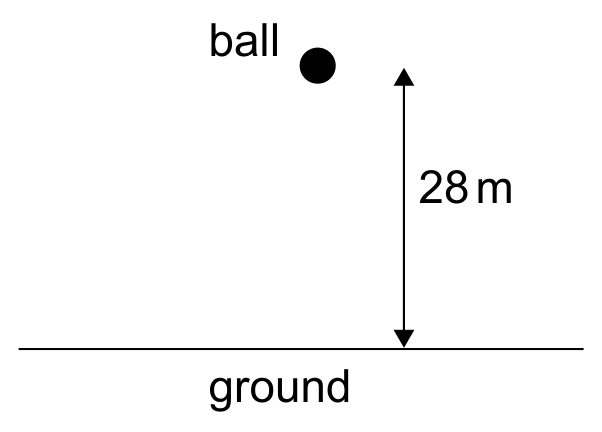
A ball of mass 2.7 g is released from rest from a height of 28 m above horizontal ground.

Question image

Question 1(a)

(a)

Show that in the absence of air resistance the ball impacts the ground with a speed of about 23 m s123 \mathrm{~m} \mathrm{~s}^{-1}.

[ 1 ]

Question 1(c)

(b)

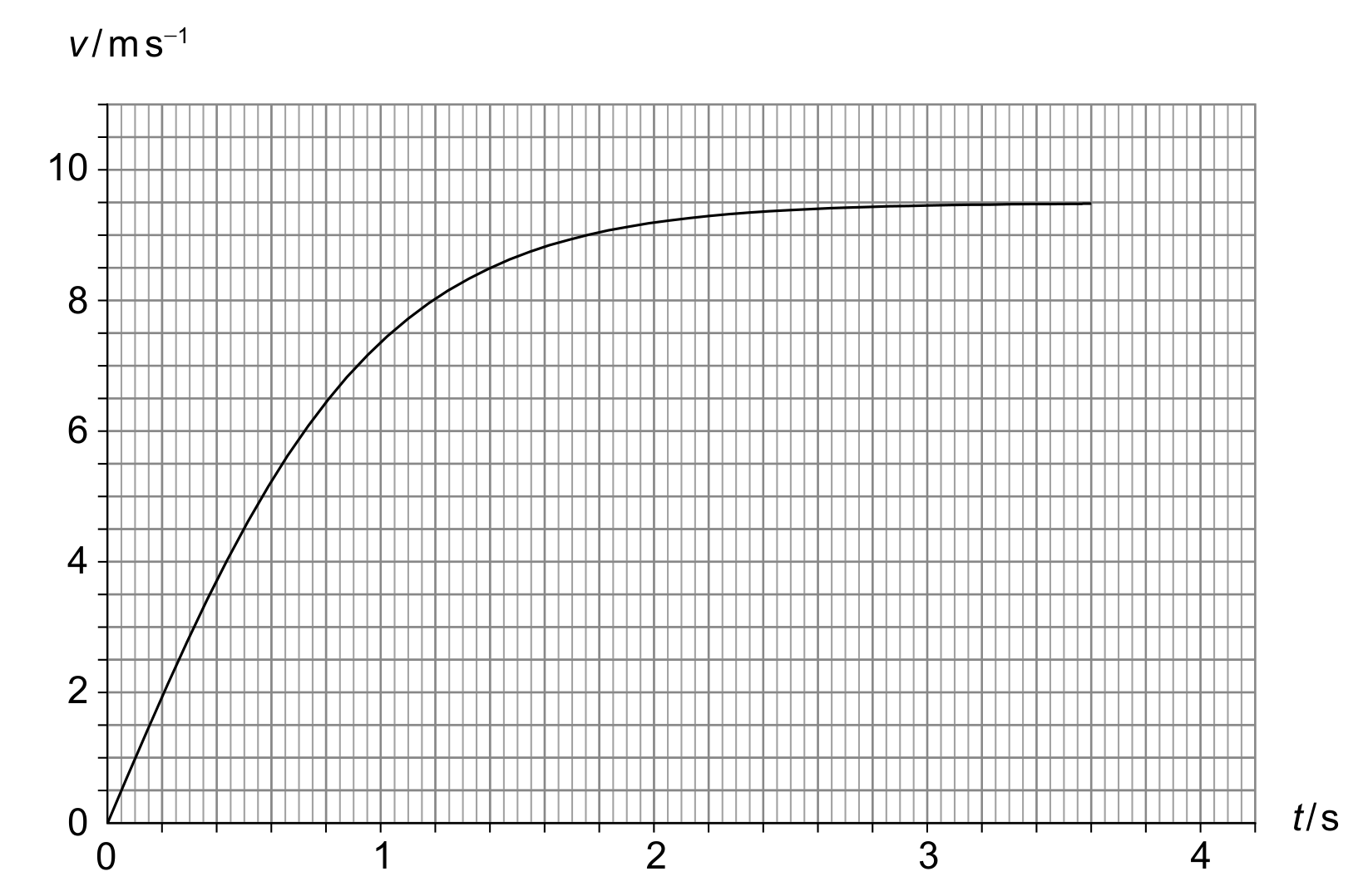
The graph shows the variation with time t of the speed v of the ball from the instant it is released until it impacts the ground.

Question image
[ 3 ]

Question 1(c)(iv)

(i)

Calculate the average power dissipated by the air resistance force.

[ 3 ]

Question 1

[Maximum number: 6]

A girl rides a bicycle that is powered by an electric motor. A battery transfers energy to the electric motor. The emf of the battery is 16 V and it can deliver a charge of 43 kC when discharging completely from a full charge.

Question 1(a)

(a)

The maximum speed of the girl on a horizontal road is 7.0 m s17.0 \mathrm{~m} \mathrm{~s}^{-1} with energy from the battery alone. The maximum distance that the girl can travel under these conditions is 20 km .

[ 4 ]

Question 1(a)(ii)

(i)

Deduce that the average power output of the battery is about 240 W .

[ 2 ]

Question 1(a)(iii)

(ii)

Friction and air resistance act on the bicycle and the girl when they move. Assume that all the energy is transferred from the battery to the electric motor. Determine the total average resistive force that acts on the bicycle and the girl.

[ 2 ]

Question 1(c)

(b)

On another journey up the slope, the girl carries an additional mass. Explain whether carrying this mass will change the maximum distance that the bicycle can travel along the slope.

[ 2 ]

Question 1

[Maximum number: 3]

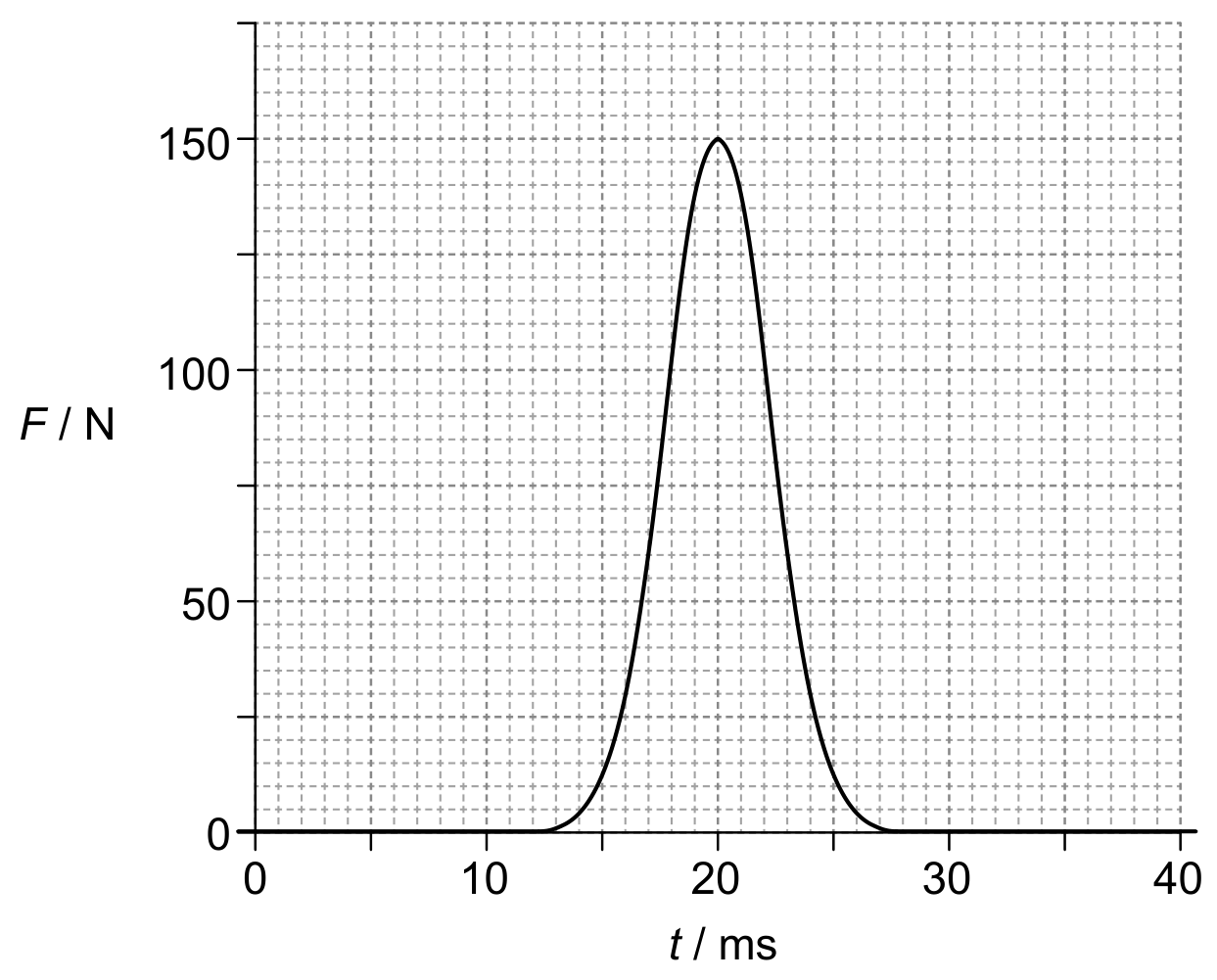
The graph shows the variation with time t of the horizontal force F exerted on a tennis ball by a racket.

Question image

The tennis ball was stationary at the instant when it was hit. The mass of the tennis ball is 5.8×10² kg5.8 \times 10^{-2} \mathrm{~kg}. The area under the curve is 0.84 Ns .

Question 1(c)

(a)

Determine, with reference to the work done by the average force, the horizontal distance travelled by the ball while it was in contact with the racket.

[ 3 ]

Question 1

[Maximum number: 2]

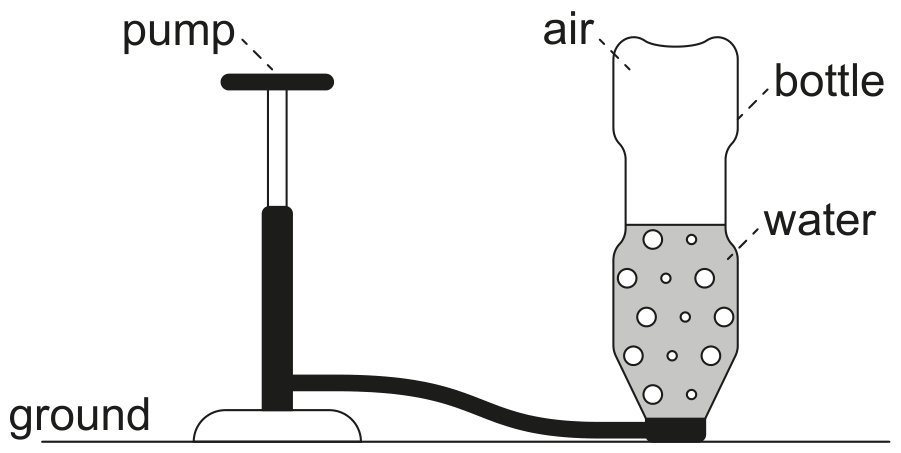
A toy rocket is made from a plastic bottle that contains some water.

Air is pumped into the vertical bottle until the pressure inside forces water and air out of the bottle. The bottle then travels vertically upwards.

Question image

The air-water mixture is called the propellant.
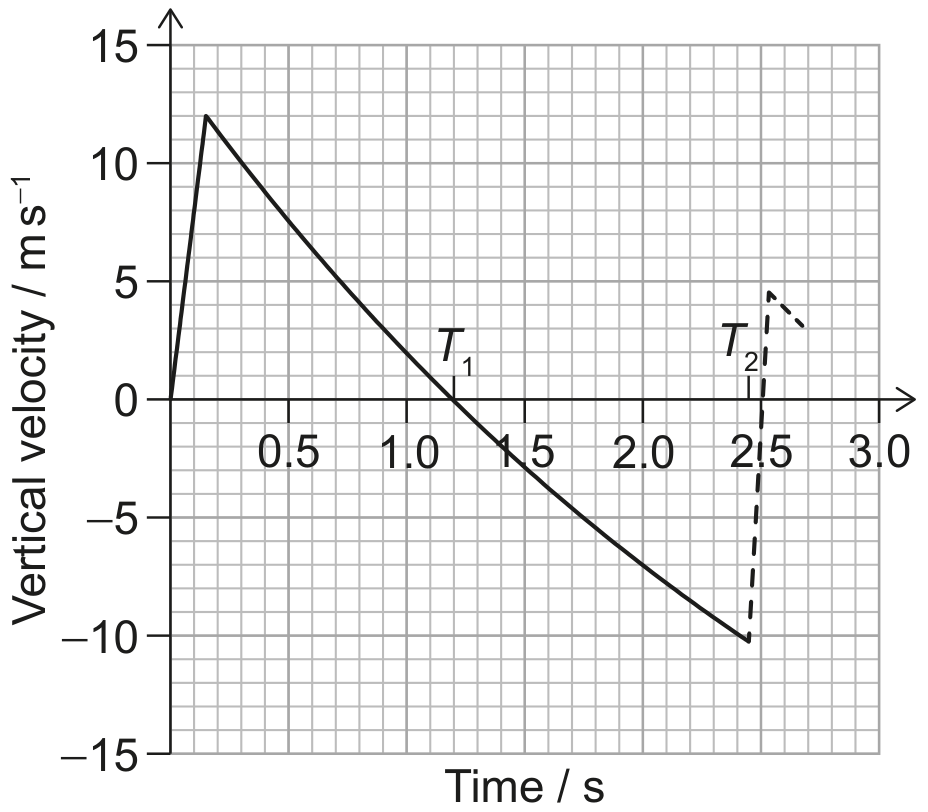
The variation with time of the vertical velocity of the bottle is shown.

Question image

The bottle reaches its highest point at time T1T_{1} on the graph and returns to the ground at time T2T_{2}. The bottle then bounces. The motion of the bottle after the bounce is shown as a dashed line.

Question 1(c)

(a)

The bottle bounces when it returns to the ground.

[ 2 ]

Question 1(c)(i)

(i)

Calculate the fraction of the kinetic energy of the bottle that remains after the bounce.

[ 2 ]

Question 1

[Maximum number: 4]

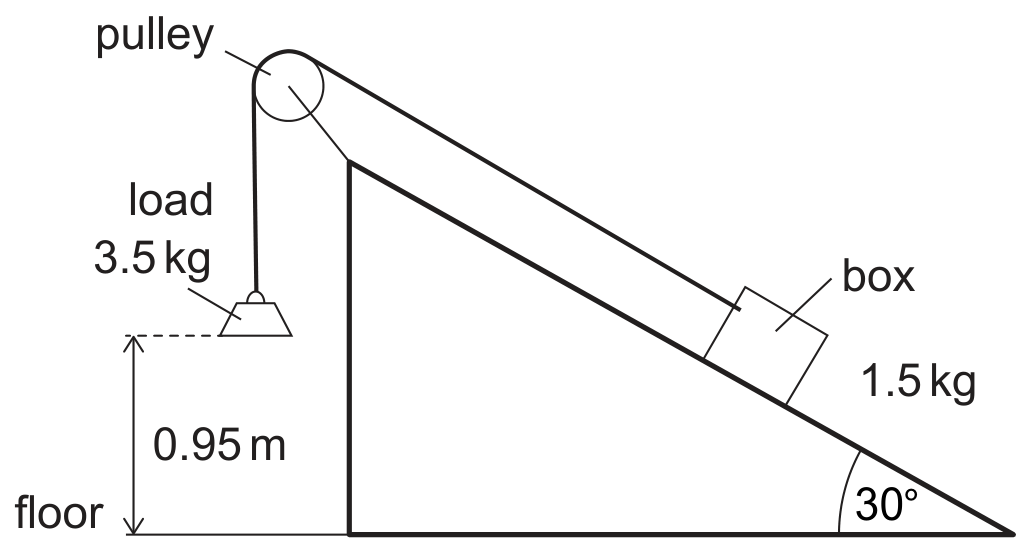
A student uses a load to pull a box up a ramp inclined at 3030^{\circ}. A string of constant length and negligible mass connects the box to the load that falls vertically. The string passes over a pulley that runs on a frictionless axle. Friction acts between the base of the box and the ramp. Air resistance is negligible.

Question image

The load has a mass of 3.5 kg and is initially 0.95 m above the floor. The mass of the box is 1.5 kg .

The load is released and accelerates downwards.

Question 1(d)

(a)

After the load has hit the floor, the box travels a further 0.35 m along the ramp before coming to rest. Determine the average frictional force between the box and the surface of the ramp.

[ 4 ]

Question 1

[Maximum number: 2]

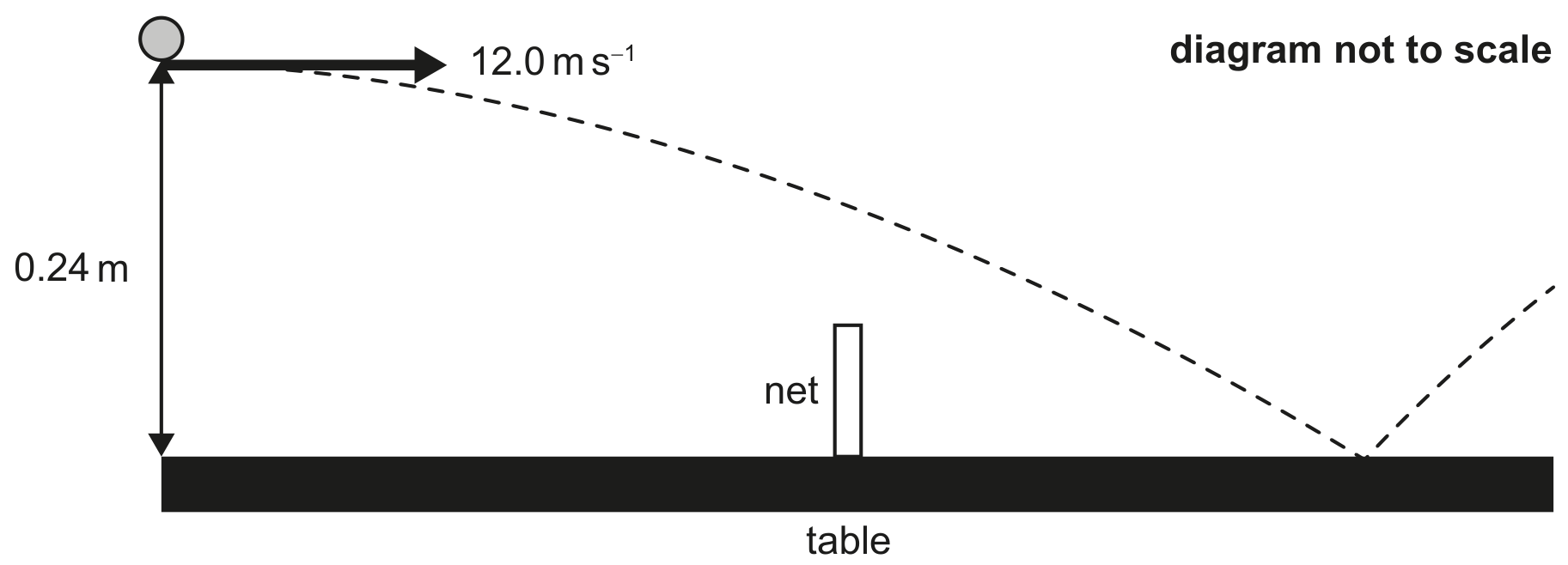
Two players are playing table tennis. Player A hits the ball at a height of 0.24 m above the edge of the table, measured from the top of the table to the bottom of the ball. The initial speed of the ball is 12.0 ms112.0 \mathrm{~ms}^{-1} horizontally. Assume that air resistance is negligible.

Question image

Question 1(d)

(a)

The ball bounces and then reaches a peak height of 0.18 m above the table with a horizontal speed of 10.5 ms110.5 \mathrm{~ms}^{-1}. The mass of the ball is 2.7 g .

[ 2 ]

Question 1(d)(i)

(i)

Determine the kinetic energy of the ball immediately after the bounce.

[ 2 ]

Question 1

[Maximum number: 1]

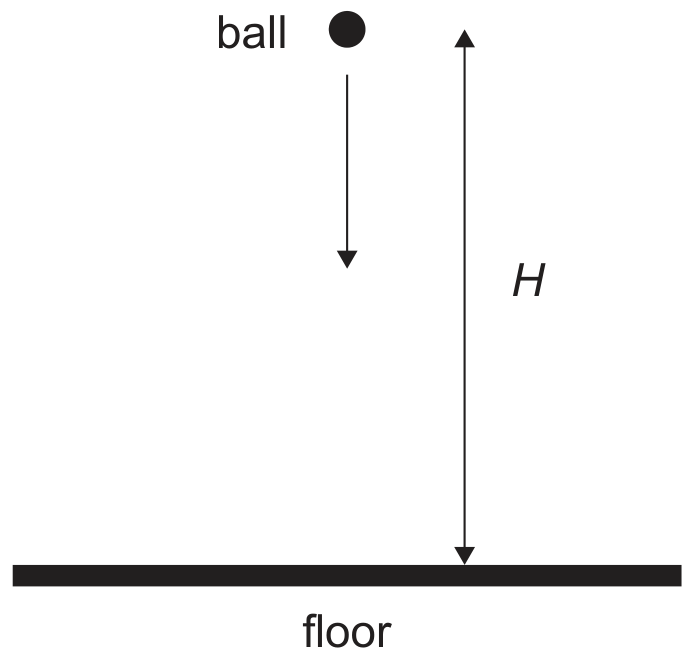
A ball of mass 0.250 kg is released from rest at time t=0, from a height H above a horizontal floor.

Question image

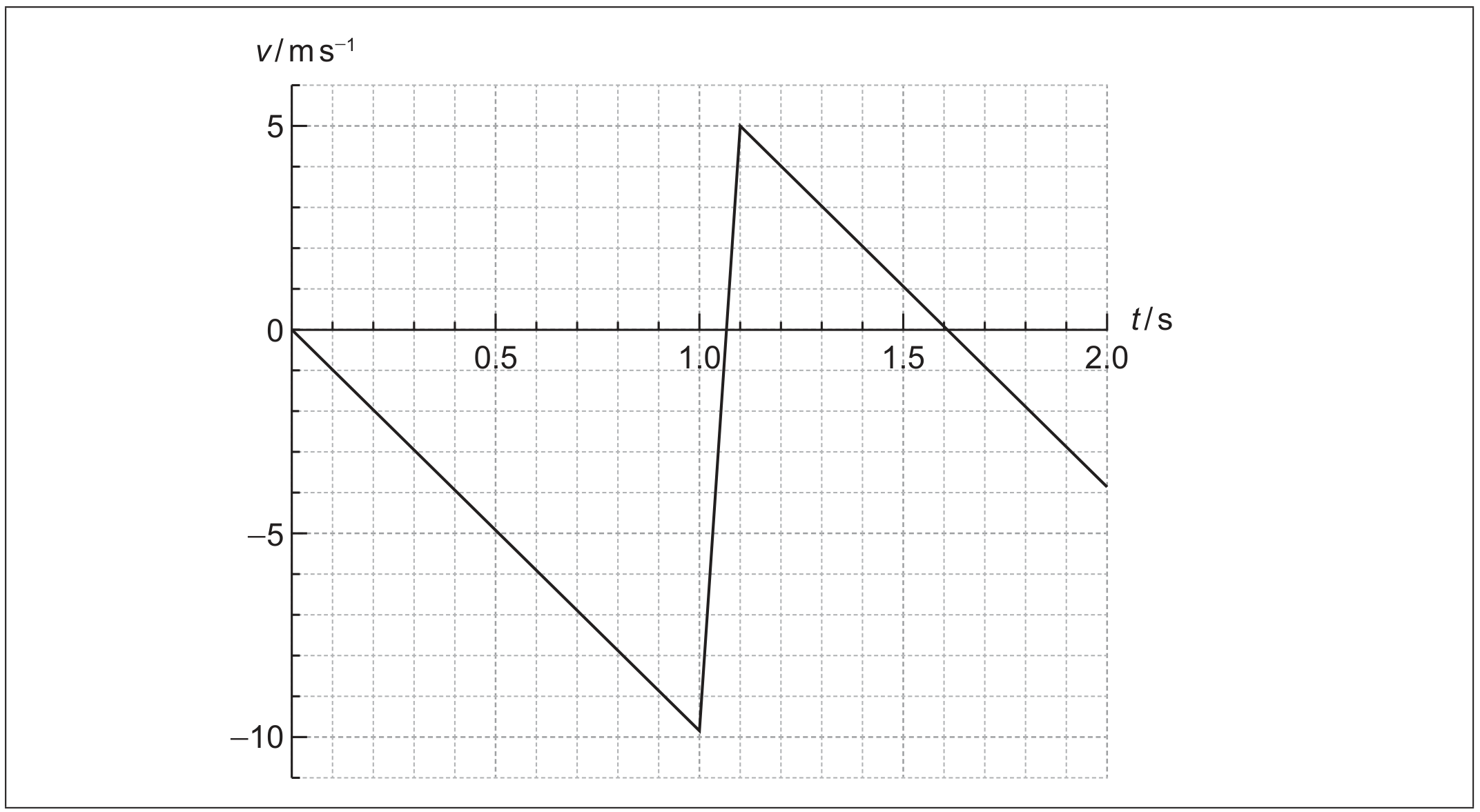
The graph shows the variation with time t of the velocity v of the ball. Air resistance is negligible. Take g=9.80 ms2g=-9.80 \mathrm{~ms}^{-2}. The ball reaches the floor after 1.0 s .

Question image

Question 1(c)

(a)

Estimate the loss in the mechanical energy of the ball as a result of the collision with the floor.

[ 1 ]

Question 1

[Maximum number: 3]

A box of mass 1.2 kg is lying at rest on a surface. The coefficient of static friction between the box and the surface is 0.36 and the coefficient of dynamic friction between the box and the surface is 0.28 .

Question 1(c)

(a)

A force of 14.0 N acts on the box for 0.35 m as shown. The force is then removed and the box continues to move. The box comes to rest after a further displacement d.

Question image

Determine d.

[ 3 ]
0 selected