EduNinja

IB Physics HLA.1 KinematicsQuestion Bank

Question 1

[Maximum number: 3]

A tennis ball is hit with a racket from a point 1.5 m above the floor. The ceiling is 8.0 m above the floor. The initial velocity of the ball is 15 m s115 \mathrm{~m} \mathrm{~s}^{-1} at 5050^{\circ} above the horizontal. Assume that air resistance is negligible.
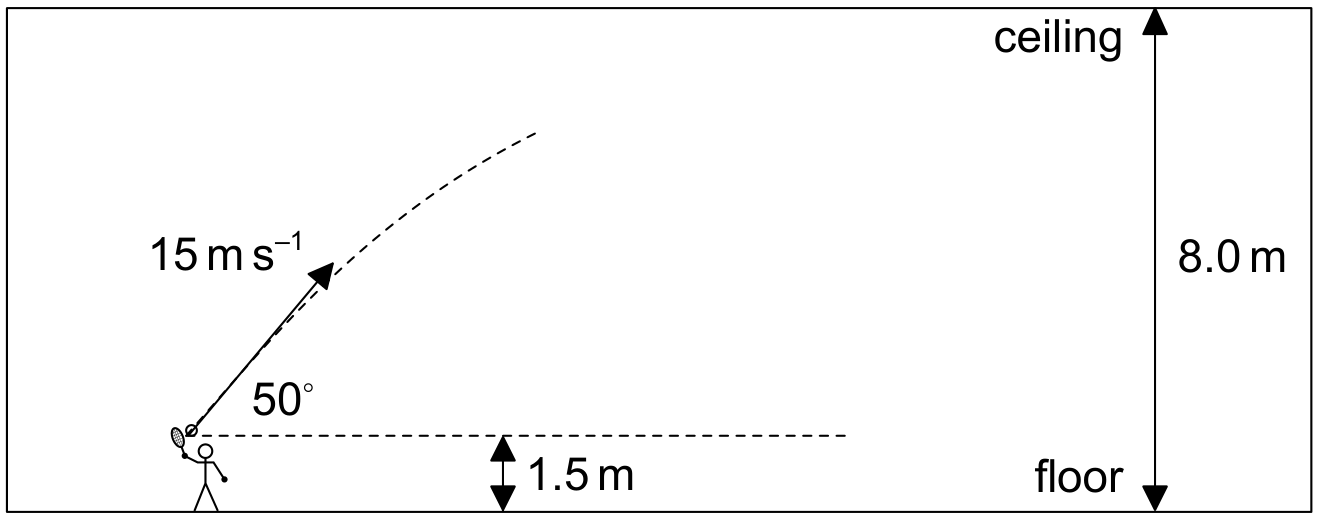
Question image

Question 1(a)

(a)

Determine whether the ball will hit the ceiling.

[ 3 ]
Question 1

[Maximum number: 1]

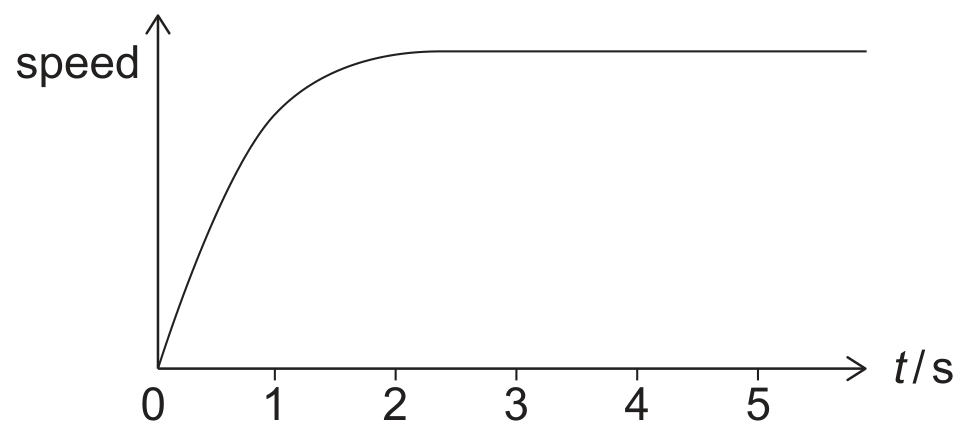
A raindrop falls vertically from rest.

Question 1(a)

(a)

State the initial acceleration of the raindrop.

The graph shows how the speed of the raindrop varies with time t.

Question image
[ 1 ]

Question 1

[Maximum number: 4]

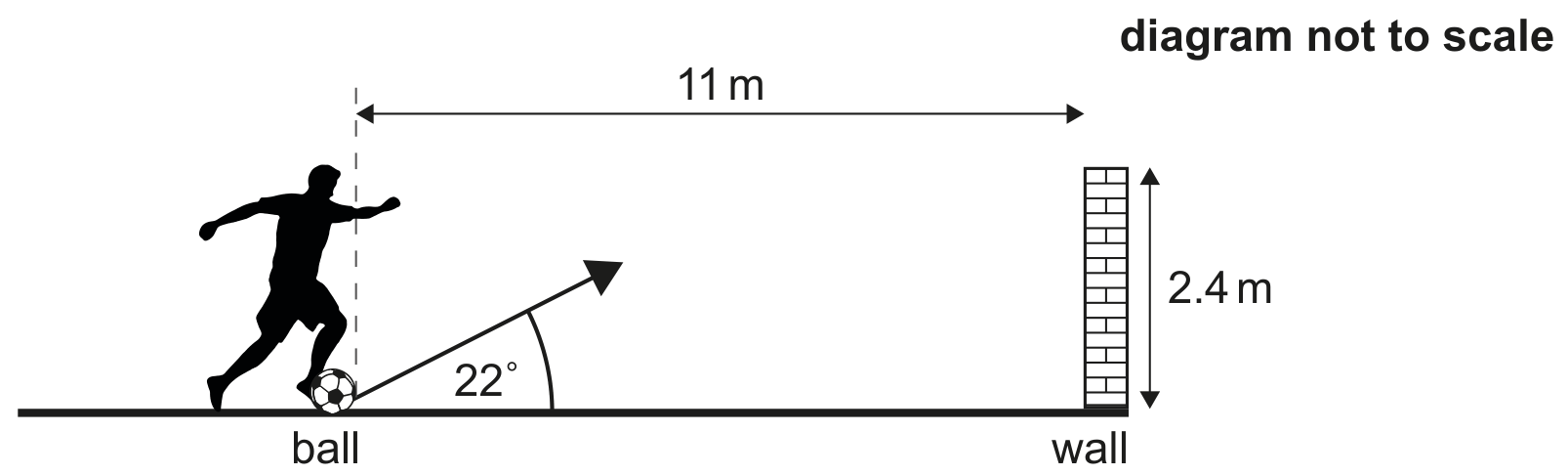
A football player kicks a stationary ball of mass 0.45 kg towards a wall. The initial speed of the ball after the kick is 19 m s119 \mathrm{~m} \mathrm{~s}^{-1} and the ball does not rotate. Air resistance is negligible and there is no wind.

Question image

Question 1(b)

Question 1(b)(i)

(a)
(i)

The ball leaves the ground at an angle of 2222^{\circ}. The horizontal distance from the initial position of the edge of the ball to the wall is 11 m . Calculate the time taken for the ball to reach the wall.

[ 2 ]

Question 1(c)

(b)

In practice, air resistance affects the ball. Outline the effect that air resistance has on the vertical acceleration of the ball. Take the direction of the acceleration due to gravity to be positive.

[ 2 ]

Question 1

[Maximum number: 5]

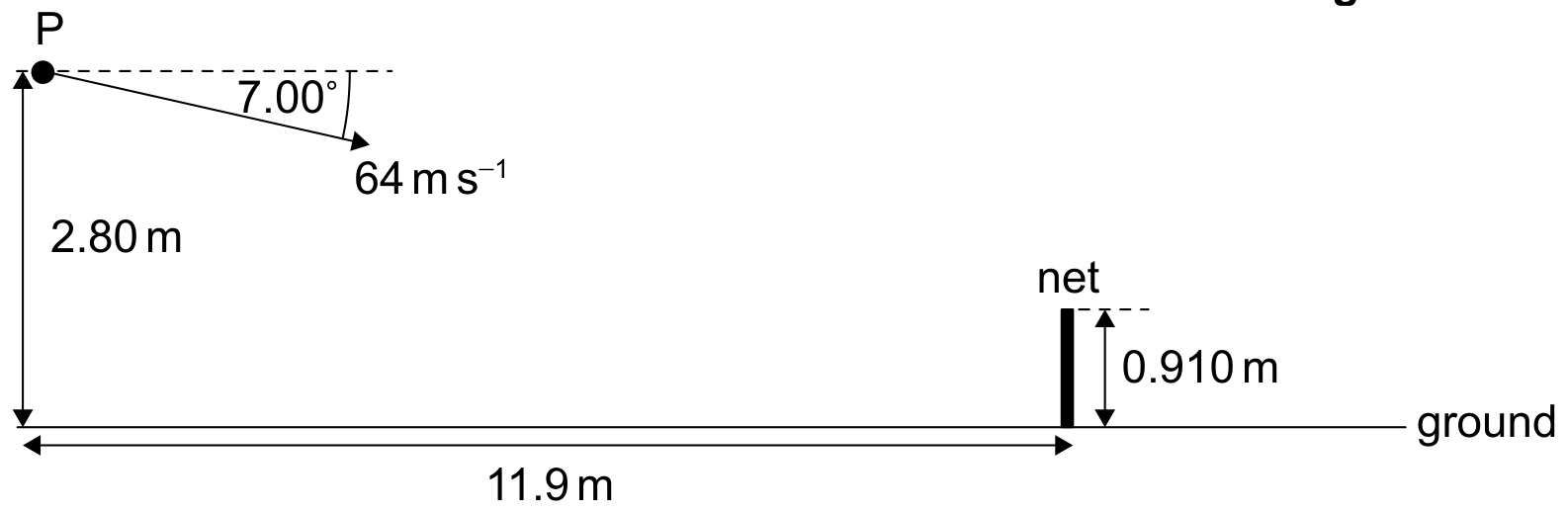
A student strikes a tennis ball that is initially at rest so that it leaves the racquet at a speed of 64 m s164 \mathrm{~m} \mathrm{~s}^{-1}. The ball has a mass of 0.058 kg and the contact between the ball and the racquet lasts for 25 ms .

Question 1(b)

(a)

The student strikes the tennis ball at point P . The tennis ball is initially directed at an angle of 7.007.00^{\circ} to the horizontal.

Question image

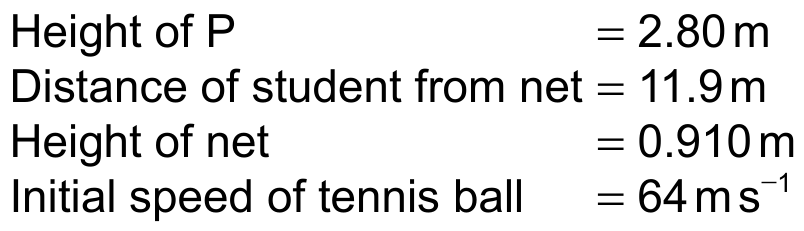
The following data are available.

Table
[ 5 ]

Question 1(b)(i)

(i)

Calculate the time it takes the tennis ball to reach the net.

[ 2 ]

Question 1(b)(ii)

(ii)

Show that the tennis ball passes over the net.

[ 3 ]

Question 1

[Maximum number: 2]

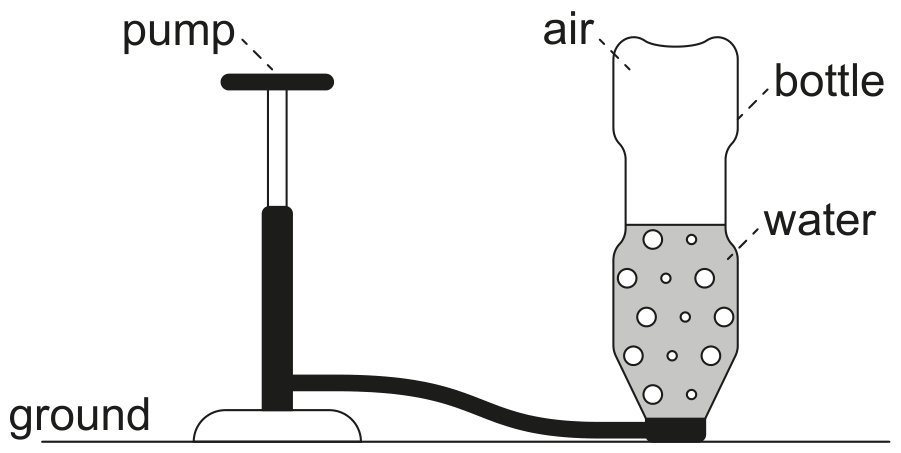
A toy rocket is made from a plastic bottle that contains some water.

Air is pumped into the vertical bottle until the pressure inside forces water and air out of the bottle. The bottle then travels vertically upwards.

Question image

The air-water mixture is called the propellant.
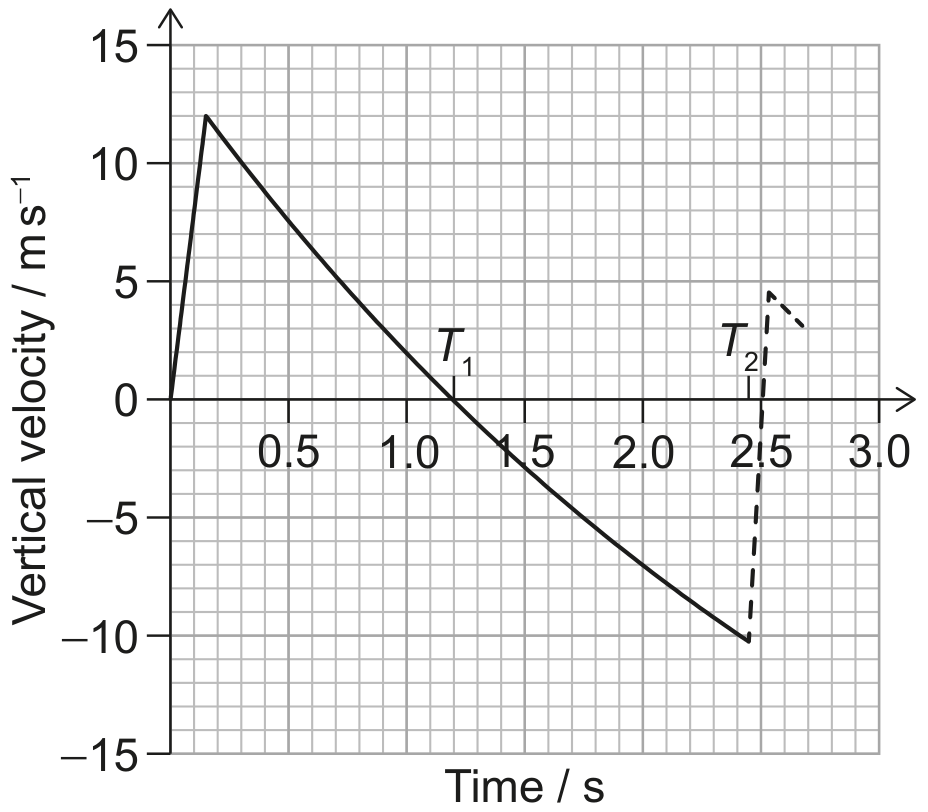
The variation with time of the vertical velocity of the bottle is shown.

Question image

The bottle reaches its highest point at time T1T_{1} on the graph and returns to the ground at time T2T_{2}. The bottle then bounces. The motion of the bottle after the bounce is shown as a dashed line.

Question 1(b)

(a)

Estimate the acceleration of the bottle when it is at its maximum height.

[ 2 ]

Question 1

[Maximum number: 3]

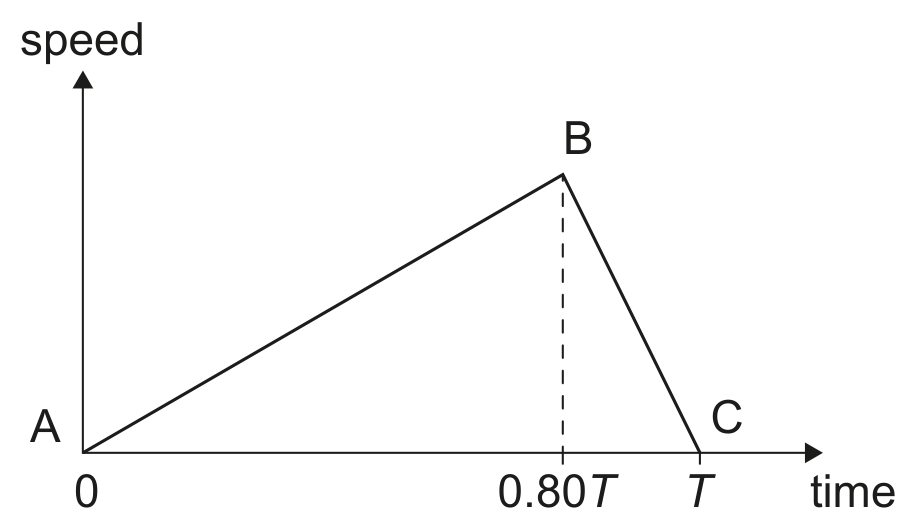
A train starting from rest travels from A to B with acceleration 0.20 m s20.20 \mathrm{~m} \mathrm{~s}^{-2} and then decelerates to rest from B to C. The total distance from A to C is 1800 m . The graph shows the variation with time of the speed of the train.

Question image

The time of travel from A to C is T and the time from A to B is 0.80 T.

Question 1(a)

(a)

Write down the speed of the train when at point B in terms of T.

[ 1 ]

Question 1(b)

(b)

Determine T.

[ 2 ]

Question 1

[Maximum number: 2]

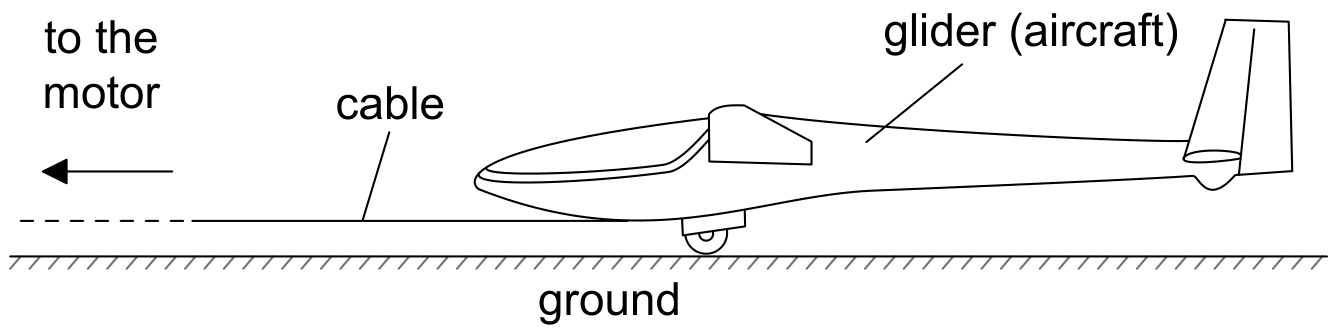
A glider is an aircraft with no engine. To be launched, a glider is uniformly accelerated from rest by a cable pulled by a motor that exerts a horizontal force on the glider throughout the launch.

Question image

Question 1(a)

(a)

The glider reaches its launch speed of 27.0 m s127.0 \mathrm{~m} \mathrm{~s}^{-1} after accelerating for 11.0 s . Assume that the glider moves horizontally until it leaves the ground. Calculate the total distance travelled by the glider before it leaves the ground.

[ 2 ]

Question 1

[Maximum number: 2]

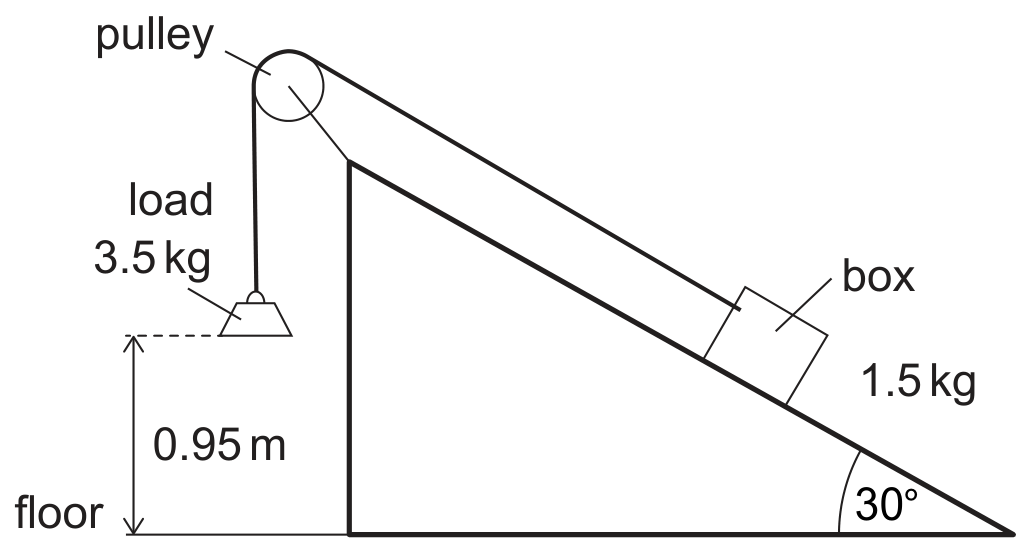
A student uses a load to pull a box up a ramp inclined at 3030^{\circ}. A string of constant length and negligible mass connects the box to the load that falls vertically. The string passes over a pulley that runs on a frictionless axle. Friction acts between the base of the box and the ramp. Air resistance is negligible.

Question image

The load has a mass of 3.5 kg and is initially 0.95 m above the floor. The mass of the box is 1.5 kg .

The load is released and accelerates downwards.

Question 1(c)

(a)

Show that the speed of the load when it hits the floor is about 2.1 ms12.1 \mathrm{~ms}^{-1}.

[ 2 ]

Question 1

[Maximum number: 2]

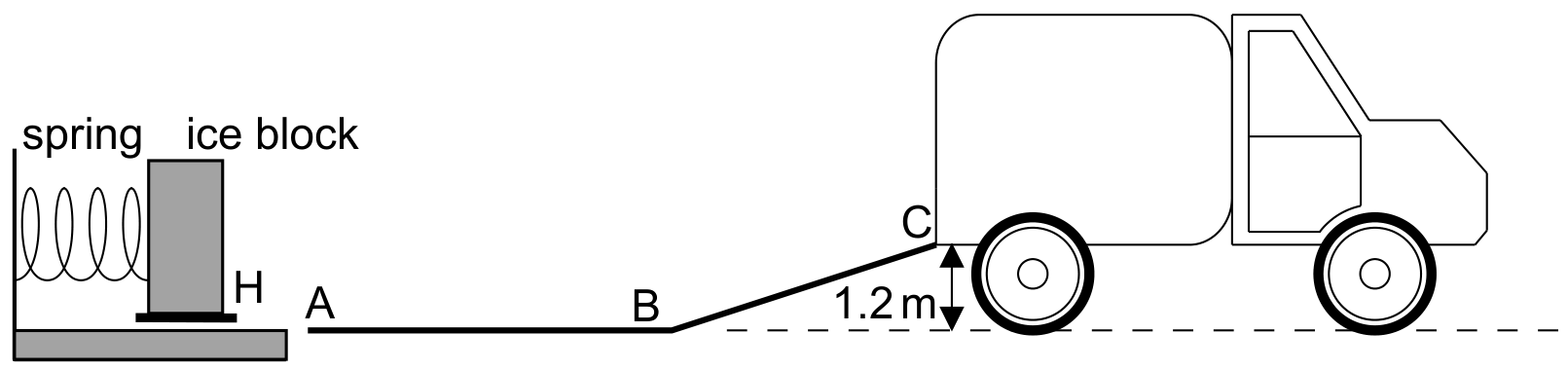
A company designs a spring system for loading ice blocks onto a truck. The ice block is placed in a holder H in front of the spring and an electric motor compresses the spring by pushing H to the left. When the spring is released the ice block is accelerated towards a ramp ABC . When the spring is fully decompressed, the ice block loses contact with the spring at A . The mass of the ice block is 55 kg .

Question image

Assume that the surface of the ramp is frictionless and that the masses of the spring and the holder are negligible compared to the mass of the ice block.

Question 1(c)

(a)

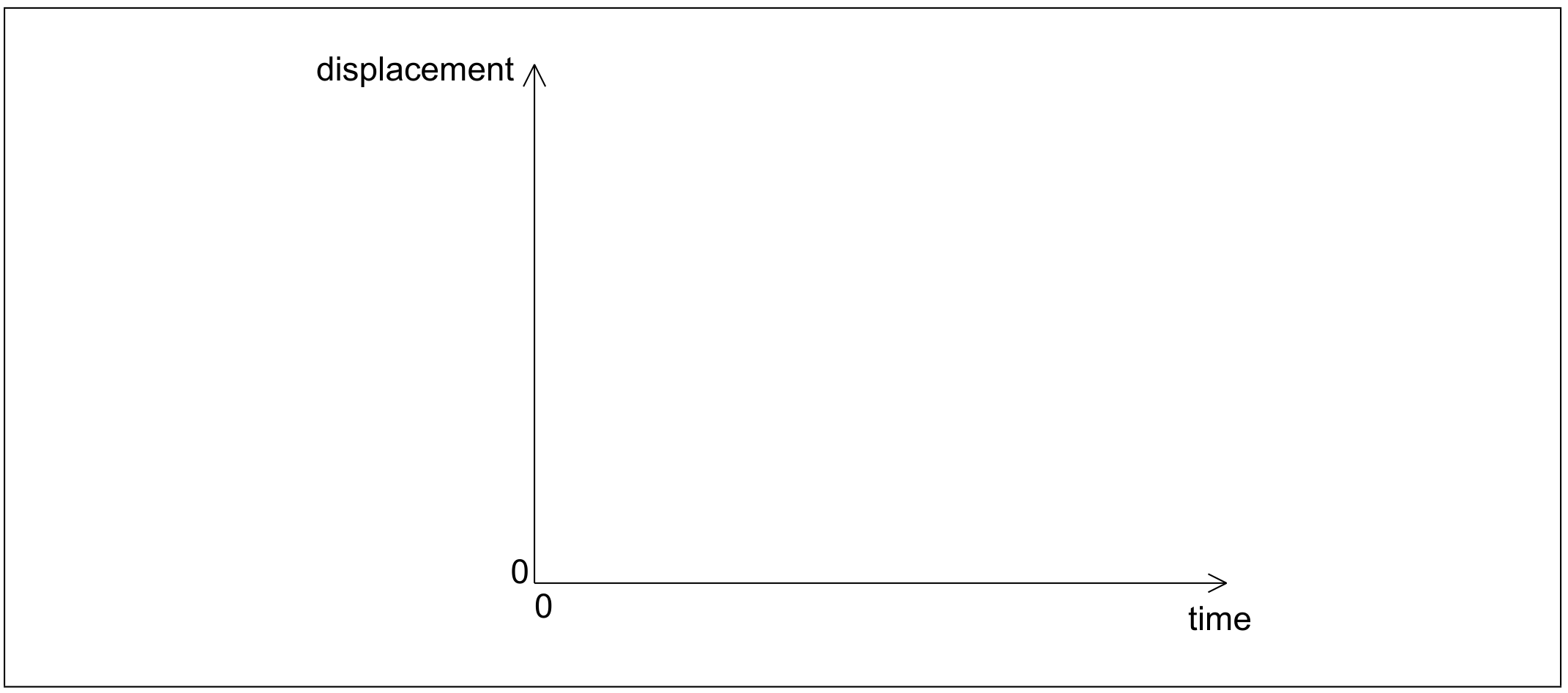
On the axes, sketch a graph to show how the displacement of the block varies with time from A to C. (You do not have to put numbers on the axes.)

Question image
[ 2 ]

Question 1

[Maximum number: 6]

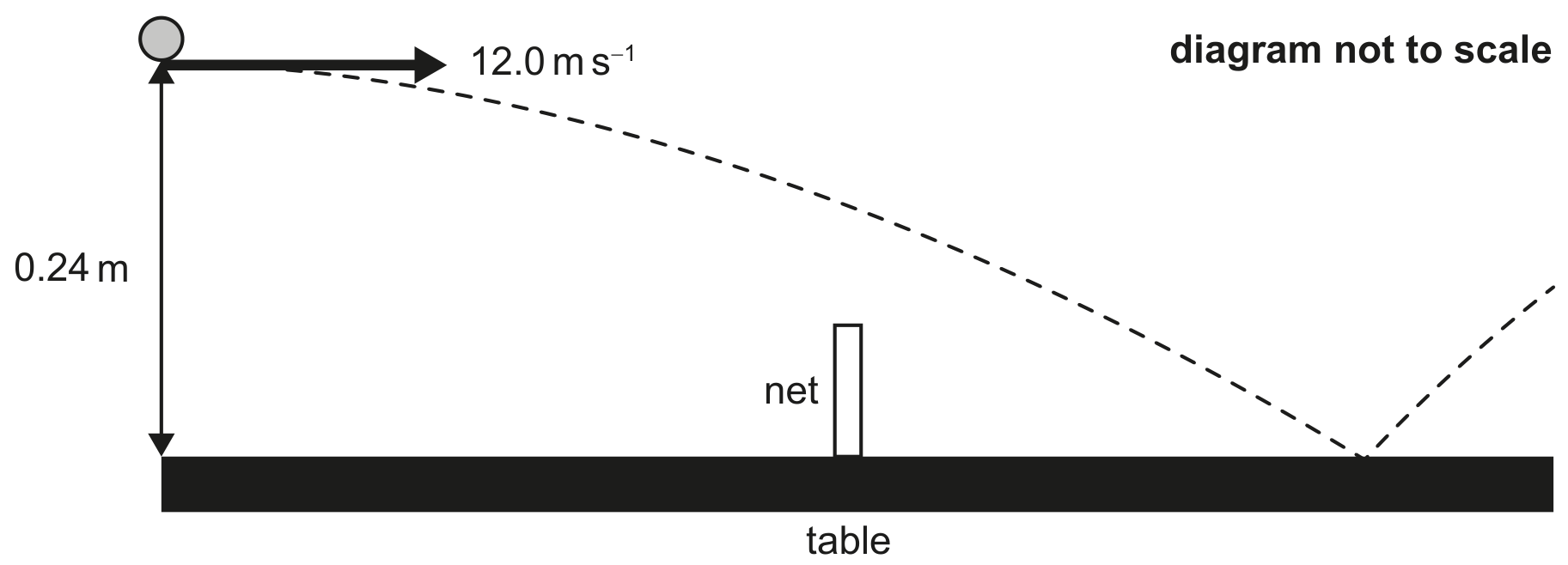
Two players are playing table tennis. Player A hits the ball at a height of 0.24 m above the edge of the table, measured from the top of the table to the bottom of the ball. The initial speed of the ball is 12.0 ms112.0 \mathrm{~ms}^{-1} horizontally. Assume that air resistance is negligible.

Question image

Question 1(a)

(a)

Show that the time taken for the ball to reach the surface of the table is about 0.2 s .

[ 1 ]

Question 1(b)

(b)

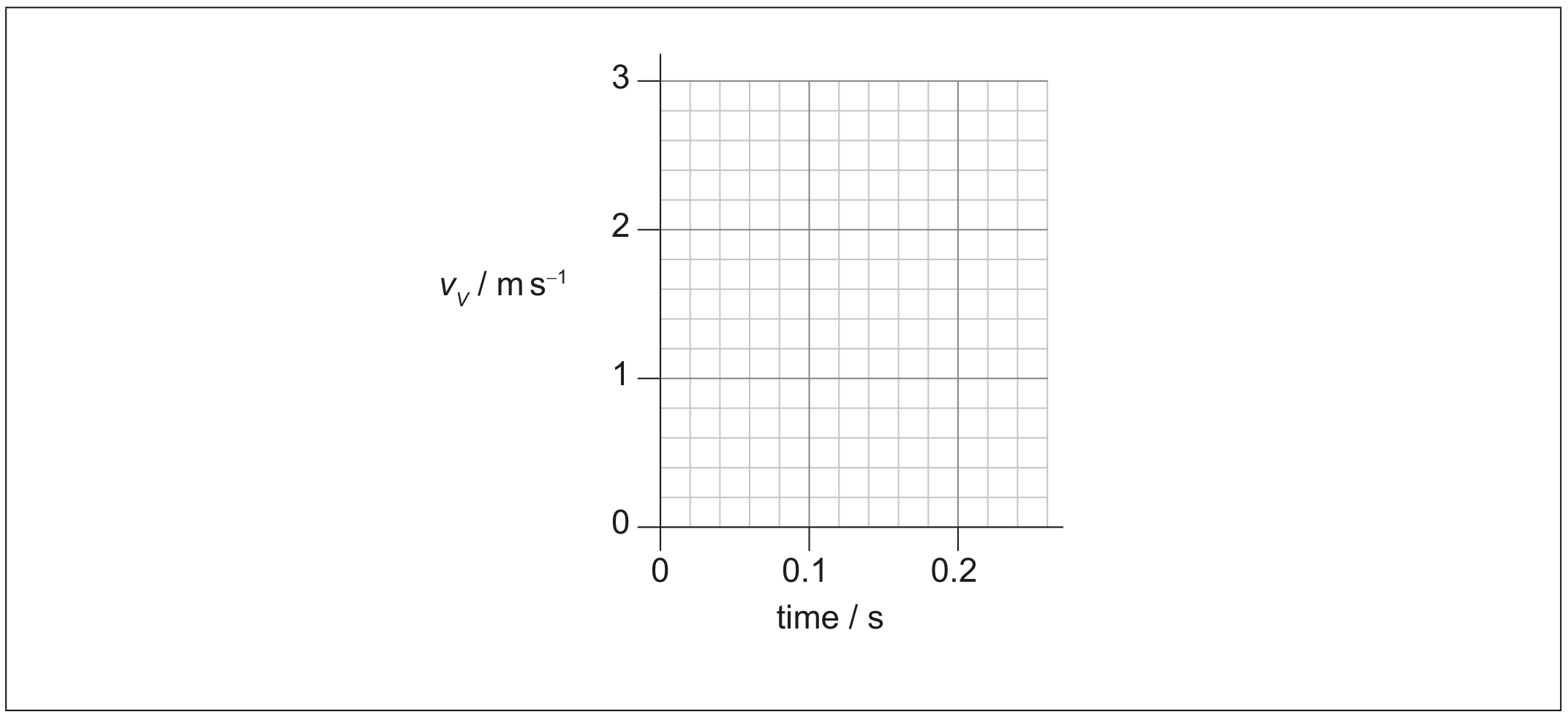
Sketch, on the axes, a graph showing the variation with time of the vertical component of velocity vvv_{v} of the ball until it reaches the table surface. Take g to be +10 ms2+10 \mathrm{~ms}^{-2}.

Question image
[ 2 ]

Question 1(c)

(c)

The net is stretched across the middle of the table. The table has a length of 2.74 m and the net has a height of 15.0 cm .

Show that the ball will go over the net.

[ 3 ]
0 selected