EduNinja

IB Physics HLC.5 Doppler effectQuestion Bank

Question A4

[Maximum number: 7]

A4. This question is about the Doppler effect.
A source emits sound of frequency 100 Hz . The speed of sound in air is 330 m s1330 \mathrm{~m} \mathrm{~s}^{-1}.
(a) Calculate the frequency measured by an observer when
(i) the observer is stationary and the source is moving towards the observer at 120 m s1120 \mathrm{~m} \mathrm{~s}^{-1}.
(ii) the source is stationary and the observer is moving towards the source at 120 ms1120 \mathrm{~ms}^{-1}.
(b) When both source and observer are stationary the wavelength is λ0\lambda_{0} and the wavespeed is v0v_{0}.

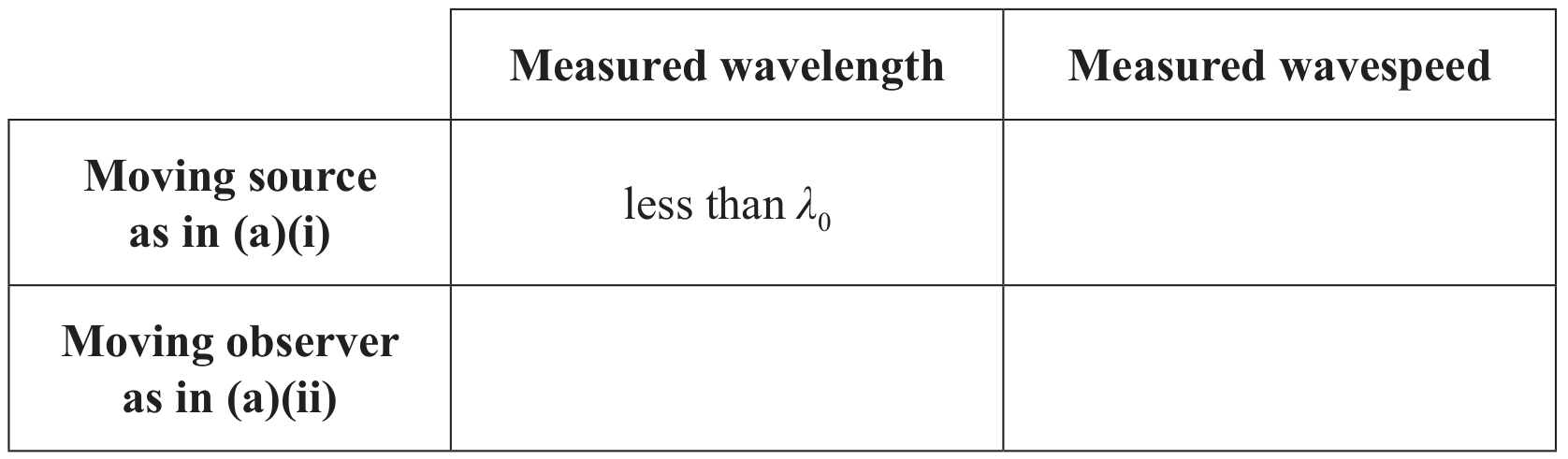
In the table below, compare the values of measured wavelength and measured wavespeed, as measured by the observer, with respect to λ0\lambda_{0} and v0v_{0}. One of the values is given for you.
Table

Question E5

[Maximum number: 3]

E5. This question is about red-shift.
The wavelengths of radio signals from galaxy A are found to be red-shifted from the wavelengths that would be observed from sources at rest relative to Earth.
(a) The fractional change in wavelength of the radio signals from galaxy A is 9.4×1039.4 \times 10^{-3}.

Calculate, in kms1\mathrm{km} \mathrm{s}^{-1}, the average velocity of galaxy A relative to Earth.
(b) A supernova was observed within galaxy A. At the peak of its emissions, the supernova had an absolute magnitude of -20 and an apparent magnitude of 13 .

Show that the distance from Earth to the supernova is about 40 Mpc .
(c) Estimate, using your answer to (a) and the result for (b), the age of the universe.

(1pc=3.1×10¹³ km)\left(1 \mathrm{pc}=3.1 \times 10^{13} \mathrm{~km}\right)

Question E1

Question E1(c)

(a)

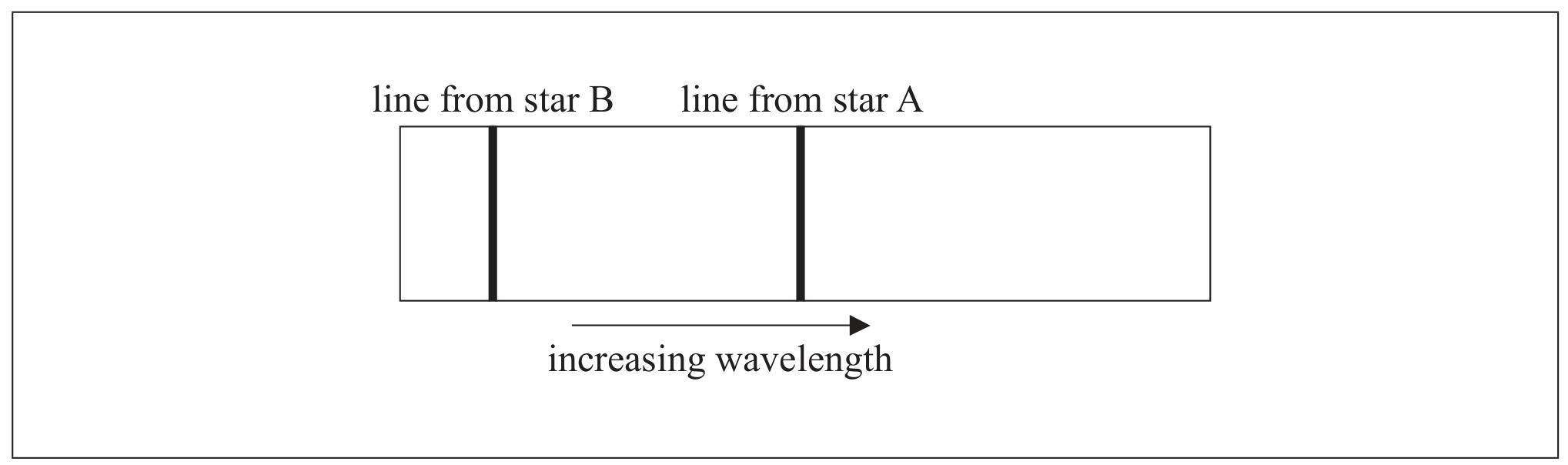
The diagram below shows the spectrum of the stars as observed from Earth. The spectrum shows one line from star A and one line from star B, when the stars are in the position shown in the diagram (b).

Question image

On the spectrum draw lines to show the approximate positions of these spectral lines after the stars have completed one quarter of a revolution.

E2. This question is about Cepheid stars.

[ 2 ]

Question 14

[Maximum number: 1]

A sample of hydrogen on Earth emits a spectral line that is measured by an Earth observer to have wavelength 500 nm . The same spectral line is emitted by a galactic source that is moving away from Earth at speed of 0.1 c . What is the wavelength of the galactic spectral line that will be measured by the Earth observer?

A

50 nm

B

450 nm

C

550 nm

D

5000 nm

Question 14

[Maximum number: 1]

A car horn emits sound of frequency f. While the horn is sounding, the car moves in a straight line towards a stationary observer. The speed of the car is 0.10 v where v is the speed of sound. What is the frequency of the sound of the horn heard by the observer?

A

f0.90\frac{f}{0.90}

B

1.1 f

C

f1.1\frac{f}{1.1}

D

0.90 f

Question 14

[Maximum number: 1]

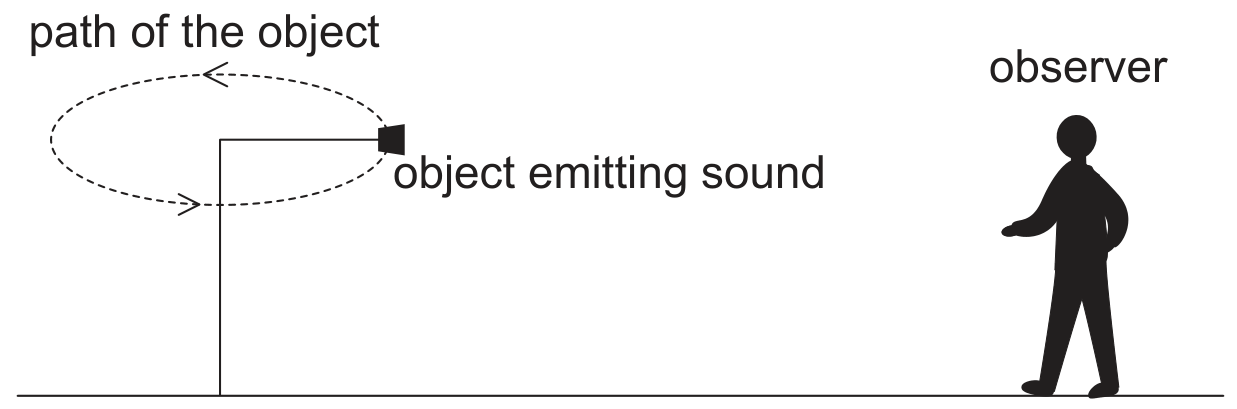
An object emitting a sound of frequency 100 Hz orbits in a horizontal circle at a rate of two revolutions per second.

Question image

An observer standing a short distance away from the object is able to hear the sound. Which of the following describes the sound the observer is able to hear?

A

A sound of constant frequency but varying in amplitude

B

A sound of constantly varying frequency

C

A sound with a frequency of 50 Hz

D

A sound with a frequency of 200 Hz

Question 14

[Maximum number: 1]

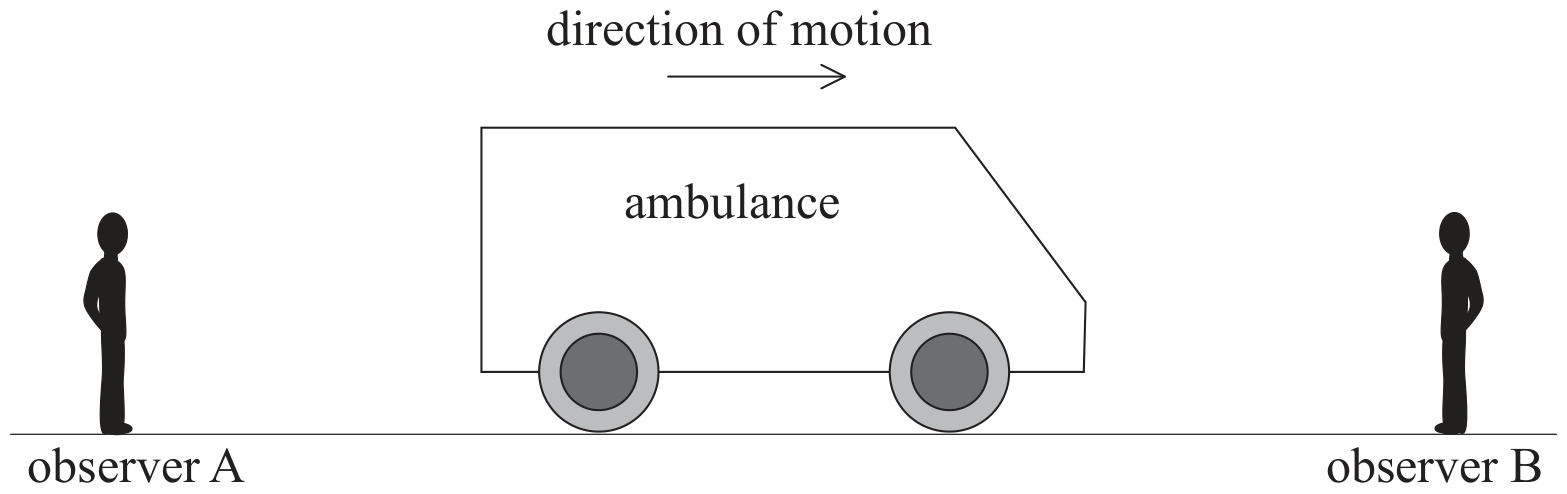
An ambulance emits a sound of frequency f as it travels along a straight road between stationary observers A and B .

Question image

Which of the following shows how the frequency of the sound heard by each observer compares with f ?

Observer A

Observer B

greater than f

greater than f

greater than f

less than f

less than f

greater than f

less than f

less than f

Question 14

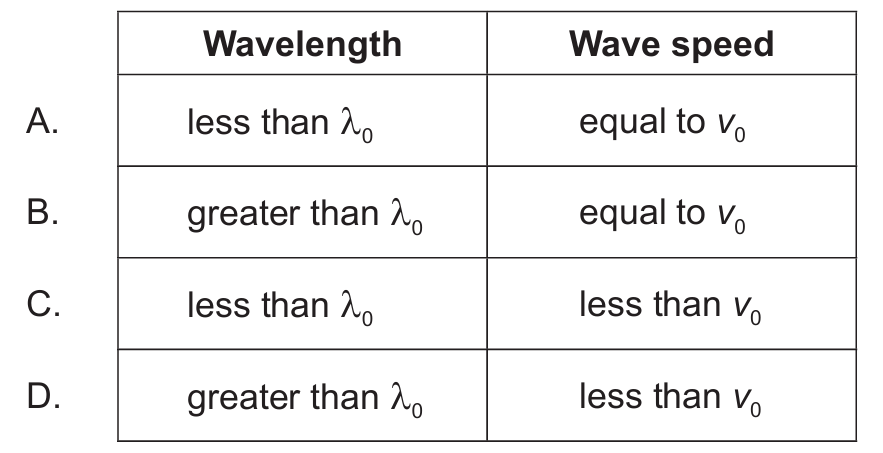
A source emits sound of wavelength λ0\lambda_{0} and wave speed v0v_{0}. A stationary observer hears the sound as the source moves away. What are the wavelength of the sound and the wave speed of the sound as measured by the stationary observer?

Question image

Question 14

[Maximum number: 1]

A source of sound moves away from an observer. The observed frequency of the sound differs from the frequency emitted by the source because the

A

observed wavelength of the sound is less than the emitted wavelength.

B

observed wavelength of the sound is greater than the emitted wavelength.

C

speed of sound relative to the observer has decreased.

D

speed of sound relative to the observer has increased.

Question 3

[Maximum number: 2]

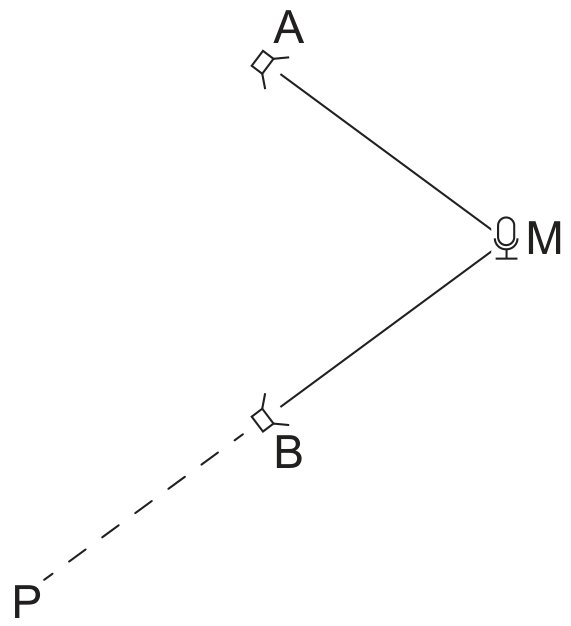
Two loudspeakers A and B are initially equidistant from a microphone M. The frequency and intensity emitted by A and B are the same. A and B emit sound in phase. A is fixed in position.

Question image

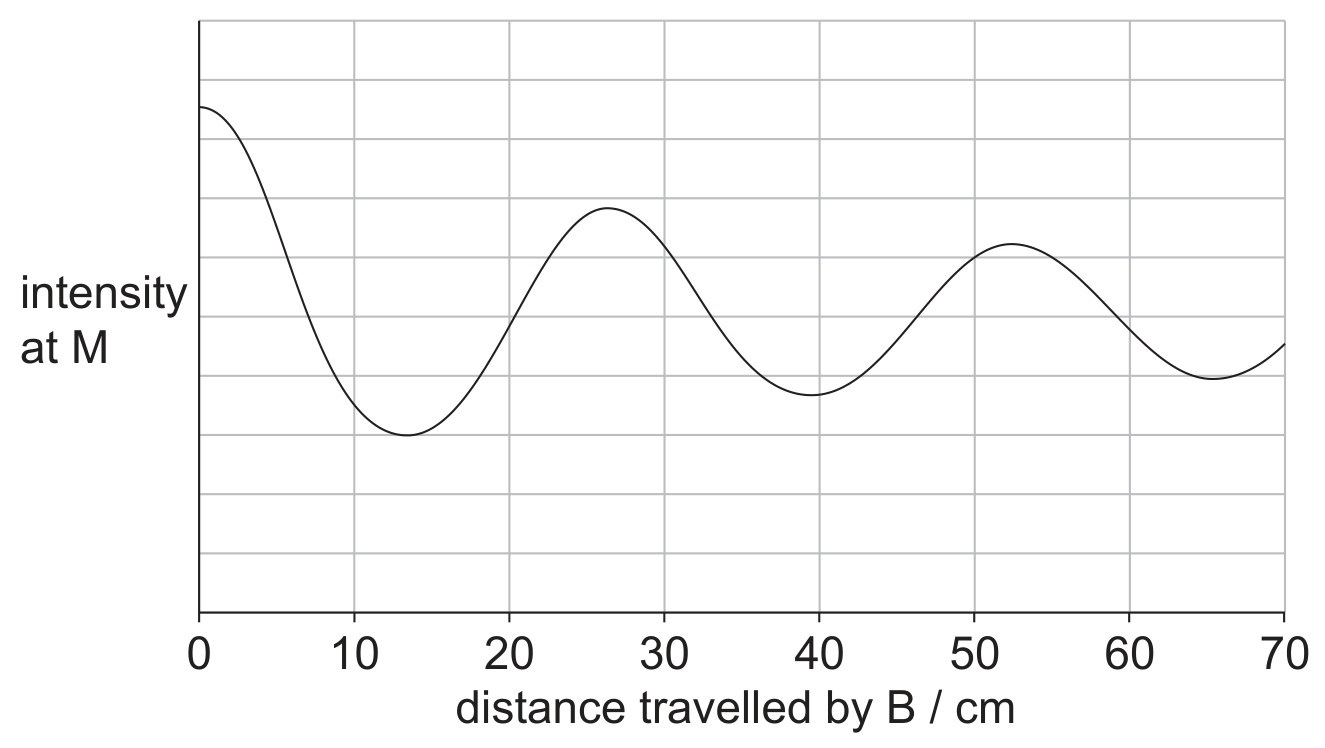
B is moved slowly away from M along the line MP. The graph shows the variation with distance travelled by B of the received intensity at M .

Question image

Question 3(d)

(a)

Loudspeaker A is switched off. Loudspeaker B moves away from M at a speed of 1.5 m s11.5 \mathrm{~m} \mathrm{~s}^{-1} while emitting a frequency of 3.0 kHz .

Determine the difference between the frequency detected at M and that emitted by B.

[ 2 ]
0 selected