EduNinja

IB Physics HLB.5 Current and circuitsQuestion Bank

Question 1

[Maximum number: 5]

A girl rides a bicycle that is powered by an electric motor. A battery transfers energy to the electric motor. The emf of the battery is 16 V and it can deliver a charge of 43 kC when discharging completely from a full charge.

Question 1(d)

(a)

The bicycle has a meter that displays the current and the terminal potential difference (pd) for the battery when the motor is running. The diagram shows the meter readings at one instant. The emf of the cell is 16 V .
pd current \\ 12 V 6.5A
Determine the internal resistance of the battery.

[ 2 ]

Question 1(e)

(b)

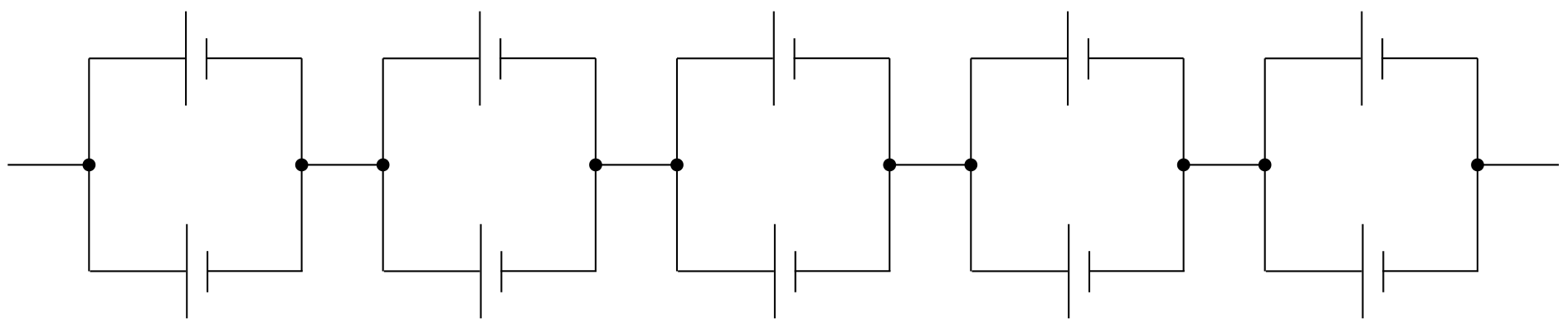
The battery is made from an arrangement of 10 identical cells as shown.
Question image

Calculate

[ 3 ]

Question 1(e)(i)

(i)

the emf of one cell.

[ 1 ]

Question 1(e)(ii)

(ii)

the internal resistance of one cell.

[ 2 ]
Question 2

[Maximum number: 2]

A solar heating panel is placed on the roof of a house in order to heat water in a storage tank. The rest of the roof is covered with tiles.

Question 2(c)

(a)

Another method of harnessing solar energy involves the use of photovoltaic cells.

Outline one advantage of the output of a photovoltaic cell compared to the output of a solar heating panel.

[ 2 ]

Question 2

[Maximum number: 6]

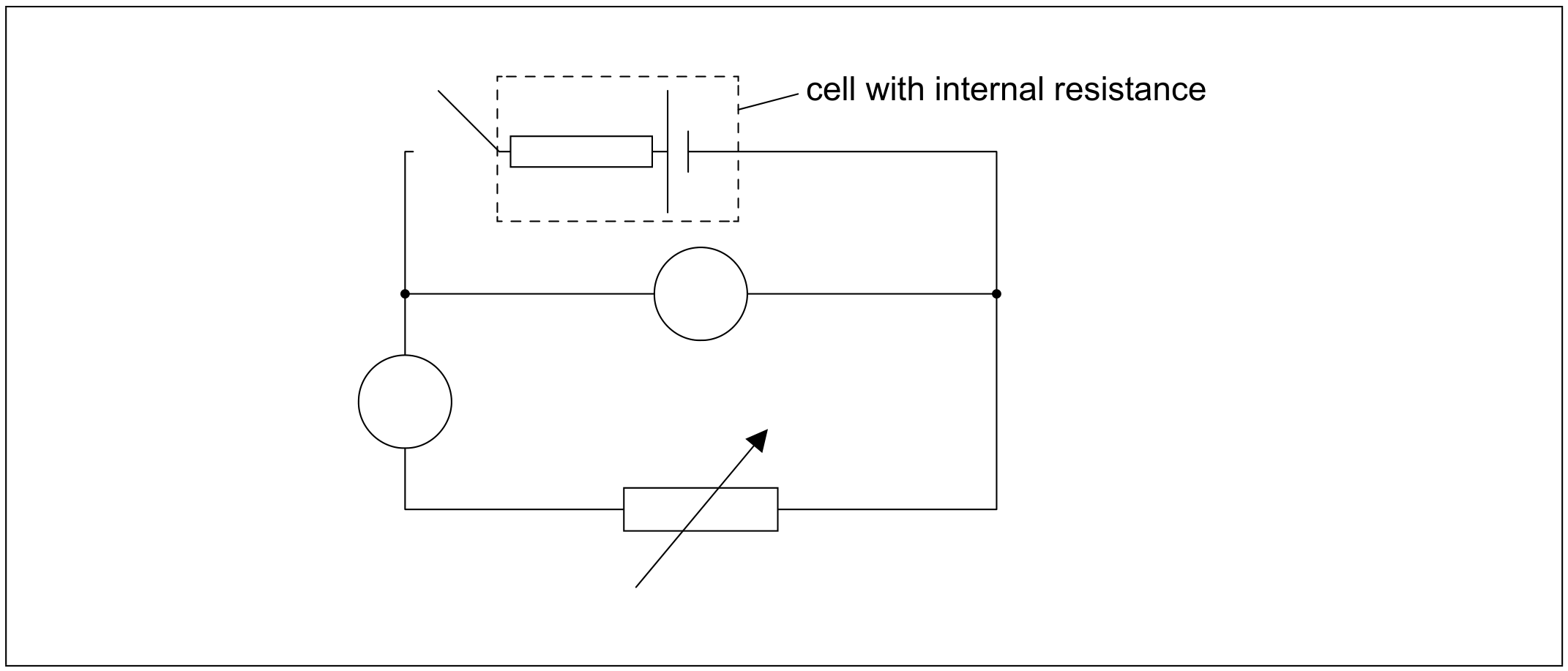
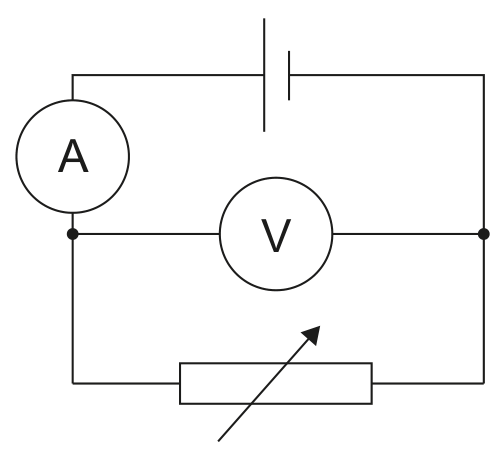
A student is investigating the emf and internal resistance of a cell, using the circuit shown. The ammeter and the voltmeter are ideal.

Question image

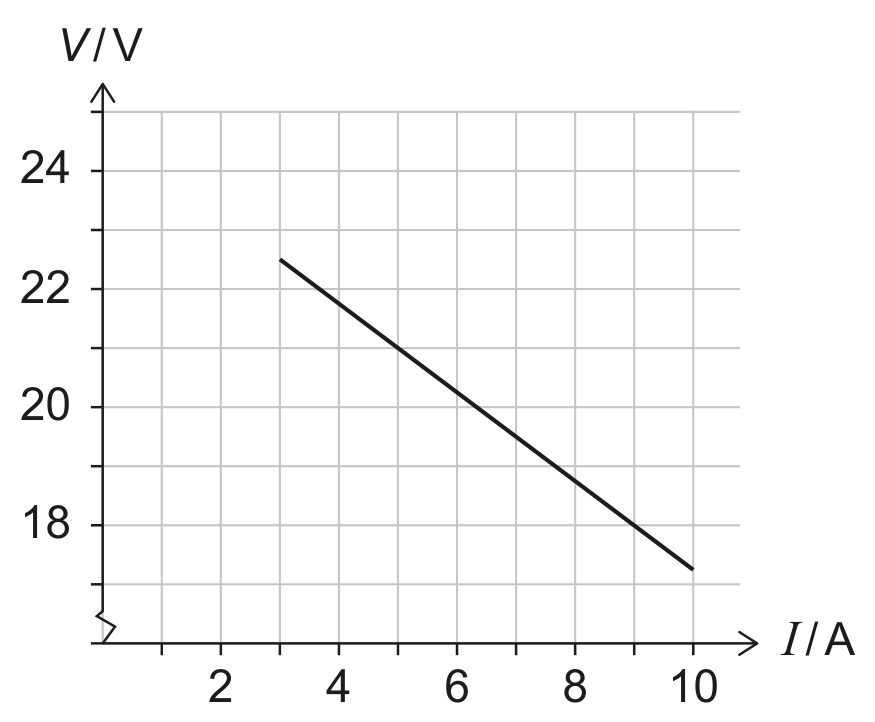
The graph shows the variation of the voltmeter reading V with the ammeter reading I.

Question image

Question 2(a)

(a)

Explain why V changes when the resistance of the variable resistor is changed.

[ 2 ]

Question 2(b)

(b)

Show that the internal resistance of the cell is about 0.8Ω0.8 \Omega.

[ 2 ]

Question 2(c)

(c)

Determine the emf of the cell.

[ 2 ]

Question 2

[Maximum number: 3]

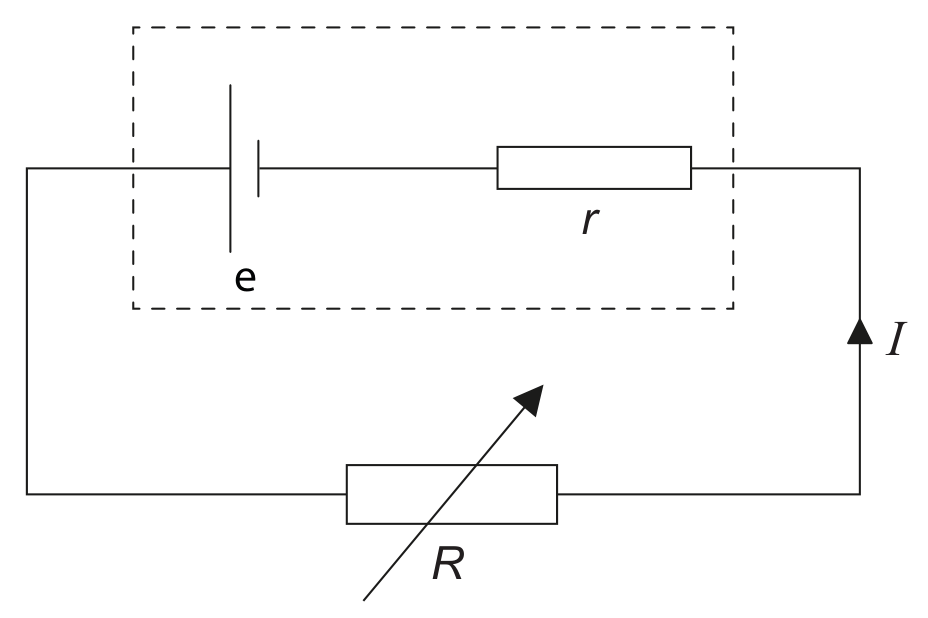
An electrical circuit is used during an experiment to measure the current I in a variable resistor of resistance R. The emf of the cell is a and the cell has an internal resistance r.

Question image

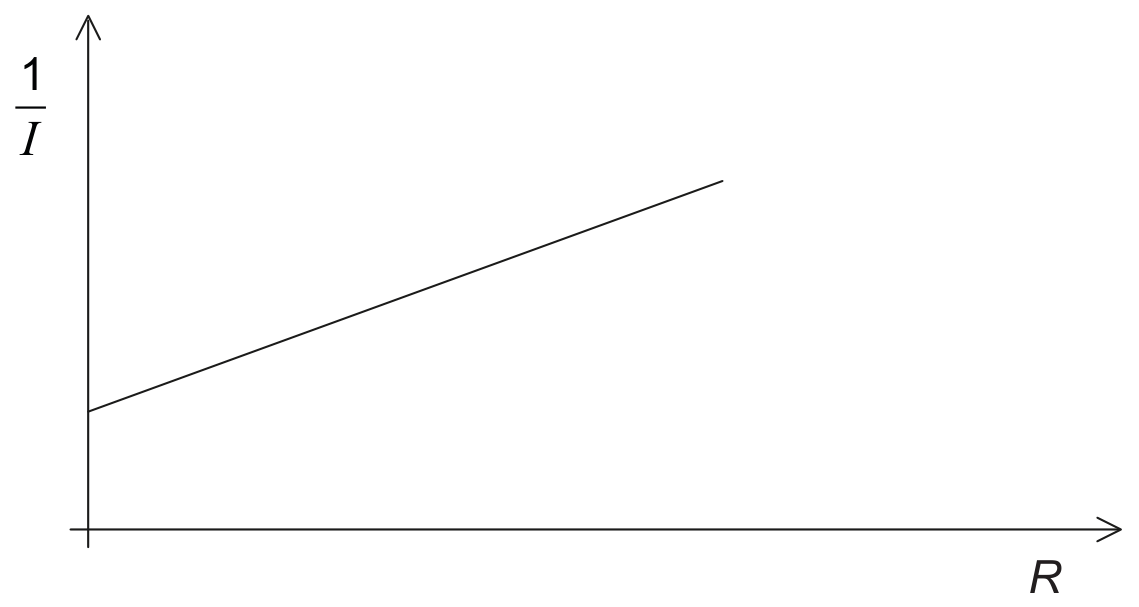
A graph shows the variation of 1I\frac{1}{I} with R.

Question image

Question 2(a)

(a)

Show that the gradient of the graph is equal to 1e\frac{1}{\mathrm{e}}.

[ 2 ]

Question 2(b)

(b)

State the value of the intercept on the R axis.

[ 1 ]

Question 2

[Maximum number: 4]

The circuit shown may be used to measure the internal resistance of a cell.

Question image

Question 2(a)

(a)

An ammeter and a voltmeter are connected in the circuit. Label the ammeter with the letter A and the voltmeter with the letter V.

[ 1 ]

Question 2(b)

(b)

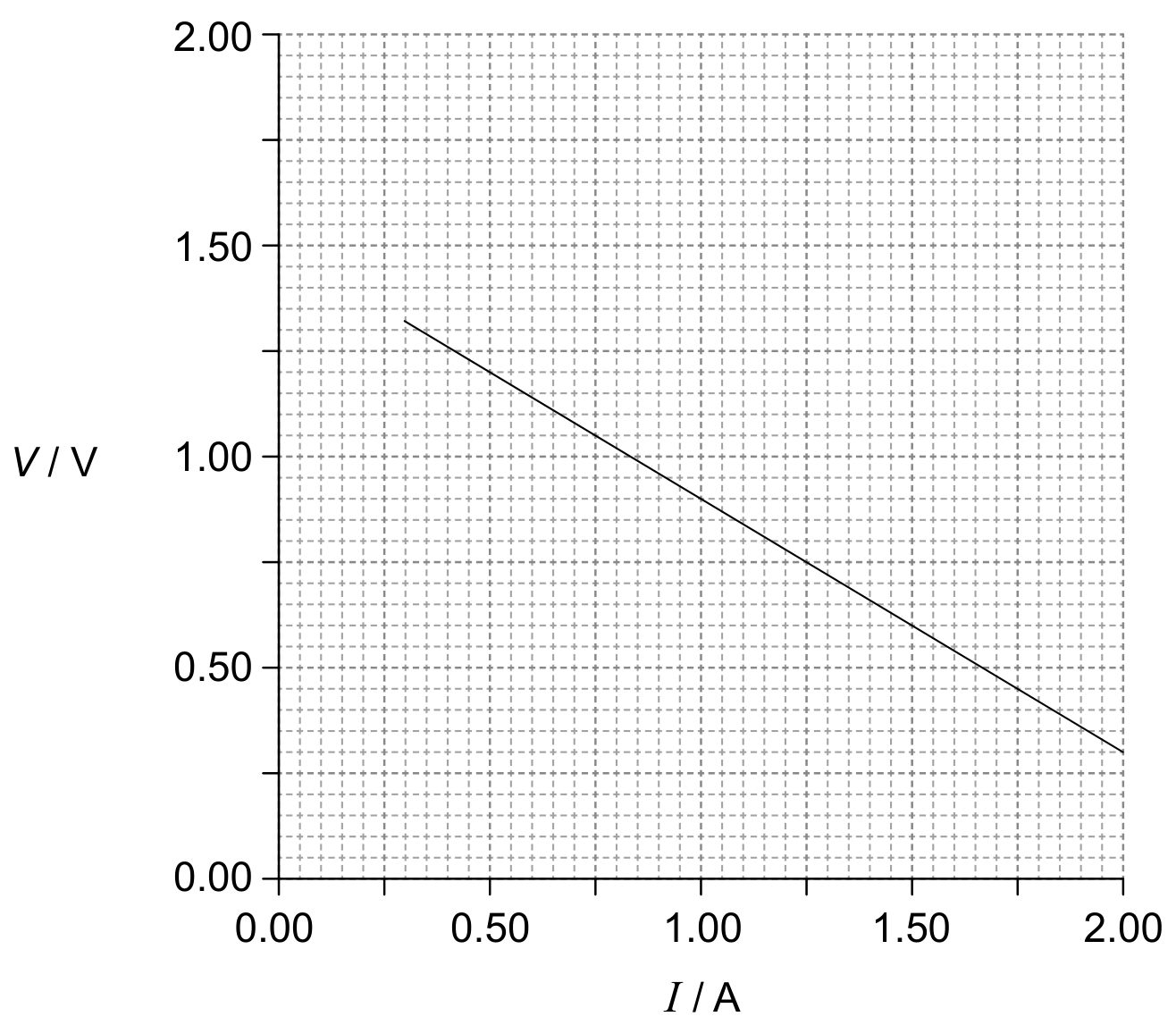
In one experiment a student obtains the following graph showing the variation with current I of the potential difference V across the cell.

Question image

Using the graph, determine the best estimate of the internal resistance of the cell.

[ 3 ]

Question 2

[Maximum number: 3]

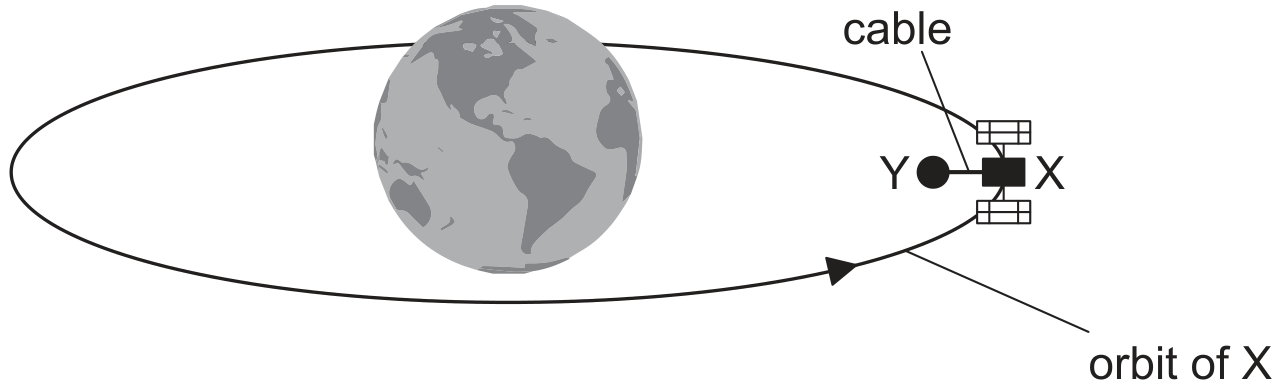
There is a proposal to power a space satellite X as it orbits the Earth. In this model, X is connected by an electronically-conducting cable to another smaller satellite Y .

not to scale

not to scale

Question 2(d)

(a)

Satellite X must release ions into the space between the satellites. Explain why the current in the cable will become zero unless there is a method for transferring charge from X to Y .

[ 3 ]

Question 2

[Maximum number: 10]

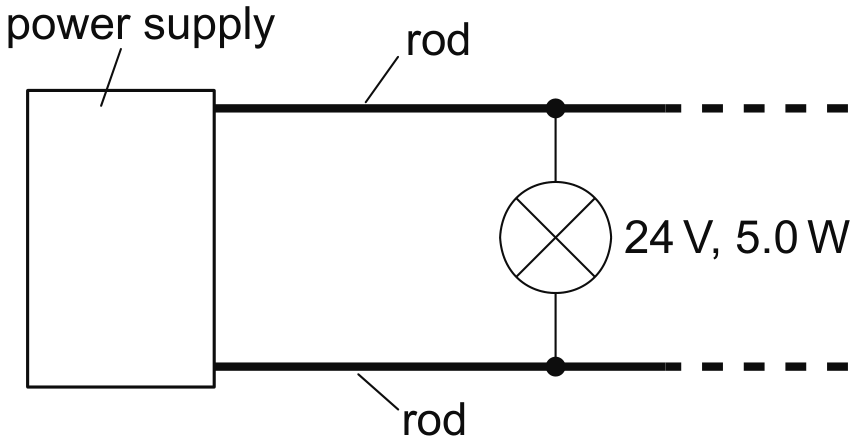
A lighting system consists of two long metal rods with a potential difference maintained between them. Identical lamps can be connected between the rods as required.

Question image

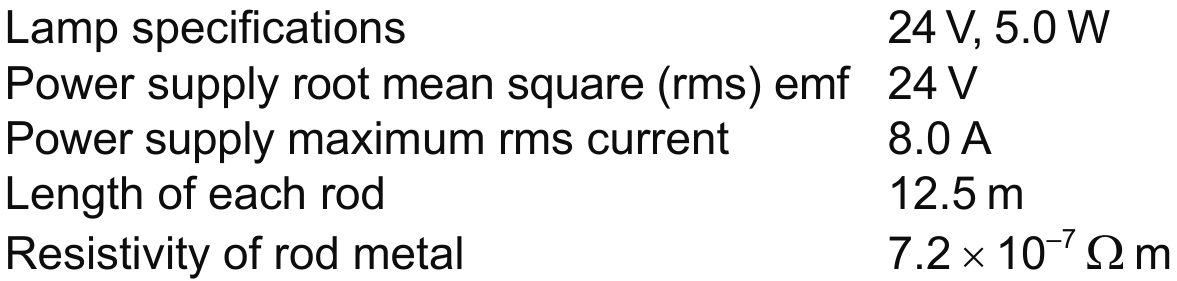
The following data are available for the lamps when at their working temperature.

Table

Question 2(a)

(a)

Each rod is to have a resistance no greater than 0.10Ω0.10 \Omega. Calculate, in m , the minimum radius of each rod. Give your answer to an appropriate number of significant figures.

[ 3 ]

Question 2(b)

(b)

Calculate the maximum number of lamps that can be connected between the rods. Neglect the resistance of the rods.

[ 2 ]

Question 2(c)

(c)

One advantage of this system is that if one lamp fails then the other lamps in the circuit remain lit. Outline one other electrical advantage of this system compared to one in which the lamps are connected in series.

[ 1 ]

Question 2(d)

(d)

A step-down transformer is used to transfer energy to the two rods. The primary coil of this transformer is connected to an alternating mains supply that has an emf of root mean square (rms) magnitude 240 V . The transformer is 95 % efficient.

[ 4 ]

Question 2(d)(ii)

(i)

Determine the peak current in the primary coil when operating with the maximum number of lamps.

[ 4 ]

Question 3

[Maximum number: 6]

This question is about voltage-current (V-I) characteristics.

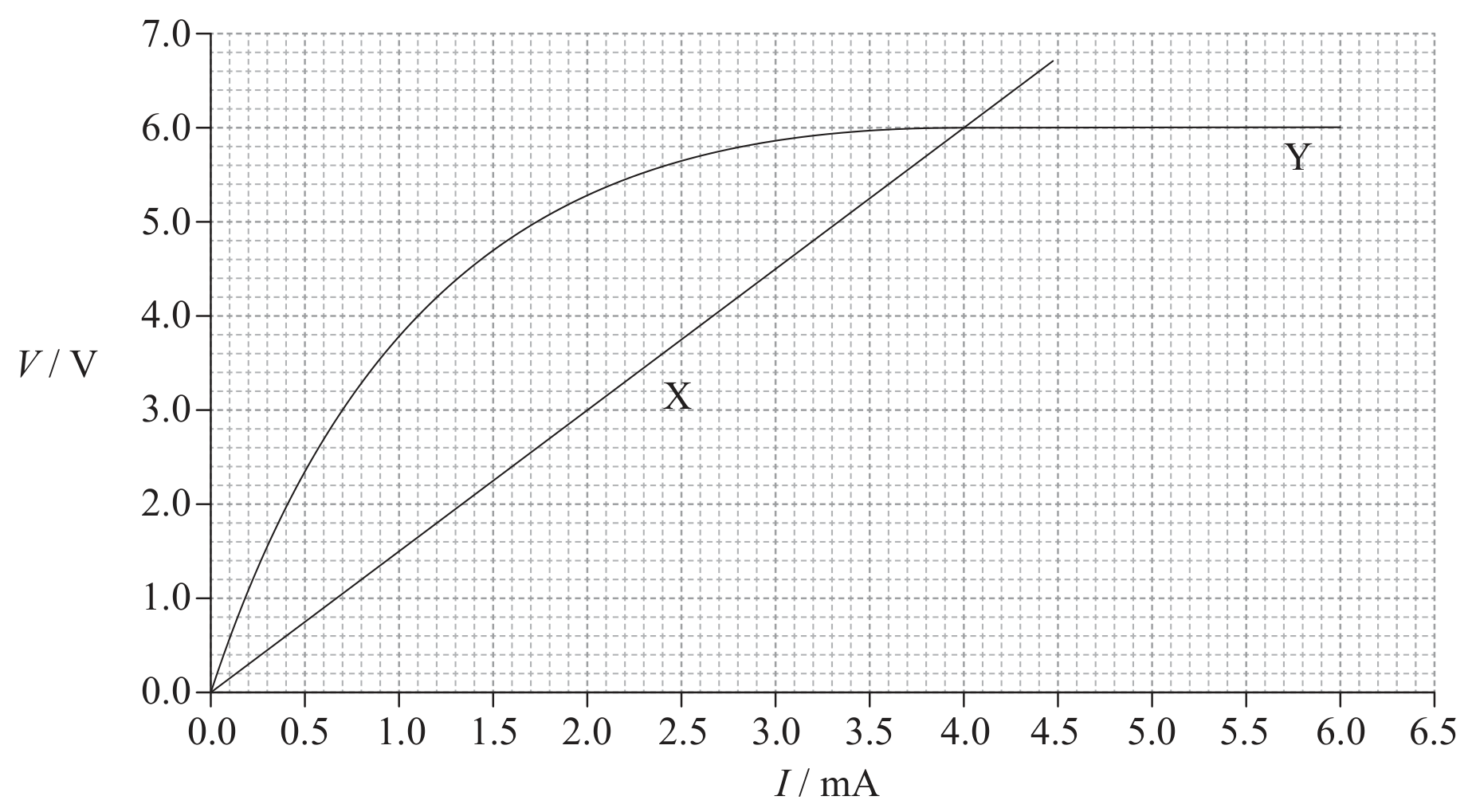
The graph shows the voltage-current ( V-I ) characteristics, at constant temperature, of two electrical components X and Y .

Question image

Question 3(a)

(a)

Outline, with reference to the graph and to Ohm's law, whether or not each component is ohmic.

X:
Y:

[ 3 ]

Question 3(b)

(b)

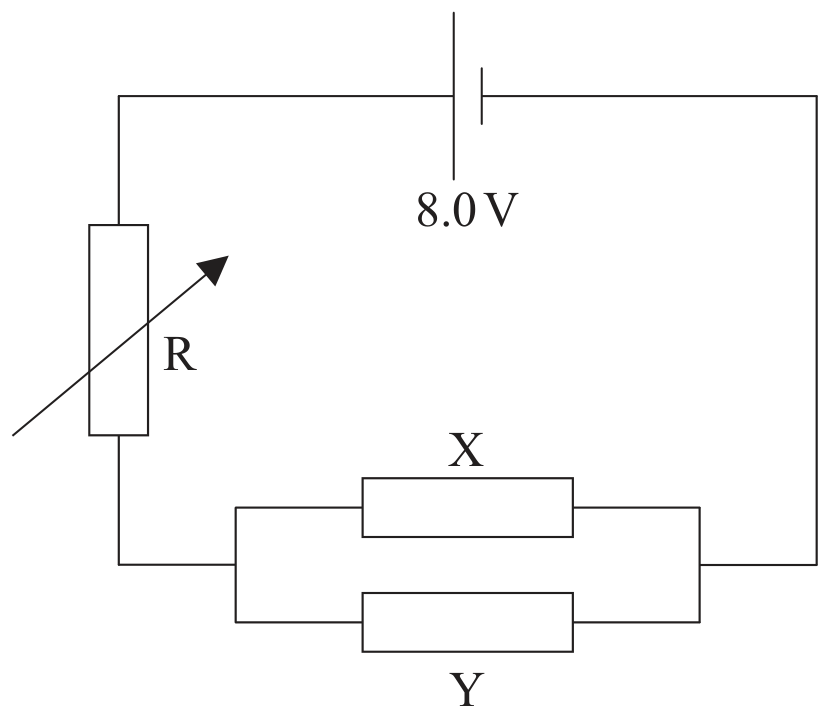
Components X and Y are connected in parallel. The parallel combination is then connected in series with a variable resistor R and a cell of emf 8.0 V and negligible internal resistance.

Question image

The resistance of R is adjusted until the currents in X and Y are equal.

[ 3 ]

Question 3(b)(i)

(i)

Using the graph, calculate the resistance of the parallel combination of X and Y .

[ 3 ]

Question 12

[Maximum number: 1]

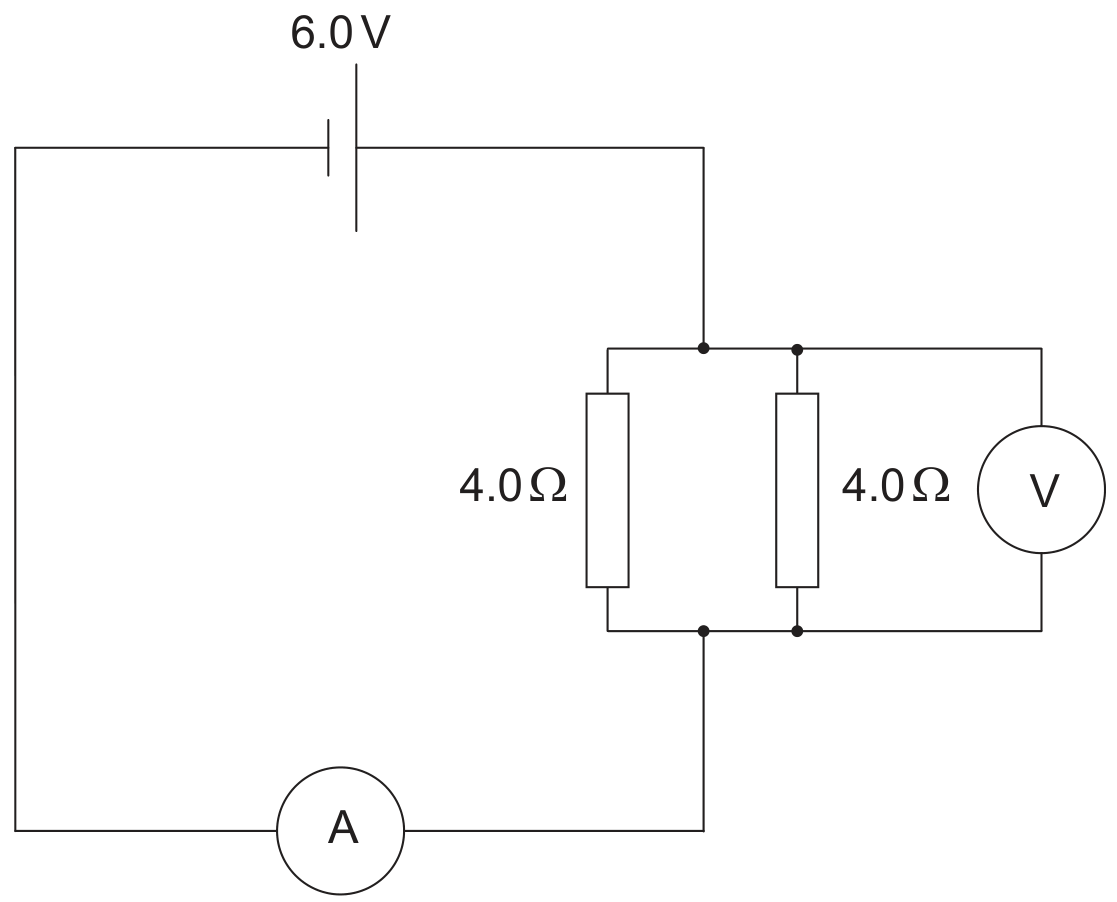
A circuit consists of a cell of electromotive force (emf) 6.0 V and negligible internal resistance connected to two resistors of 4.0Ω4.0 \Omega.

Question image

The ammeter has resistance equal to 1.0Ω1.0 \Omega and the voltmeter is ideal. What are the readings of the ammeter and the voltmeter?

Ammeter

Voltmeter

2.0 A

3.0 V

3.0 A

3.0 V

2.0 A

4.0 V

3.0 A

4.0 V

Question 14

[Maximum number: 1]

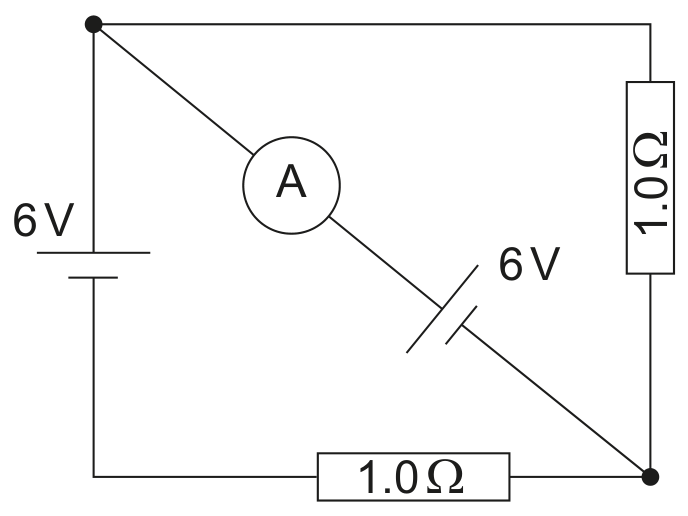
Two 1.0Ω1.0 \Omega resistors are placed in a circuit with two 6 V cells of negligible internal resistance as shown.

Question image

What is the reading on the ideal ammeter?

A

2.0 A2.0 \mathrm{~A}

B

3.0 A3.0 \mathrm{~A}

C

6.0 A

D

12.0 A12.0 \mathrm{~A}

0 selected