Question 1
[Maximum number: 3]
This question is about stars in the constellation Canis Minor.
Question 1(d)
Question 1(d)(i)
(a)
(i)
Using the data in (c), calculate, in parsecs, the distance from Earth to Gomeisa.
[ 3 ]
 EduNinja
This question is about stars in the constellation Canis Minor.
Using the data in (c), calculate, in parsecs, the distance from Earth to Gomeisa.
The diagram below shows part of a downhill ski course which starts at point above level ground. Point B is 20 m above level ground.
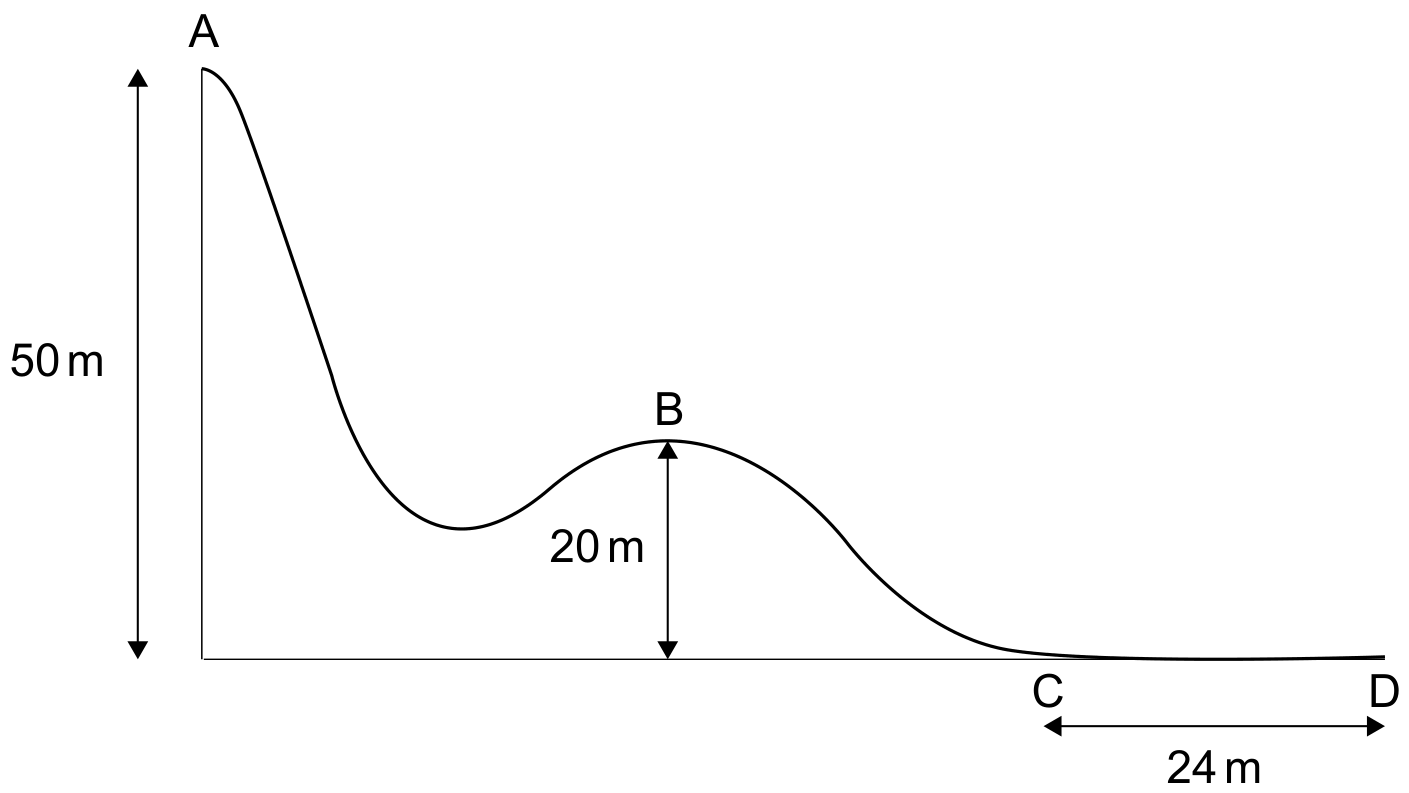
A skier of mass 65 kg starts from rest at point A and during the ski course some of the gravitational potential energy transferred to kinetic energy.
Some of the gravitational potential energy transferred into internal energy of the skis, slightly increasing their temperature. Distinguish between internal energy and temperature.
A thermometer and an electrical heater are inserted into small holes in a solid aluminium block.
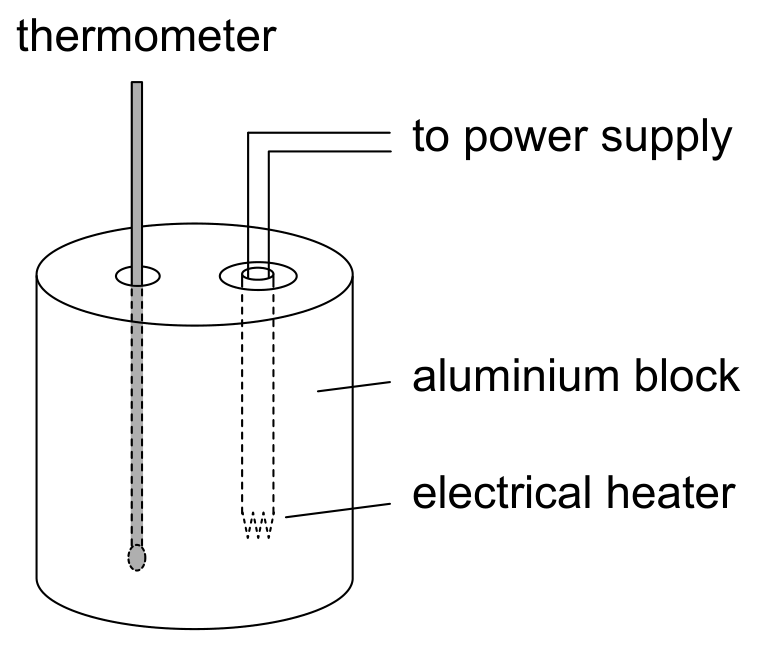
The heater is turned on at time t=0. The graph shows the variation of the temperature of the block with time t.
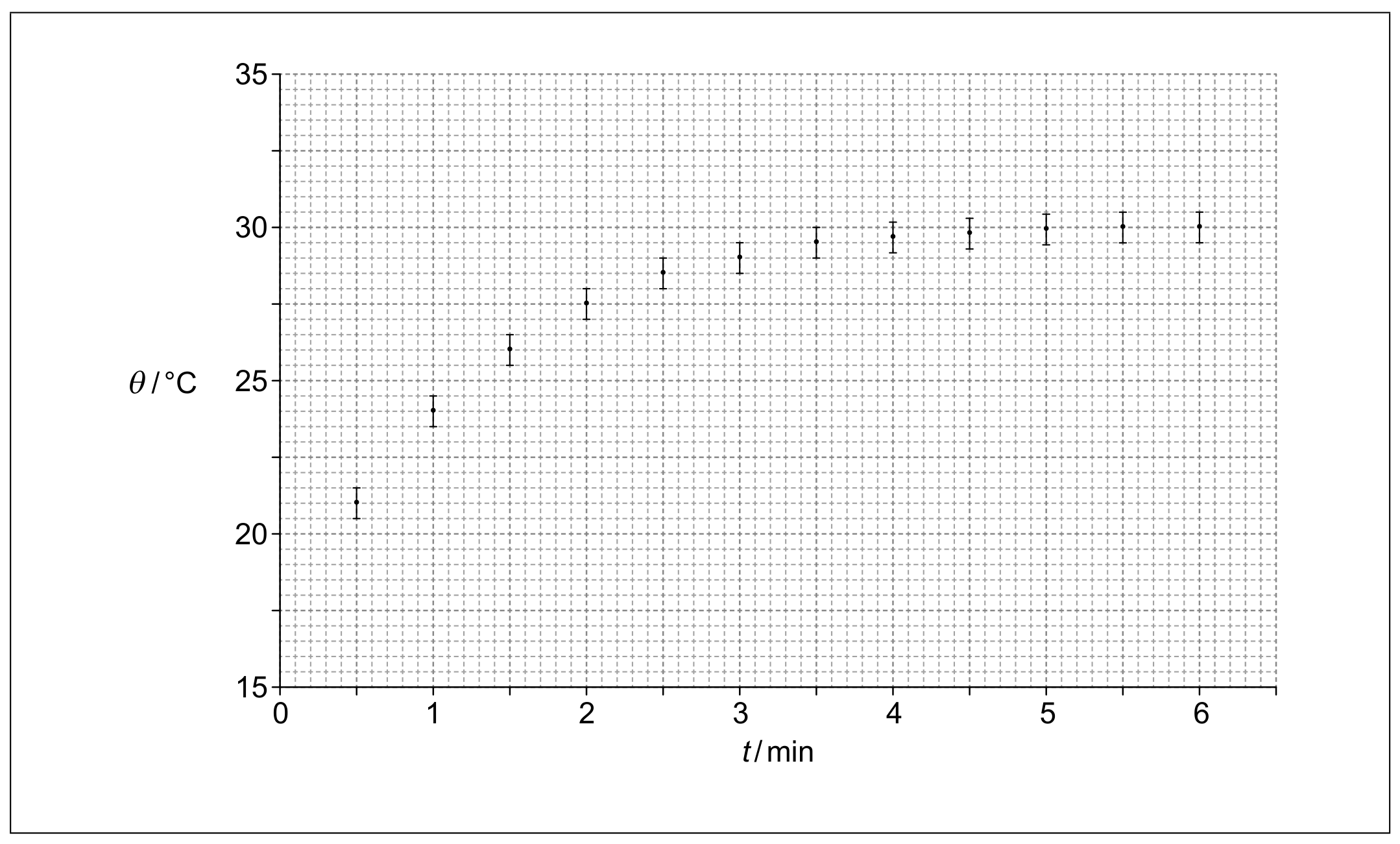
The power of the heater is 52 W . The mass of the block is 0.85 kg . Determine the specific heat capacity of aluminium.
Using the axes below, sketch a graph to show the variation with wavelength of the intensity of the cosmic background radiation.
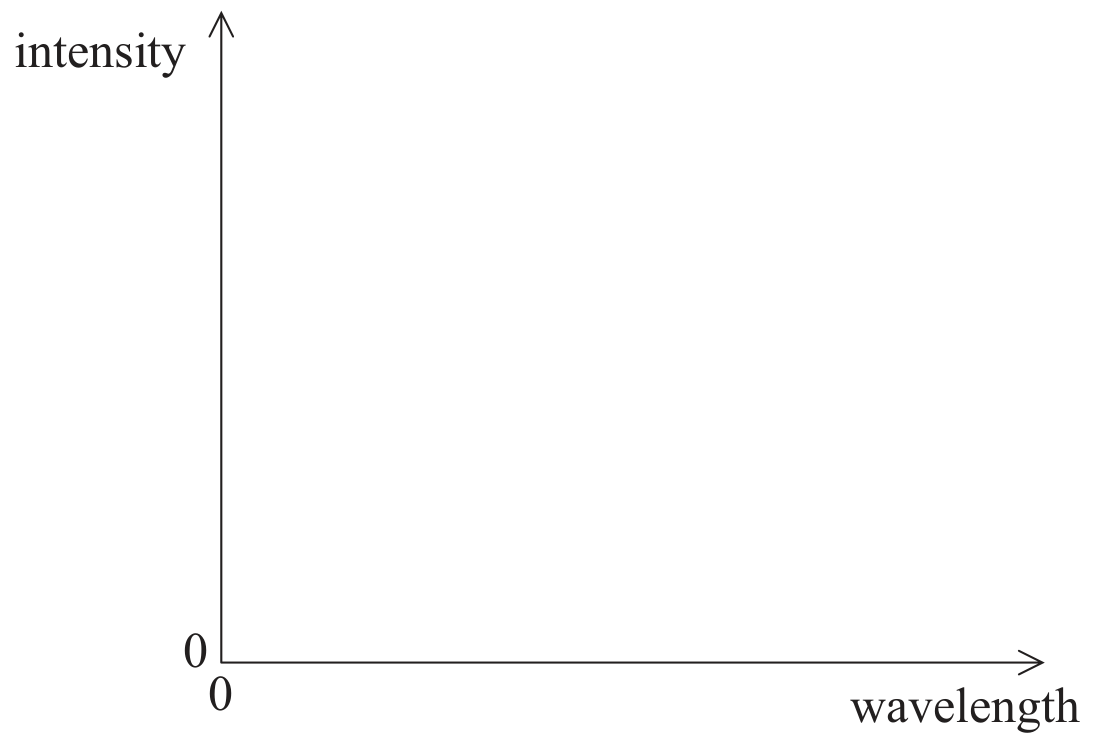
Explain how the graph may be used to determine the temperature of the cosmic background radiation.
A thermometer and an electrical heater are inserted into small holes in a solid aluminium block.
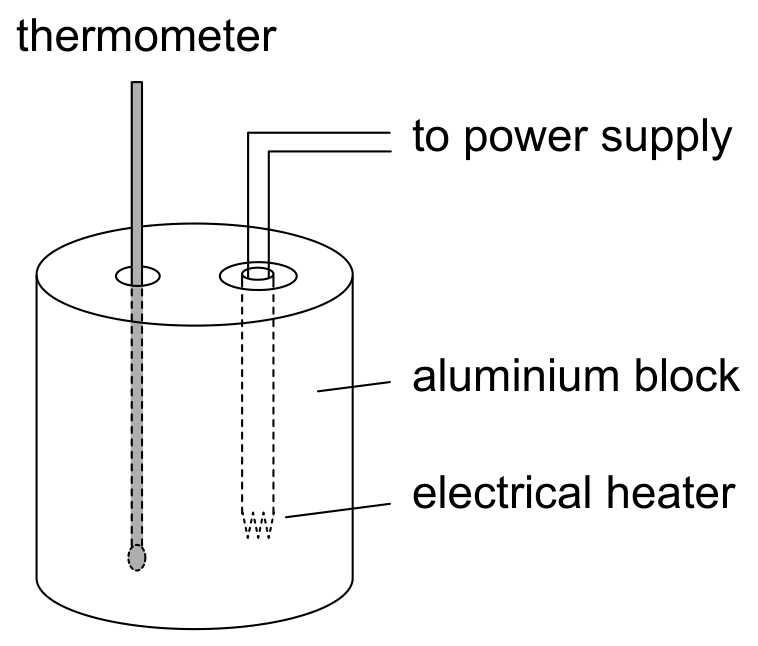
The heater is turned on at time t=0. The graph shows the variation of the temperature of the block with time t.
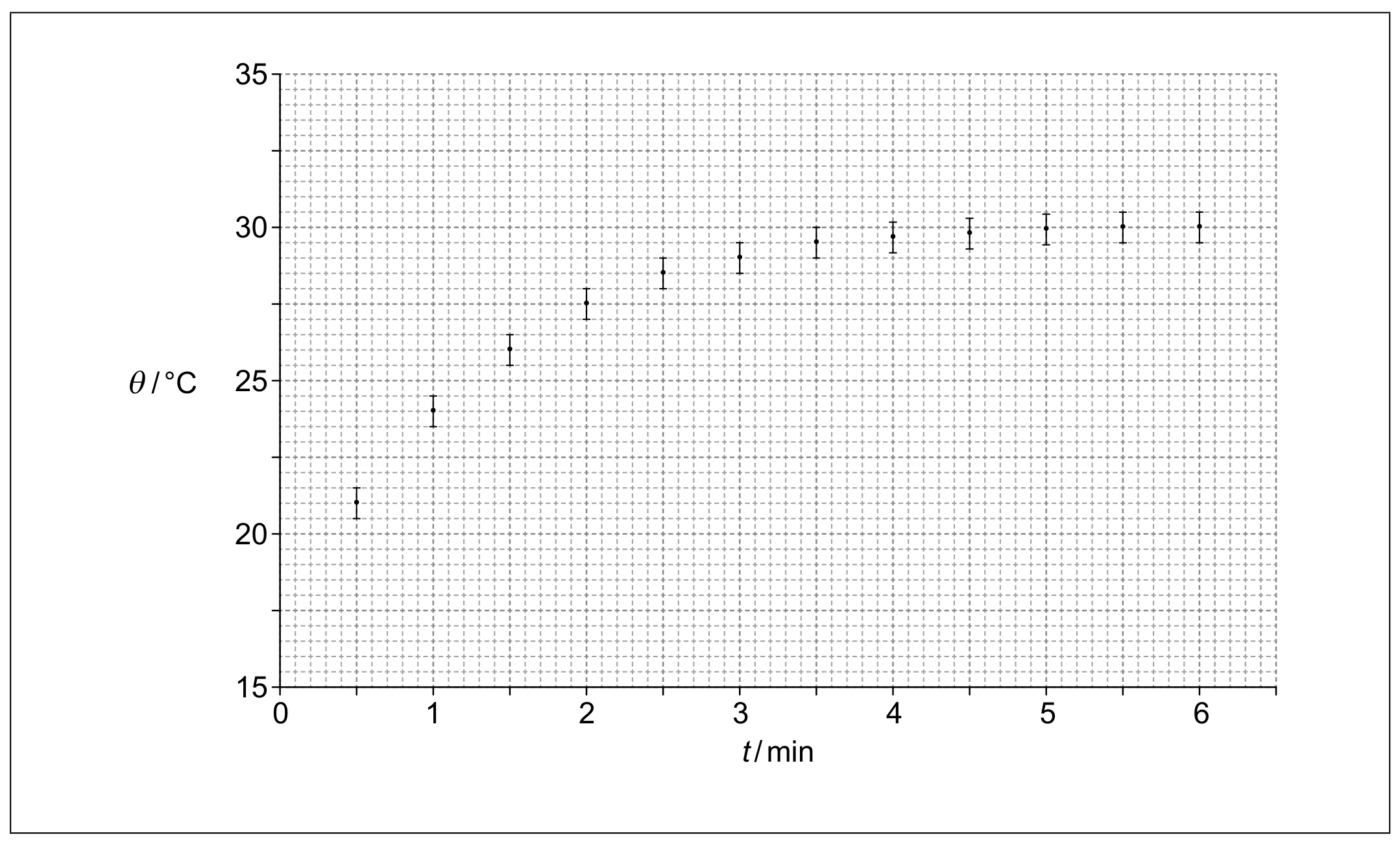
The power of the heater is 52 W . The mass of the block is 0.85 kg . Determine the specific heat capacity of aluminium.
A group of students is trying to determine the density and the viscosity of a liquid.
To determine the density, they use a balance to read the mass m of a sphere in air and immersed in the liquid.
They use a sphere of volume .
The readings are in air and in the liquid.
The readings are different due to buoyancy. The buoyancy force is given by
where V is the volume of the sphere and is the density of the liquid.
Calculate the density of the liquid.
The equipment shown in the diagram was used by a student to investigate the variation with volume, of the pressure p of air, at constant temperature. The air was trapped in a tube of constant cross-sectional area above a column of oil.
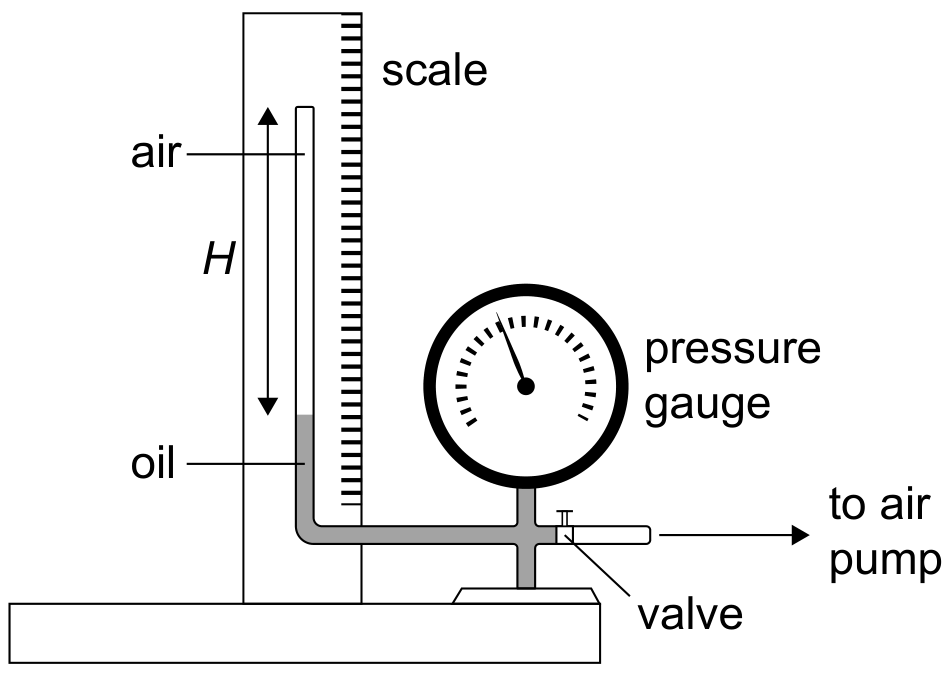
The pump forces oil to move up the tube decreasing the volume of the trapped air.
The student measured the height H of the air column and the corresponding air pressure p. After each reduction in the volume the student waited for some time before measuring the pressure. Outline why this was necessary.
This question is about objects in the universe.
The graph shows the variation with wavelength of the intensity of a main sequence star.
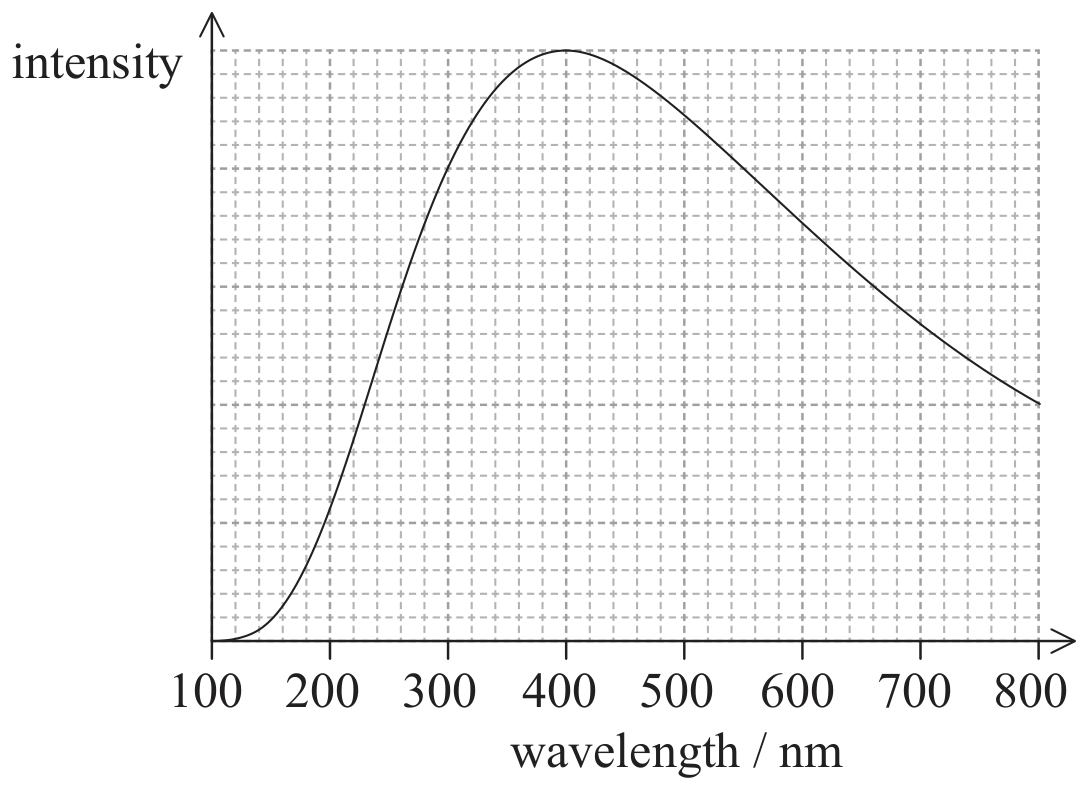
Calculate the surface temperature of this star.
In an experiment, data were collected on the variation of specific heat capacity of water with temperature. The graph of the plotted data is shown.
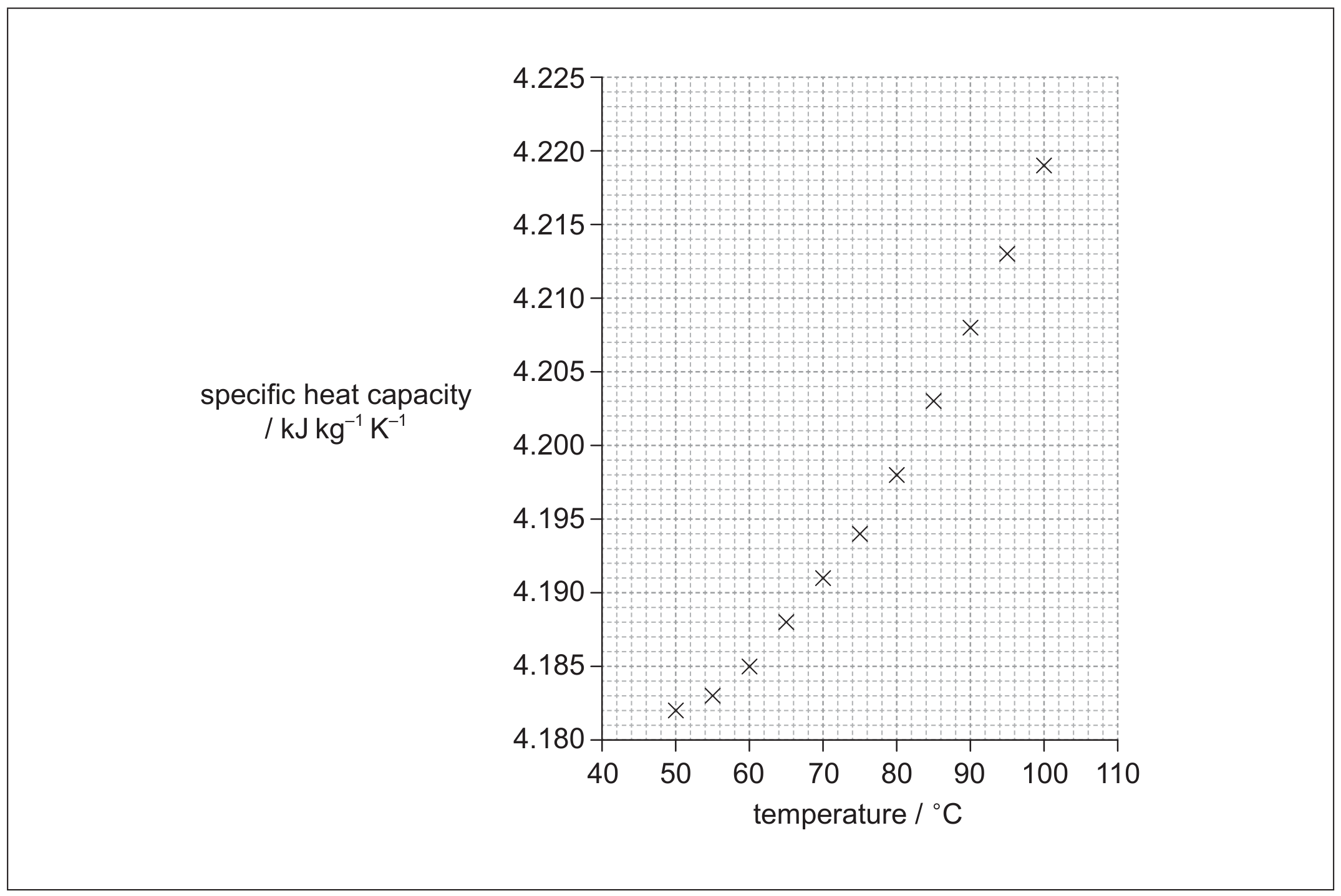
The uncertainty in the values for specific heat capacity is 5 %.
Water of mass is heated from to .
Calculate the energy required to raise the temperature of the water from to .
Aldebaran is a red giant star in the constellation of Taurus.
Define the luminosity of a star.
The apparent brightness of Aldebaran is and the luminosity of the Sun is . The luminosity of Aldebaran is 370 times that of the Sun. Show that Aldebaran is at a distance of 19 pc from Earth.
The apparent magnitude of Aldebaran is 0.75 .
State what is meant by the apparent magnitude of a star.