EduNinja

IB Physics HLE.1 Structure of the atomQuestion Bank

Question 1

[Maximum number: 4]

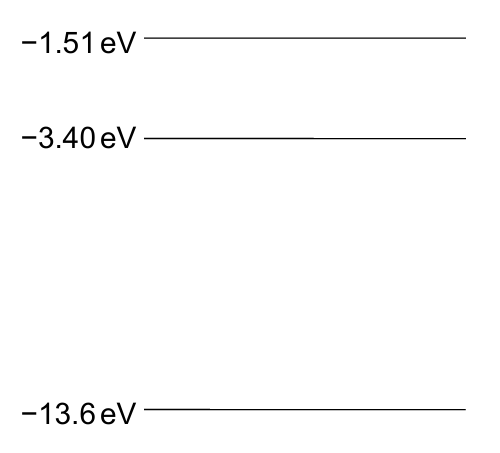
The diagram shows the three lowest energy levels of the hydrogen atom.

The energy of each level is indicated.
Question image

Question 1(a)

(a)

State the number of transitions between these levels that result in the emission of photons.

[ 1 ]

Question 1(b)

(b)

Calculate the largest photon wavelength for these transitions.

[ 3 ]
Question 1

[Maximum number: 1]

This question is about objects in the universe.

Question 1(b)

(a)

State how

[ 1 ]

Question 1(b)(i)

(i)

it is known that main sequence stars are made predominantly of hydrogen.

[ 1 ]

Question 1

[Maximum number: 1]

The ratio of the diameter of an atom to the diameter of its nucleus is:

A

10110^{1}

B

10310^{3}

C

10510^{5}

D

10710^{7}

Question 3

Question 3(a)

(a)

Rutherford modelled the scattering of alpha particles by a nucleus of gold. However, when the initial alpha particle energy is greater than a certain value E0E_{0}, the fraction of alpha particles scattered at angles close to 180180^{\circ} does not follow Rutherford's model.

Outline

[ 3 ]

Question 3(a)(i)

(i)

why this deviation from the model occurs, and

[ 1 ]

Question 3(a)(ii)

(ii)

how E0E_{0} can be used to estimate the nuclear radius of gold.

Gold-198 (Au-198) is a radioactive nuclide of gold. Au-198 decays into stable mercury-198 (Hg-198) with an emission of a beta particle followed by one or two gamma photons.

The half-life of Au-198 is 2.69 days.

[ 2 ]

Question 2

Question 2(a)

(a)

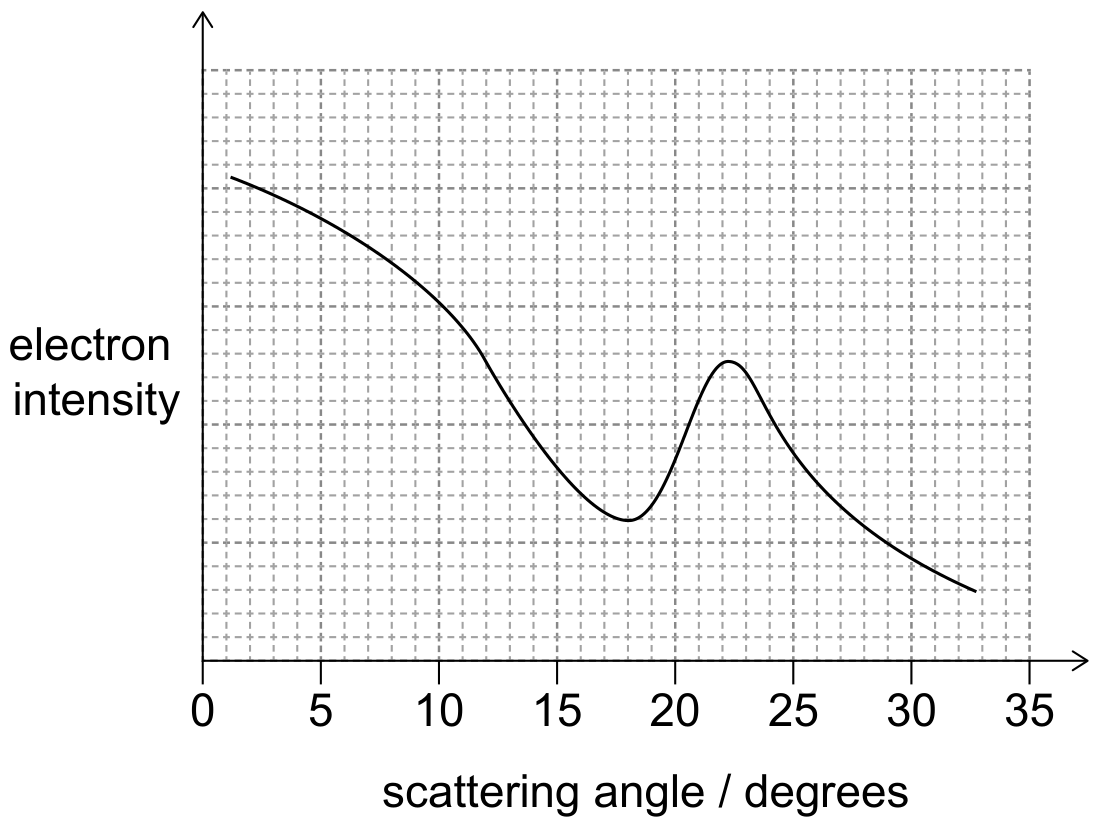
A beam of electrons each of de Broglie wavelength 2.4×10¹⁵ m2.4 \times 10^{-15} \mathrm{~m} is incident on a thin film of silicon-30 (1430Si)\left({ }_{14}^{30} \mathrm{Si}\right). The variation in the electron intensity of the beam with scattering angle is shown.

Question image
[ 7 ]

Question 2(a)(i)

(i)

Use the graph to show that the nuclear radius of silicon-30 is about 4 fm .

[ 3 ]

Question 2(a)(ii)

(ii)

Estimate, using the result from (a)(i), the nuclear radius of thorium-232 (90232Th)\left({ }_{90}^{232} \mathrm{Th}\right).

[ 2 ]

Question 2(a)(iv)

(iii)

Outline why deviations from Rutherford scattering are observed when high-energy alpha particles are incident on nuclei.

[ 2 ]

Question A4

[Maximum number: 1]

This question is about nuclear reactions and radioactive decay.

Question A4(b)

(a)

Tritium may be produced by bombarding a nucleus of the isotope lithium-7 with a high-energy neutron. The reaction equation for this interaction is

37Li+01n13H+Z4X+01n.{ }_{3}^{7} \mathrm{Li}+{ }_{0}^{1} \mathrm{n} \rightarrow{ }_{1}^{3} \mathrm{H}+{ }_{Z}^{4} \mathrm{X}+{ }_{0}^{1} \mathrm{n} .
[ 1 ]

Question A4(b)(i)

(i)

Identify the proton number Z of X.

Z=
[ 1 ]

Question 20

[Maximum number: 1]

In the Rutherford-Geiger-Marsden scattering experiment it was observed that a small percentage of alpha particles are deflected through large angles.

Three features of the atom are

I. the nucleus is positively charged
II. the nucleus contains neutrons
III. the nucleus is much smaller than the atom.

Which features can be inferred from the observation?

A

I and II only

B

I and III only

C

II and III only

D

I, II and III

Question 20

[Maximum number: 1]

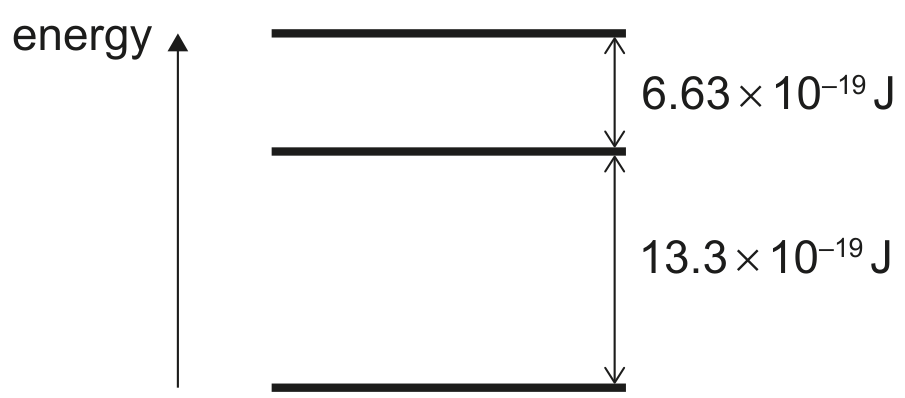
A simple model of an atom has three energy levels. The differences between adjacent energy levels are shown below.

Question image

What are the two smallest frequencies in the emission spectrum of this atom?

A

0.5×10¹⁵ Hz0.5 \times 10^{15} \mathrm{~Hz} and 1.0×10¹⁵ Hz1.0 \times 10^{15} \mathrm{~Hz}

B

0.5×10¹⁵ Hz0.5 \times 10^{15} \mathrm{~Hz} and 1.5×10¹⁵ Hz1.5 \times 10^{15} \mathrm{~Hz}

C

1.0×10¹⁵ Hz1.0 \times 10^{15} \mathrm{~Hz} and 2.0×10¹⁵ Hz2.0 \times 10^{15} \mathrm{~Hz}

D

1.0×10¹⁵ Hz1.0 \times 10^{15} \mathrm{~Hz} and 3.0×10¹⁵ Hz3.0 \times 10^{15} \mathrm{~Hz}

Question 20

[Maximum number: 1]

Which statement about atomic spectra is not true?

A

They provide evidence for discrete energy levels in atoms.

B

Emission and absorption lines of equal frequency correspond to transitions between the same two energy levels.

C

Absorption lines arise when electrons gain energy.

D

Emission lines always correspond to the visible part of the electromagnetic spectrum.

Question 3

Question 3(b)

(a)

Particles can be used in scattering experiments to estimate nuclear sizes.

[ 2 ]

Question 3(b)(i)

(i)

Outline how these experiments are carried out.

[ 2 ]

Question 3(d)

(b)

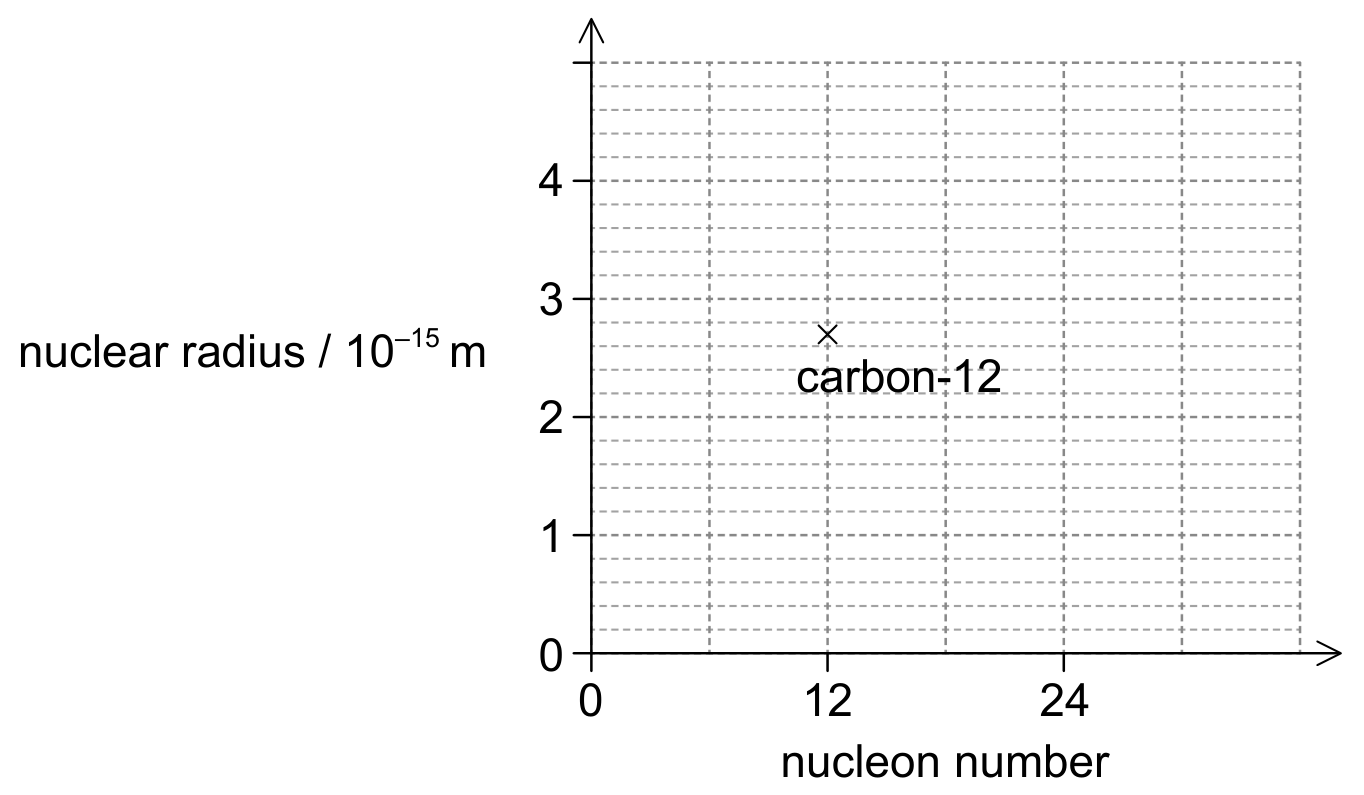
Electron diffraction experiments indicate that the nuclear radius of carbon-12 (612C)\left({ }_{6}^{12} \mathrm{C}\right) is 2.7×10¹⁵ m2.7 \times 10^{-15} \mathrm{~m}. The graph shows the variation of nuclear radius with nucleon number. The nuclear radius of the carbon-12 is shown on the graph.

Question image
[ 2 ]

Question 3(d)(i)

(i)

Determine the radius of the magnesium-24 (1224Mg)\left({ }_{12}^{24} \mathrm{Mg}\right) nucleus.

[ 2 ]
0 selected