EduNinja

IB Physics HLB.3 Gas lawsQuestion Bank

Question 1

[Maximum number: 6]

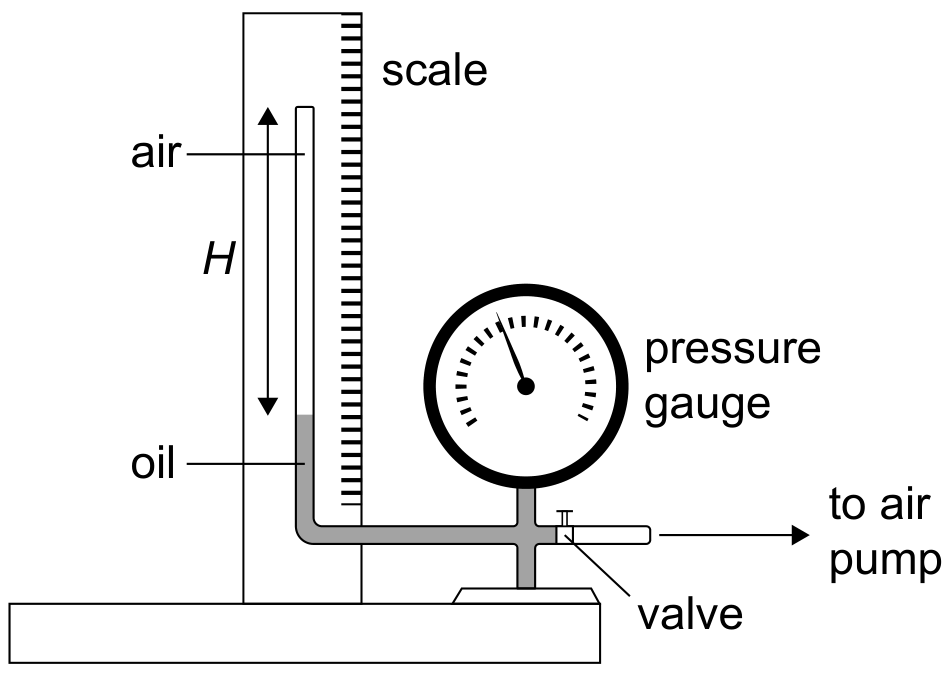
The equipment shown in the diagram was used by a student to investigate the variation with volume, of the pressure p of air, at constant temperature. The air was trapped in a tube of constant cross-sectional area above a column of oil.
Question image

The pump forces oil to move up the tube decreasing the volume of the trapped air.

Question 1(c)

(a)

Outline how the results of this experiment are consistent with the ideal gas law at constant temperature.

[ 2 ]

Question 1(d)

(b)

The cross-sectional area of the tube is 1.3×10³ m21.3 \times 10^{-3} \mathrm{~m}^{2} and the temperature of air is 300 K . Estimate the number of moles of air in the tube.

[ 2 ]

Question 1(e)

(c)

The equation in (b) may be used to predict the pressure of the air at extremely large values of 1H\frac{1}{H}. Suggest why this will be an unreliable estimate of the pressure.

[ 2 ]
Question 1

[Maximum number: 1]

Which quantity has the same units as those for energy stored per unit volume?

A

Density

B

Force

C

Momentum

D

Pressure

Question 2

[Maximum number: 6]

The air in a kitchen has pressure 1.0×10⁵ Pa1.0 \times 10^{5} \mathrm{~Pa} and temperature 22C22^{\circ} \mathrm{C}. A refrigerator of internal volume 0.36 m30.36 \mathrm{~m}^{3} is installed in the kitchen.

Question 2(a)

(a)

With the door open the air in the refrigerator is initially at the same temperature and pressure as the air in the kitchen. Calculate the number of molecules of air in the refrigerator.

[ 2 ]

Question 2(b)

(b)

The refrigerator door is closed. The air in the refrigerator is cooled to 5.0C5.0^{\circ} \mathrm{C} and the number of air molecules in the refrigerator stays the same.

[ 4 ]

Question 2(b)(i)

(i)

Determine the pressure of the air inside the refrigerator.

[ 2 ]

Question 2(b)(ii)

(ii)

The door of the refrigerator has an area of 0.72 m20.72 \mathrm{~m}^{2}. Show that the minimum force needed to open the refrigerator door is about 4 kN .

[ 2 ]

Question 2

[Maximum number: 3]

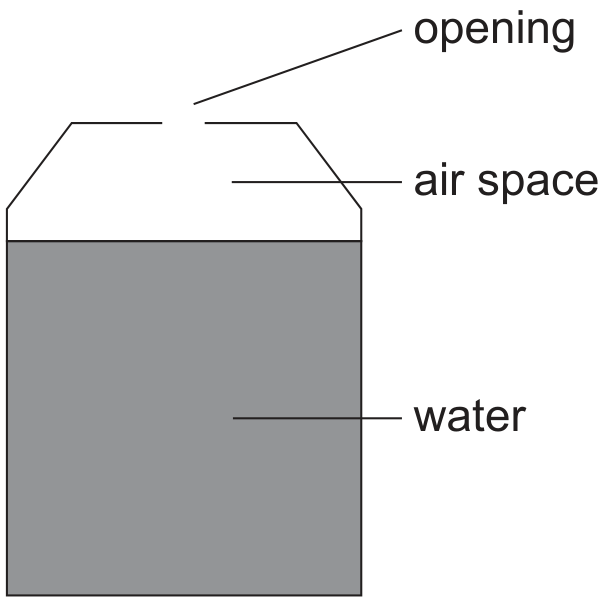
A solar heating panel is placed on the roof of a house in order to heat water in a storage tank. The rest of the roof is covered with tiles.

Question 2(b)

(a)

There is an air space above the water in the storage tank with an opening to the atmosphere. Assume that air behaves like an ideal gas.

Question image
[ 3 ]

Question 2(b)(i)

(i)

State one way in which a real gas differs from an ideal gas.

The air space is always at constant atmospheric pressure and constant volume, as the water level is kept constant. The air-space temperature and water temperature are the same.

[ 1 ]

Question 2(b)(ii)

(ii)

The water is heated. Explain why the quantity of air in the storage tank decreases.

[ 2 ]

Question 2

[Maximum number: 6]

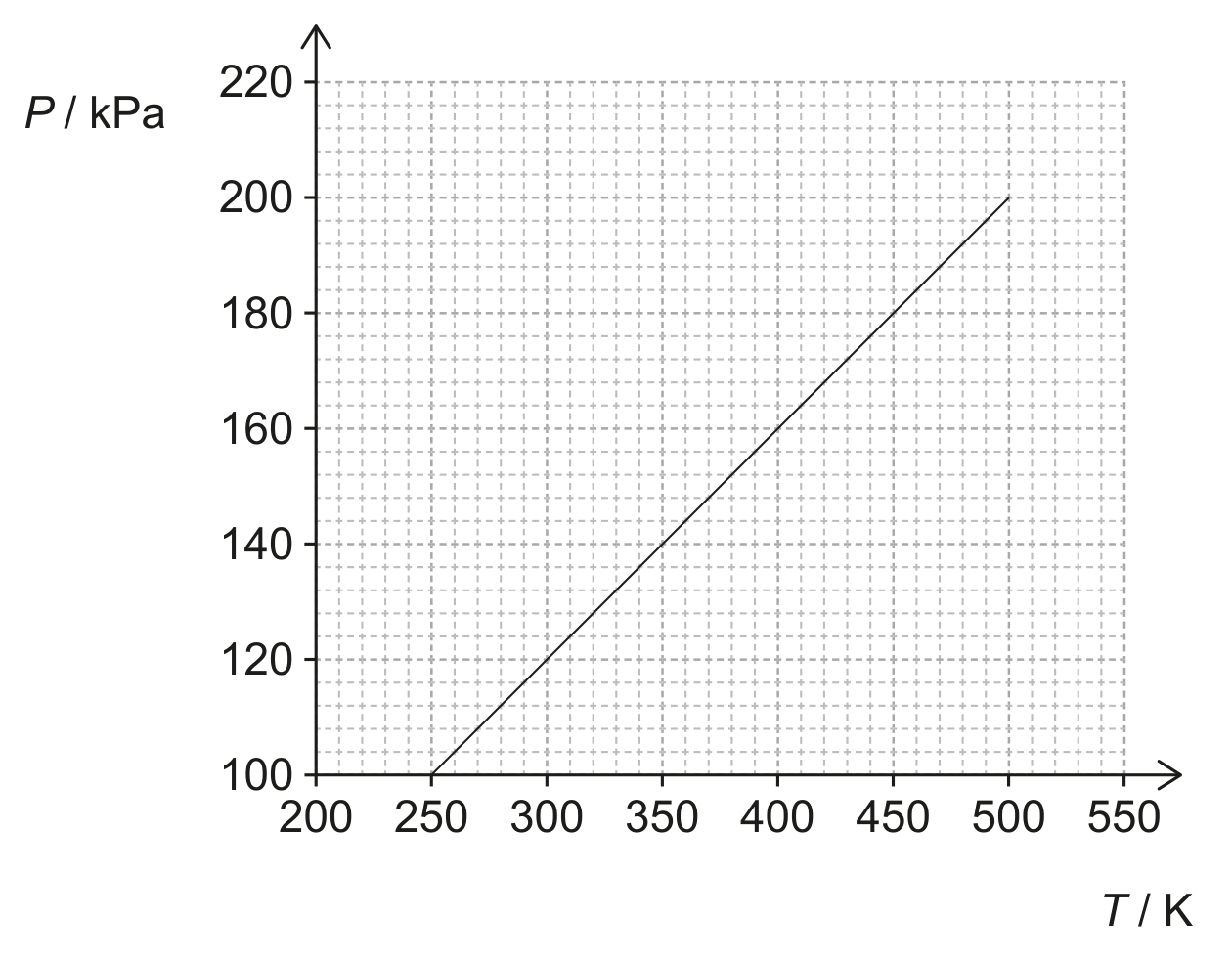
The graph shows the variation with temperature T of the pressure P of a fixed mass of helium gas trapped in a container with a fixed volume of 1.0×10³ m31.0 \times 10^{-3} \mathrm{~m}^{3}.

Question image

Question 2(a)

(a)

Deduce whether helium behaves as an ideal gas over the temperature range 250 K to 500 K .

[ 2 ]

Question 2(b)

(b)

Helium has a molar mass of 4.0 g . Calculate the mass of gas in the container.

[ 2 ]

Question 2(c)

(c)

A second container, of the same volume as the original container, contains twice as many helium atoms. The graph of the variation of P with T is determined for the gas in the second container.

Predict how the graph for the second container will differ from the graph for the first container.

[ 2 ]

Question 2

Question 2(c)

(a)

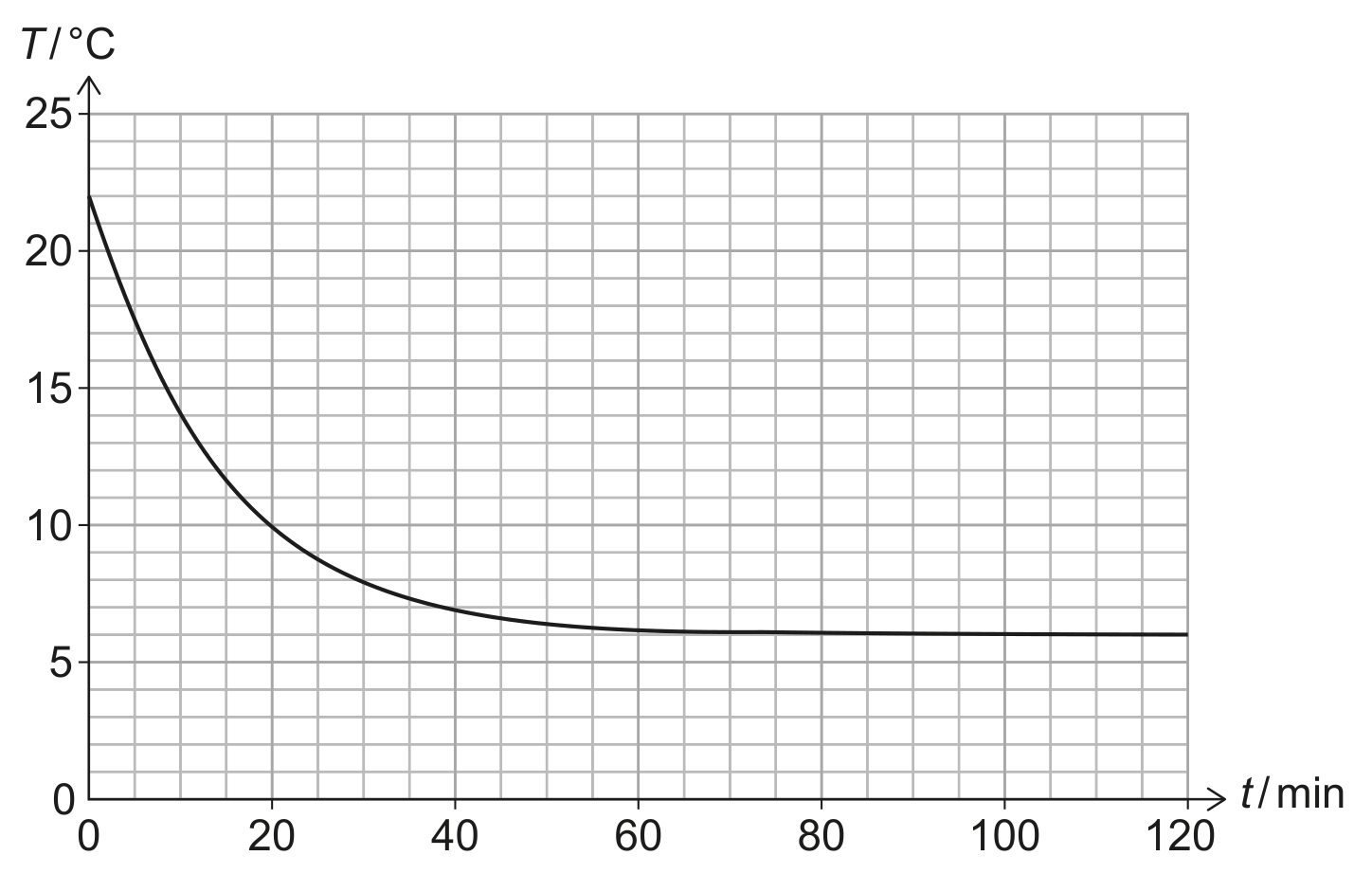
At night the outside temperature falls below 13C13^{\circ} \mathrm{C}. The heater is turned off at time t=0. The graph shows the variation with time t of the temperature T of the room.

Question image
[ 3 ]

Question 2(c)(ii)

(i)

The pressure and volume of the air in the room remain constant but the number of molecules has increased. Determine the percentage increase in the number of molecules of air in the room between t=0 and t=120 mint=120 \mathrm{~min}.

[ 3 ]

Question 7

[Maximum number: 1]

Which of the following is an assumption of the kinetic model of an ideal gas?

A

The gas is at high pressure.

B

There are weak forces of attraction between the particles in the gas.

C

The collisions between the particles are elastic.

D

The energy of the particles is proportional to the absolute temperature.

Question 7

[Maximum number: 1]

What is not an assumption of the kinetic model of an ideal gas?

A

Attractive forces between molecules are negligible.

B

Collision duration is negligible compared with time between collisions.

C

Molecules suffer negligible momentum change during wall collisions.

D

Molecular volume is negligible compared with gas volume.

Question 8

[Maximum number: 1]

What are the conditions of temperature and pressure at which the behaviour of a real gas approximates to the behaviour of an ideal gas?

A

Low pressure and low temperature

B

Low pressure and high temperature

C

High pressure and low temperature

D

High pressure and high temperature

Question 8

[Maximum number: 1]

An assumption of the kinetic model of an ideal gas is that each gas particle

A

has the same speed as all the others.

B

collides elastically with the container walls.

C

travels parallel to the container walls.

D

has a momentum that does not change.

0 selected