
EduNinja

D.4 Induction Topic Practice

D.4 Induction Topic Practice
IB Physics syllabusPhysics SL/HLFirst assessment 2025

Practise linking changing magnetic flux to induced emf, current direction and generator graphs using coils, rods, fields and time-based data.

Exam points

  • calculate induced emf from a flux-linkage graph using the gradient, including turn number and unit checks
  • apply Lenz’s law to decide current or force direction in coils, rings or moving rods as flux changes
  • interpret rotating-coil emf graphs by linking waveform amplitude and period to field strength and rotation rate

Question 4(a)(iv)

[Maximum number: 2]

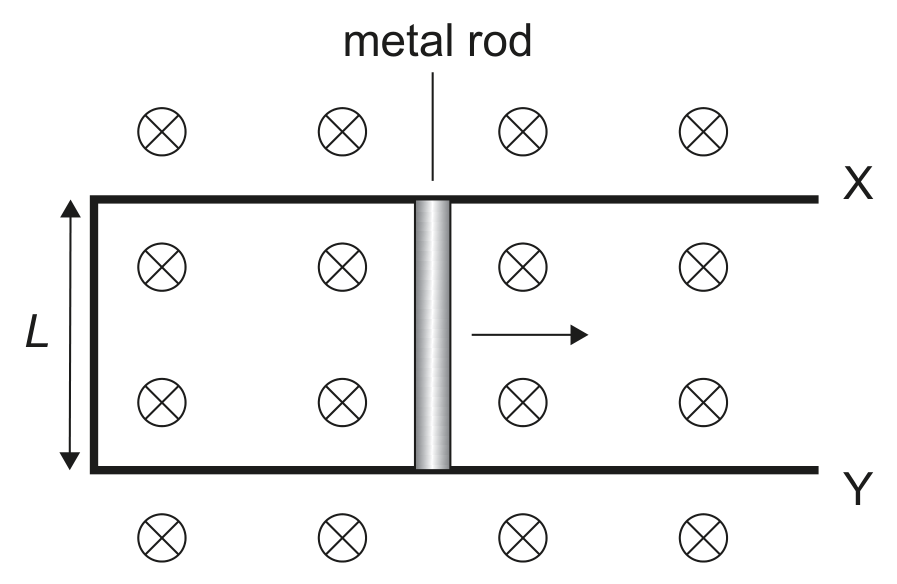
A metal rod is pulled along two horizontal conducting rails X and Y so that it rolls to the right at a constant speed. The two rails are connected by a straight conducting wire of Length L=0.60 mL=0.60 \mathrm{~m}. The system is in a region of uniform magnetic field of magnitude B=1.2 TB=1.2 \mathrm{~T} directed into the page.

Question image

As a result of the motion, the metal rod experiences a magnetic force of 0.084 N .

Outline how Lenz's law applies to this system.
Question 28

[Maximum number: 1]

A horizontal conducting ring is perpendicular to a uniform vertical magnetic field. When the ring is rotated through 180180^{\circ} about the horizontal axis, an average emf of 2.0μ V2.0 \mu \mathrm{~V} is induced in the ring. The area enclosed by the ring is 4.0 cm24.0 \mathrm{~cm}^{2} and the rotation takes 2.0 s .

What is the magnetic field?

A

2.5 mT

B

5.0 mT

C

10.0 mT

D

20.0 mT

Question 30

[Maximum number: 1]

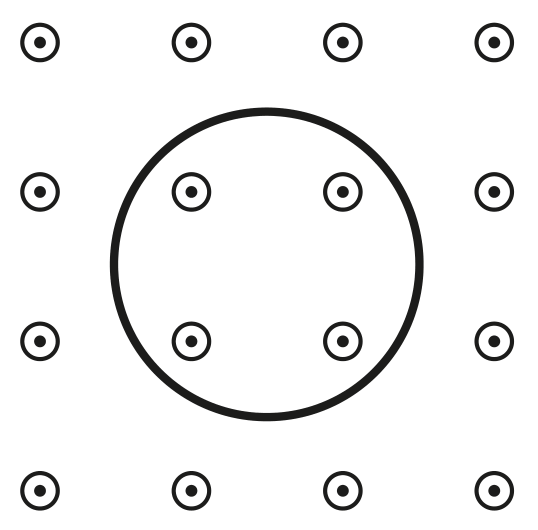
A conducting ring is perpendicular to a uniform magnetic field directed out of the page.

Question image

The magnitude of the magnetic field strength increases. What are the direction of the conventional current induced in the ring and the net magnetic force on the ring?

Current induced in the ring

Magnetic force on the ring

clockwise

zero

counter-clockwise

zero

clockwise

non-zero

counter-clockwise

non-zero

Question 31

[Maximum number: 1]

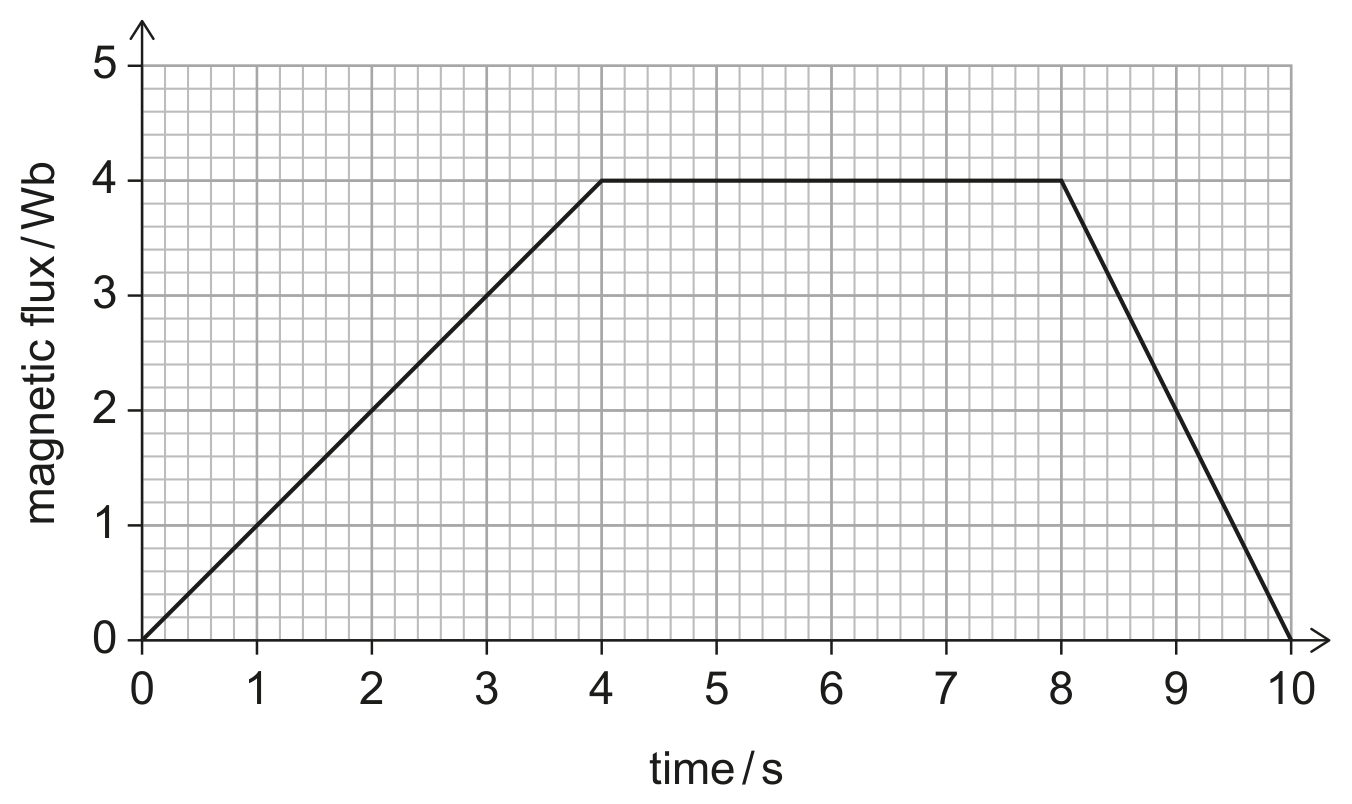
The graph shows how the magnetic flux linked through a conducting coil varies with time. The coil has only one turn.

Question image

What is the maximum emf induced in the coil?

A

0.40 V0.40 \mathrm{~V}

B

4.0 V

C

2.0 V

D

4.0 V

Question 8

Question 8(a)

(a)

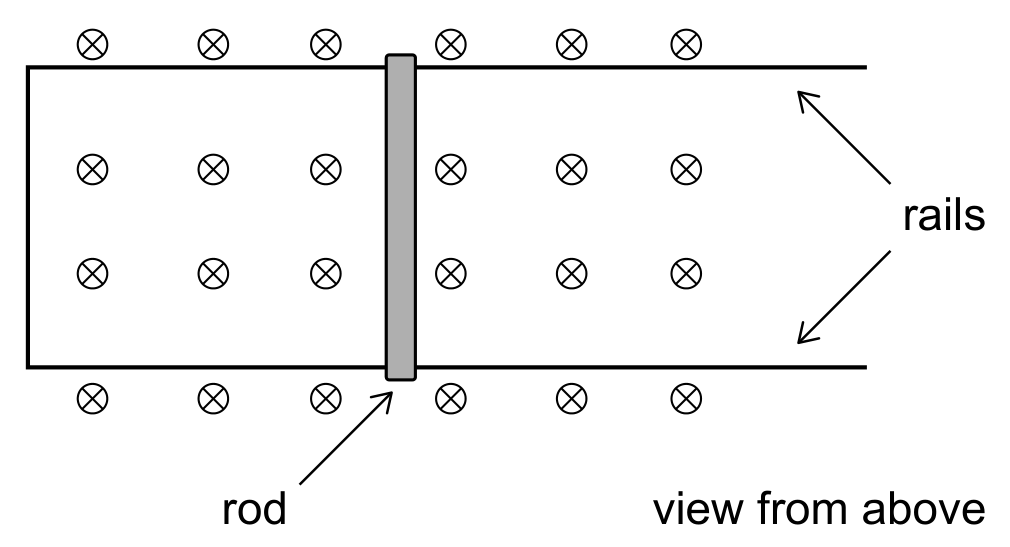
A conducting rod is placed on horizontal, conducting, frictionless rails.

Question image

A uniform magnetic field is directed into the plane of the page.
The rod begins to move to the right after it is given a short push. Explain why the rod will quickly stop moving.

[ 3 ]

Question 8(b)

(b)

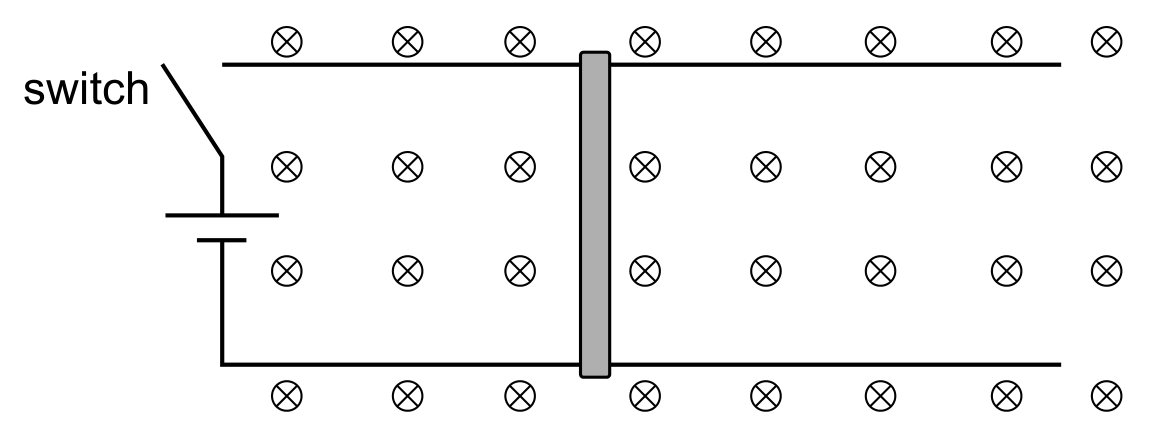
In another experiment, the rod is at rest on the rails. A cell and a switch are inserted as shown.

Question image

The switch is closed.

[ 2 ]

Question 8(b)(ii)

(i)

Explain why the rod will eventually reach terminal speed.

[ 2 ]

Question 8

[Maximum number: 9]

A rod, R , lies perpendicular to a uniform magnetic field B of strength 0.50 T directed into the plane of the page. R is connected to a circuit and the electric current IRI_{\mathrm{R}} is 2.0 A .

Question 8(c)

(a)

A small coil of wire of radius 2.0 cm and 20 turns is now located with its centre 10.0 cm from R. The current in R is kept constant at 2.0 A .

Question image
[ 7 ]

Question 8(c)(i)

(i)

Explain why there is no current induced in the coil.

[ 2 ]

Question 8(c)(ii)

(ii)

The current in R increases at a constant rate from 2.0 A to 10.0 A in 0.5 seconds.

Calculate the emf induced in the coil.

[ 3 ]

Question 8(c)(iii)

(iii)

Deduce the direction of the current induced in (c)(ii).

[ 2 ]

Question 8(d)

(b)

The coil is made to rotate such that an emf is induced. The graph shows the variation with time of the emf induced in the coil.

Question image

The frequency of rotation is doubled. Draw on the graph the variation with time of the new emf induced.

[ 2 ]

Question 9

[Maximum number: 7]

A bar magnet of mass 0.12 kg is suspended from a vertical spring of spring constant 7.4Nm17.4 \mathrm{Nm}^{-1}. The mass of the spring is negligible.

Question 9(d)(i)

(a)

Discuss two factors that affect the magnitude of the emf induced in the coil. In your answer, you should explain:
- how an induced emf can arise in the coil, and
- how each factor affects the magnitude of the emf.

[ 4 ]

Question 9(d)(ii)

(b)

A resistor is now connected across the coil. The amplitude of oscillation of the magnet rapidly decreases.

Explain this phenomenon.

[ 3 ]
0 selected