EduNinja
[Maximum number: 8]

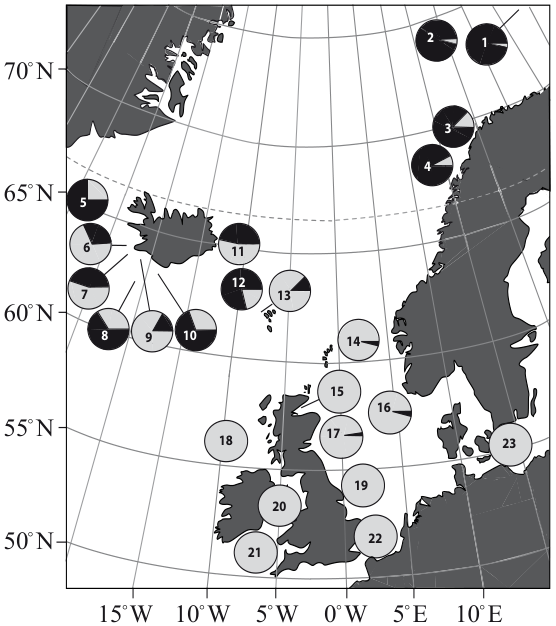
PanI is a gene in cod fish that codes for an integral membrane protein called pantophysin. Two alleles of the gene, PanIA\operatorname{PanI}{ }^{\mathrm{A}} and PanIB\operatorname{PanI}{ }^{\mathrm{B}}, code for versions of pantophysin, that differ by four amino acids in one region of the protein. Samples of cod fish were collected from 23 locations in the north Atlantic and were tested to find the proportions of PanI A{ }^{\mathrm{A}} and PanI B{ }^{\mathrm{B}} alleles in each population. The results are shown in pie charts, numbered 1-23, on the map below. The proportions of alleles in a population are called the allele frequencies. The frequency of an allele can vary from 0.0 to 1.0 . The light grey sectors of the pie charts show the allele frequency of PanI A{ }^{\mathrm{A}} and the black sectors show the allele frequency of PanI B{ }^{\mathrm{B}}.

Question image
(a)
(i)

State the two populations with the highest PanIB\operatorname{PanI}^{\mathrm{B}} allele frequencies.

[ 1 ]
(ii)

State the population in which the allele frequencies were closest to 0.5 .

[ 1 ]
(b)

Deduce the allele frequencies of a population in which half of the cod fish had the genotype PanIIAPanIIA\operatorname{PanI} \mathrm{I}^{\mathrm{A}} \operatorname{PanI} \mathrm{I}^{\mathrm{A}}, and half had the genotype PanIIAPanIIB\operatorname{PanI} \mathrm{I}^{\mathrm{A}} \operatorname{PanI} \mathrm{I}^{\mathrm{B}}.

[ 1 ]
(c)

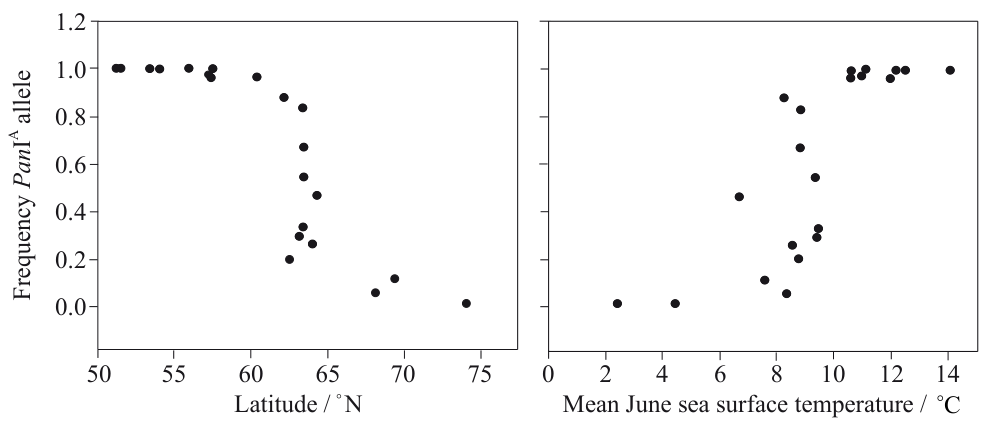
The graphs below show the latitude and the mean surface sea temperature in June of the sampling locations and the frequency of the PanIA\operatorname{PanI}^{\mathrm{A}} allele.

Question image

State the relationship between

[ 1 ]
(i)

latitude and the frequency of the PanIA\operatorname{PanI}^{\mathrm{A}} allele.

[ 1 ]
(ii)

mean surface sea temperature in June and the frequency of the PanI A{ }^{\mathrm{A}} allele.

(d)

Suggest how natural selection could have caused the relationships shown in the graphs.

[ 2 ]
(e)

The sites close to Iceland, at a latitude of 606560-65^{\circ}, had very varied allele frequencies, with both PanI A{ }^{\mathrm{A}} and PanI B{ }^{\mathrm{B}} occurring. The water at these sample sites was highly stratified, with much warmer water at the surface and much colder water below. Suggest reasons for both PanIA\operatorname{PanI}^{\mathrm{A}} and PanIB\operatorname{PanI}^{\mathrm{B}} alleles occurring at these sites.
[ 2 ]
[Maximum number: 2]

Several studies have been undertaken to determine whether there is an evolutionary explanation for menopause, the time when reproductive capacity stops in women. Two contemporary hunter-gatherer societies were studied. The graph shows what percentage of women survive to each of the ages given.

(a)

Explain the possible natural selection of menopause among humans during the hunter-gatherer period of their evolution.

[ 2 ]
[Maximum number: 3]

Obesity (excessive weight) is recognized as a global health problem and has been correlated with a large number of health issues, diseases and deaths. The increased consumption of fructose, now widely used as a sweetener, has been associated with the increase in obesity.

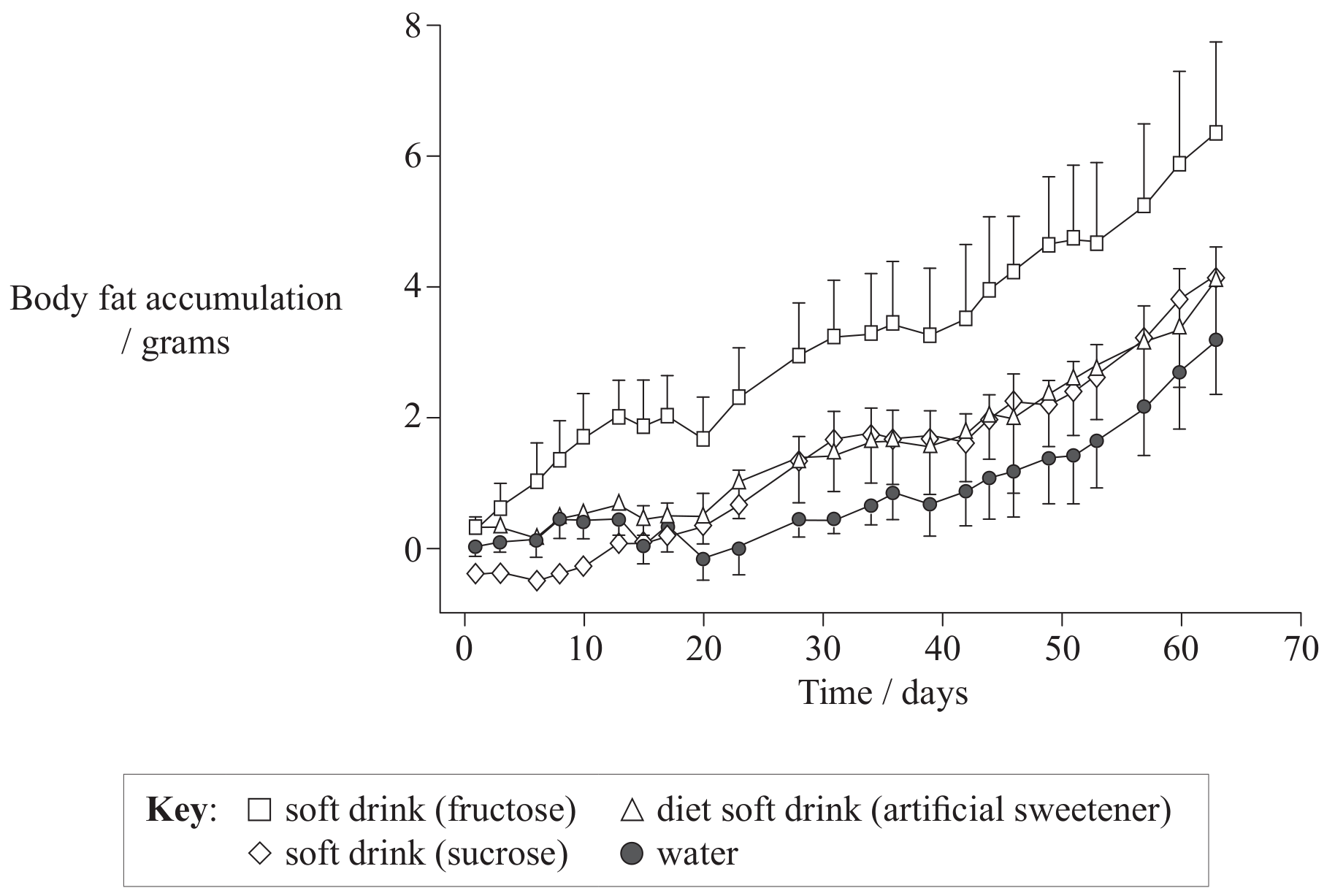
In a study, mice were divided into four groups. Each group was given the same amount of food and either a soft drink with a different sweetener or water.

Question image
(a)

Using all of the data, evaluate the evidence that suggests the consumption of large amounts of fructose poses a risk to human health.

[ 3 ]
[Maximum number: 2]

The yeast Metschnikowia bicuspidata is a parasite of a species of zooplankton, Daphnia dentifera. Biologists monitored the infections of D. dentifera populations in a series of lakes in Indiana (USA). An increase in nitrogen compounds dissolved in the lakes causes the phytoplankton populations to increase. D. dentifera feed on phytoplankton.

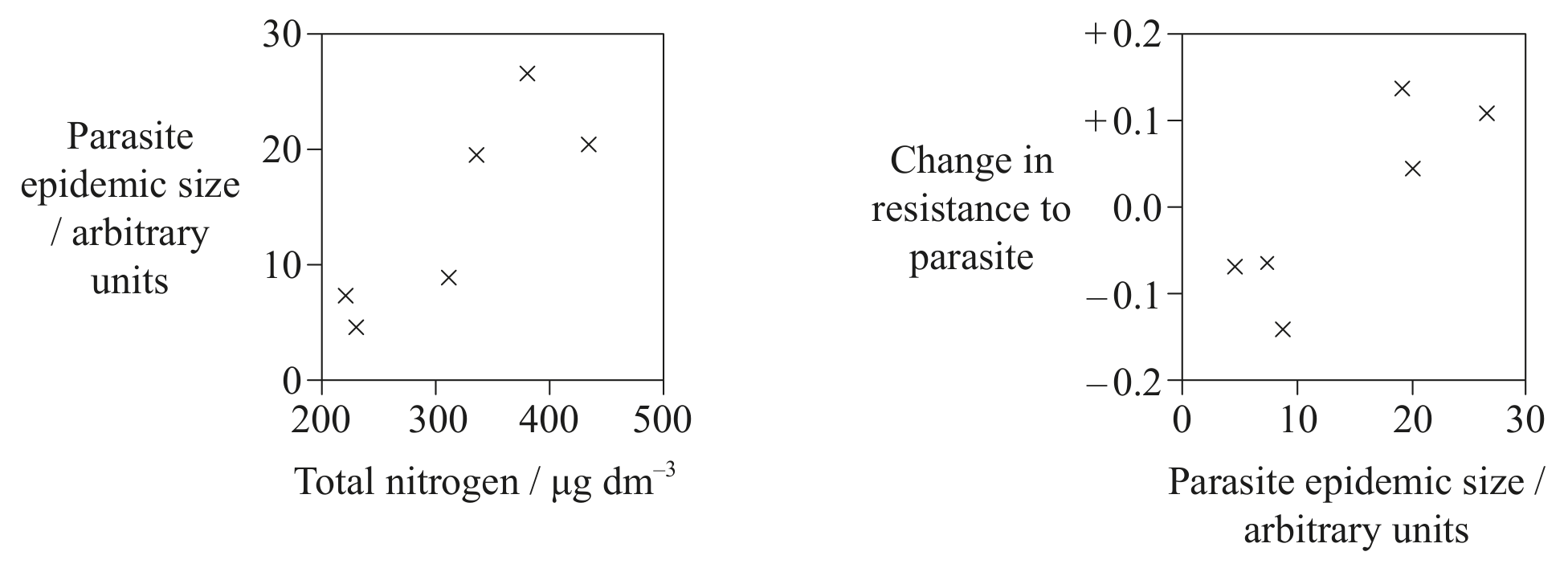
The graphs show the
- relationship between nitrogen levels dissolved in the water and the size of the parasite epidemic in the D. dentifera population.
- relationship between the size of the parasite epidemic in the D. dentifera population and the change in the resistance (established by comparing the infection of the D. dentifera populations before and after the epidemic).

Question image
(a)

Outline, according to the theory of natural selection, how increased size of the parasite epidemic in the D. dentifera will result in the evolution of increased resistance to the parasite.
Predatory fish tend to eat infected D. dentifera more than uninfected D. dentifera.

[ 2 ]
[Maximum number: 4]

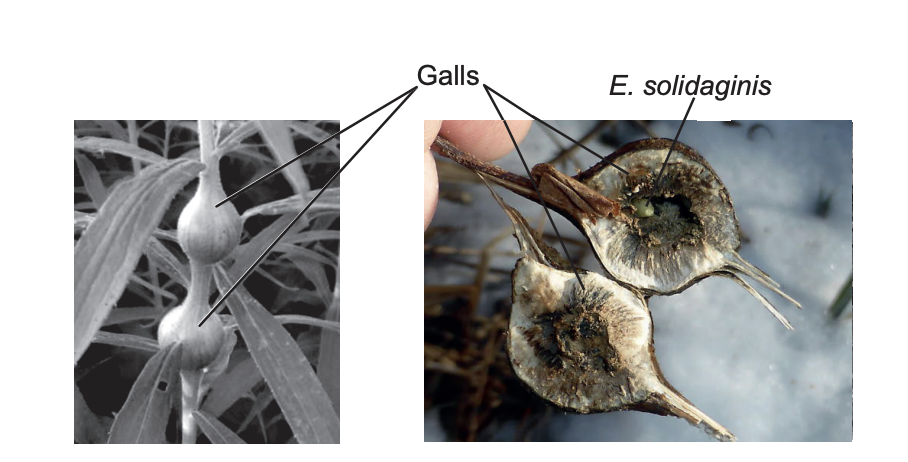
The larval stage of the fly Eurosta solidaginis develops in the plant Solidago altissima.

The larva secretes a chemical which causes plant tissue to grow around it forming a swelling called a gall. The gall provides the developing insect with protection from predators.

Question image

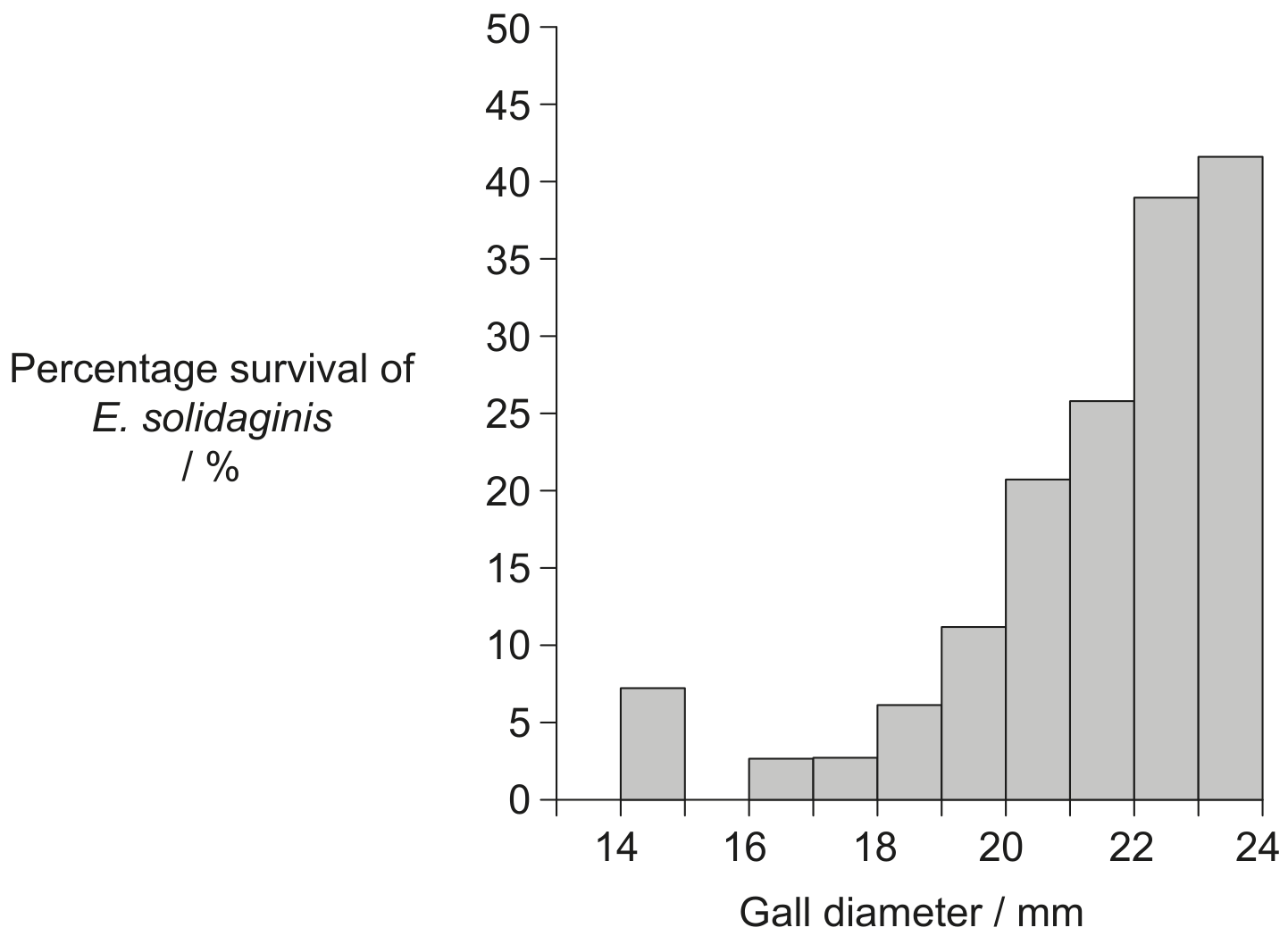
The E. solidaginis fly is preyed upon by the parasitic wasp Eurytoma gigantea. The graph shows the relationship between gall diameter and the percentage of flies that avoid predation by E. gigantea.

Question image
(a)

Describe the relationship between gall diameter and percentage survival of E. solidaginis.

[ 2 ]
(b)

Explain the concept of directional selection with respect to this example.

[ 2 ]
[Maximum number: 2]

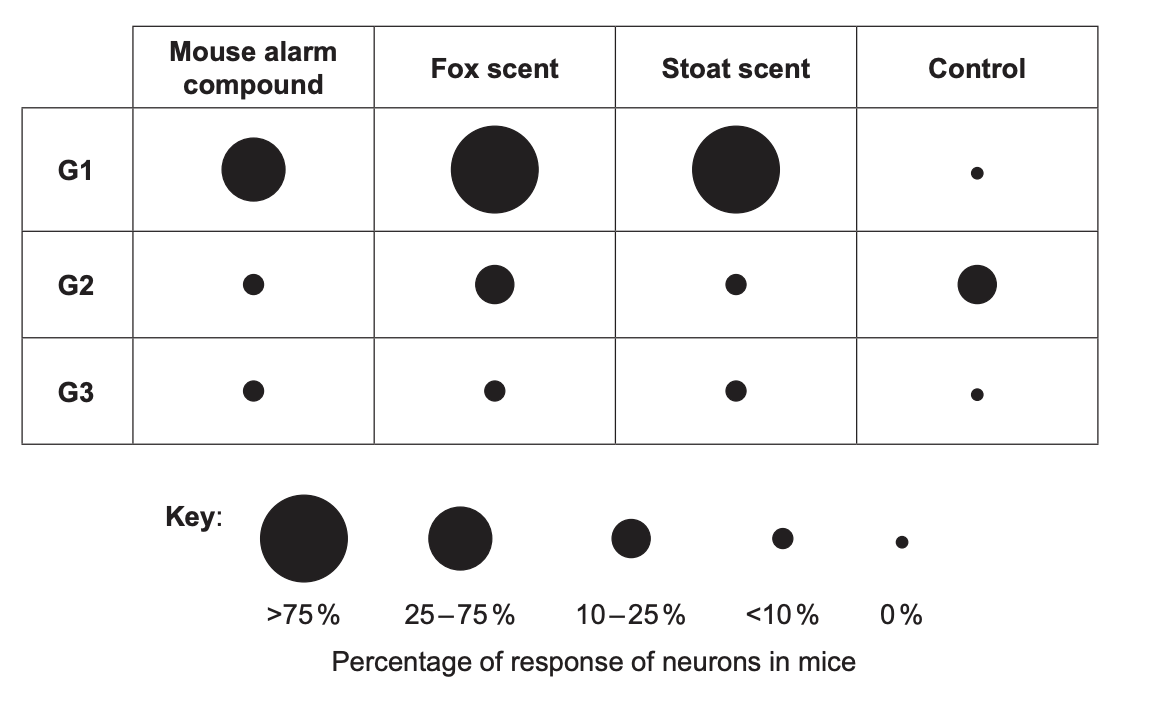
Mice (Mus musculus) have various defence systems against predators such as foxes (Vulpus vulpus) or stoats (Mustela erminea). The mice release specific alarm compounds when under threat that serve as danger signals for other mice. Predators also release scents that the mice can detect.

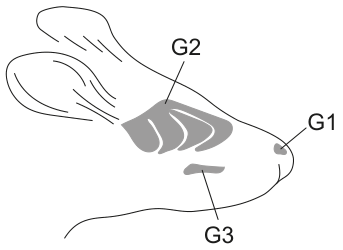
In one study, mice were exposed to paper soaked in compounds taken from other mice, foxes or stoats in a test chamber. The scientists then measured the reaction of three different groups of neurons used in smelling: G1, G2 and G3, as shown in the diagram.

Question image

The percentage of G1, G2 and G3 neurons responding to the mouse, fox and stoat compounds, as well as a control compound, are shown in the chart.

Question image
(a)

Discuss whether natural selection would favour the transgenic EBF-producing thale cress plants if they were released into the wild.

[ 2 ]
[Maximum number: 7]

Increases in the frequency and severity of drought are part of climate change in many areas of the world. Drought represents one of the major threats to food security as it can drastically decrease crop yield.

Water stress occurs when the demand for water exceeds its availability. A water stress index of 0.0 indicates non-water-stressed plants with normal transpiration and 1.0 is maximum water stress with much less transpiration.

(a)
(i)

Compare and contrast the relative abundance of Gram-negative bacteria in the soil and the roots of pre-flowering drought plants.

[ 3 ]
(b)

Scientists inoculated the roots of the sorghum plants with one of two different species of Gram-positive bacteria. One set of plants was grown under drought conditions and the control with normal water. They compared the fresh mass of the roots of these two groups of plants.

[ 4 ]
(i)

Deduce the effect of drought on the fresh mass of the roots that have not been inoculated (X).

[ 1 ]
(ii)

Compare and contrast the effect of the inoculations with Gram-positive I (Y) and Gram-positive II (Z) on the fresh mass of control and drought roots.

[ 3 ]
[Maximum number: 2]

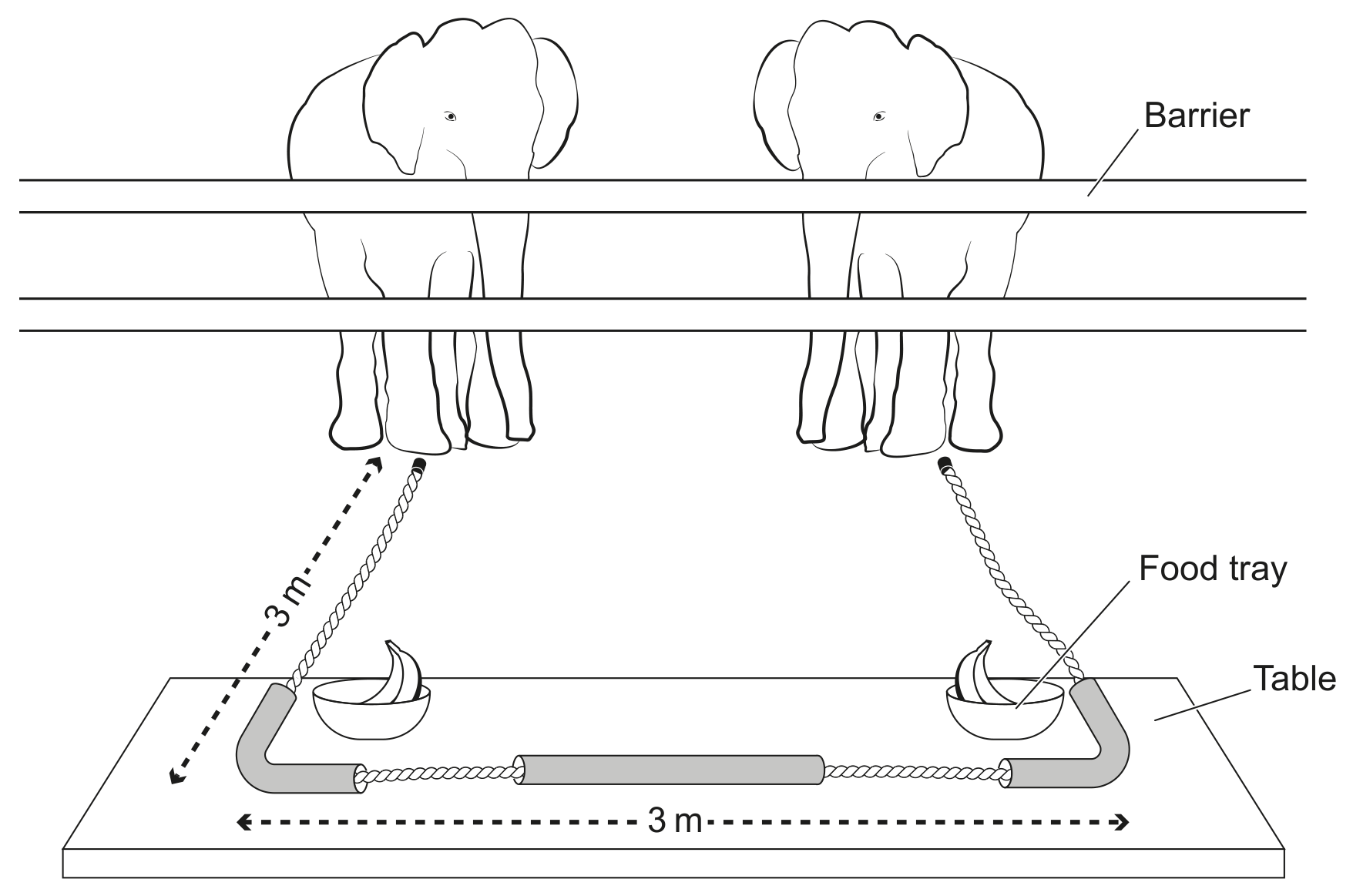
A group of nine semi-wild Asian elephants (Elephas maximus) from an elephant camp in Myanmar were trained to pull two ends of a single rope to get access to food in food trays located on a table behind a barrier. When both elephants pulled the rope, the table moved towards them making the food trays accessible. The task required two elephants to work together in cooperation for mutual benefit to obtain food.

Question image

The graph shows the rate of cooperation between pairs of elephants in pulling the rope when there were two food trays, one at each end of the table (as shown in the diagram), or when there was one food tray placed in the centre of the table. The cooperation rate was the number of successful cooperative attempts divided by the number of all attempts in one session. The experiment was repeated for many sessions on successive days.

(a)

Evaluate the hypothesis the researchers put forward from their experiments that in some circumstances natural selection favours competitive behaviour.

[ 2 ]
(a)
(i)

In fruit flies (Drosophila melanogaster) the allele for long wings is dominant to the allele for short (vestigial) wings. In a laboratory population of 200 flies there were 168 with long wings. Using the Hardy-Weinberg equation, calculate the percentage of flies that would be heterozygous for this characteristic. Show your working.

[ 2 ]
(ii)

State two assumptions made when using the Hardy-Weinberg equation to calculate allele frequencies.

[ 1 ]
(a)

State two assumptions that are made when the Hardy-Weinberg equation is used.

[ 2 ]
0