Lead is a toxic heavy metal responsible for a range of developmental and physiological disorders in children, including behaviour and learning problems, slowed growth and anaemia. The blood lead level (BLL) is a reliable biological indicator of a child's lead exposure. Scientists of the Environmental Protection Agency (EPA) looked at all the available data to determine the pathways by which lead entered the blood of children in three age categories in the US. The chart summarizes their findings.
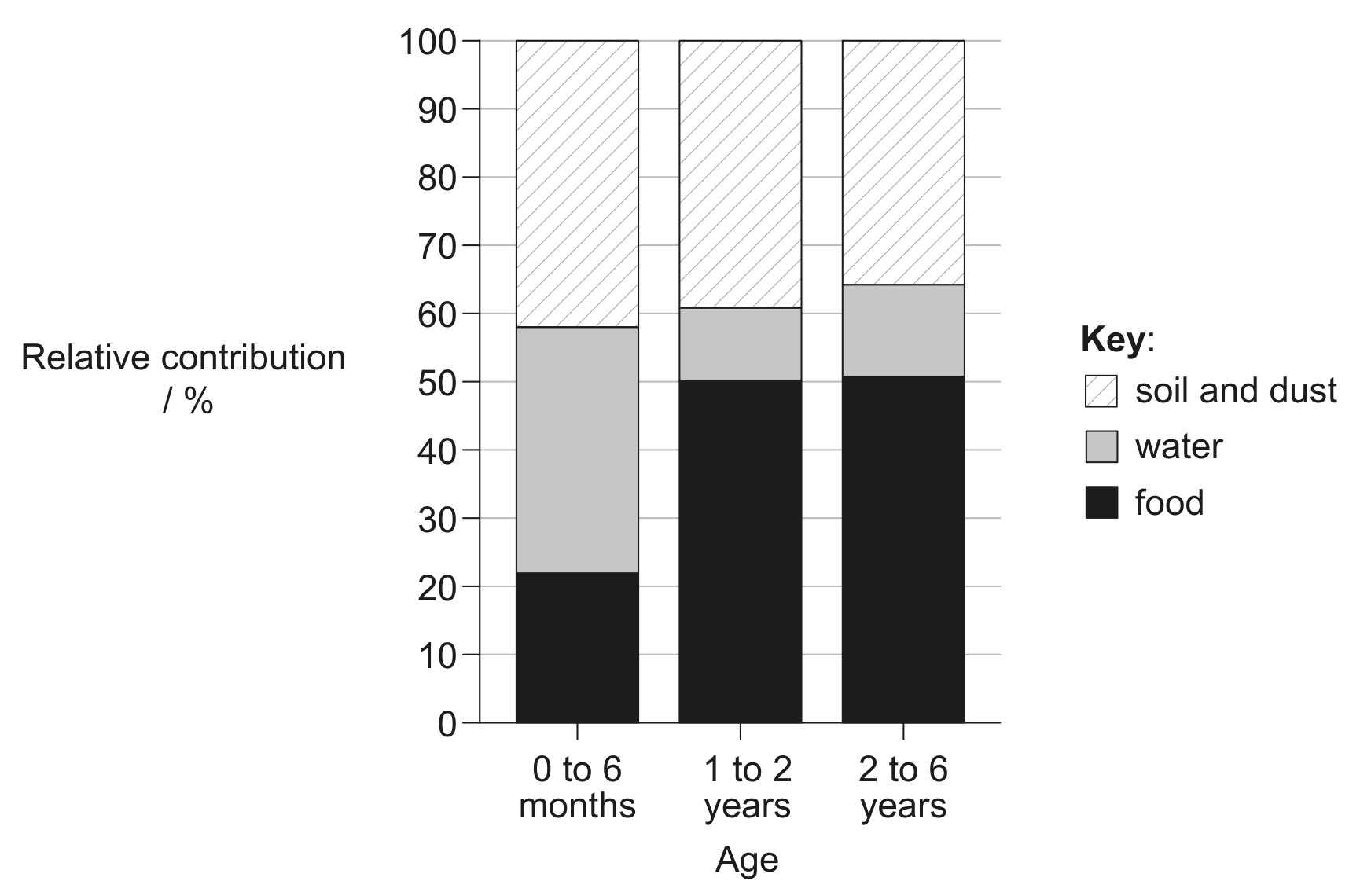
Suggest how a change in the habits of children as they grow older may affect the relative contribution of the three pathways by which lead enters the blood.
The Centers for Disease Control and Prevention (CDC) in the US recommended that children with a BLL of more than have treatment to remove lead from the blood. Outline the need for treatment for the children in both countries from 2000 onwards.
No data was recorded for heavy traffic environments from 1987 to 1996. Predict with a reason how the mean BLL for heavy traffic environments in this period would compare to the BLL for 1997 to 2006.
Using all the data, discuss the potential effect of e-waste dumping on the BLL of children.