Stem cells in the bone marrow can be forced into blood vessels in a process called mobilization. Mobilization of stem cells from the bone marrow into the blood vessels represents the basis for modern bone marrow transplantation procedures.
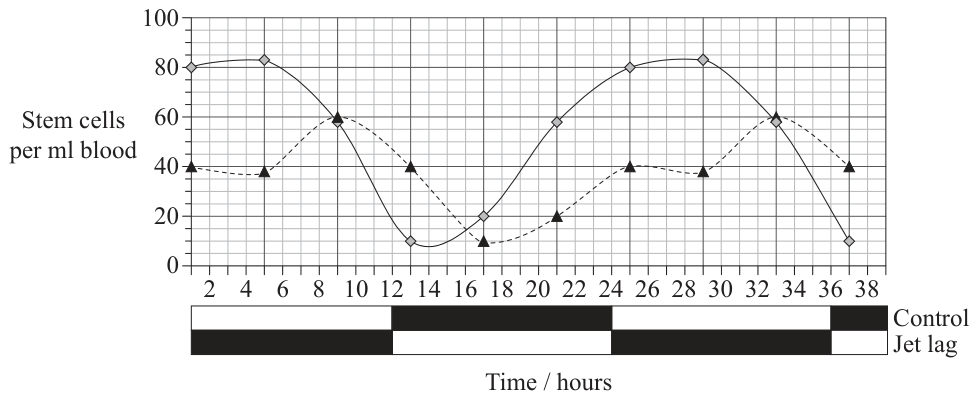
To test the effect of light on the mobilization of stem cells, mice were subjected to a simulated "jet lag" by advancing the light-dark cycle by 12 hours. This was done by subjecting mice to a 24 -hour light period before the results shown in the graph were recorded. The results were compared to the stem cells in control mice under normal conditions of 12 hours of light ( □ ) and 12 hours of darkness ( dark box) and 12 hours of darkness ( dark box ).

One important chemical in the mobilization of stem cells is a protein, CXCL12, which maintains the stem cells inside the bone marrow. The breakdown of CXCL12 causes the mobilization of stem cells to the blood vessels.
The graph below shows the mobilization of stem cells and the production of mRNA for CXCL12 when the bone marrow is treated with two different chemicals (isoprenaline and clenbuterol).
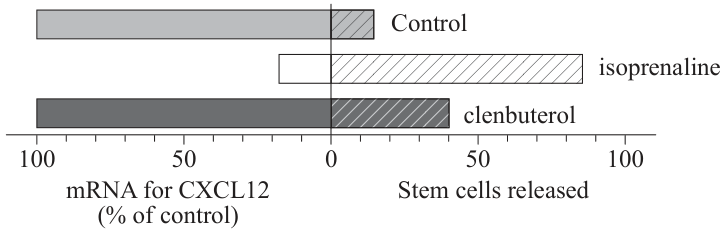
Explain how the amount of mRNA for CXCL12 gives an indication of the amount of protein CXCL12 produced.
Compare the effect of isoprenaline and clenbuterol with the normal release of stem cells and the production of mRNA for CXCL12.