C1.3.13 (HL)—NADP reduction

NADP is reduced in the light-dependent reactions when electrons from Photosystem I are accepted to form reduced NADP, connecting the mechanism to observable photosynthesis evidence.

Syllabus
First assessment 2025
Objective
C1.3.13
Level
HL

Exam analysis

Chance of appearing4%of analysed past papers
Latest appearanceMay 2025
Most common paperPaper1
Typical marks1

Recent exam appearances

May 2025Paper1A ["HL"] · TZ27[ 1 ]C1.3.13 (HL)—NADP reduction
May 2021Paper1 ["HL"] · TZ132[ 1 ]C1.3.13 (HL)—NADP reduction
May 2018Paper1 ["HL"] · TZ215[ 1 ]C1.3.13 (HL)—NADP reduction
May 2017Paper1 ["HL"] · TZ215[ 1 ]C1.3.13 (HL)—NADP reduction
Practice this objective

Coverage 2017–2025 · Updated 15 Jul 2026

Photolysis and NADP reduction

HL only
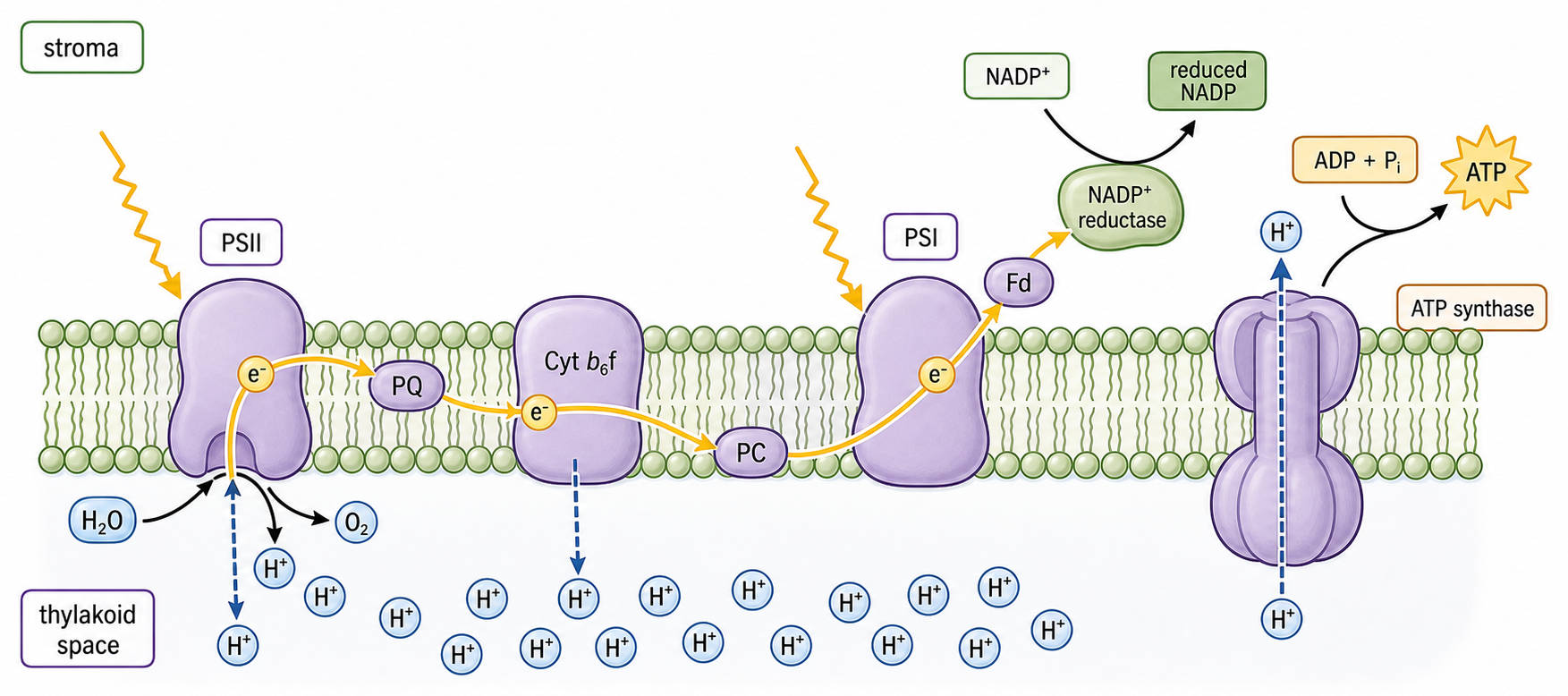
Thylakoid membrane showing PSII, electron carriers, PSI, photolysis, proton movement and NADP reduction.

In photosystem II, light-driven photolysis splits water; later, photosystem I supplies excited electrons that reduce NADP on the stromal side of the thylakoid.

2H2O4H++4e+O22H₂O → 4H⁺ + 4e⁻ + O₂

Photolysis replaces electrons lost by photosystem II. Its protons contribute to the thylakoid proton gradient and its oxygen is released as waste; oxygen generation profoundly changed Earth's living and geological systems.
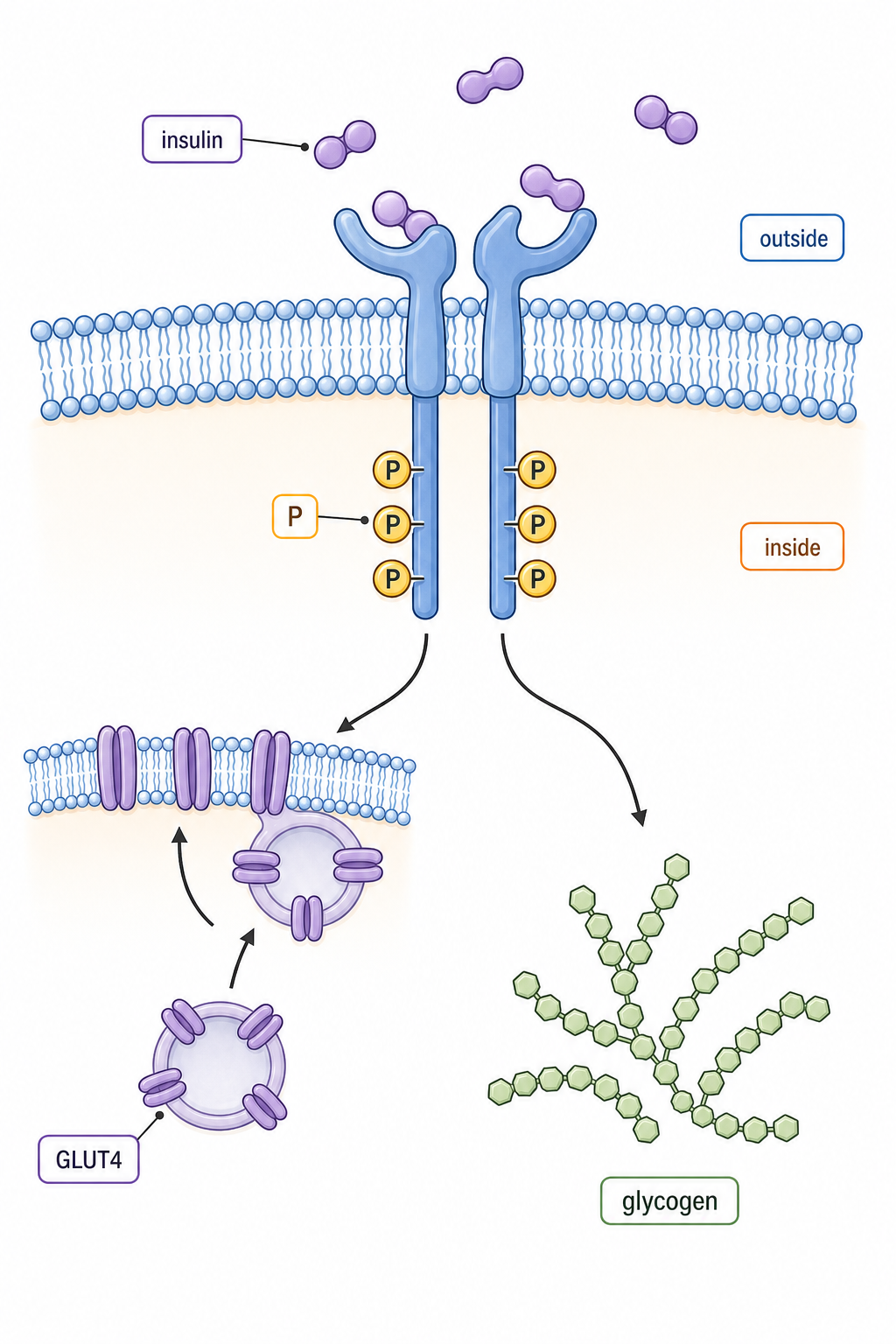
At photosystem I, NADP accepts two excited electrons originating from photosystem I and one H⁺ from the stroma to form reduced NADP (NADPH), which carries reducing power to the Calvin cycle.
Use one consistent pair of names: NADP/reduced NADP or NADP⁺/NADPH. The released O₂ comes from water, not carbon dioxide, and photolysis does not directly make glucose.

NADP reduction

HL only

Assessment in practice

1 marks
How it is assessed

This objective is assessed through multiple choice.

What earns marks

Build the answer around this relationship: Photosystem I supplies electrons used to reduce NADP.

Representative question

Question 1

[Maximum number: 1]

What occurs during photosynthesis?

A

Water is oxidized by releasing two electrons to NADPH.

B

Glycerate-3-phosphate (GP) is oxidized by releasing two electrons to photosystem II.

C

NAD is reduced by accepting two electrons from ATP.

D

NADP is reduced by accepting two electrons from photosystem I.

Trace Photosynthesis Mechanism

HL only

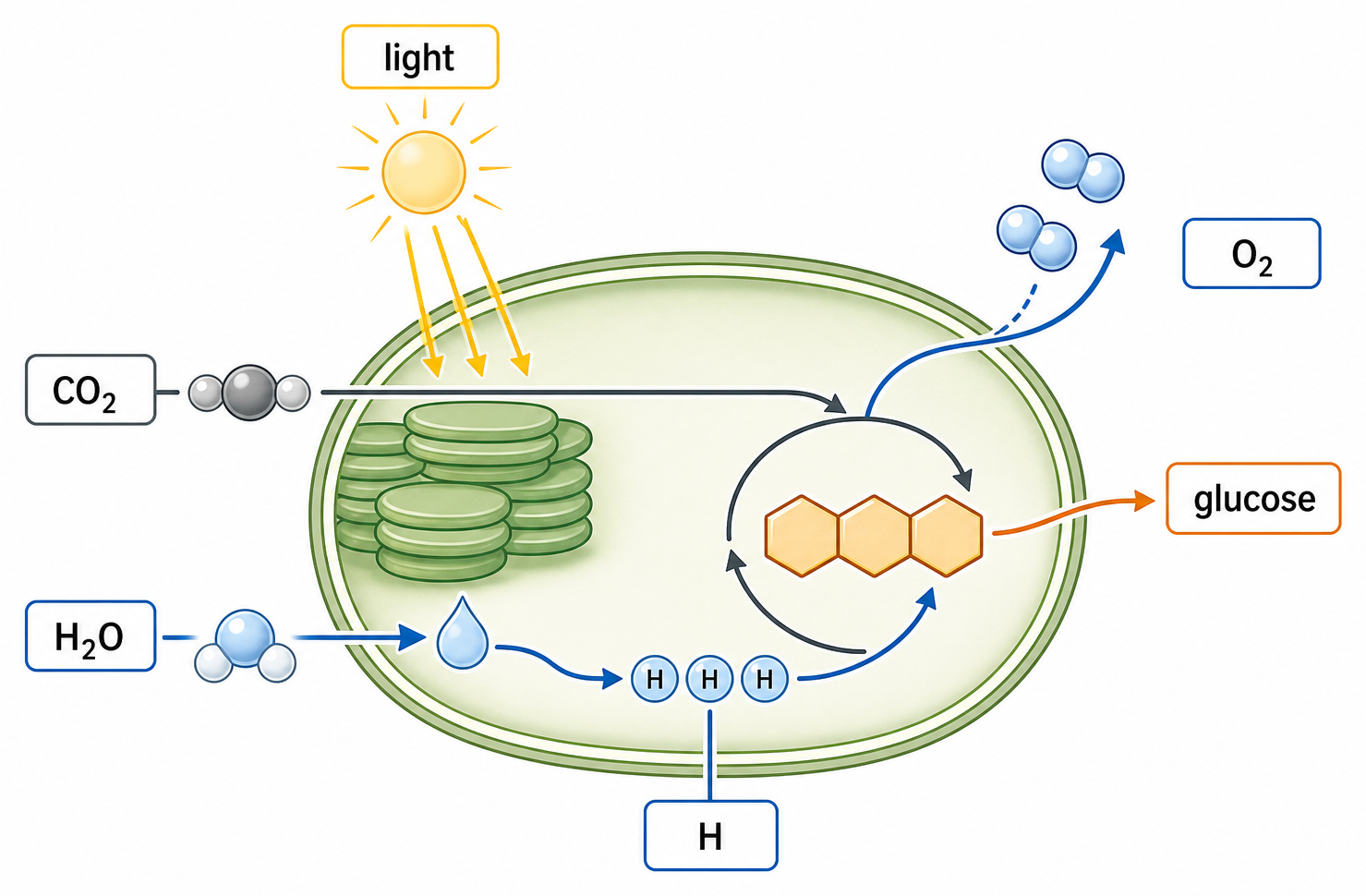
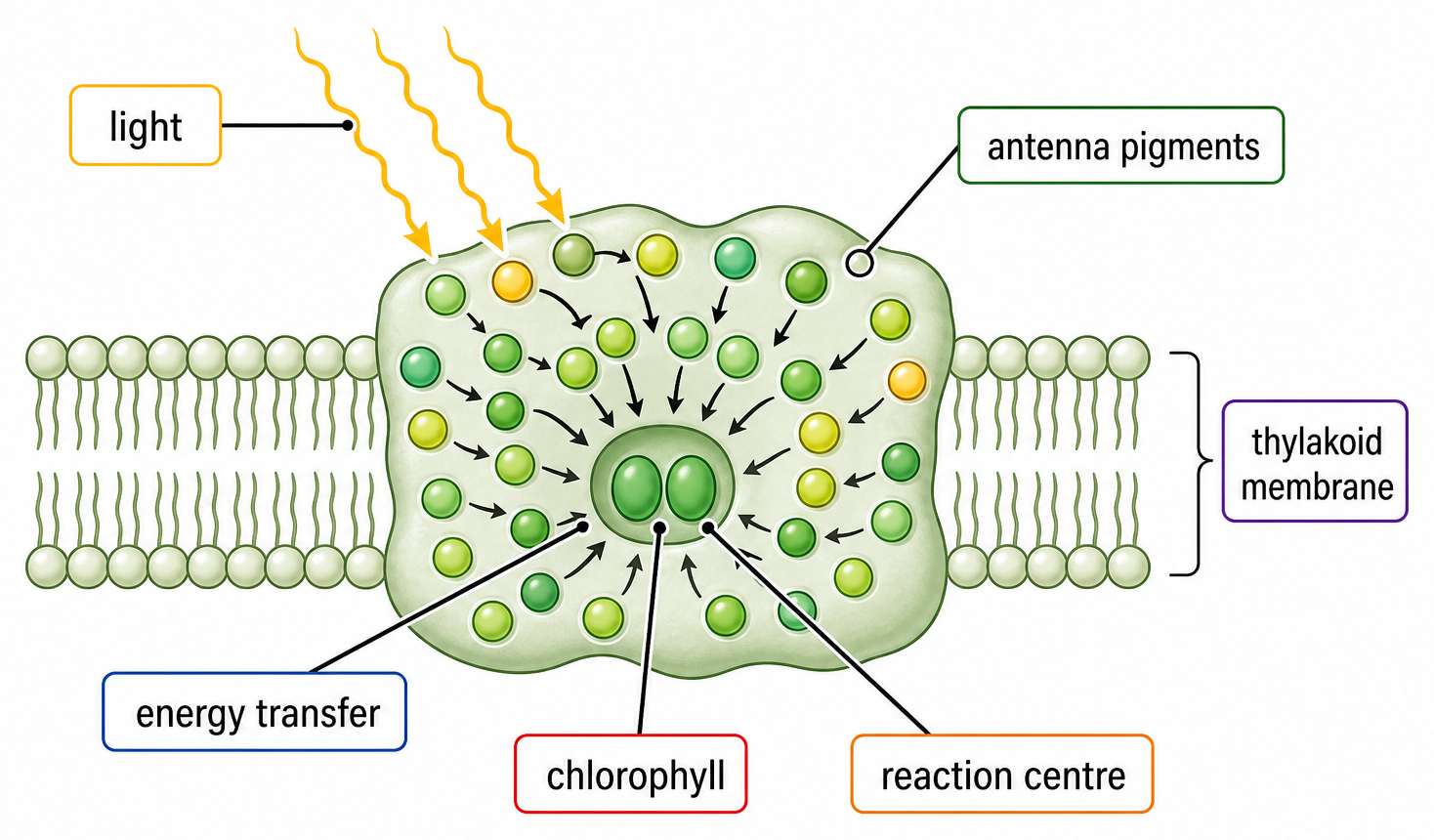
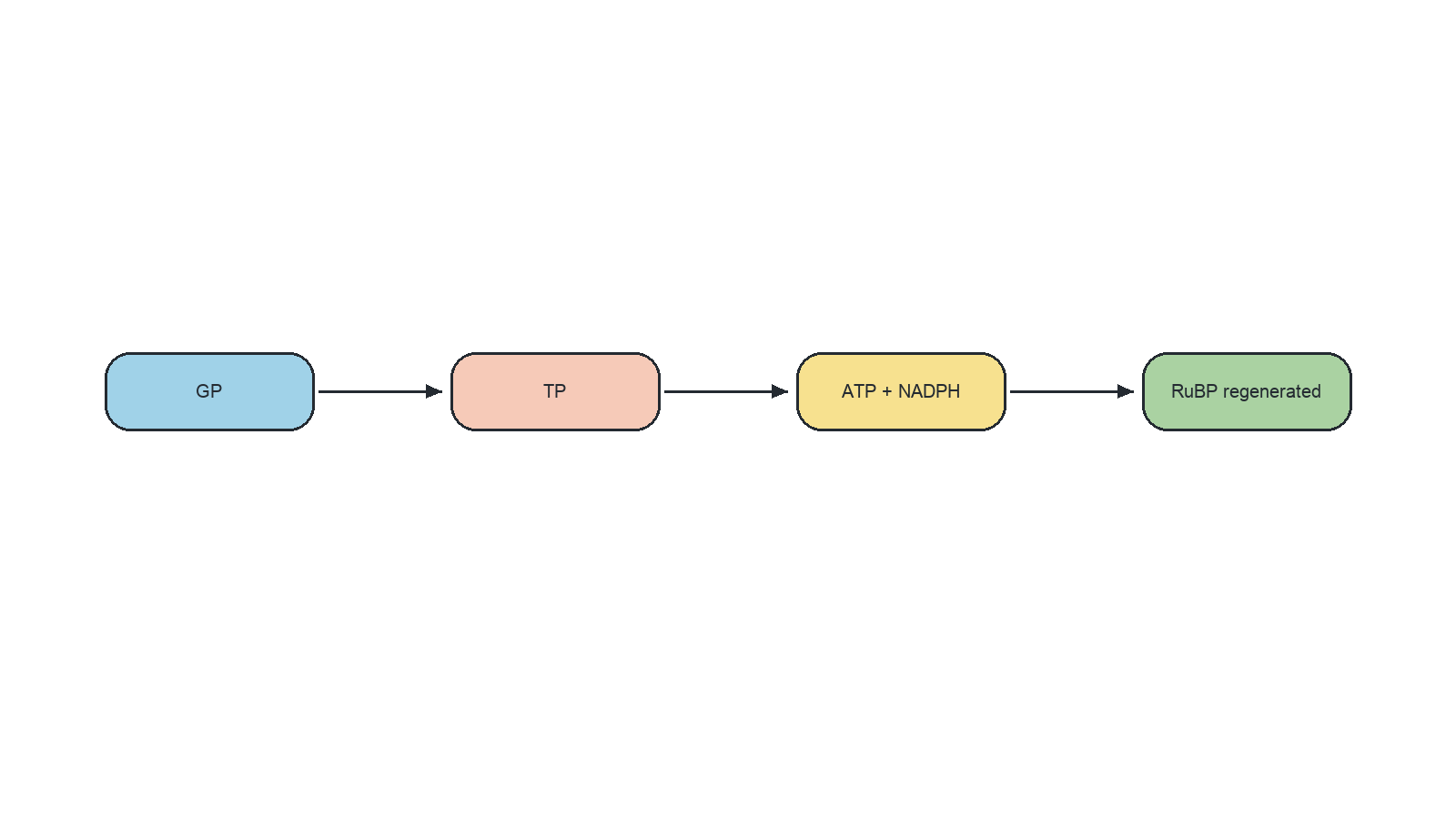
HL photosynthesis links light-dependent reactions to the Calvin cycle. Photosystems are pigment-protein arrays in thylakoid membranes; antenna pigments broaden absorption and pass energy to reaction-centre chlorophyll. PSII uses light to split water, supplying electrons, protons, and oxygen. Electron transport pumps protons into the thylakoid space, ATP synthase makes ATP by photophosphorylation, PSI re-excites electrons, and NADP is reduced. The Calvin cycle uses ATP and reduced NADP: Rubisco fixes CO2 to RuBP to form GP, GP is reduced to triose phosphate, most triose phosphate regenerates RuBP, and some becomes wider biomolecules.

  • Trace energy: pigments -> reaction centres -> ATP and reduced NADP.
  • Trace electrons/protons: water -> PSII -> carriers -> PSI -> NADP; proton gradient -> ATP synthase.
  • Trace carbon: CO2 -> RuBP/GP -> triose phosphate -> RuBP regeneration and biomolecule synthesis.
  • Trace exchange: light-dependent reactions supply ATP/reduced NADP; Calvin cycle returns ADP/NADP.

Concept essentials

  • Photosystem I supplies electrons used to reduce NADP.
  • NADP, not NAD or FAD, is the photosynthetic electron acceptor.
  • Reduced NADP carries reducing power to the Calvin cycle.
  • NADP reduction belongs to the light-dependent reaction sequence.