Q BankQuestion BankDocsDocuments

C3.1 Integration of body systems

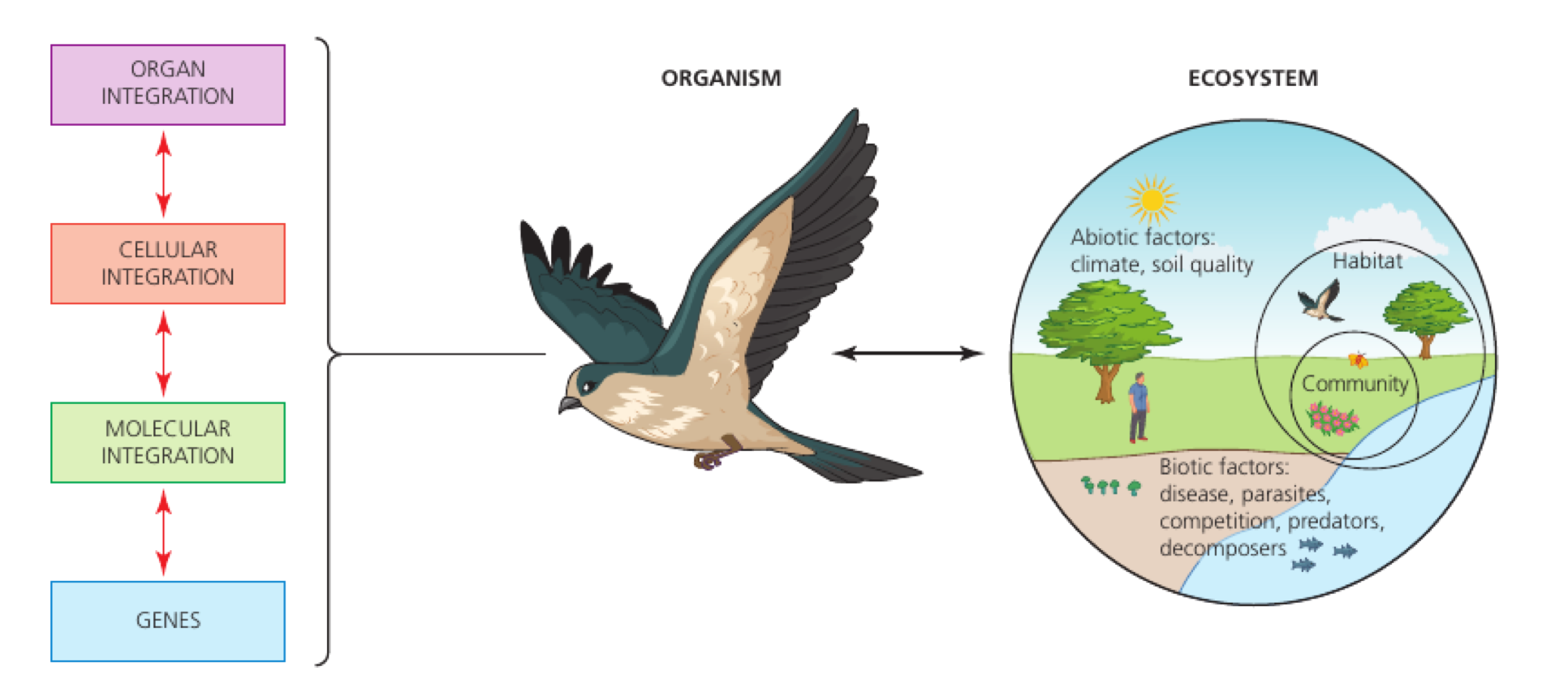
Integrated body systems coordinate neural, hormonal and plant responses through receptors, control centres and effectors, maintaining function across organisms and changing environmental conditions.

Syllabus
First assessment 2025
Topic
C3.1
Level
HL

Integration joins specialised parts into a working whole

Integration joins specialised parts into a working whole.

In a multicellular organism, tissues, organs and organ systems exchange information and materials so the organism can coordinate one response. Nervous impulses are fast; hormones travel in blood and can act on distant targets.

Name the parts; identify the signal or material crossing between them; then state the coordinated outcome.

During exercise, receptors and the brain increase heart and ventilation activity while blood delivers oxygen to working muscle.

Integration is more than a list of organs: the explanation must include communication and a shared function.

System integration

Assessment in practice

1–3 marks
How it is assessed

This objective is assessed through structured response, commonly using Identify / Explain.

Command terms

Identify / Explain

What earns marks

Mark schemes reward named structures, correct direction of information flow and explanations that keep the sequence causal.

Watch for

Naming a brain region without linking it to information integration or coordination.

Representative question

Question 1

[Maximum number: 3]

Using the diagram, explain the concept of emergent properties of biofilms.

Organisation builds new properties at each level

Organisation builds new properties at each level.

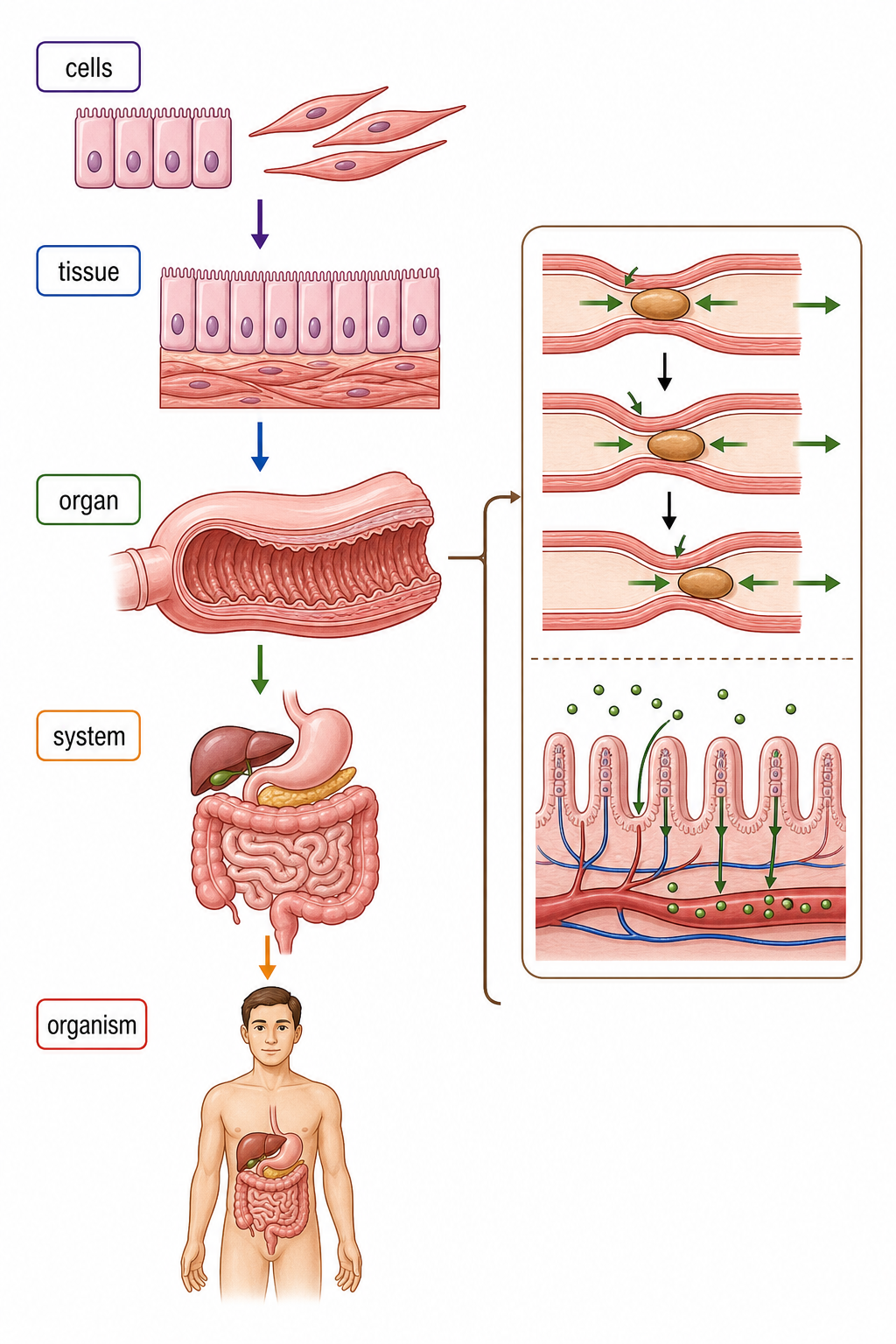
Cells of one type form tissues, different tissues form organs, and organs form systems. Interactions between parts can produce an emergent capability that no isolated cell performs alone.

cell → tissue → organ → system → organism; at each step ask what cooperation adds.

Cardiac muscle, connective tissue and blood vessels combine in a heart that pumps blood; no one tissue performs the whole job.

Hierarchy is not just size ranking; it is a functional relationship between levels.

Hierarchy in multicellular organisms

Assessment in practice

1 marks
How it is assessed

This objective is assessed through multiple choice, commonly using Explain.

Command terms

Explain

What earns marks

Mark schemes reward named structures, correct direction of information flow and explanations that keep the sequence causal.

Representative question

Question 1

[Maximum number: 1]

Why do multicellular organisms have emergent properties?

A

They have more genes than unicellular organisms.

B

Properties of unicellular organisms are enhanced by having many cells.

C

All of their genes are expressed whereas unicellular organisms express only some.

D

They show properties that can only result from the interaction of many cells.

Organs integrate by sharing materials and control

Organs integrate by sharing materials and control.

An organ system works only when its organs exchange inputs and outputs. Blood can carry oxygen, urea or hormones between organs, while nervous and endocrine signals adjust their activity.

trace source → transport or signal → target → physiological effect.

The liver makes urea, blood carries it to the kidneys, and the kidneys remove it; separating any link breaks the process.

A hormone’s source and target need not be the same organ, and transport is part of the mechanism.

Integration of organs

Assessment in practice

1–2 marks
How it is assessed

This objective is assessed through structured response, commonly using Identify / Explain / Draw.

Command terms

Identify / Explain / Draw / Deduce / Suggest / Outline / Describe

What earns marks

Mark schemes reward named structures, correct direction of information flow and explanations that keep the sequence causal.

Watch for

Giving a general body-system answer without the specific pathway step for integration of organs.

Representative question

Question 1

[Maximum number: 3]


(b) Pancreatic secretions contain sodium hydrogen carbonate, making them basic.
Deduce the significance of the response by the pancreas to secretin.

The brain combines information before coordinating responses

The brain combines information before coordinating responses.

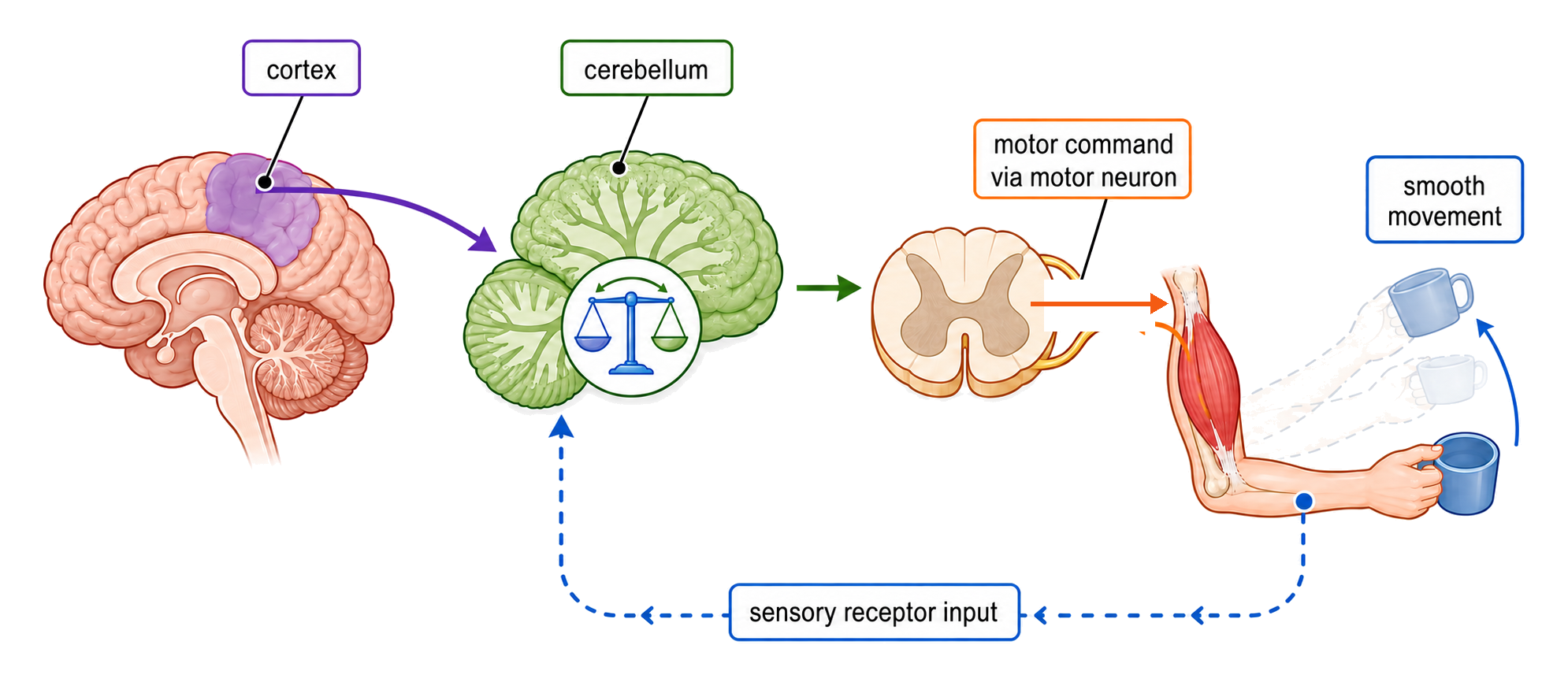
The brain receives sensory input, compares it with stored information and sends outputs to muscles or glands. Different regions contribute different jobs: cortex for conscious processing, cerebellum for coordination and medulla for vital automatic control.

input → integration region → output; distinguish conscious processing from automatic control.

A change in body position reaches the brain; the cerebellum helps adjust muscle activity so balance is restored.

Do not assign every response to the cortex: many homeostatic actions are coordinated below conscious awareness.

Brain as information integration organ

Assessment in practice

1–3 marks
How it is assessed

This objective is assessed through essay response, commonly using Explain / Outline / Identify.

Command terms

Explain / Outline / Identify / Label / State / Discuss / Determine / Compare / Contrast

What earns marks

Mark schemes reward named structures, correct direction of information flow and explanations that keep the sequence causal.

Watch for

Naming a brain region without linking it to information integration or coordination.

Representative question

Question 1

[Maximum number: 6]

Explain two methods that scientists have used to determine the different functions of the brain.

The spinal cord can integrate a rapid response

The spinal cord can integrate a rapid response.

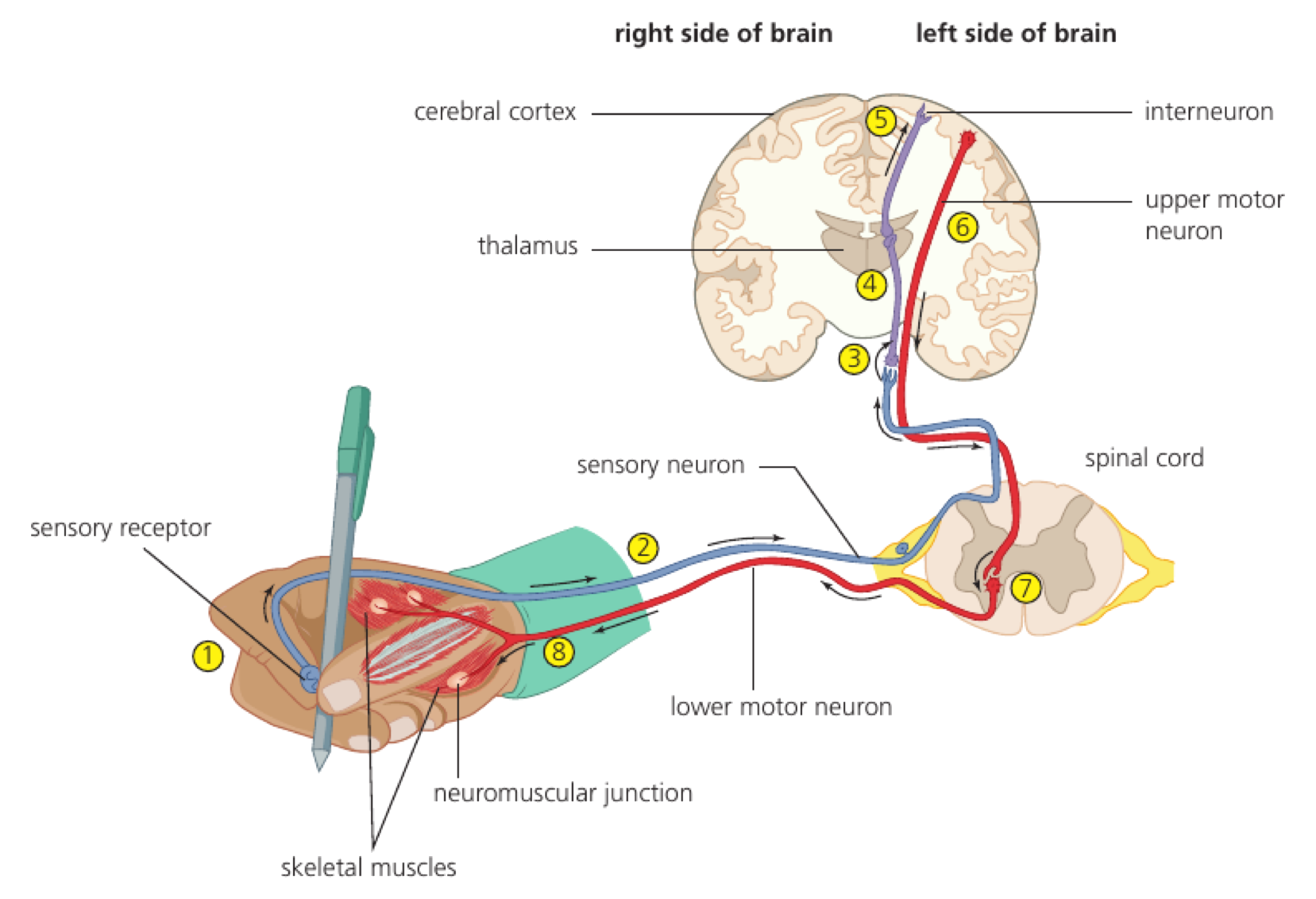
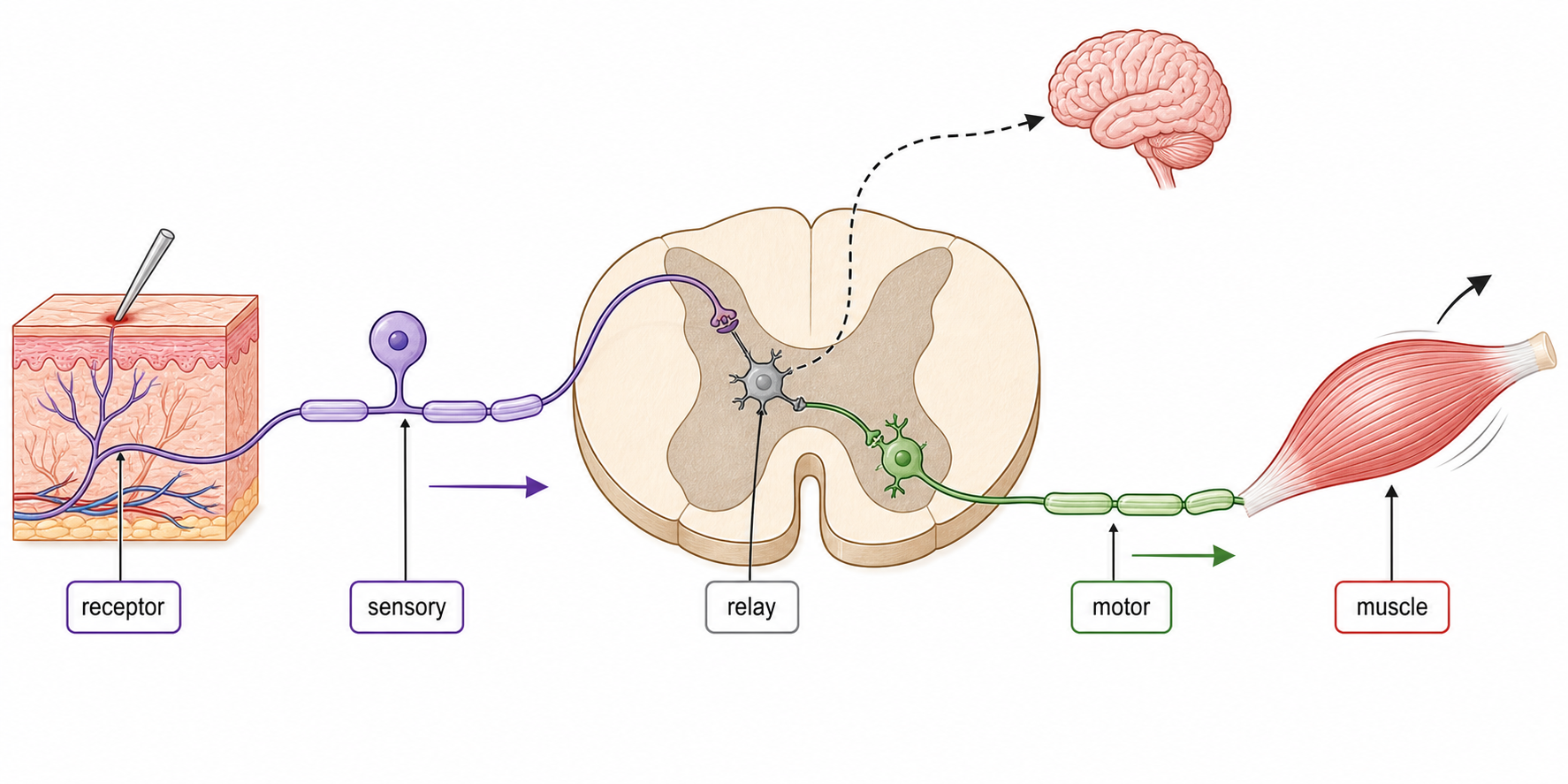
The spinal cord links body and brain, but grey matter can connect sensory input to motor output without waiting for conscious brain processing. White matter carries impulses along longer pathways.

receptor → sensory neurone → spinal integration → motor neurone → effector.

Touching a hot surface triggers a withdrawal through a spinal reflex; the brain receives information as the movement is already beginning.

A reflex is not brain-free information: the spinal cord handles the immediate response, while the brain can receive the signal afterwards.

Spinal cord

Assessment in practice

1 marks
How it is assessed

This objective is assessed through structured response, commonly using State.

Command terms

State

What earns marks

Mark schemes reward named structures, correct direction of information flow and explanations that keep the sequence causal.

Representative question

Question 1

[Maximum number: 1]

The spinal cord is involved in the coordination of involuntary actions such as the pain reflex.

Where are synapses between sensory neurons and interneurons found?

Sensory neurones carry transduced information to the CNS

Sensory neurones carry transduced information to the CNS.

A receptor detects a stimulus and converts its energy into a change in membrane potential. If threshold is reached, an action potential travels along a sensory neurone to the CNS.

identify stimulus; receptor type; transduction; threshold; direction to CNS.

Salt ions entering taste-receptor channels depolarise the receptor cell, which then excites a sensory neurone carrying the signal to the brain.

A stronger stimulus is not encoded by a larger action potential; it can increase firing frequency or recruit receptors.

Input through sensory neurons

Assessment in practice

1–2 marks
How it is assessed

This objective is assessed through multiple choice, commonly using Identify / Outline.

Command terms

Identify / Outline

What earns marks

Mark schemes reward named structures, correct direction of information flow and explanations that keep the sequence causal.

Watch for

Giving a general body-system answer without the specific pathway step for sensory neuron input pathway.

Representative question

Question 1

[Maximum number: 1]

Between which structures do sensory neurons carry nerve impulses?

A

From receptors to muscles

B

From effectors to the central nervous system (CNS)

C

From the central nervous system (CNS) to receptors

D

From receptors to the central nervous system (CNS)

Motor neurones turn CNS decisions into muscle action

Motor neurones turn CNS decisions into muscle action.

Motor neurones carry action potentials from the CNS to an effector. At a neuromuscular junction, acetylcholine depolarises the muscle membrane and starts the calcium-controlled contraction sequence.

CNS signal → motor axon → acetylcholine release → muscle action potential → calcium release.

An impulse at a motor end plate opens ion channels; the resulting muscle action potential travels along the fibre and triggers calcium release from the sarcoplasmic reticulum.

The motor neurone does not contract the muscle directly; transmitter and membrane events link the two cells.

Output through motor neurons

Assessment in practice

1 marks
How it is assessed

This objective is assessed through multiple choice, commonly using Describe / Identify.

Command terms

Describe / Identify

What earns marks

Mark schemes reward named structures, correct direction of information flow and explanations that keep the sequence causal.

Watch for

Giving a general body-system answer without the specific pathway step for motor neuron output pathway.

Representative question

Question 1

[Maximum number: 1]

What is the main role of nerves in human movement?

A

To cause muscles to stretch

B

To move joints

C

To transport pain signals that indicate muscle injuries

D

To stimulate muscle contraction

A nerve is a bundle of neurone axons

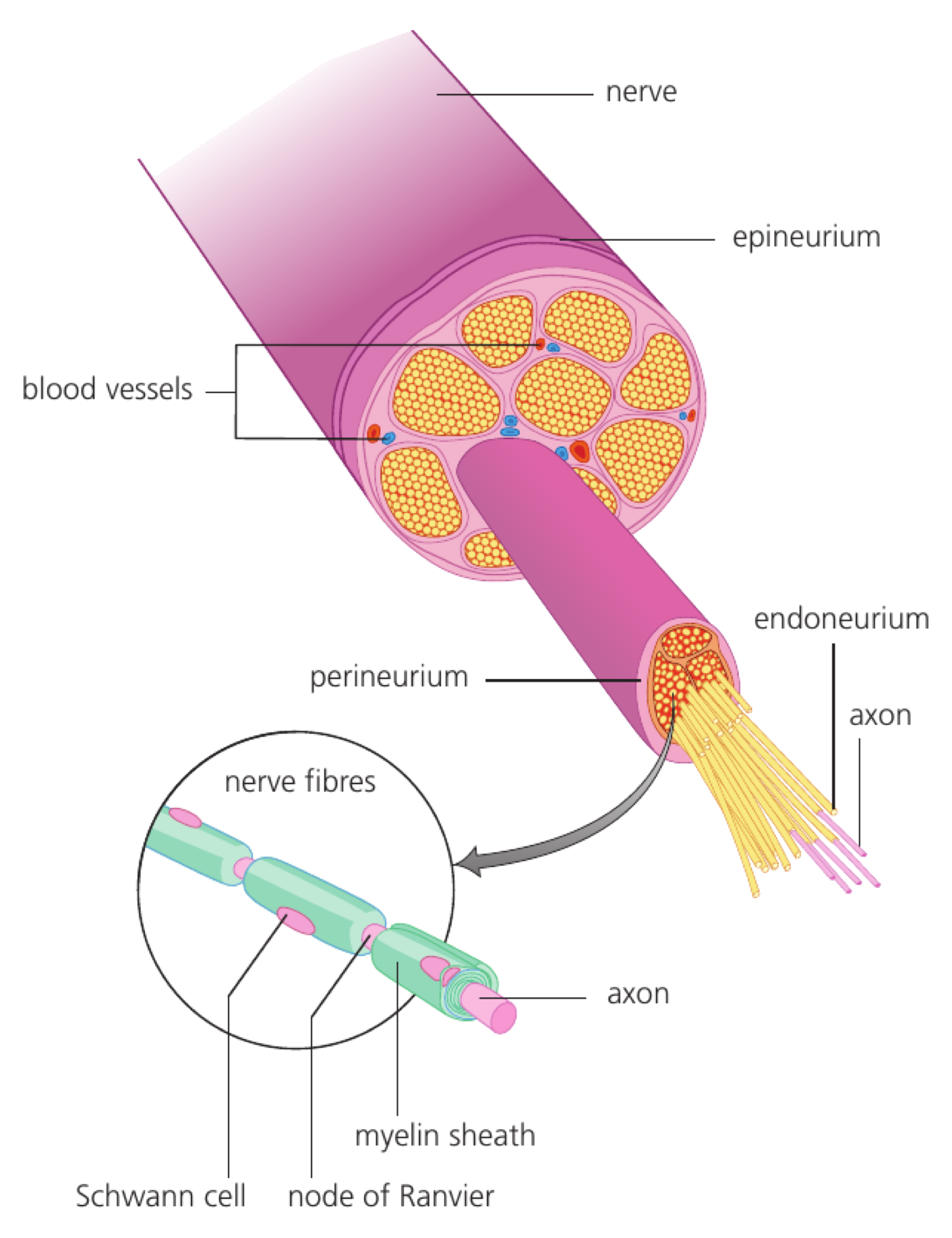
A nerve is a bundle of neurone axons.

A nerve contains many sensory or motor neurones bundled together, often with connective tissue and blood supply. Each axon remains a separate information pathway.

distinguish one neurone from a nerve; identify sensory versus motor direction; note myelination where relevant.

A peripheral nerve can contain many axons carrying impulses from skin receptors toward the CNS, or from the CNS toward muscles.

A nerve is not one giant neurone, and a bundle’s signal does not have one single stimulus or destination.

Nerves as bundles

Assessment in practice

1 marks
How it is assessed

This objective is assessed through structured response, commonly using State.

Command terms

State

What earns marks

Mark schemes reward named structures, correct direction of information flow and explanations that keep the sequence causal.

Representative question

Question 1

[Maximum number: 1]

State the role of the vagus nerve.

A reflex arc trades deliberation for speed

A reflex arc trades deliberation for speed.

A reflex arc routes a stimulus through receptor, sensory neurone, relay neurone and motor neurone to an effector. Spinal integration makes the response rapid and usually unconscious.

receptor → sensory → relay → motor → effector; state why the route is fast.

A painful pin activates nociceptors; the hand withdraws before conscious pain processing is complete.

The reflex is not purposeless and does not bypass the CNS: it uses spinal processing while the brain is informed in parallel.

Pain reflex arcs

Assessment in practice

1–3 marks
How it is assessed

This objective is assessed through experimental design, commonly using Define / Label / Explain.

Command terms

Define / Label / Explain / Draw / Identify / Outline / Describe / Annotate

What earns marks

Mark schemes reward named structures, correct direction of information flow and explanations that keep the sequence causal.

Watch for

Putting the brain before the spinal relay in a rapid pain reflex.

Representative question

Question 1

[Maximum number: 4]

Draw a labelled diagram of a reflex arc for a pain withdrawal reflex.

The cerebellum coordinates movement and balance

The cerebellum coordinates movement and balance.

The cerebellum compares intended movement with sensory feedback and adjusts motor output. It helps timing, posture, balance and smooth coordination rather than choosing the goal of a movement.

separate movement planning from coordination; link sensory feedback to corrective output.

If balance shifts while walking, cerebellar processing helps alter muscle activity before the person falls.

The cerebellum does not initiate every voluntary action; it refines the accuracy and timing of movement.

Cerebellum role

Assessment in practice

1 marks
How it is assessed

This objective is assessed through structured response, commonly using State / Identify / Describe.

Command terms

State / Identify / Describe

What earns marks

Mark schemes reward named structures, correct direction of information flow and explanations that keep the sequence causal.

Watch for

Naming a brain region without linking it to information integration or coordination.

Representative question

Question 1

[Maximum number: 2]

Describe the use of fMRI to identify the role of the cerebellum.

Melatonin links darkness to the body clock

Melatonin links darkness to the body clock.

Melatonin released by the pineal gland rises in darkness and helps synchronise circadian timing, including sleep propensity. Light reaching the retina can suppress its release.

light input → clock pathway → pineal melatonin → timing effect.

A bright screen late at night can delay the melatonin rise, shifting the timing signal even if the person feels tired.

Melatonin is a timing hormone, not an instant anaesthetic; sleep also depends on behaviour and other signals.

Melatonin and sleep

Assessment in practice

1 marks
How it is assessed

This objective is assessed through structured response, commonly using Explain / Identify / Describe.

Command terms

Explain / Identify / Describe / State / Deduce / Outline

What earns marks

Mark schemes reward named structures, correct direction of information flow and explanations that keep the sequence causal.

Watch for

Describing melatonin as a general energy hormone instead of a sleep-timing signal.

Representative question

Question 1

[Maximum number: 2]

Outline the role of melatonin in humans.

Epinephrine prepares several organs for immediate demand

Epinephrine prepares several organs for immediate demand.

Epinephrine from the adrenal medulla binds receptors in target tissues during acute stress. It raises cardiac output, widens airways and mobilises glucose so muscles can respond quickly.

hormone source; receptor-bearing target; response in heart, airways and liver; adaptive purpose.

A sudden threat increases epinephrine, accelerating heart rate and glycogen breakdown while reducing investment in digestion.

The hormone does not affect every cell equally: receptor type and tissue context determine the response.

Epinephrine (adrenaline)

Assessment in practice

1 marks
How it is assessed

This objective is assessed through structured response, commonly using State / Explain / Identify.

Command terms

State / Explain / Identify / Describe

What earns marks

Mark schemes reward named structures, correct direction of information flow and explanations that keep the sequence causal.

Watch for

Treating low oxygen as the only trigger and omitting carbon-dioxide-driven pH change.

Representative question

Question 1

[Maximum number: 2]

Describe two ways in which epinephrine in the body facilitates intense muscle contraction. [2]
1.
2.

The hypothalamus coordinates endocrine control through the pituitary

The hypothalamus coordinates endocrine control through the pituitary.

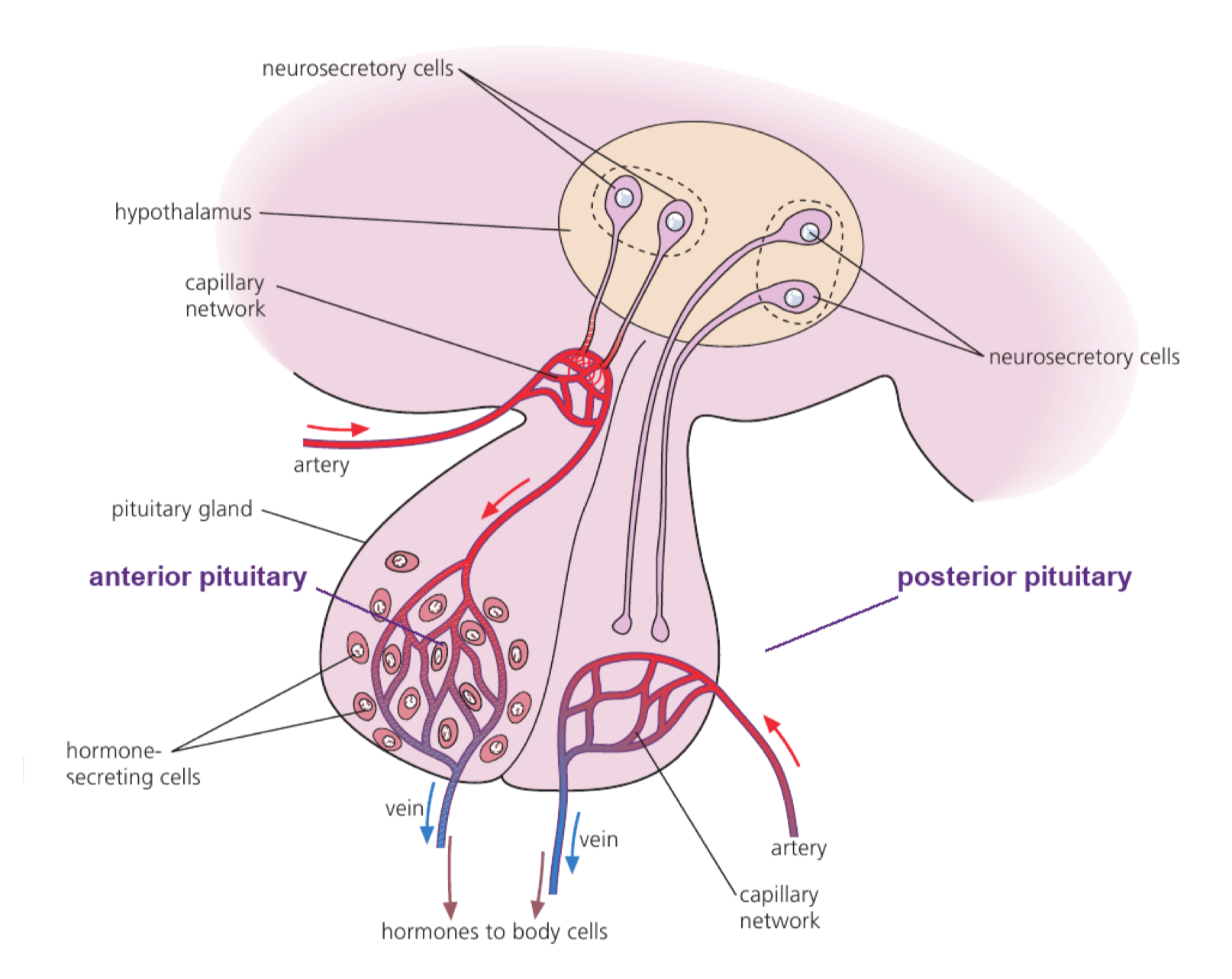
The hypothalamus links neural information to hormone release and regulates the pituitary with releasing or inhibiting signals. Pituitary hormones then act on distant glands or tissues.

stimulus or brain signal → hypothalamus → pituitary → target gland/tissue → feedback.

A hypothalamic signal can control pituitary FSH release, which then influences reproductive tissues.

The hypothalamus and pituitary are control centres, not the final target for every hormone they regulate.

Hypothalamus and pituitary control

Assessment in practice

1–2 marks
How it is assessed

This objective is assessed through structured response, commonly using Suggest / Describe / State.

Command terms

Suggest / Describe / State / Identify / Label / Explain / Outline

What earns marks

Mark schemes reward named structures, correct direction of information flow and explanations that keep the sequence causal.

Watch for

Confusing releasing hormones from the hypothalamus with hormones secreted by the pituitary.

Representative question

Question 1

[Maximum number: 7]

Explain the roles of named hormones in the development and function of the sexual reproductive systems in males and females.

Heart rate is adjusted by feedback from the body

Heart rate is adjusted by feedback from the body.

Receptors detect changes such as pressure or blood chemistry; the medulla and autonomic nerves alter pacemaker activity. The response is negative feedback when it opposes the initial disturbance.

change detected → control centre → autonomic output → sinoatrial node → heart-rate change.

If arterial pressure falls, reflex control can increase sympathetic drive and heart rate, helping restore pressure.

Heart rate alone is not cardiac output: stroke volume and vessel resistance also affect circulation.

Heart rate feedback control

Assessment in practice

1–4 marks
How it is assessed

This objective is assessed through structured response, commonly using Outline / Identify / State.

Command terms

Outline / Identify / State / Compare / Describe / Explain

What earns marks

Mark schemes reward named structures, correct direction of information flow and explanations that keep the sequence causal.

Watch for

Treating low oxygen as the only trigger and omitting carbon-dioxide-driven pH change.

Representative question

Question 1

[Maximum number: 7]

Explain the control mechanism of the heart rate.

Ventilation feedback matches breathing to CO₂ demand

Ventilation feedback matches breathing to CO₂ demand.

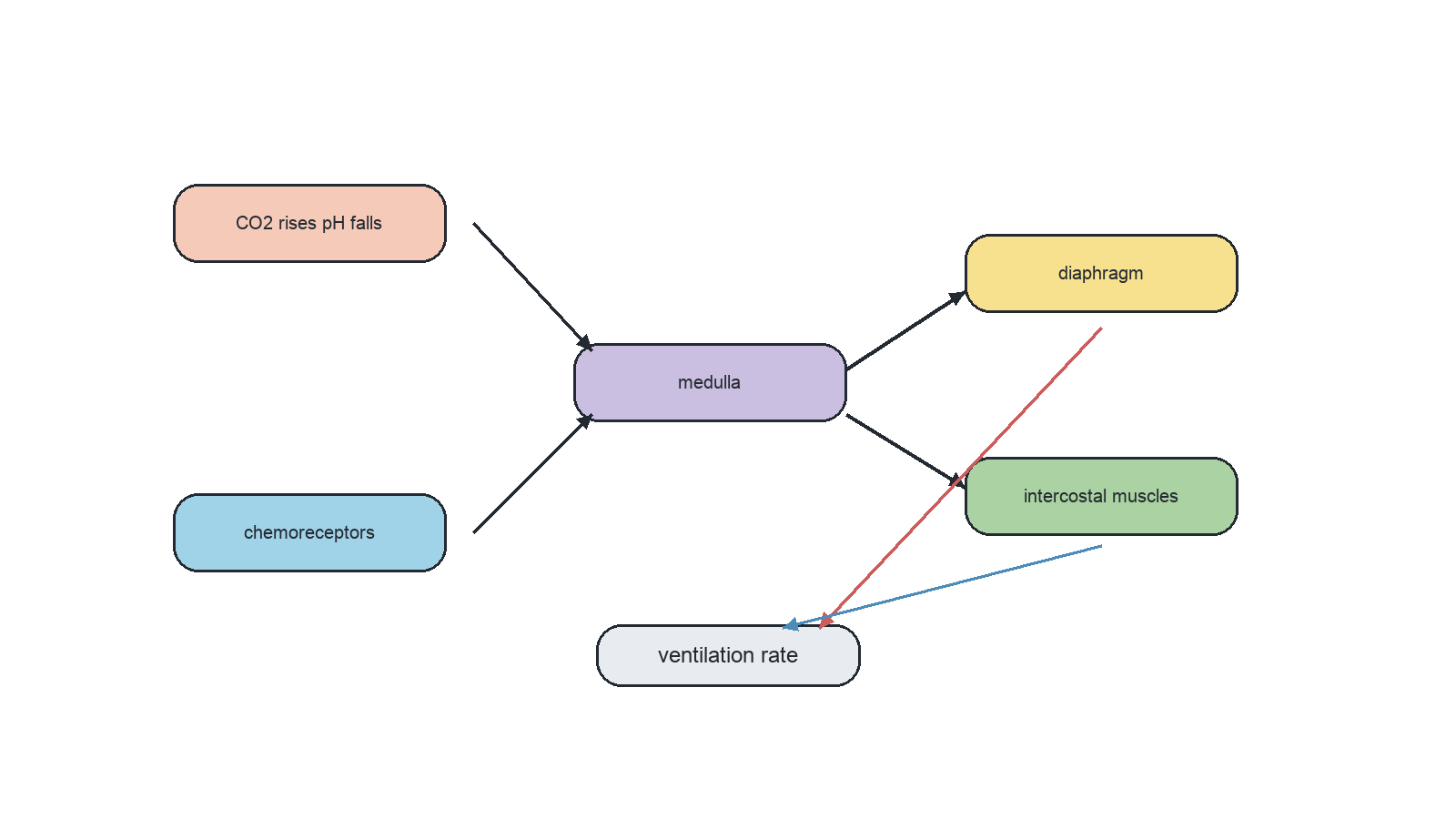
Chemoreceptors monitor CO₂-related pH changes in blood and cerebrospinal fluid. The respiratory control centre changes motor output to breathing muscles, altering ventilation and CO₂ removal.

CO₂/pH change → chemoreceptor → medulla → respiratory muscles → ventilation.

During exercise, extra CO₂ lowers pH; ventilation rises, removing CO₂ and pushing pH back toward its set range.

The lungs respond to a chemical signal; they do not sense and correct pH without nervous control.

Ventilation rate feedback control

Assessment in practice

1–3 marks
How it is assessed

This objective is assessed through structured response, commonly using Explain / State / Outline.

Command terms

Explain / State / Outline / Identify

What earns marks

Mark schemes reward named structures, correct direction of information flow and explanations that keep the sequence causal.

Watch for

Treating low oxygen as the only trigger and omitting carbon-dioxide-driven pH change.

Representative question

Question 1

[Maximum number: 8]

Explain the causes of a decreased blood pH and its effects on the ventilation rate in humans.

Peristalsis moves gut contents by coordinated smooth muscle

Peristalsis moves gut contents by coordinated smooth muscle.

Stretch and chemical signals activate enteric control. Circular and longitudinal smooth muscles contract in sequence so a wave of pressure moves food along the gut.

stimulus in gut wall → enteric control → contraction behind and relaxation ahead → forward movement.

A bolus stretches the oesophagus; a contraction behind it and relaxation ahead propel it toward the stomach.

Peristalsis is a travelling coordination pattern, not one simultaneous squeeze of the whole gut.

Peristalsis control

Assessment in practice

1–3 marks
How it is assessed

This objective is assessed through structured response, commonly using Outline / Identify.

Command terms

Outline / Identify

What earns marks

Mark schemes reward named structures, correct direction of information flow and explanations that keep the sequence causal.

Watch for

Giving a general body-system answer without the specific pathway step for peristalsis control in the gut.

Representative question

Question 1

[Maximum number: 3]

Outline how food is moved from the stomach to the large intestine.

Body-System Integration

  • Nervous signals, hormones and blood transport integrate organs into coordinated systems; emergent functions arise from their interactions.
  • Sensory neurons carry receptor input to the CNS; motor neurons carry output to effectors. Mixed nerves contain both fibre types.
  • Reflex arcs provide rapid involuntary responses through sensory, relay and motor neurons. The spinal cord also links the brain and peripheral nerves.
  • Cerebral hemispheres support conscious processing; the cerebellum coordinates movement and balance; the medulla adjusts ventilation and heart activity.
  • The hypothalamus links nervous and endocrine control through the pituitary. Pineal melatonin helps time sleep; adrenal epinephrine supports acute stress responses.
  • Baroreceptors and chemoreceptors provide feedback about pressure, CO2, pH and O2.
  • The CNS controls voluntary swallowing and egestion, while the enteric nervous system coordinates gut peristalsis.

Tropisms make plant growth directional

HL only

Tropisms make plant growth directional.

A tropism is a directional growth response to a stimulus. Unequal hormone distribution changes cell elongation on opposite sides, bending the organ toward or away from the stimulus.

stimulus direction → hormone redistribution → unequal growth → curvature.

A seedling can bend toward light because the shaded side elongates more than the illuminated side.

Tropism is growth-based and directional; it is not the same as a reversible movement.

Shoots show positive phototropism

HL only

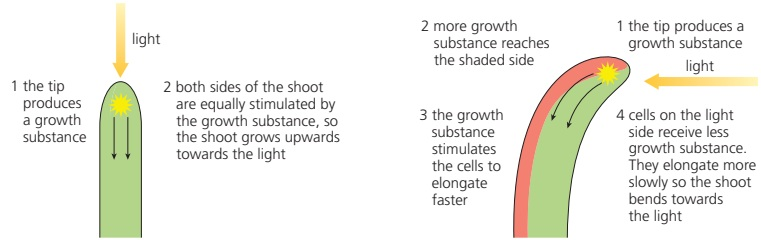
Shoots show positive phototropism.

Light direction is detected at the shoot tip, while auxin redistribution causes greater elongation on the shaded side. The shoot therefore curves toward the light.

light sensed at tip → auxin moves to shaded side → shaded cells elongate → shoot bends toward light.

Auxin concentration rises on the shaded side, so those cells extend more and the shoot exposes its leaves to light.

The curvature is caused by unequal growth, not by the tip physically pulling the rest of the shoot.

Positive phototropism

HL only

Assessment in practice

1–4 marks
How it is assessed

This objective is assessed through structured response, commonly using Identify / Outline / Explain.

Command terms

Identify / Outline / Explain / Describe

What earns marks

Mark schemes reward named structures, correct direction of information flow and explanations that keep the sequence causal.

Watch for

Treating low oxygen as the only trigger and omitting carbon-dioxide-driven pH change.

Representative question

Question 1

[Maximum number: 5]

Outline how the hormone auxin controls phototropism in plant shoots.

Phytohormones coordinate plant decisions

HL only

Phytohormones coordinate plant decisions.

Plant hormones are chemical signals made in small amounts that alter growth or development in target tissues. Their effects depend on concentration, tissue sensitivity, transport and interactions with other hormones.

hormone source/transport; target tissue; cellular response; environmental context.

The same auxin signal can promote shoot elongation but, with a different concentration or tissue, influence rooting.

A hormone is not a single instruction with one universal effect across every plant tissue.

Phytohormones exam focus

HL only

Assessment in practice

1–2 marks
How it is assessed

This objective is assessed through structured response, commonly using Identify / State / Calculate.

Command terms

Identify / State / Calculate / Compare / Contrast

What earns marks

Mark schemes reward named structures, correct direction of information flow and explanations that keep the sequence causal.

Watch for

Treating low oxygen as the only trigger and omitting carbon-dioxide-driven pH change.

Representative question

Question 1

[Maximum number: 2]

State the name and site of production of two phytohormones that regulate the growth of seedlings.

\begin{tabular}{|l|l|}
\hline Name of phytohormone & Site of production \\
\hline & \\
\hline & \\
\hline
\end{tabular}

Auxin efflux carriers create directional hormone flow

HL only

Auxin efflux carriers create directional hormone flow.

PIN-family efflux carriers are positioned asymmetrically in cell membranes, so auxin leaves one side of a cell more readily than another. Tissue-level carrier polarity creates a directional auxin stream.

carrier position → auxin movement between cells → local concentration pattern → growth response.

Changing which side of a stem cell has an auxin efflux carrier can reverse the direction of the local auxin flow.

Auxin direction is not explained by diffusion alone; membrane transporters and their polarity matter.

Auxin efflux carriers

HL only

Assessment in practice

1–2 marks
How it is assessed

This objective is assessed through structured response, commonly using Analyse / Compare / Contrast.

Command terms

Analyse / Compare / Contrast / Deduce / Identify

What earns marks

Mark schemes reward named structures, correct direction of information flow and explanations that keep the sequence causal.

Watch for

Treating low oxygen as the only trigger and omitting carbon-dioxide-driven pH change.

Representative question

Question 1

[Maximum number: 2]

Deduce the effect of NPA on auxin transport between L6 and the stem base.

Auxin promotes cell elongation through wall loosening

HL only

Auxin promotes cell elongation through wall loosening.

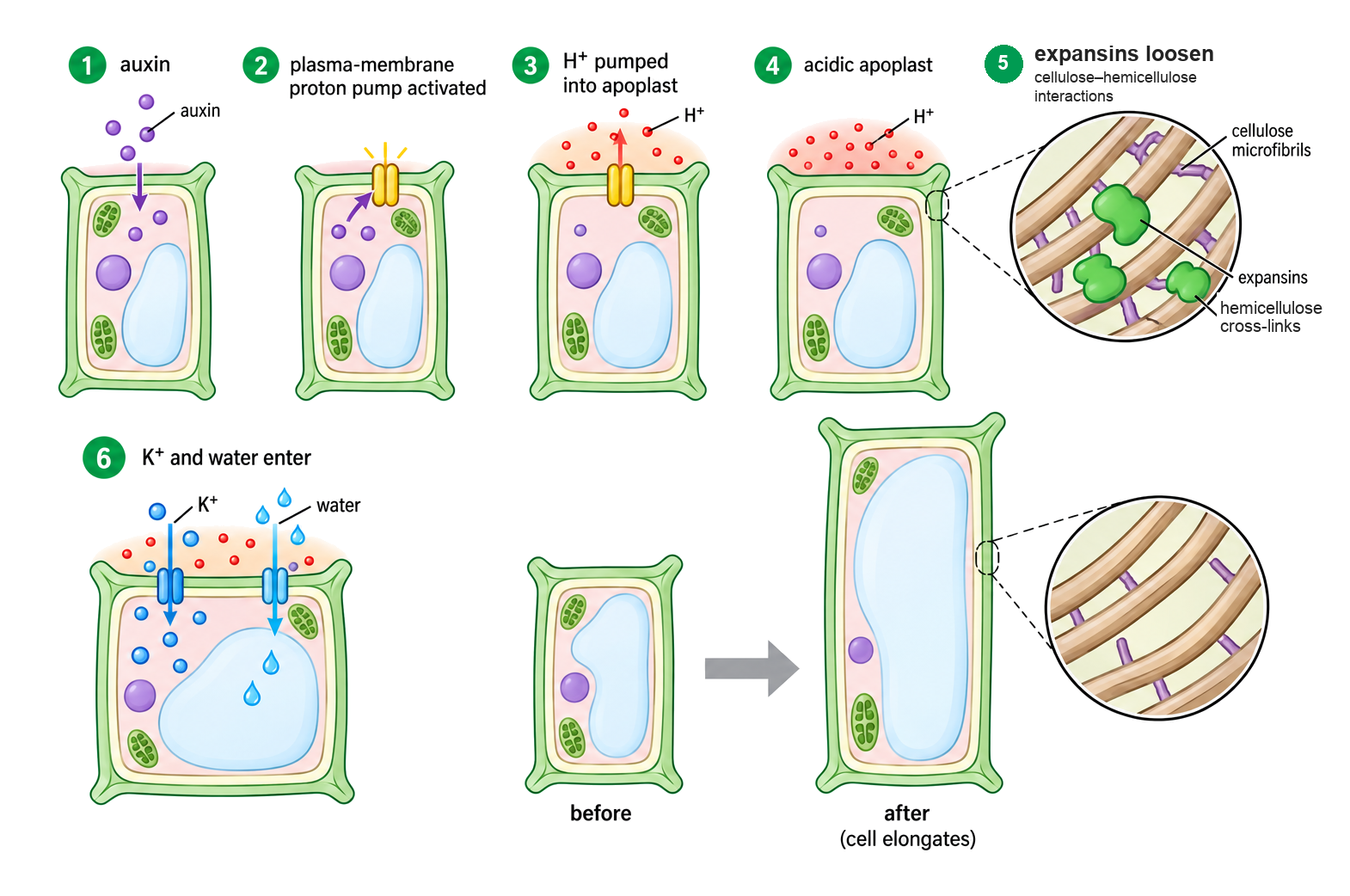
Auxin can activate proton pumps, acidifying the cell wall and activating expansins. A loosened wall lets water-driven turgor extend the cell, increasing shoot length.

auxin signal → H⁺ export → wall pH falls → expansins loosen wall → water/turgor drives extension.

A young shoot cell elongates after auxin increases wall extensibility; the cell must still have water and turgor to grow.

Auxin does not make a cell expand without limit, and its effect depends on tissue, dose and other signals.

Auxin promotes cell growth

HL only

Assessment in practice

1–2 marks
How it is assessed

This objective is assessed through structured response, commonly using Explain / Identify.

Command terms

Explain / Identify

What earns marks

Mark schemes reward named structures, correct direction of information flow and explanations that keep the sequence causal.

Watch for

Saying light directly makes cells grow instead of tracing auxin redistribution and cell elongation.

Representative question

Question 1

[Maximum number: 2]

When a plant cell grows, the cell wall must expand. Explain the role of auxin in cell wall expansion.

Auxin and cytokinin balance plant growth

HL only

Auxin and cytokinin balance plant growth.

Auxin and cytokinin interact rather than acting as isolated switches. Their relative levels and sensitivity influence whether cells divide, form roots or maintain shoot growth.

compare hormone ratio; identify tissue; predict division or organ-development tendency; state context.

A culture rich in auxin tends to favour root formation, while a cytokinin-rich balance can favour shoot development.

The ratio is a useful pattern, not a universal numerical rule; species, tissue age and other hormones modify the outcome.

Ethylene coordinates ripening as a feedback process

HL only

Ethylene coordinates ripening as a feedback process.

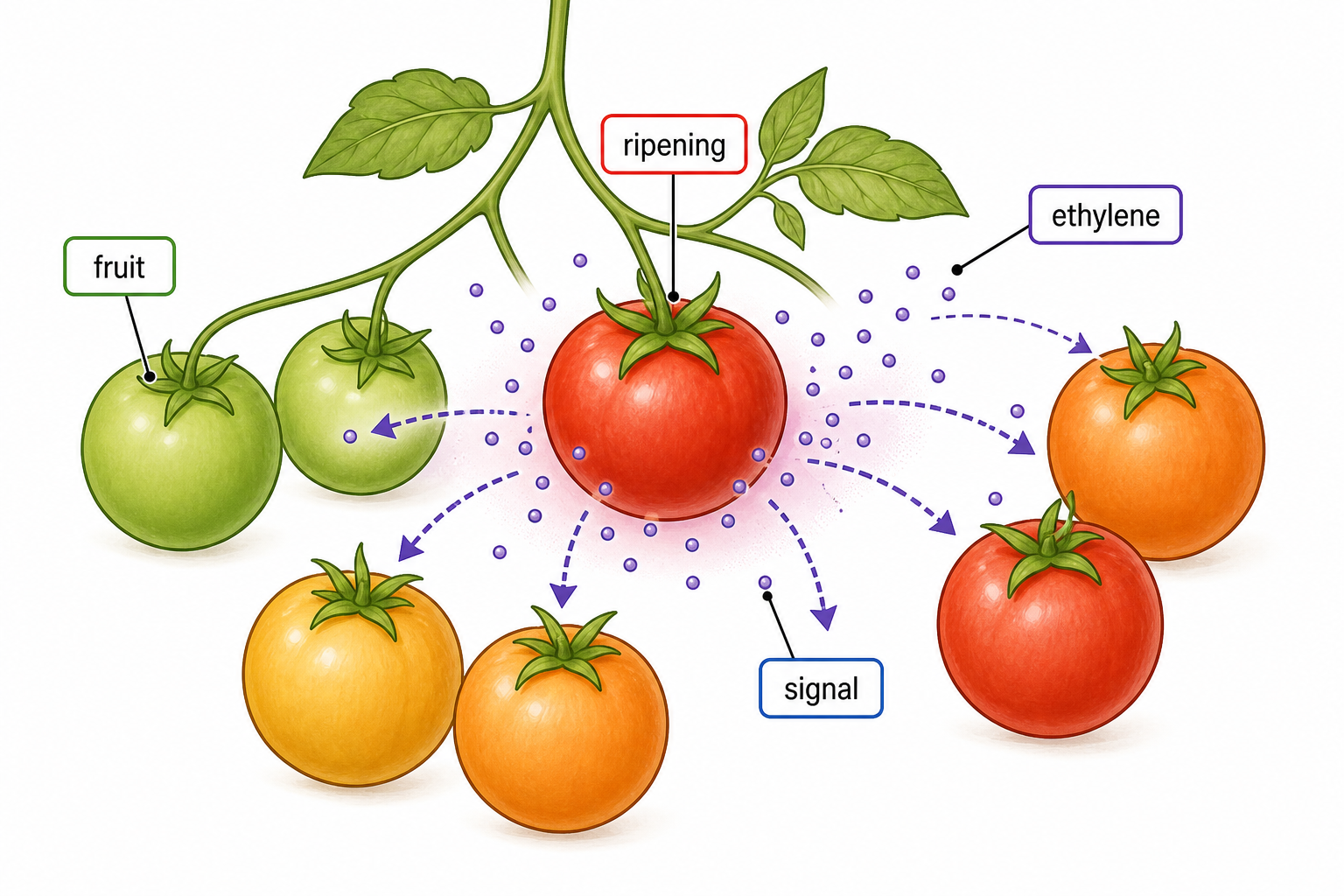
Ethylene is a gaseous plant hormone that can trigger ripening enzymes, softening, colour change and aroma production. Ripening tissues may produce more ethylene, amplifying the response in climacteric fruits.

ethylene production → receptor/signalling response → ripening enzymes → changed fruit traits; include feedback.

One ripe apple can accelerate nearby climacteric fruit ripening in a closed container because ethylene accumulates.

Ethylene does not make every fruit respond identically; fruit type, temperature and oxygen conditions matter.

Ethylene and fruit ripening

HL only

Assessment in practice

1 marks
How it is assessed

This objective is assessed through multiple choice, commonly using Identify.

Command terms

Identify

What earns marks

Mark schemes reward named structures, correct direction of information flow and explanations that keep the sequence causal.

Watch for

Treating low oxygen as the only trigger and omitting carbon-dioxide-driven pH change.

Representative question

Question 1

[Maximum number: 1]

Which chemical causes positive feedback to ensure rapid ripening of fruit?

A

Auxin

B

Cytokinin

C

Epinephrine

D

Ethylene

Plant Signalling Integration

HL only

Plant signalling integrates directional growth, phytohormones, and responses to stimuli. Tropisms are directional growth responses in seedlings; experiments compare shoot or root growth under lateral light or gravity stimuli. Shoots show positive phototropism toward lateral light; auxin redistribution causes greater elongation on the shaded side. Phytohormones are plant signalling chemicals controlling growth and development; auxin, cytokinin, and ethylene coordinate responses to stimuli and internal state. PIN auxin efflux carriers actively move auxin between plant cells; asymmetric carrier placement maintains auxin gradients during tropic responses. Auxin activates proton pumping into the apoplast; acidified cell walls loosen, allowing water uptake, elongation, and bending. Auxin generally promotes root formation; cytokinin promotes shoot formation and division; their ratio coordinates root-shoot growth and plant tissue culture outcomes. Ethylene is a gaseous phytohormone that promotes fruit ripening; ripening fruit releases more ethylene, creating positive feedback in nearby fruit.

ConceptIB Biology HL