C1.3 Photosynthesis
Photosynthesis converts light energy into chemical energy by using pigments, thylakoid reactions and Calvin-cycle carbon fixation to build organic compounds from carbon dioxide.
- Syllabus
- First assessment 2025
- Topic
- C1.3
- Level
- HL
Photosynthesis converts light energy into chemical energy by using pigments, thylakoid reactions and Calvin-cycle carbon fixation to build organic compounds from carbon dioxide.
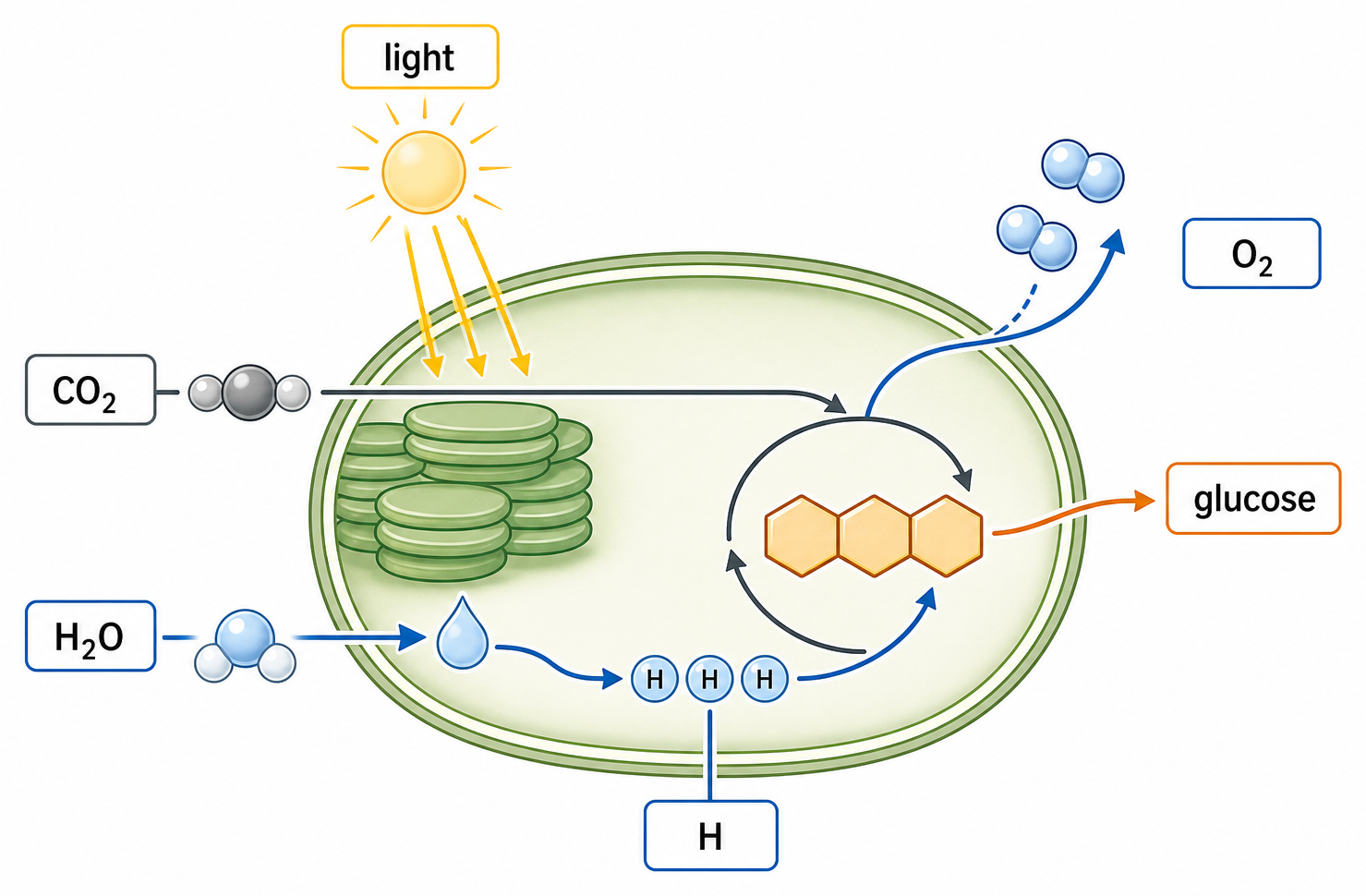
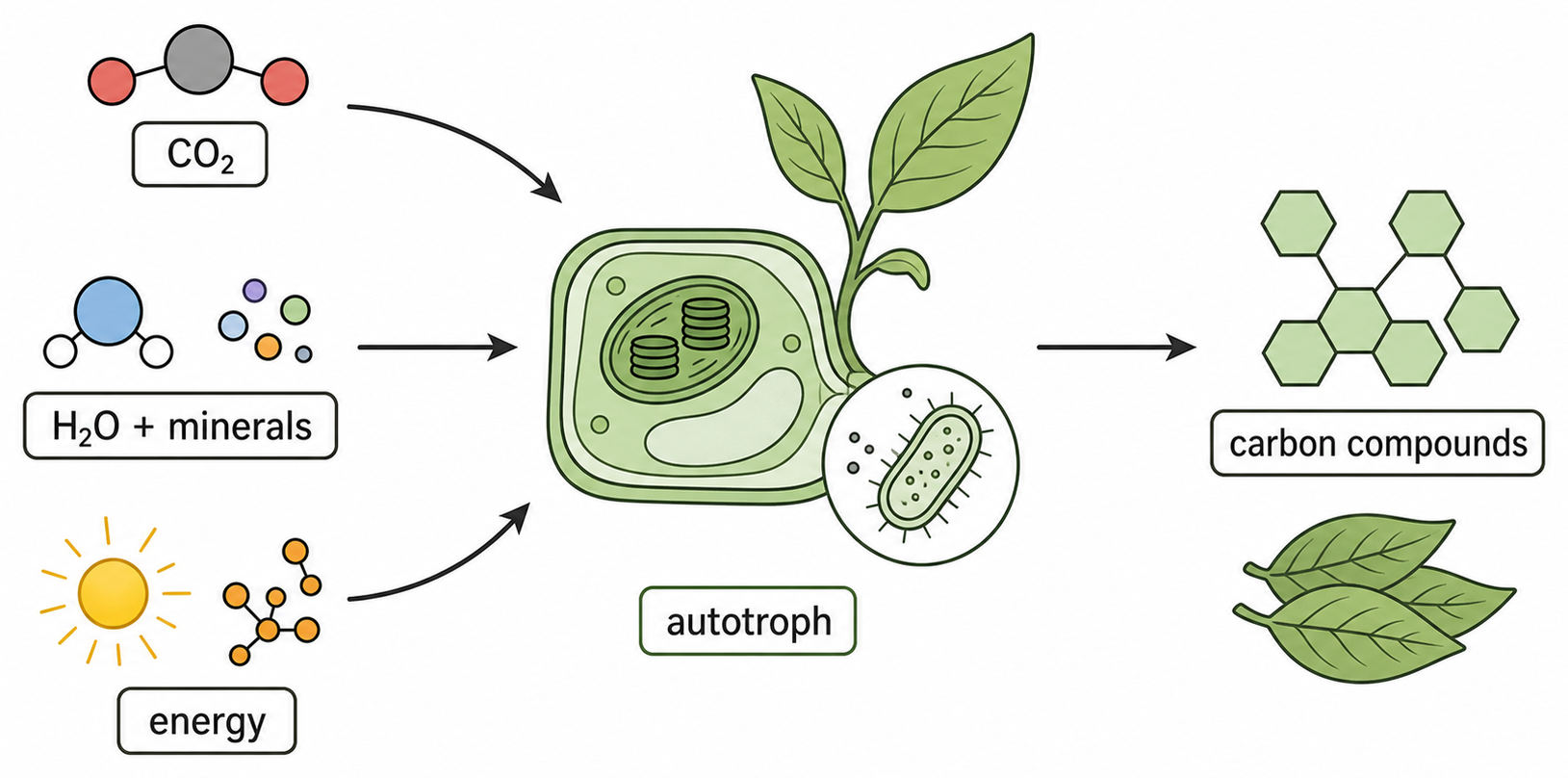
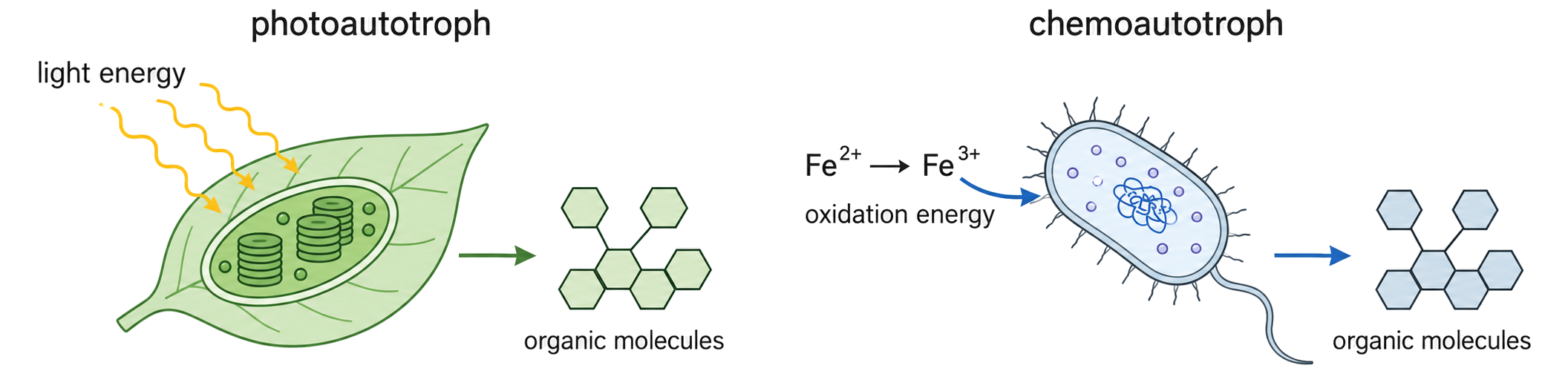
Photosynthesis captures light energy and stores it as chemical energy in organic molecules.
Pigments absorb photons and excite electrons; electron transfer creates ATP and reduced NADP, which then drive carbon fixation. The process depends on light, pigments, membranes, water, carbon dioxide and suitable conditions.
Trace the energy conversion:
A leaf exposed to light can use ATP and reduced NADP from the thylakoid reactions to build carbohydrate in the stroma.
Light provides energy but is not itself converted directly into glucose molecules.
This objective is assessed through structured response, commonly using Identify / State / Outline.
Identify / State / Outline / Describe / Explain / Distinguish
Build the answer around this relationship: Chlorophyll and other pigments absorb light energy inside chloroplasts.
Representative question
Explain the processes by which light energy is converted into chemical energy.
a. plants/producers/autotrophs convert light to chemical energy by photosynthesis
b. chlorophyll/photosynthetic pigments absorb light
c. electrons are excited/raised to higher energy level
d. excited electrons pass along chain of electron carriers
e. energy from electrons used to pump protons across thylakoid membrane/into thylakoid space
f. chemiosmosis/proton gradient used to make ATP
g. ATP synthase generates ATP
h. pigments arranged in photosystems
i. electrons from Photosystem II flow via the electron chain to Photosystem I
j. electrons from Photosystem I are used to reduce NADP
k. ATP and reduced NADP used in the light independent reactions/Calvin cycle
I. carbohydrate/glucose/carbon compounds produced containing energy
Marking guidance:
Award marking points for any point made on a clearly annotated diagram.
8 max

The overall photosynthesis equation shows carbon dioxide and water converted to carbohydrate using light energy: 6CO₂ + 6H₂O → C₆H₁₂O₆ + 6O₂. Carbon dioxide supplies the carbon skeleton and is reduced using hydrogen derived from water. Oxygen is released when water is split by photolysis in the light-dependent reactions, not directly from CO₂. Glucose represents a carbohydrate product; the products can be used to make starch, sucrose and other organic compounds.
This objective is assessed through structured response, commonly using State / Outline / Predict.
State / Outline / Predict / Suggest
Build the answer around this relationship: Carbon dioxide is the source of carbon for photosynthetic carbohydrates.
Representative question
Outline how photosynthesis produces glucose.
a. solar/light energy is converted to chemical energy
b. energy needed to produce glucose
c. only specific wavelengths are absorbed by chlorophyll OR
red and blue absorbed most strongly.
OR
chlorophyll is the pigment that absorbs light energy
d. H(+)/electrons from water are used to reduce compounds
e CO2 is absorbed/used/reduced to produce carbohydrates
f. correct word/balanced symbol equation of photosynthesis
Marking guidance:
Accept correct reference to NADPH/ATP from AHL.
This objective is assessed through multiple choice, commonly using State.
State
Build the answer around this relationship: Photolysis splits water during the light-dependent reactions.
Representative question
Which group(s) produce(s) oxygen as a by-product of photosynthesis?
I. Algae
II. Cyanobacteria
III. Fungi
I only
I and II only
II and III only
I, II and III
B
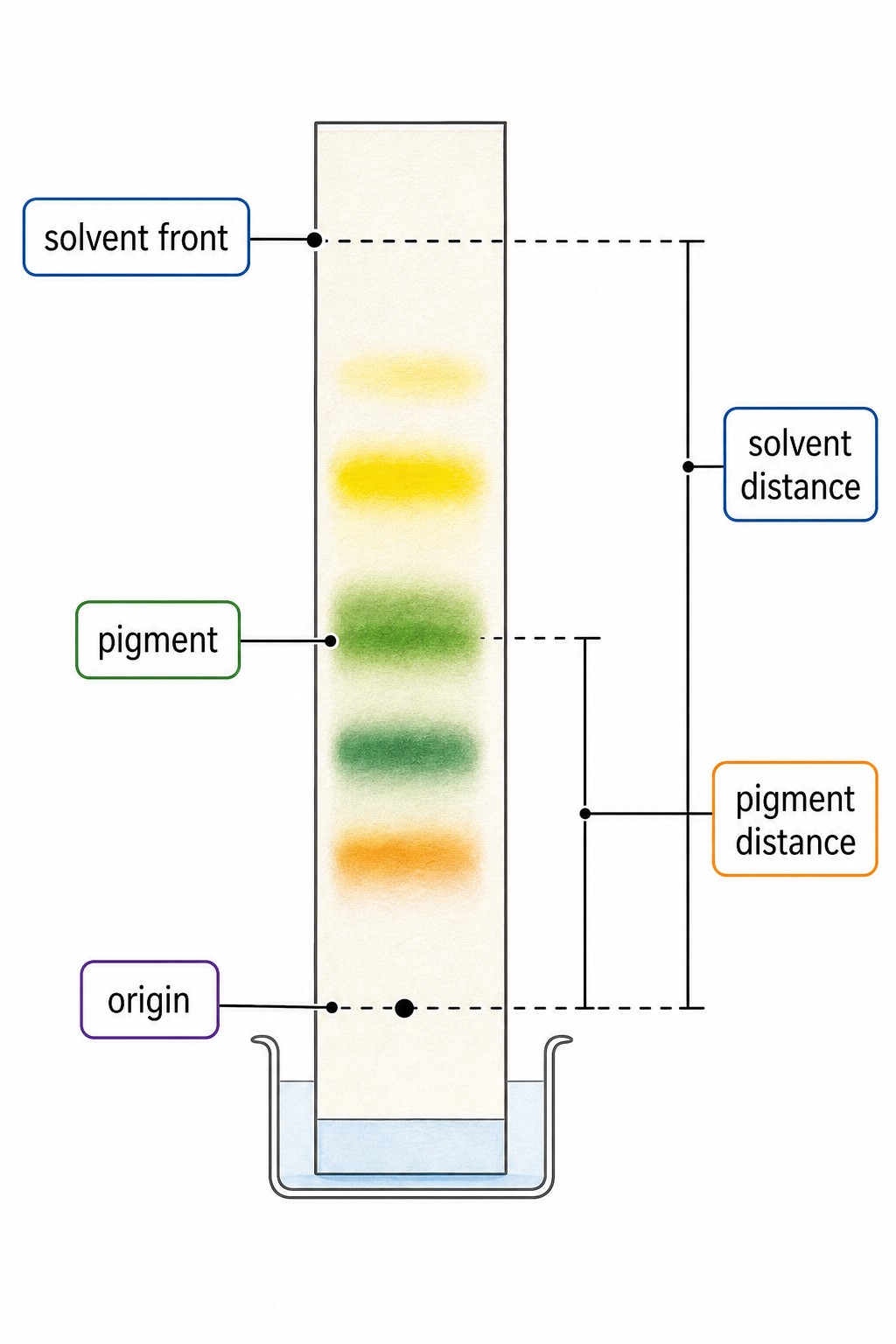
Photosynthetic pigments can be separated because they differ in solubility, polarity and attraction to the stationary phase.
In paper or thin-layer chromatography, a solvent carries pigments at different rates. The separation reveals a mixture such as chlorophylls and carotenoids rather than one universal green pigment.
Interpret a pigment separation:
A yellow carotenoid band may travel farther than a green chlorophyll band if it dissolves better in the chosen solvent.
Band distance depends on the solvent and medium; it is not a direct measure of pigment abundance alone.
This objective is assessed through structured response, commonly using Identify / State / Outline.
Identify / State / Outline / Describe / Explain
Build the answer around this relationship: Chromatography separates pigments because they move different distances with the solvent.
Representative question
Describe the process used to obtain this chromatogram.
a. crush/blend algae with organic solvent/alcohol/other valid solvent;
b. place drop of extracted algal pigments/ obtained liquid on thin layer
OR
mark the origin;
c. place slide (with pigments) in solvent ensuring the pigment spot does not touch the solvent
OR
solvent moves up carrying pigments
OR
different pigments move at different rates/distances (so can be distinguished);
Thin layer could be
(chromotography) paper, slide,
column etc.
3 max

An absorption spectrum shows how strongly a pigment absorbs each wavelength of light, usually with wavelength in nanometres on the x-axis. An action spectrum shows the rate or effectiveness of photosynthesis at each wavelength, measured by oxygen production or CO₂ uptake. The action spectrum reflects the combined contribution of chlorophyll and accessory pigments, so its peaks generally correspond to wavelengths that drive light-dependent electron excitation most effectively.
This objective is assessed through structured response, commonly using Describe / Distinguish / Outline.
Describe / Distinguish / Outline / Predict / Explain
Build the answer around this relationship: Chlorophyll absorbs blue and red light more strongly than green light.
Representative question
Outline how plants make use of the different wavelengths of light.
a. light used in photosynthesis/light-dependent reactions/ photolysis/photosystems/photophosphorylation/excitation of electrons/switch to flowering
b. chlorophyll absorbs red AND blue light (more)
c. chlorophyll/leaf/plant reflects/does not absorb/does not use green light
d. absorption spectrum of chlorophyll has peaks in the red and blue/sketch graph to show this
e. action spectrum shows which wavelengths plants use in photosynthesis/sketch graph of action spectrum showing peaks in the blue and red
f. accessory/other (named) photosynthetic pigments absorb different wavelengths/colours
g. violet is the shortest wavelength and red the longest
h. red light and far red/infra-red absorbed to measure length of light/dark periods
4 max
This objective is assessed through experimental design, commonly using Sketch / Draw / Explain.
Sketch / Draw / Explain / Compare / Contrast / Predict / Deduce / Identify
Build the answer around this relationship: Absorption spectra measure light absorbed by pigments at each wavelength.
Representative question
Draw a fully labelled graph of the action spectrum for photosynthesis.
a. axes correctly labelled «wavelength and rate of photosynthesis»
b. 400 and 700 nm as limits
c. correct shape of curve involving two peaks at the correct places, broader in the blue-violet range not starting at zero and a narrower peak in the orange-red range with the trough in the green range that does not reach zero
d. peaks of activity at 430 nm AND at 660 nm
e. peaks indicated as «violet» blue light AND peak indicated as «orange» red light
Accept rate of oxygen production for rate of photosynthesis.
3 max
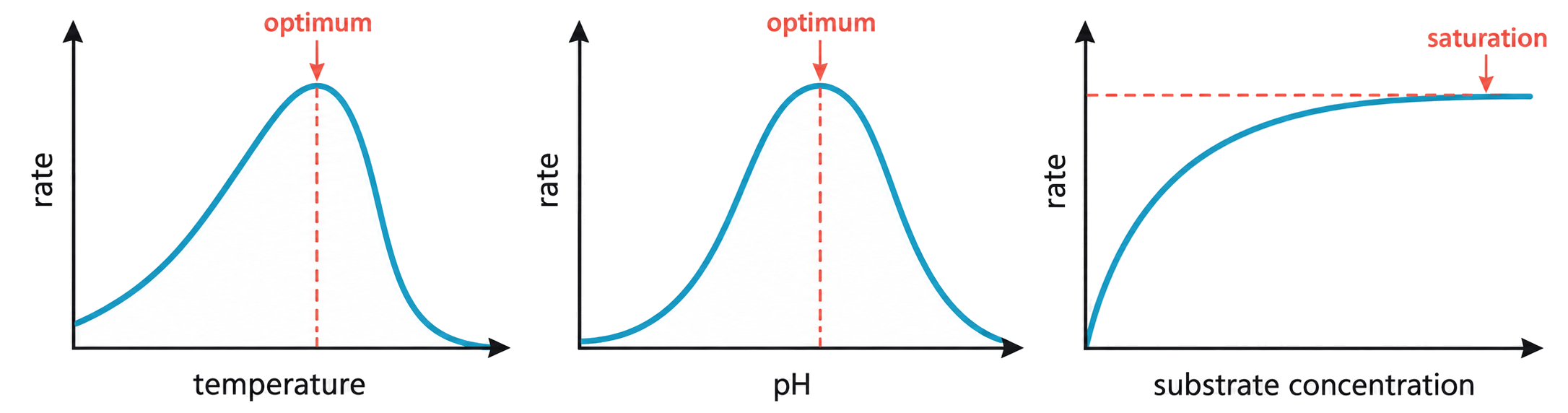
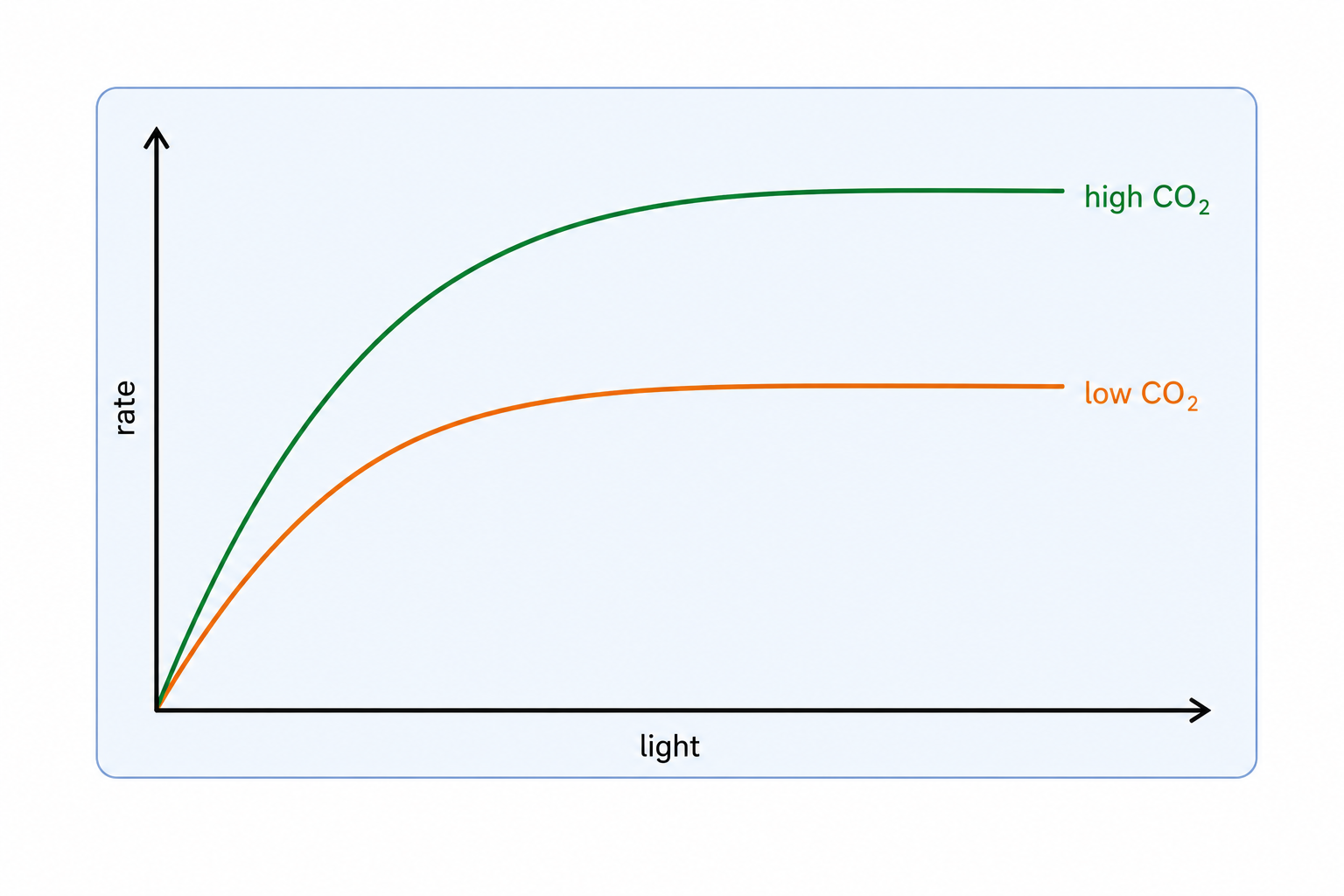
The rate of photosynthesis is controlled by the factor in shortest supply relative to the plant’s demand.
Light intensity, carbon dioxide concentration and temperature can each limit the rate. Increasing a non-limiting factor has little effect until another factor becomes limiting.
Design a limiting-factor investigation:
If increasing CO₂ raises oxygen production at low light but not high light, light becomes the limiting factor in the high-light treatment.
A plateau does not mean photosynthesis has stopped; it indicates that a different factor now limits the rate.
This objective is assessed through structured response, commonly using State / Identify / Determine.
State / Identify / Determine / Calculate / Describe / Compare / Explain / Suggest / Draw / Sketch / Predict / Outline / Discuss
Build the answer around this relationship: Photosynthesis rises with a limiting factor only while that factor restricts the rate.
Representative question
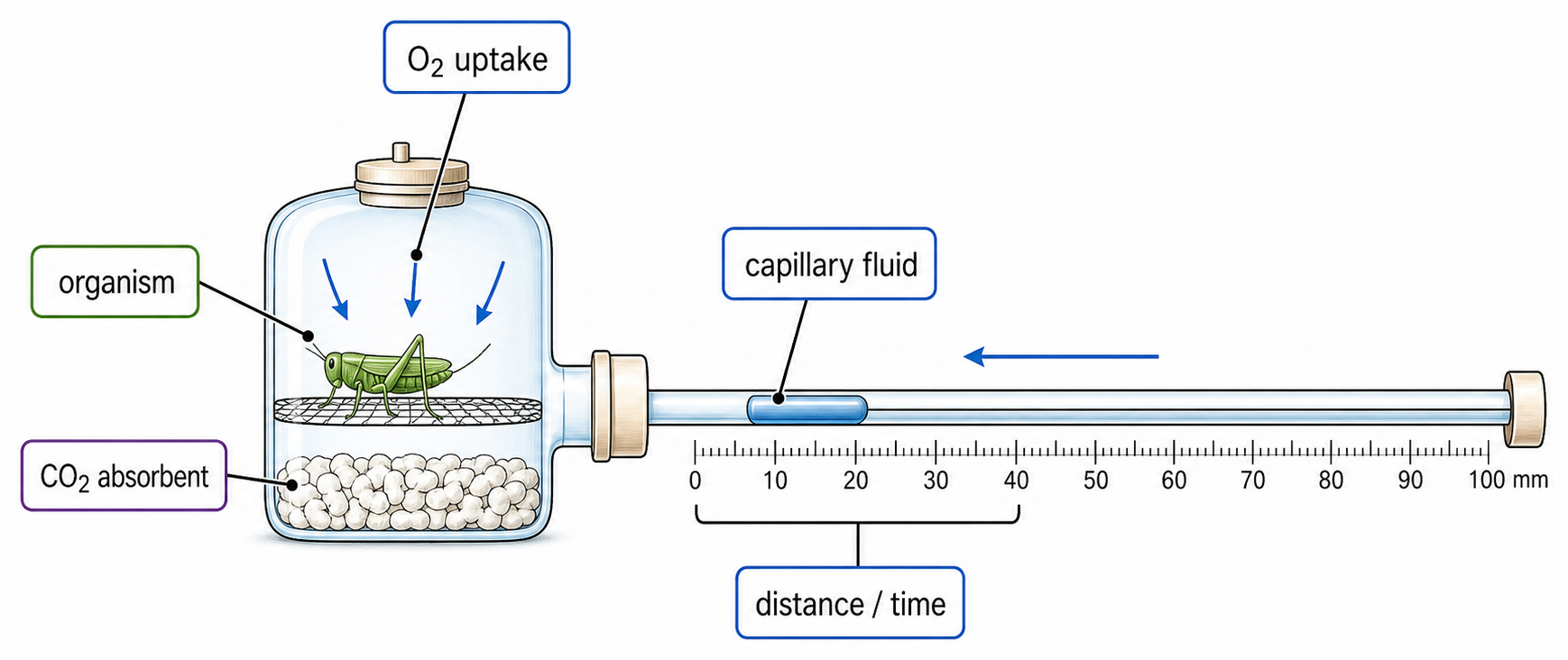
Explain methods by which the rate of photosynthesis can be measured, including conditions that affect the rate.
measuring oxygen release;
measuring volume / counting rising oxygen bubbles / counting rising disks; measuring carbon dioxide intake/uptake;
CO2 can be measured by change in pH / increase in pH shows an increase in CO2 fixation;
increase in biomass would be an indirect measure of photosynthesis / measure of net photosynthesis;
measure starch production / dry organic mass;
increasing temperature would increase the rate of photosynthesis; provided the temperature did not go above optimum temperature of enzymes;
increasing carbon dioxide concentration would increase the rate of photosynthesis; higher light intensity would increase the rate of photosynthesis;
light of different wavelengths / blue and red light can affect photosynthesis / green wavelength usually not absorbed;
Increasing carbon dioxide can raise photosynthetic rate when CO₂ is limiting and other resources are sufficient.
More CO₂ increases the chance that Rubisco fixes carbon, but the response plateaus when light, temperature, nutrients or enzyme capacity limits the pathway. Enrichment also has ecological and economic costs.
Interpret an enrichment result by checking:
A greenhouse crop may show faster CO₂ uptake after enrichment at moderate light, but little extra uptake under shade.
Higher CO₂ does not guarantee proportionally higher biomass or yield.
This objective is assessed through structured response, commonly using Discuss.
Discuss
Build the answer around this relationship: FACE experiments expose plants to elevated carbon dioxide under more realistic field conditions.
Representative question
Using the data in the graph, discuss whether rising carbon dioxide levels in the atmosphere will increase growth rates in maize.
data does not support idea that rising CO2 levels will increase growth rates in maize;
(at all temperatures) there appears to be no difference between exchange rate at current or elevated CO2 levels;
temperature has larger effect on growth of maize;
so if rising CO2 levels causes more of a greenhouse effect/larger temperature increase, this will affect growth of maize;
Photosynthesis converts light energy into chemical energy in carbon compounds. Carbon dioxide is reduced to carbohydrate using hydrogen from water, glucose is the main stored product, and released oxygen comes from photolysis of water. Pigment evidence is tested with chromatography and Rf, spectra questions separate absorption from action, and rate/evidence questions use limiting factors, controls, and CO2 enrichment context.

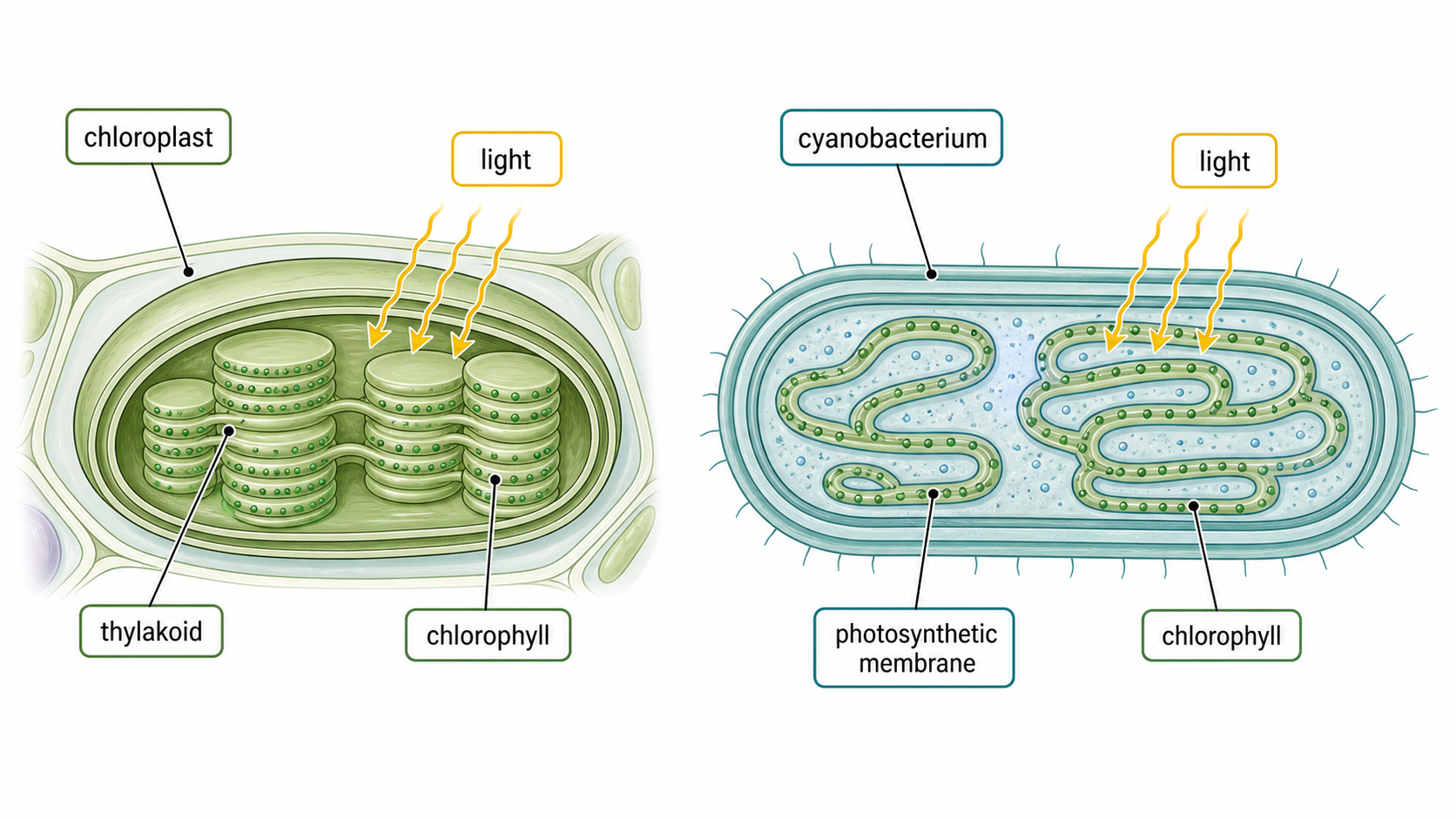
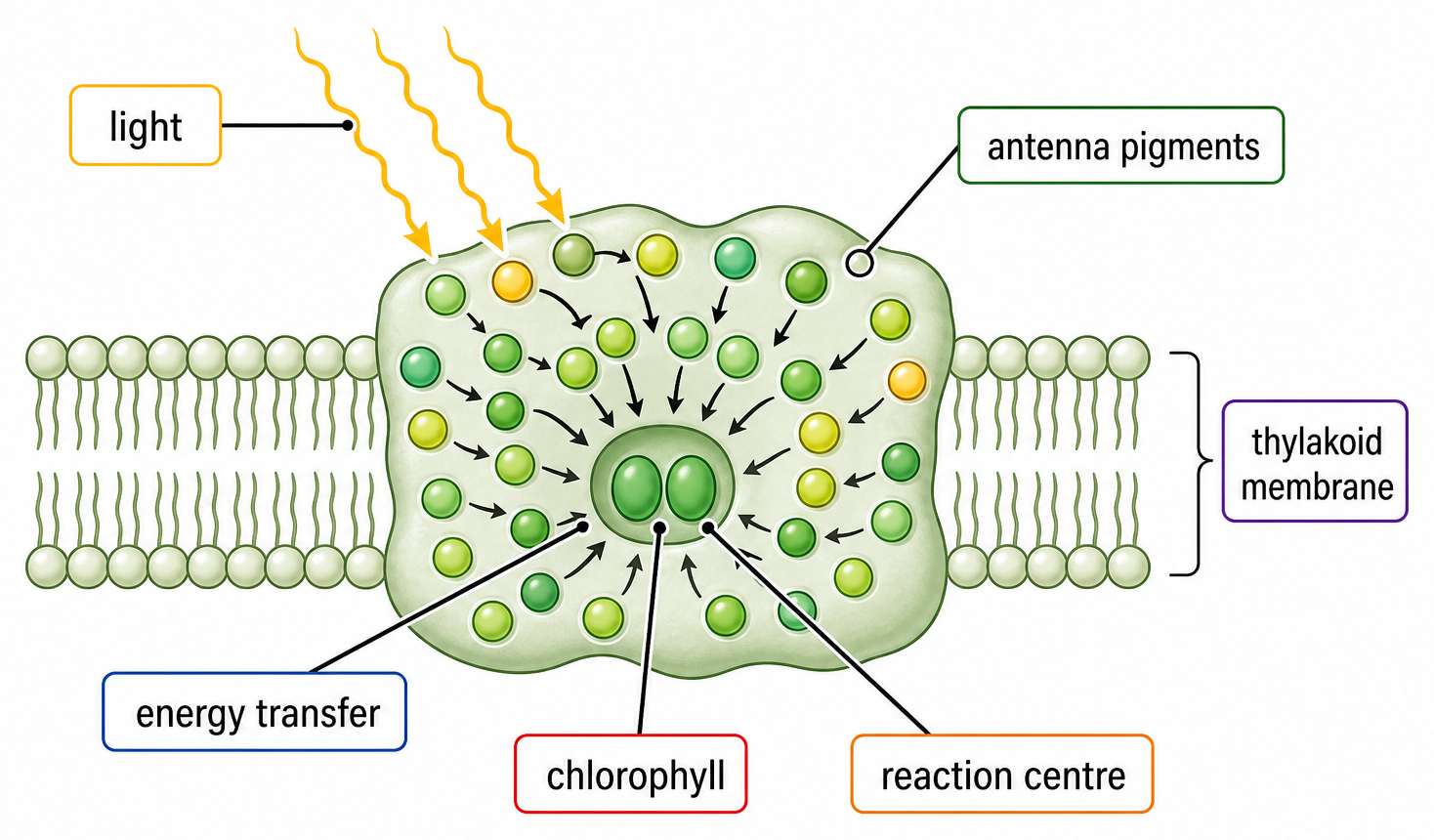
A photosystem is a pigment–protein array embedded in a thylakoid membrane. Many antenna pigments absorb different wavelengths and transfer excitation energy to a special reaction-centre chlorophyll. The reaction centre emits an excited electron to an electron carrier, initiating the light-dependent electron transport chain. Using an array broadens the usable spectrum and funnels energy to one reaction centre; a single chlorophyll molecule cannot perform the full system.
This objective is assessed through structured response, commonly using Outline.
Outline
Build the answer around this relationship: Photosystems are located in thylakoid membranes.
Representative question
Outline the relationship between structure and function in photosystems.
a. photosystems embedded/located in chloroplast/thylakoid membranes;
b. two types of photosystems, (Photosystem I and Photosystem II/PSI and PSII);
c. structure allows light energy to be captured;
d. (energy used) to emit excited electron;
e. molecular arrays of chlorophyll (and accessory pigments)
OR
photosystem combines different types of pigments in one array;
f. a greater proportion of wavelengths can be absorbed / greater proportion of sunlight can be used
OR
a single molecule of chlorophyll would not be able to perform photosynthesis;
3
Marking guidance:
max
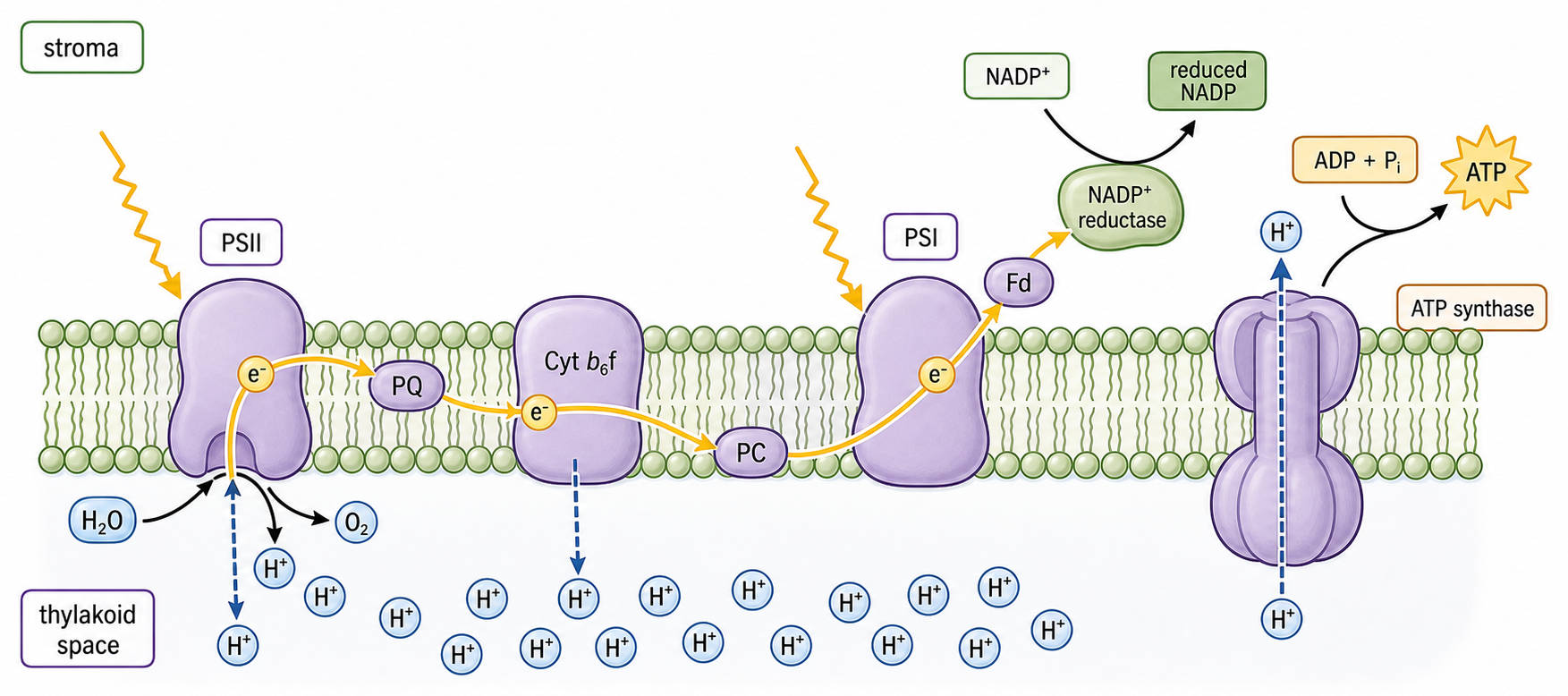
Photosystem II uses light to excite electrons and replace them by photolysis of water: 2H₂O → 4H⁺ + 4e⁻ + O₂. The oxygen is released, while protons contribute to the thylakoid proton gradient and electrons enter the electron transport chain. Photosystem I re-excites the electrons; NADP accepts the high-energy electrons and H⁺ to form reduced NADP (NADPH), which carries reducing power to the Calvin cycle.
This objective is assessed through structured response, commonly using Describe / Explain.
Describe / Explain
Build the answer around this relationship: Photolysis uses light energy to split water.
Representative question
Some of the water carried to the leaves of a plant is used in photosynthesis. Explain the role of water in the light-dependent reactions of photosynthesis.
water only plays a role in non-cyclic photophosphorylation;
chlorophyll absorbs light/photons and activates electrons of photosystem II; excited/active electrons of photosystem II are passed to carriers; photolysis is the splitting of water;
produces O2 and H+/proton and electrons;
O2 released (as waste);
electrons (from water) replace lost electrons in photosystem II; electrons from photosystem II pass (through carriers) to photosystem I;
electrons from photosystem I pass to NADP +(in stroma);
NADP +accepts H+/proton (from water) to form NADPH;
electron flow causes protons pumped across thylakoid membranes/into the thylakoid space;
creating a proton concentration gradient;
chemiosmosis couples electron transport to ATP synthesis; protons pass through ATP synthase/synthetase;
NADPH/H+/proton is passed to the light-independent reactions (to fix carbon);
Marking guidance:
[8 max]

Thylakoid membranes organize photosystems, electron carriers and ATP synthase into a system for the light-dependent reactions. Electron transport and photolysis move H⁺ into the thylakoid lumen, creating an electrochemical gradient. H⁺ then diffuses through ATP synthase into the stroma; the released energy drives ADP + Pi → ATP, called photophosphorylation. Reduced NADP is formed on the stromal side and, with ATP, supplies the Calvin cycle.
This objective is assessed through structured response, commonly using Describe / Explain / Compare.
Describe / Explain / Compare / Contrast
Build the answer around this relationship: Electron transport in thylakoid membranes helps build a proton gradient.
Representative question
Explain chemiosmosis as it occurs in photophosphorylation.
photophosphorylation is the production of ATP;
b. (some of the) light absorbed by chlorophyll / photosystem II;
c. photolysis/splitting of water separation of hydrogen ion from its electron;
d. the electron transport system moves the electrons through a series of carriers;
e. (electron transport system occurs) in the thylakoid membrane;
f. electron transport linked to movement of protons into thylakoid space;
g. a proton gradient builds up (in the thylakoid space);
h. small thylakoid space enhances the gradient;
i. hydrogen ions move by diffusion through the ATP synthase;
j. ADP + inorganic phosphate ( Pi ) forms ATP;
k. (the kinetic energy from) movement of hydrogen ions (through ATP synthase) generates ATP;
I. ATP synthase is a protein complex in the thylakoid membrane;
m. formation of proton gradient / ATP synthesis linked to electron transport is chemiosmosis;
Marking guidance:
Award marks for a clearly drawn correctly annotated diagram.
This objective is assessed through multiple choice.
Build the answer around this relationship: Photosystem I supplies electrons used to reduce NADP.
Representative question
What occurs during photosynthesis?
Water is oxidized by releasing two electrons to NADPH.
Glycerate-3-phosphate (GP) is oxidized by releasing two electrons to photosystem II.
NAD is reduced by accepting two electrons from ATP.
NADP is reduced by accepting two electrons from photosystem I.
D
This objective is assessed through structured response, commonly using State.
State
Build the answer around this relationship: Thylakoids house the light-dependent reactions of photosynthesis.
Representative question
State two products that pass from the light-dependent to the light-independent stages of photosynthesis.
1.
2.
ATP and NADPH2/NADPH+H+(both needed)
Rubisco catalyses the addition of carbon dioxide to the five-carbon acceptor RuBP in the Calvin cycle.
The unstable six-carbon intermediate splits into two three-carbon molecules. Rubisco therefore begins carbon entry into the cycle, but its slow rate and oxygen-binding side reaction limit photosynthesis.
For a fixation step, identify:
One CO₂ fixation produces two molecules of glycerate 3-phosphate before reduction and later sugar formation.
Rubisco does not produce glucose directly; it starts a cycle that generates triose phosphate.
This objective is assessed through structured response, commonly using State / Describe / Explain.
State / Describe / Explain / Identify / Predict
Build the answer around this relationship: Rubisco catalyses carboxylation of RuBP.
Representative question
With reference to Calvin's experiment, explain the fixation of carbon dioxide in photosynthesis.
a. Calvin's experiment used algae/Chlorella in a round/thin/flat apparatus/"lollipop";
b. labelled carbon dioxide with radioactive carbon/ C14/14C (supplied to algae);
c. exposed the algae to light to promote photosynthesis;
d. every 5/few seconds/at short time intervals, samples of algae were taken;
e. carbon compounds separated using chromatography;
f. radioactive carbon compounds/molecules with radioactive carbon/C14/ 14C identified with x-rays (autoradiography) / molecules containing radioactive carbon/C14/ 14C traced / glycerate 3-phosphate was the first compound detected/identified;
g. Calvin cycle/carbon fixation is the light-independent phase (of photosynthesis);
h. it takes place in the stroma (of the chloroplast);
i. ribulose bisphosphate/RuBP carboxylated to glycerate 3-phosphate/G3P;
j. catalysed by rubisco / (ribulose bisphosphate) carboxylase;
k. glycerate 3-phosphate/G3P is reduced to triose phosphate (using reduced NADP/NADPH and ATP);
I. triose phosphate is used to produce glucose;
m. triose phosphate is used to regenerate RuBP;
Marking guidance:
Allow clear annotated diagrams for
marking points mpi to mpm.
8 max

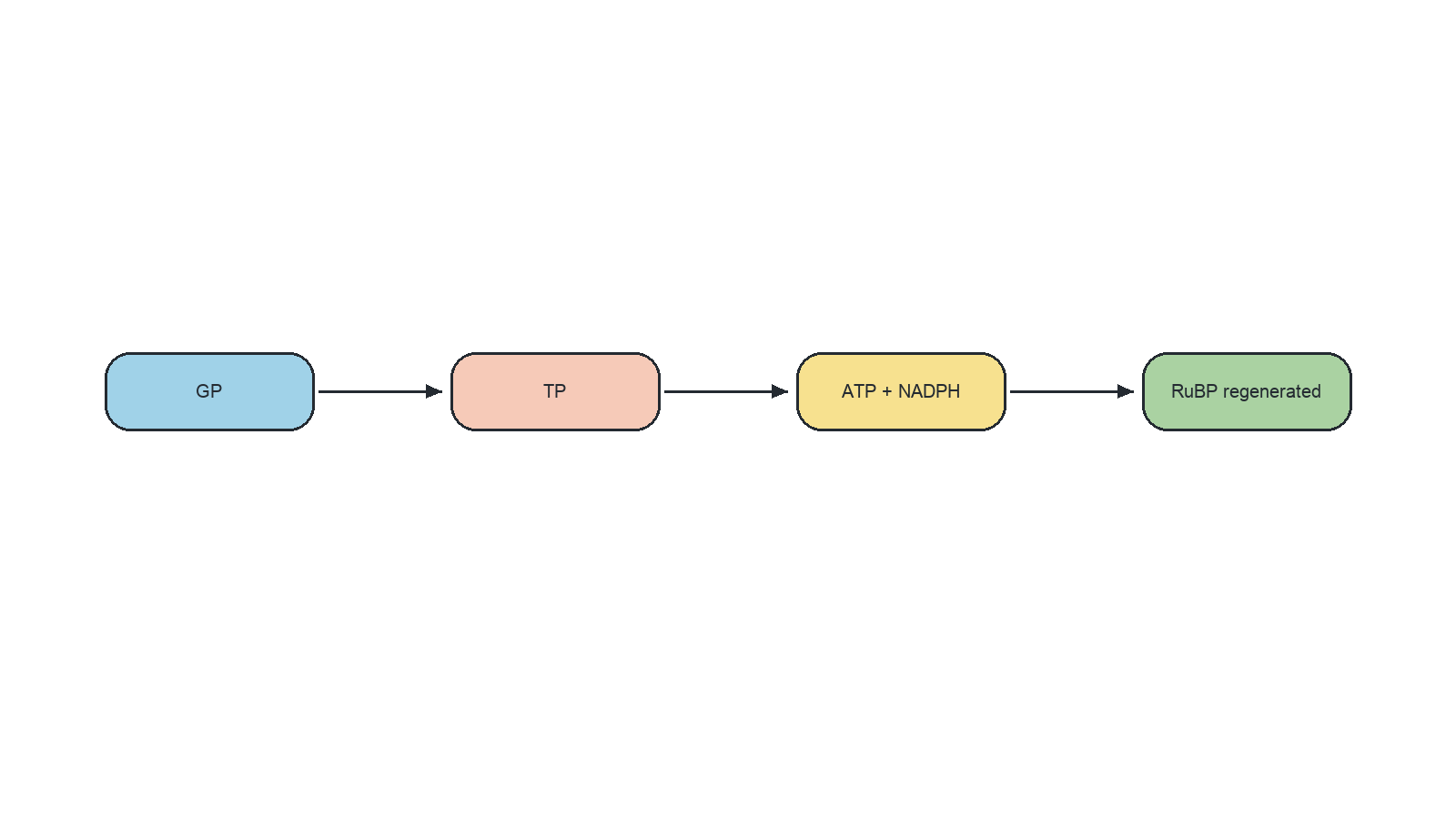
After carbon fixation, each glycerate 3-phosphate (GP) molecule is reduced to triose phosphate (TP). ATP provides energy, while reduced NADP (NADPH) provides hydrogen and electrons. Most TP is used, with ATP, to regenerate the five-carbon CO₂ acceptor RuBP; the remaining TP can be used to make carbohydrates.
This objective is assessed through multiple choice.
Build the answer around this relationship: Glycerate 3-phosphate is reduced to triose phosphate in the Calvin cycle.
Representative question
What occurs in the light-independent reactions of photosynthesis?
Glycerate 3-phosphate is reduced to triose phosphate.
Ribulose bisphosphate is regenerated using reduced NADP.
Ribulose bisphosphate is oxidized to two molecules of glycerate 3-phosphate.
Both ATP and NADP are used to produce triose phosphate.
A
This objective is assessed through multiple choice.
Build the answer around this relationship: RuBP is the carbon dioxide acceptor in the Calvin cycle.
Representative question
The Calvin cycle continues throughout the life of a plant. In this cycle, triose phosphate is produced, which is used to form glucose. In total, how many RuBP molecules are regenerated in the process of creating one glucose molecule?
2
6
10
14
B
Triose phosphate (TP) is the useful carbon product of the Calvin cycle. Some TP is used to make sugars and starch; carbon skeletons can also contribute to lipids, amino acids and other organic compounds when appropriate mineral nutrients are available. Most TP is retained to regenerate RuBP. The light-dependent reactions supply ATP and reduced NADP (NADPH), while the Calvin cycle returns ADP and NADP⁺ for reuse.
This objective is assessed through structured response, commonly using Explain / Distinguish.
Explain / Distinguish
Build the answer around this relationship: Light-dependent reactions produce ATP and reduced NADP.
Representative question
Explain how the light-independent reactions of photosynthesis rely on the light-dependent reactions.
a light-dependent reactions produce ATP/reduced NADP;
b ATP generated by chemiosmosis/by photophosphorylation/by ATP synthase;
c reduced NADP produced by/using electrons from Photosystem I;
d RuBP +CO2 to glycerate 3-phosphate (in light independent reactions);
e glycerate 3-phosphate reduced to triose phosphate (in light independent reactions);
f ATP/reduced NADP used in the light-independent reactions;
g reduced NADP provides electrons/hydrogen / to reduce (glycerate 3phosphate)
OR
reduced NADP used to convert glycerate 3-phosphate to triose phosphate;
h ATP provides energy (for reduction of glycerate 3-phosphate);
i ATP needed to regenerate RuBP
j ATP/reduced NADP run out in darkness
k Calvin cycle only possible with light/in the day/is indirectly dependent on light;
7 max
HL photosynthesis links light-dependent reactions to the Calvin cycle. Photosystems are pigment-protein arrays in thylakoid membranes; antenna pigments broaden absorption and pass energy to reaction-centre chlorophyll. PSII uses light to split water, supplying electrons, protons, and oxygen. Electron transport pumps protons into the thylakoid space, ATP synthase makes ATP by photophosphorylation, PSI re-excites electrons, and NADP is reduced. The Calvin cycle uses ATP and reduced NADP: Rubisco fixes CO2 to RuBP to form GP, GP is reduced to triose phosphate, most triose phosphate regenerates RuBP, and some becomes wider biomolecules.