C1.1 Enzymes and metabolism
Enzymes and metabolism explain how catalysts, active sites, reaction conditions and pathway regulation control cellular chemical reactions in living systems.
- Syllabus
- First assessment 2025
- Topic
- C1.1
- Level
- HL
Enzymes and metabolism explain how catalysts, active sites, reaction conditions and pathway regulation control cellular chemical reactions in living systems.
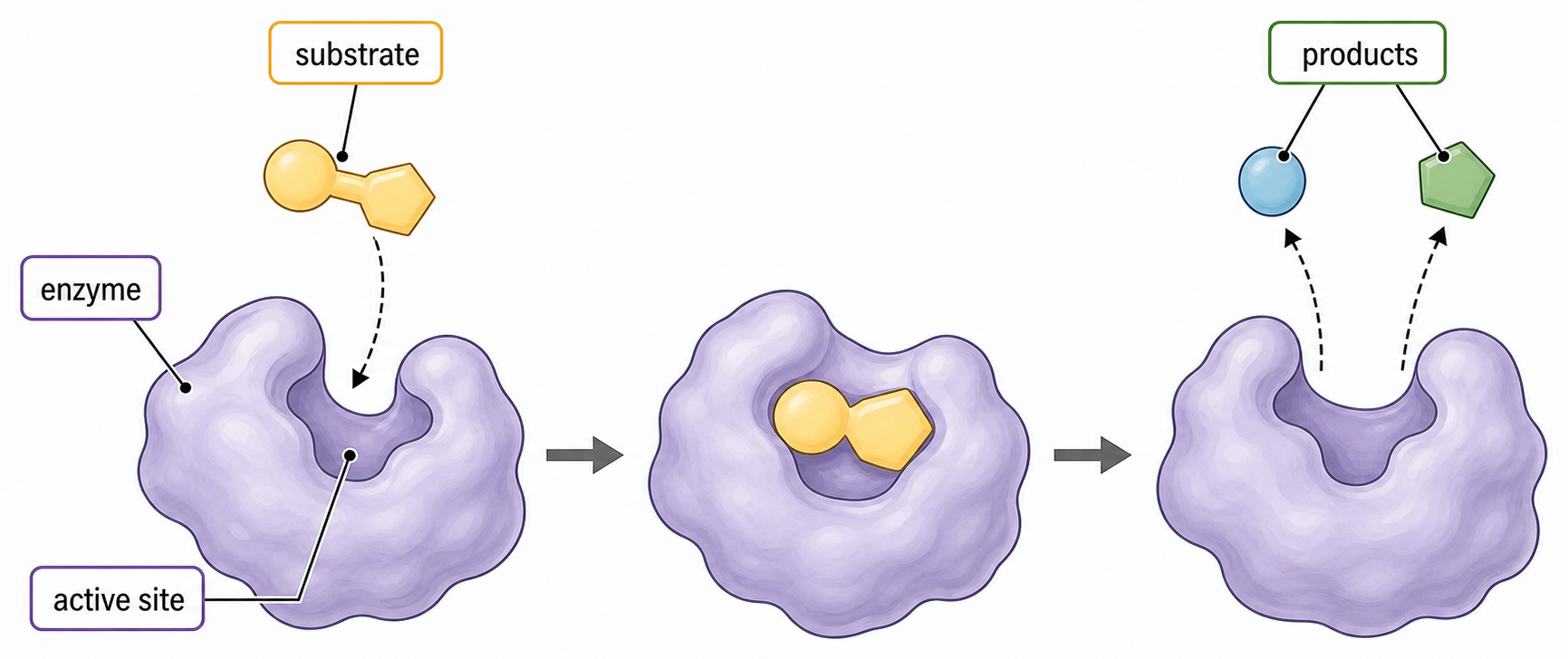
Enzymes are biological catalysts that increase reaction rate without being consumed.
They provide an alternative pathway with lower activation energy, so more substrate molecules can react at a given temperature. The enzyme is regenerated after products leave its active site.
For a catalyst claim, check:
Adding catalase to hydrogen peroxide makes oxygen bubbles appear faster, but the catalase remains available for further reactions.
An enzyme changes kinetics, not the overall energy difference or equilibrium constant.
This objective is assessed through structured response, commonly using Outline / Explain.
Outline / Explain
Build the answer around this relationship: Enzymes speed biological reactions without being used up.
Representative question
Explain how enzymes catalyse chemical reactions.
a. enzymes work by forming enzyme-substrate complexes
b. binding of substrate«s» to active site «of enzyme»
c. «enzyme» changes shape slightly
OR puts strains on chemical bonds «of substrate»
d. decreases activation energy / increases rate of reaction
e. enzymes bind to specific substrates
Can show these points in an annotated diagram.
3 max
Clarity of communication: [1]
The candidate's answers are clear enough to be understood without re-reading. The candidate has answered the question succinctly with little or no repetition or irrelevant material.
Enzymes make metabolism feasible by controlling the rates and sequence of reactions in cells.
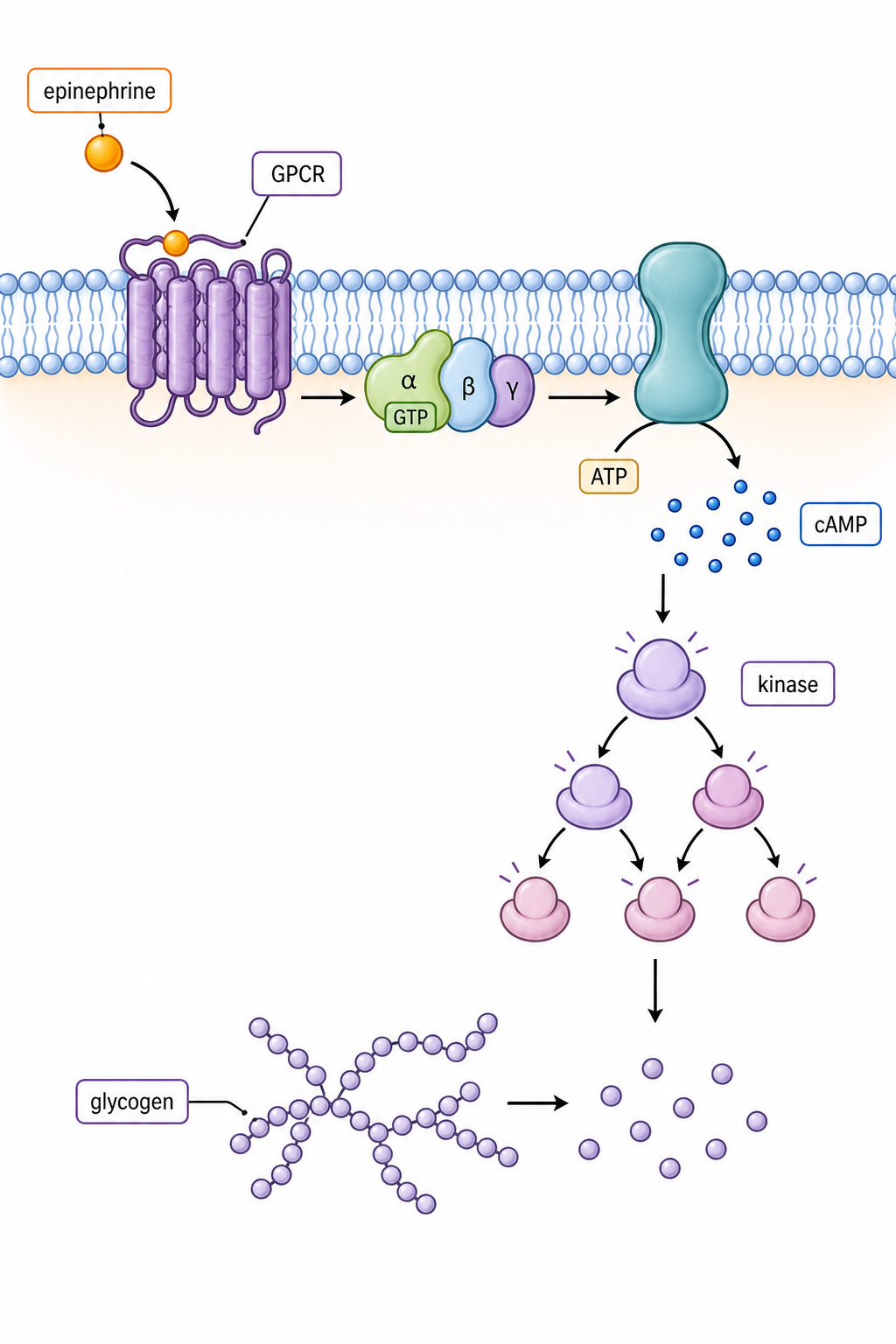
Different enzymes recognize particular substrates and conditions, allowing pathways to run in compartments and at regulated rates. Without catalysts, many reactions would be too slow at cell temperature.
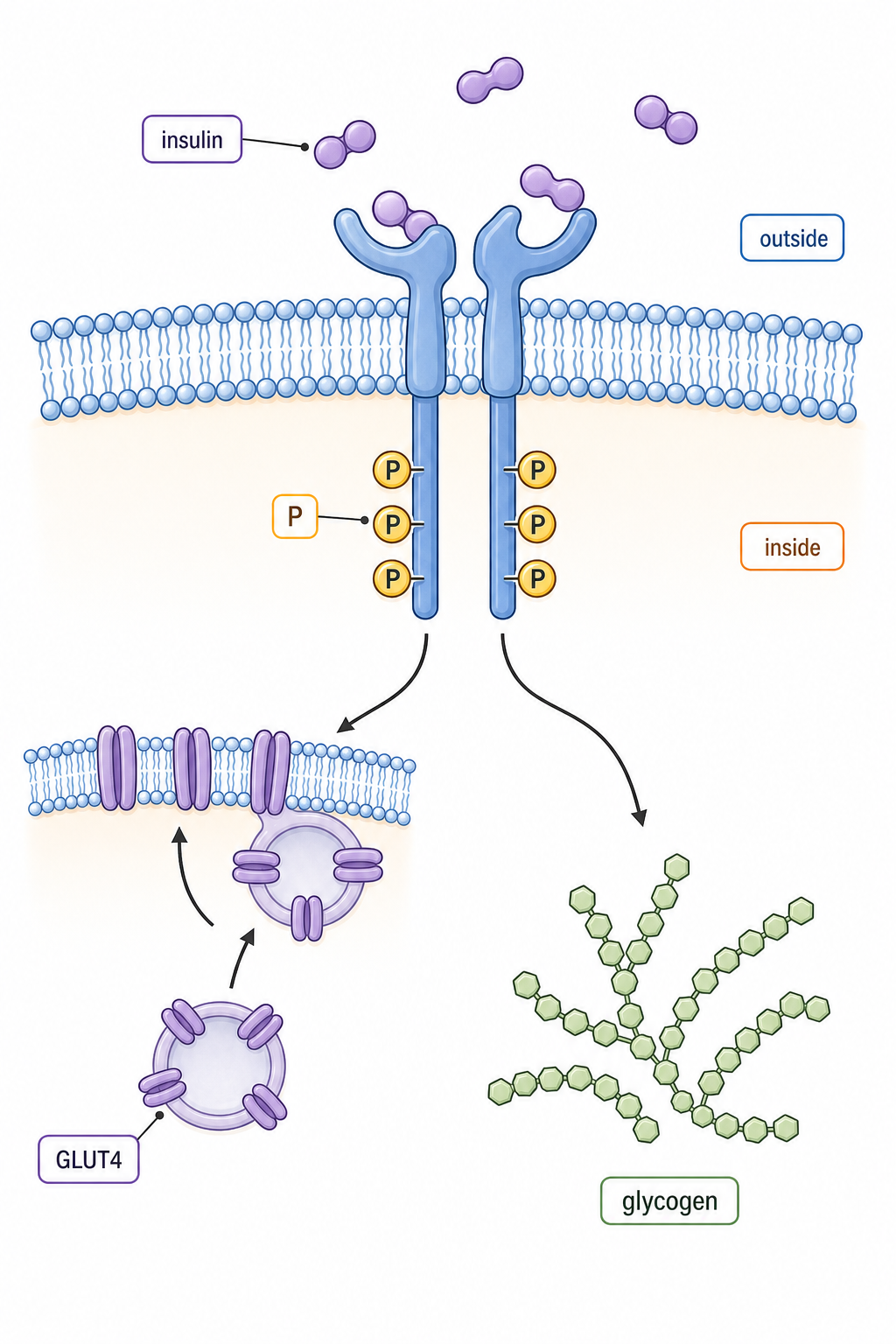
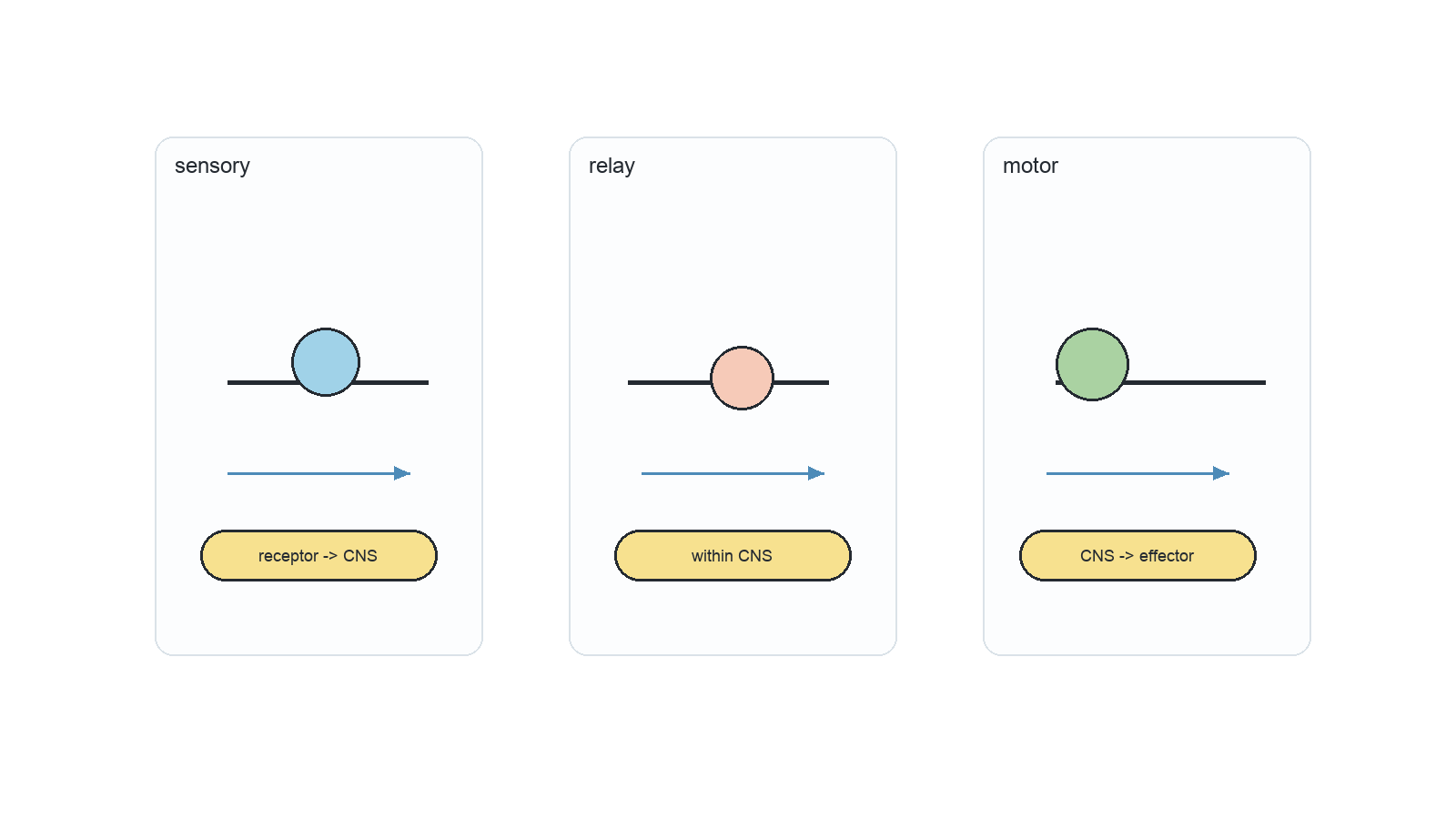
Think of enzyme control at three levels:
A cell can increase a digestive enzyme when food is present while keeping unrelated pathways slower, conserving resources.
Metabolism is not one reaction; it is a network whose steps require different enzymes.
This objective is assessed through structured response, commonly using Define / Explain.
Define / Explain
Build the answer around this relationship: Metabolism is the total set of chemical reactions in cells or organisms.
Representative question
Explain the role of enzymes in metabolic pathways.
enzymes speed up/catalyse metabolic reactions; by reducing the activation energy; each reaction (in the pathway) has a different enzyme;
metabolic pathways can be controlled by controlling which enzymes are produced; end-products of a metabolic pathway act as inhibitors; end-product inhibitors bind to/inhibit an enzyme at the start of the pathway;
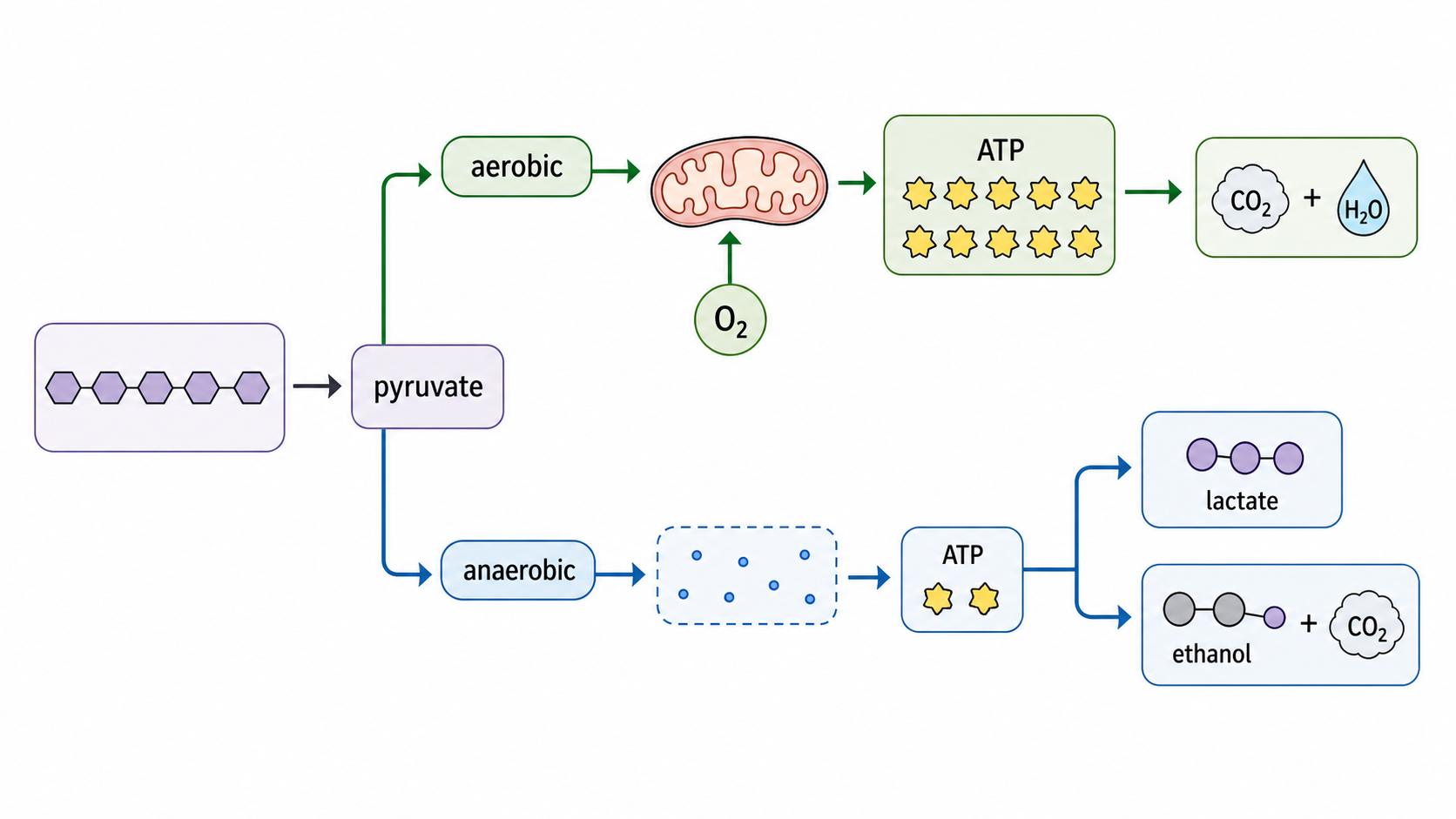
Anabolic reactions build larger molecules from smaller units, whereas catabolic reactions break molecules down and often release usable energy.
Cells couple the two: catabolism supplies ATP or reducing power, while anabolism uses energy and building blocks for growth and repair. Both directions require enzymes and regulation.
Classify the reaction by its flow:
Protein synthesis is anabolic; digestion of a protein into amino acids is catabolic.
A reaction can be chemically reversible, but the pathway context determines whether the cell uses it for building or breakdown.
This objective is assessed through structured response, commonly using Identify / Distinguish.
Identify / Distinguish
Build the answer around this relationship: Anabolism builds larger or more complex molecules from smaller units.
Representative question
Identify the following processes as either anabolism or catabolism by placing a tick ( ✓ ) in the correct box.
\begin{tabular}{|l|c|c|}
\hline \multicolumn{1}{|c|}{ Process } & Anabolism & Catabolism \\
\hline Light-independent reactions of photosynthesis & □ & □ \\
\hline Glycolysis & □ & □ \\
\hline
\end{tabular}

Most enzymes are globular proteins whose folded three-dimensional shape creates a specific active site.
Hydrophobic interactions, hydrogen bonds, ionic attractions and disulfide bonds stabilize the fold. The active site presents chemical groups in a geometry that binds substrates and promotes the transition state.
Connect structure to function:
Changing one amino acid near an active site can alter its shape and reduce activity even if the rest of the protein remains folded.
An enzyme’s function depends on its three-dimensional conformation, not only its amino-acid list.
This objective is assessed through structured response, commonly using Define / State.
Define / State
Build the answer around this relationship: Most enzymes are globular proteins with specific folded shapes.
Representative question
State a role of the active site of an enzyme.
site to which substrate binds
OR
catalytic site
Give credit for the lock and key analogy
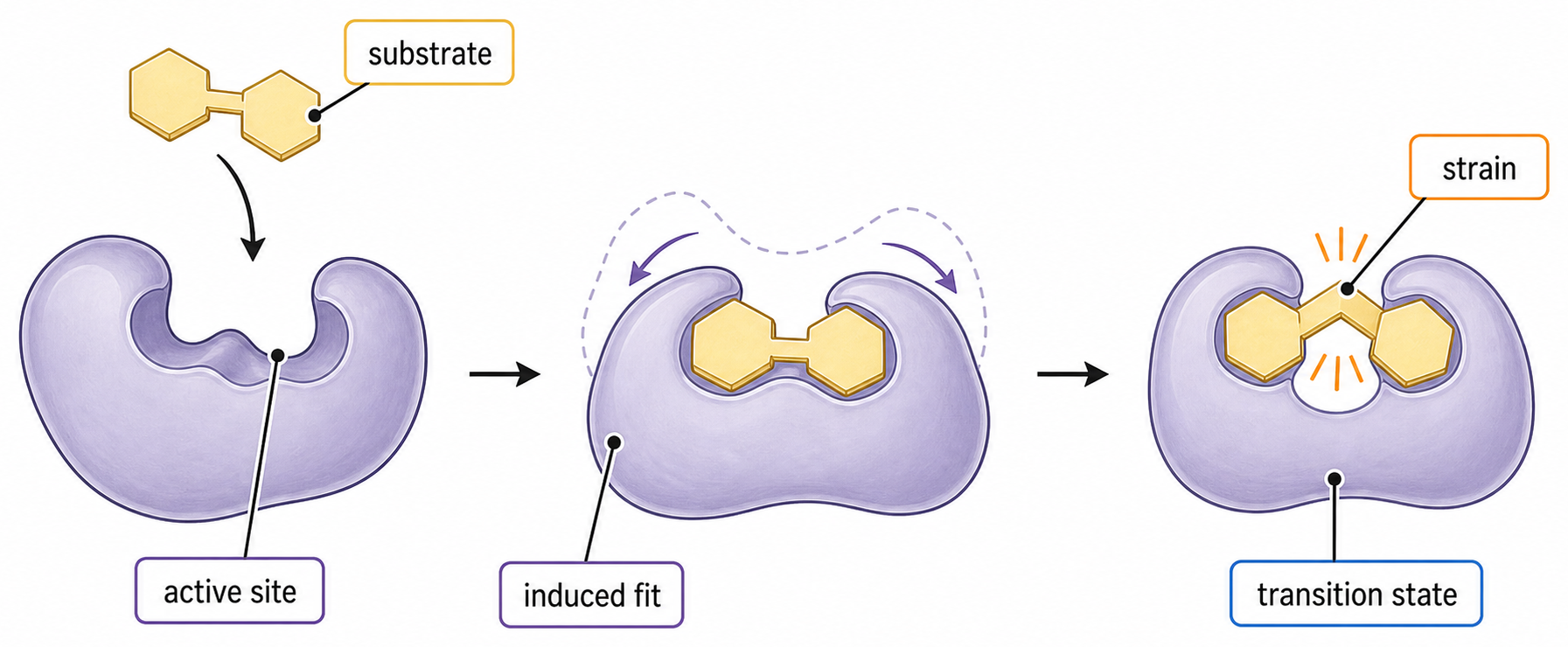
In the induced-fit model, substrate binding causes a small active-site shape change that positions reactants and catalytic groups.
The flexible fit stabilizes the transition state and can strain bonds or exclude water. Binding is therefore more than a rigid lock-and-key match.
A useful induced-fit explanation includes:
When substrate enters an enzyme pocket, side chains can rotate into a catalytic arrangement; products then leave because their interactions are weaker.
Induced fit does not mean every substrate binds equally well or that the enzyme permanently changes shape.
This objective is assessed through structured response, commonly using Describe / Outline.
Describe / Outline
Build the answer around this relationship: Induced fit involves a shape change when substrate binds.
Representative question
Describe the lock and key model of enzyme activity and how the induced fit model extends it.
enzymes are (globular) proteins that are catalysts/lower activation energy of chemical reactions;
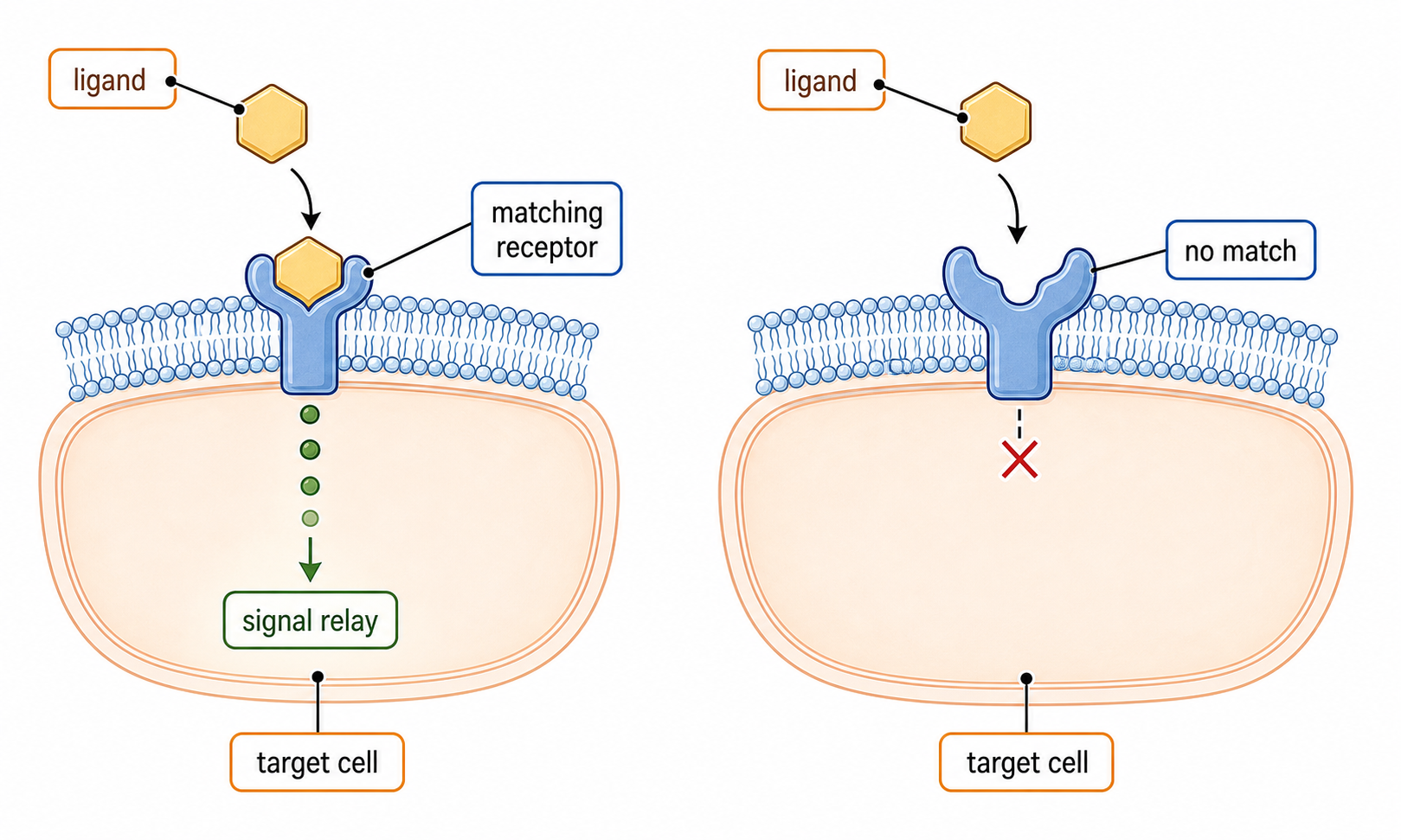
lock and key model: explains specificity of enzyme-substrate; the substrate (key) fits into/has complementary shape to the active site (lock) of the enzyme;
the active site can be changed by different chemicals/temperatures/ pH so substrate cannot bind;
induced-fit model:
changes in the active site/conformational changes to allow substrate to bind; the substrate induces the active site to change; bonds weakened in the substrate (so easier to break); explain reduction of activation energy/wider substrate specificity;
Marking guidance:
Accept the above points in the form of a clearly drawn annotated diagram.
Award [3 max] if only one model addressed.
Molecules move randomly, and enzyme reactions depend on collisions that have enough energy and the correct orientation.
Temperature changes average kinetic energy and collision frequency. Diffusion brings substrate and enzyme together, while the active site filters collisions by shape and chemistry.
For a collision explanation, include:
At low substrate concentration, adding more substrate increases productive collisions until most active sites are occupied.
Faster motion alone does not guarantee reaction; collisions still need a suitable orientation and energy.
This objective is assessed through multiple choice, commonly using Identify.
Identify
Build the answer around this relationship: Substrates must collide with enzyme active sites for catalysis.
Representative question
Which statement applies to enzymes?
Enzyme function depends on collisions between substrate and active sites.
One active site typically binds to a broad range of substrates.
The active site on the substrate is specific to one enzyme.
When enzymes are immobilized they stop working.
A
Enzyme function depends on the relationship between amino-acid sequence, three-dimensional shape and active-site chemistry.
A mutation, pH shift or temperature change can alter bonds maintaining the fold. If substrate contacts or catalytic residues move, binding and reaction rate change even when the protein is still present.
Trace a structure–function effect:
Replacing a charged residue in an active site with a non-polar one can remove an ionic interaction and lower catalytic activity.
A smaller enzyme band or unchanged concentration does not prove that its active site still works.
This objective is assessed through structured response, commonly using Explain.
Explain
Build the answer around this relationship: Active-site structure determines which substrates can bind.
Representative question
Some proteins in membranes act as enzymes. Outline enzyme-substrate specificity.
enzyme shape is specific to (particular) substrate;
lock and key analogy/model; example of specific enzyme and substrate; has specific 3-D/tertiary configuration/3-D/tertiary shape essential to functioning; active site on enzyme binds to substrate; substrate and active site complementary/fit together;
(substrate and active site) are complementary due to structure/chemical attraction; enzyme-substrate complex forms;
denaturation changes enzyme's binding ability (to specific substrate);
Marking guidance:
Award [6] for the above points clearly shown in an annotated diagram.
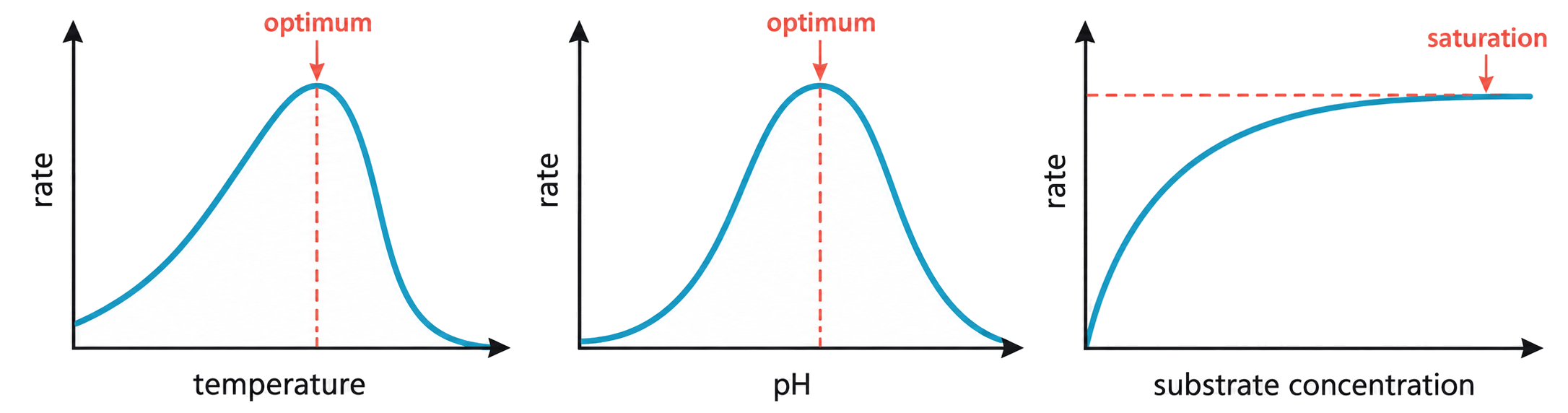
Enzyme activity depends on temperature, pH, substrate concentration and enzyme concentration within an appropriate range.
Warming usually increases collisions until bonds in the protein are disrupted; pH changes alter ionization and active-site interactions. More substrate or enzyme increases rate only while another factor is not limiting.
Interpret a rate curve by locating:
Increasing substrate raises rate until every active site is occupied; further substrate then produces little additional increase.
The optimum is not a universal constant: it depends on the enzyme’s structure and cellular environment.
This objective is assessed through structured response, commonly using Explain / Outline / Describe.
Explain / Outline / Describe / Determine / Compare / Evaluate / Suggest / Sketch / Label
Build the answer around this relationship: Temperature increases collision frequency up to an optimum before denaturation lowers activity.
Representative question
Explain the effect of changes of pH , substrate concentration and temperature on enzyme activity.
p H :
enzymes have an optimal pH / work best at a given pH ;
activity increases as pH gets closer to optimal pH ; extreme pH denatures enzymes;
by breaking bonds / changing enzyme shape/structure / active site shape/structure;
substrate:
as substrate concentration increases, activity increases; as substrate concentration increases, the collisions between substrate and enzyme increase; up to a maximal level of action / reaching a plateau; all active sites are saturated/occupied;
temperature:
enzymes have an optimal temperature (where they work most effectively); activity increases as it gets closer to optimal temperature; high temperatures stop enzyme activity due to irreversible changes in structure /denaturation; by breaking bonds / changing enzyme shape/structure / active site shape/structure;
Marking guidance:
Award any of the above points in an annotated graph.
Award up to [8] if all three addressed and [6 max] if only two addressed.
An enzyme reaction rate is measured from the change in substrate or product concentration per unit time.
Choose a signal proportional to concentration, keep conditions controlled and use the initial linear section before substrate depletion or product inhibition changes the rate.
A sound measurement includes:
A colorimeter can track product colour every ten seconds; the slope of absorbance against time estimates the initial rate.
A final product amount alone cannot distinguish a fast reaction from a slow reaction allowed to run longer.
This objective is assessed through experimental design, commonly using Calculate / Suggest / Identify.
Calculate / Suggest / Identify / Describe / Outline / Evaluate / Deduce / Discuss / State
Build the answer around this relationship: Enzyme activity can be measured through product formation or substrate disappearance.
Representative question
Suggest how the percentage of decolorization could be obtained experimentally.
a. suggested method that could be used to measure colour change;
b. measure absorbance/transmittance/OWTTE of light before the experiment/adding laccase/control group
OR
compare colour with colour chart before the experiment/adding laccase;
c. measure absorbance/transmittance/OWTTE of light after the experiment/adding laccase
OR
compare colour with colour chart after the experiment/adding laccase;
d. calculate the (percentage) difference;
a. Colorimeter/spectrophotometer/serial dilutions/colour chart / standard curve.
b and c : A quantifiable reference must be used.
3
Marking guidance:
max
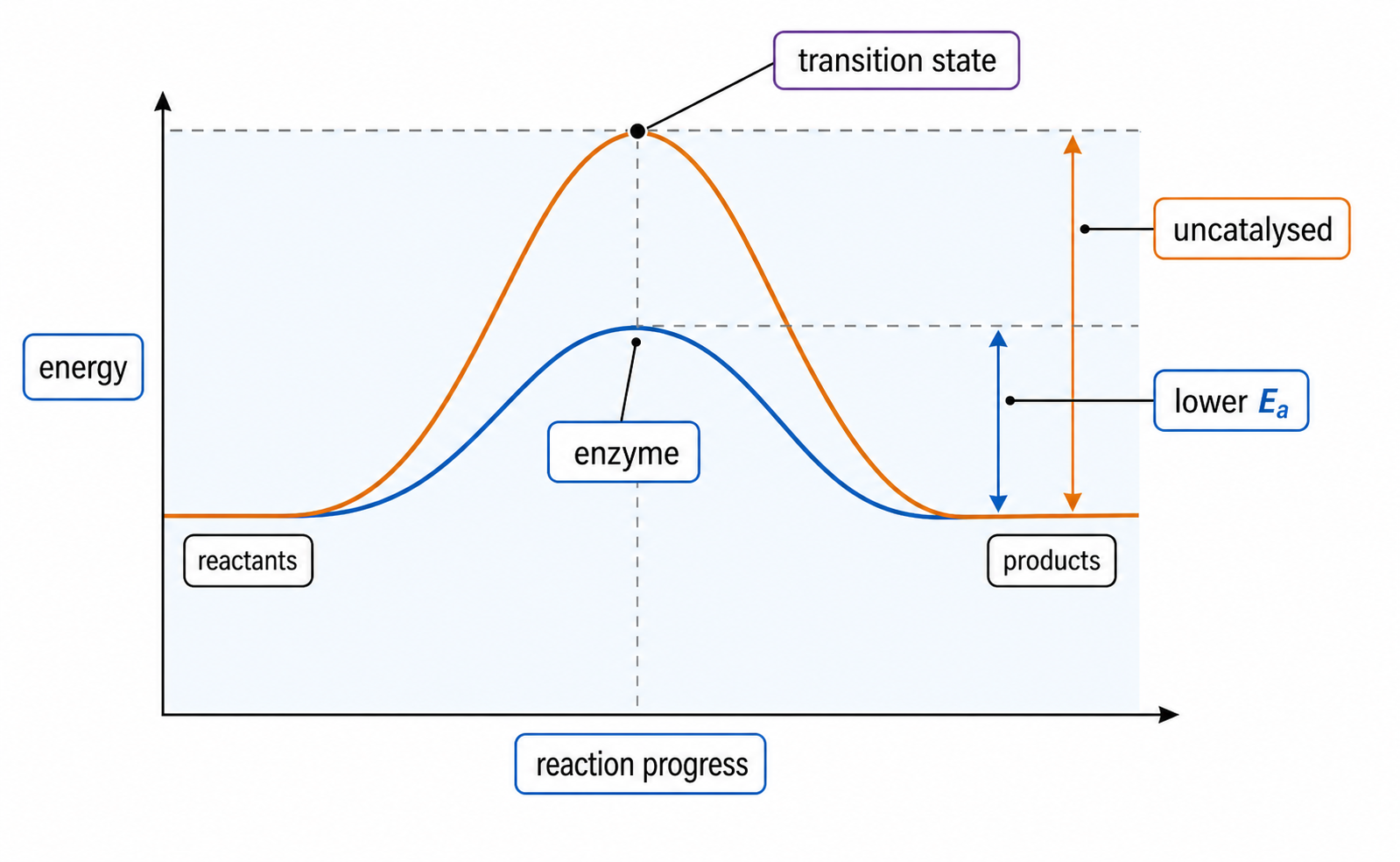
Enzymes lower the activation energy needed to reach the transition state, increasing the fraction of successful collisions.
They bind substrates and orient reactive groups, strain bonds or create a favorable local environment. The energy difference between reactants and products is unchanged.
Compare catalysed and uncatalysed paths:
On an energy profile, the catalysed curve has a lower peak while its starting and ending energy levels match the uncatalysed curve.
Lower activation energy does not mean the reaction becomes more exergonic.
This objective is assessed through multiple choice, commonly using Predict / Identify.
Predict / Identify
Build the answer around this relationship: Enzymes lower the activation energy required for reaction.
Representative question
The graph shows energy changes during a reaction both with and without an enzyme present.
Which statement correctly identifies two of the regions labelled X, Y and Z in the graph?
X is the activation energy with an enzyme and Z is the net energy released from the reaction.
X is the energy released from the reaction and Y is the activation energy with an enzyme.
Y is the energy released with an enzyme and Z is the energy released when bonds are broken.
Y is the activation energy with an enzyme and Z is the net energy released.
D
Enzymes are biological catalysts that lower activation energy and remain unchanged. Their globular protein shape creates active-site specificity; induced fit aligns substrates; molecular motion and collisions affect rate; temperature, pH, and substrate concentration change activity; assays measure substrate loss or product formation over time.
Intracellular enzymes act inside cells, while extracellular enzymes are secreted and act outside the producing cell.
Location matches the task: lysosomal enzymes digest material in a compartment, whereas digestive enzymes such as amylase act in the gut lumen after secretion. Secretion requires targeting and transport.
Distinguish the locations:
A fungus secretes cellulase into its surroundings, breaks cellulose into sugars, then absorbs the products.
Extracellular does not mean non-biological; it describes where the enzyme acts.
This objective is assessed through structured response, commonly using Explain / Discuss / Outline.
Explain / Discuss / Outline / State / Identify
Build the answer around this relationship: Intracellular enzymes catalyse reactions inside cells.
Representative question
Outline the role of amylase in digestion in humans.
a. amylase is an enzyme
b. secreted by salivary glands/pancreas
c. active/released into the mouth/small intestine
d. acts on starch/polysaccharides
e. breaks «glycosidic» bond by hydrolysis/adding water
f. converts insoluble/large molecule to soluble/small molecules
g. product is maltose/disaccharide/sugar molecule
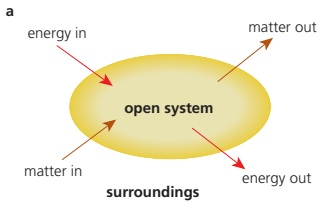
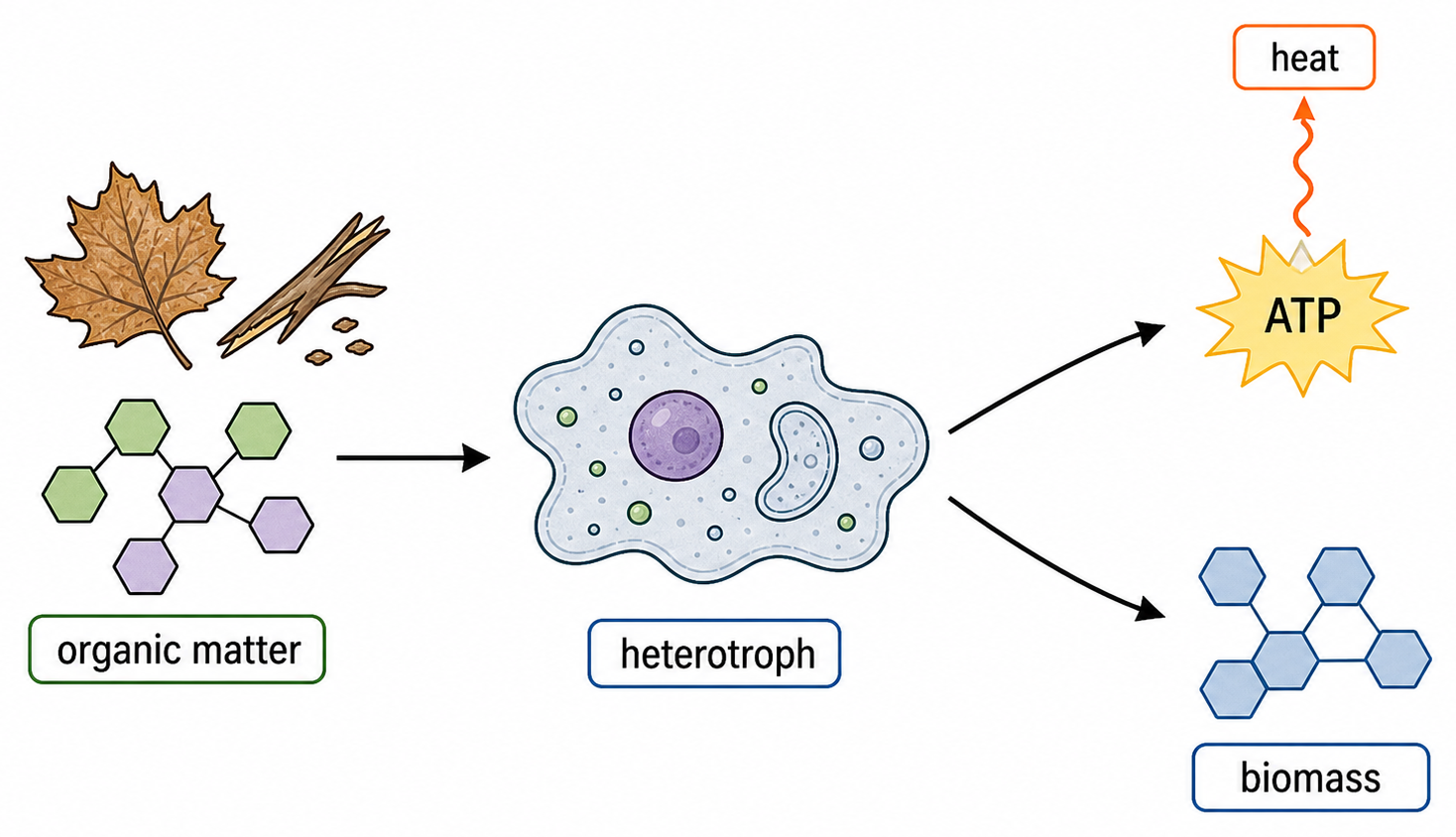
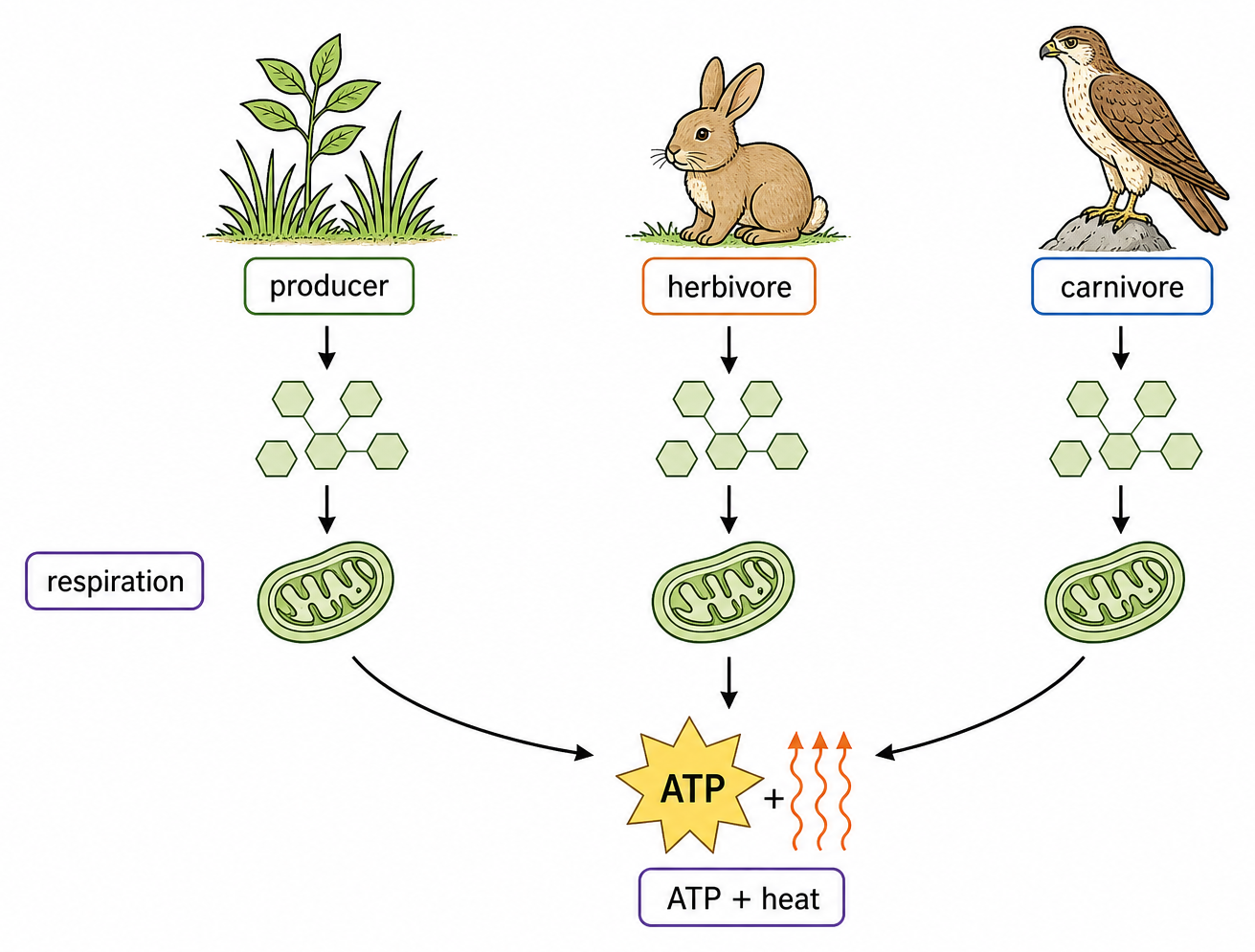
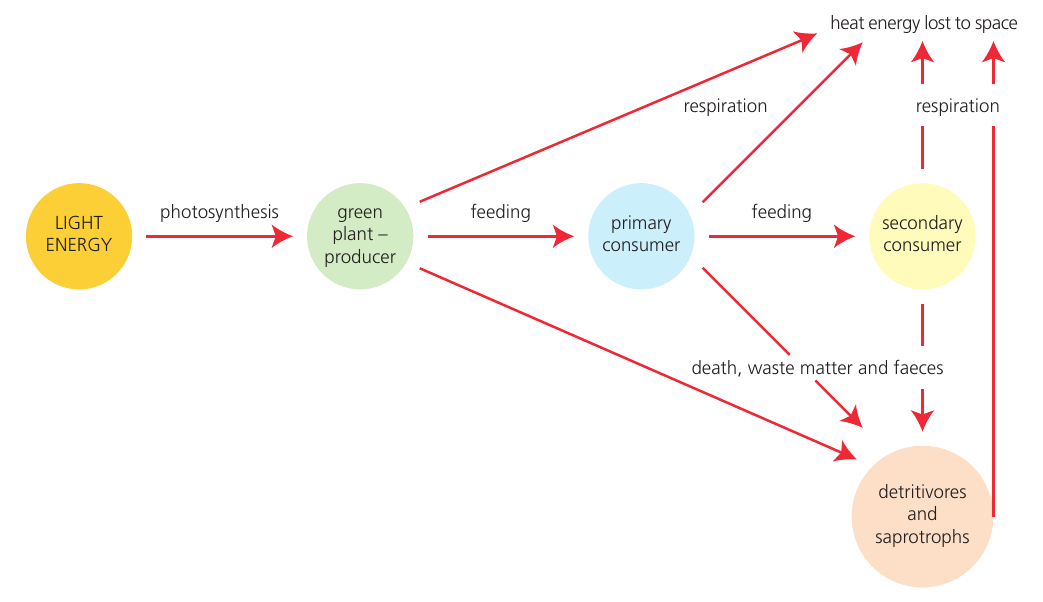
Metabolic reactions transfer energy, and some of the released energy appears as heat rather than being captured in ATP or products.
Cells use coupled reactions and ATP to conserve part of the energy, but inefficiency and thermodynamic constraints produce heat. Heat generation can help endotherms maintain body temperature but must be regulated.
Trace energy allocation:
During respiration, not all glucose energy becomes ATP; some warms tissues and must be dissipated or used for thermoregulation.
Heat is an energy transfer, not a separate metabolic substance or proof that ATP production stopped.
This objective is assessed through structured response, commonly using Explain.
Explain
Build the answer around this relationship: Metabolic reactions release some energy as heat.
Representative question
Above a body mass of 10 kg , there is little difference in BMR between desert and polar mammals. Suggest reasons for this.
a. surface area to volume ratio is low in large mammals/above 10 kg ;
b. less heat/energy loss in larger mammals;
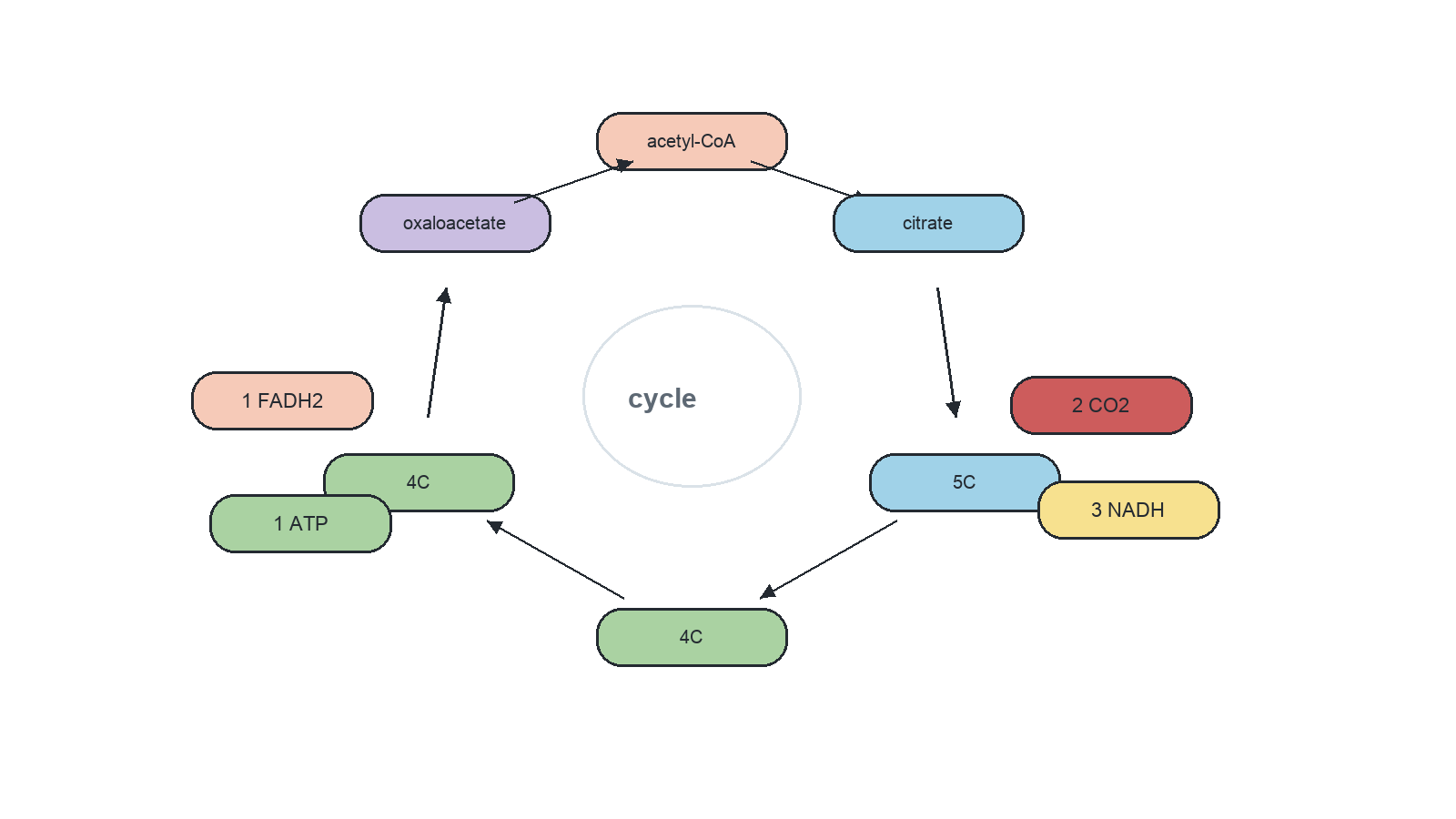
A linear pathway passes through a sequence of intermediates, whereas a cyclic pathway regenerates a starting acceptor so the sequence can repeat.
Pathway shape affects regulation and flux. Linear pathways can end in a product; cycles can process repeated inputs while conserving key carriers or accepting molecules.
Identify pathway structure by asking:
The Krebs cycle regenerates oxaloacetate after acetyl groups are processed, allowing another turn when substrates and electron acceptors are available.
A cycle is not perpetual motion; it still needs inputs, energy and conditions that sustain each step.
This objective is assessed through structured response, commonly using Distinguish.
Distinguish
Build the answer around this relationship: Linear pathways proceed from substrate to final product.
Representative question
Distinguish between processes involved in cyclical and linear metabolic pathways.
in linear products are not recycled but in cyclical they are recycled/become substrates/reactants / OWTTE;
The format "they are recycled in cyclical, but they are not in linear" is acceptable.
Marking guidance:
Do not accept enzymes instead of products/ substrates/reactants.
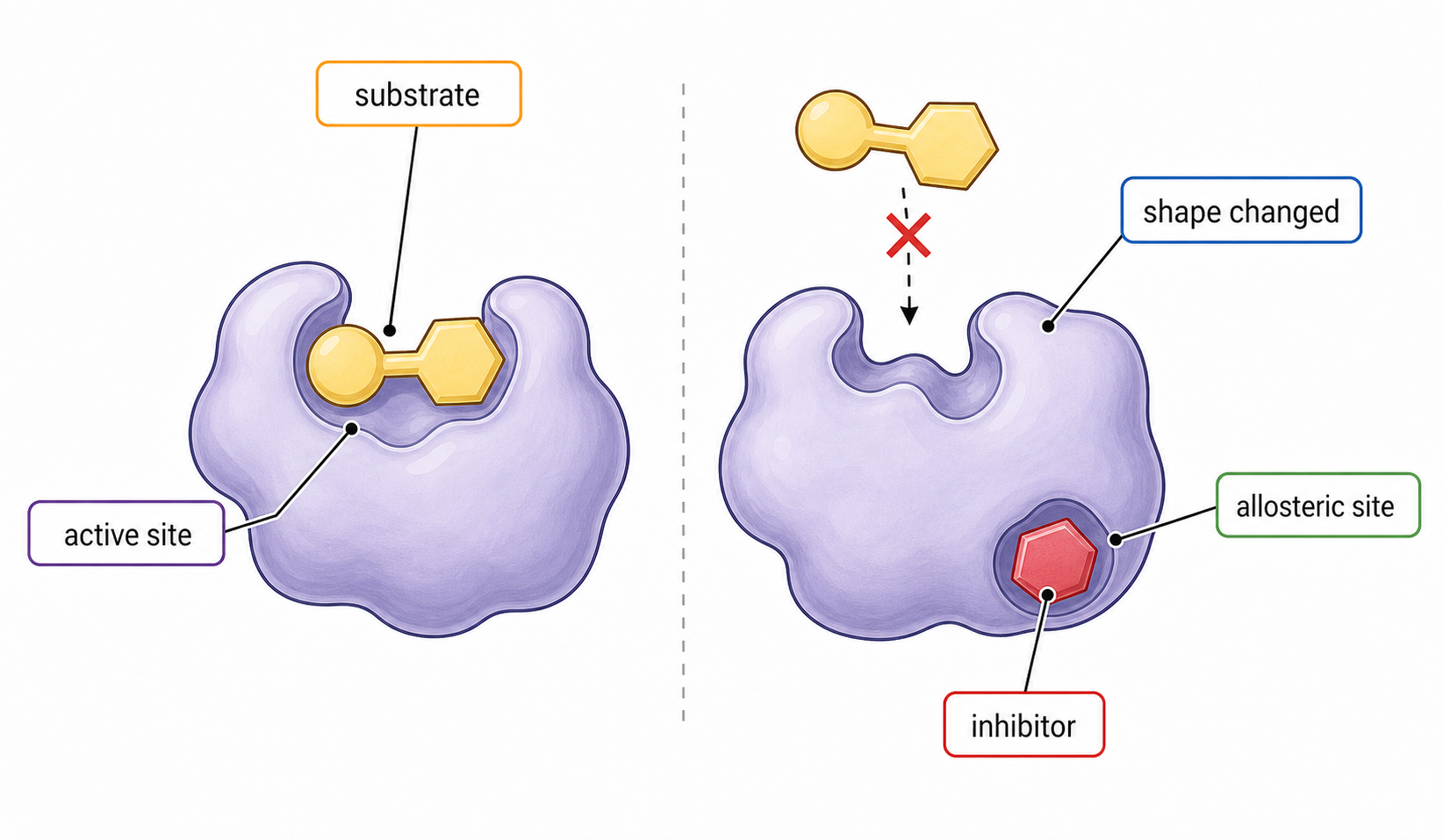
An allosteric site is a regulatory binding site separate from the active site; binding there changes enzyme conformation and activity.
A non-competitive inhibitor can reduce activity by stabilizing a shape that binds substrate poorly or catalyses slowly. Increasing substrate cannot fully overcome inhibition when the active-site enzyme population is altered.
Diagnose allosteric inhibition:
If an inhibitor lowers the maximum rate at every substrate concentration, it is consistent with non-competitive effects on functional enzyme molecules.
Non-competitive does not mean the inhibitor never affects substrate binding; the key is the separate site and altered activity.
This objective is assessed through structured response, commonly using Describe / Explain / Deduce.
Describe / Explain / Deduce / Outline / Compare / Distinguish
Build the answer around this relationship: Non-competitive inhibitors bind away from the active site.
Representative question
Explain how a non-competitive inhibitor such as copper causes a reduction in enzyme activity.
copper binds to the enzyme away from the active site; this changes the shape of the active site; prevents substrate binding;
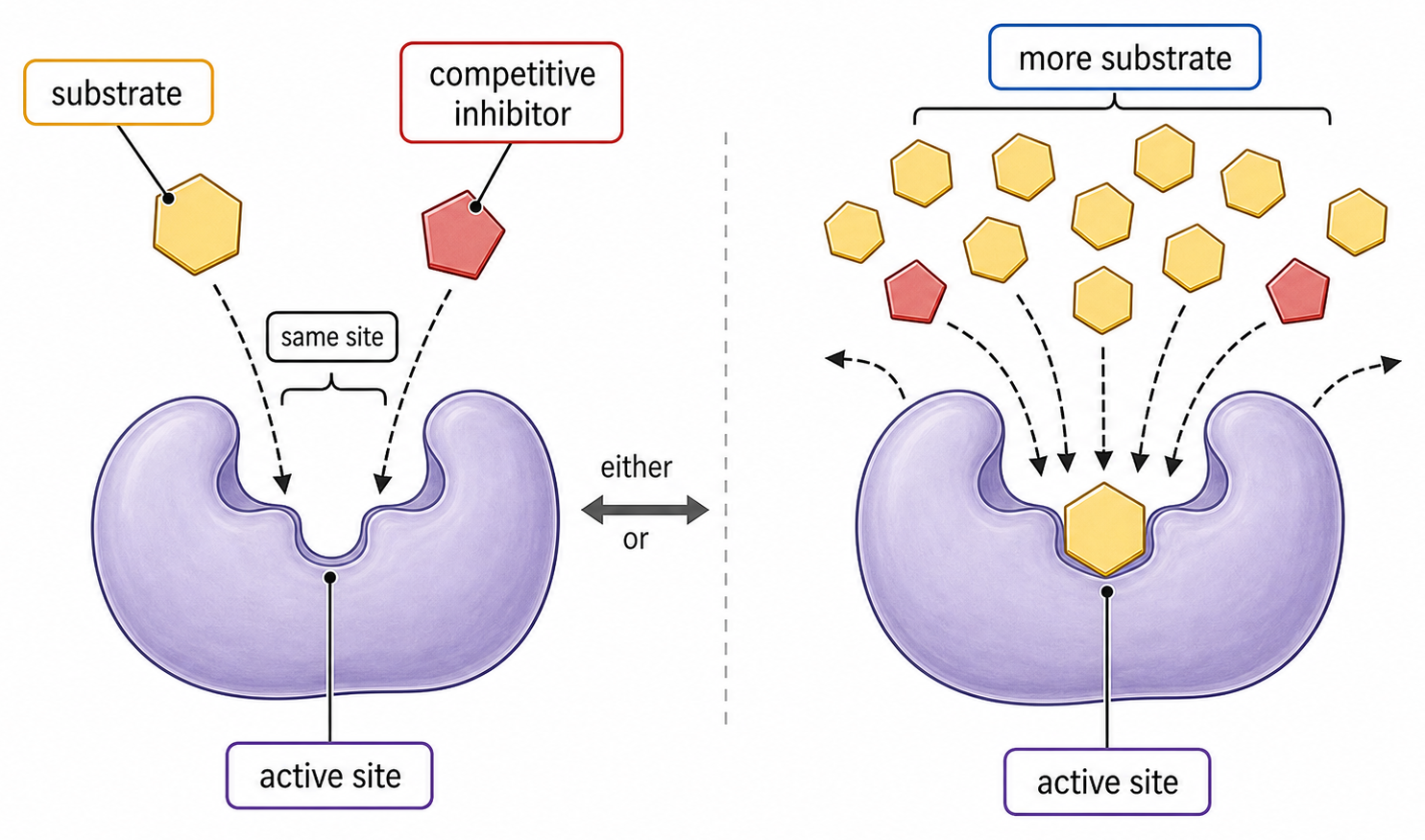
A competitive inhibitor resembles the substrate and competes for the active site, reducing reaction rate at a given substrate concentration.
Because the competition is reversible, increasing substrate can outcompete the inhibitor in the ideal model. The apparent substrate concentration needed for a given rate rises, while maximum rate can remain reachable.
Look for the competitive pattern:
If adding more substrate restores the original maximum rate, active-site competition is a plausible explanation.
A competitive inhibitor does not permanently destroy the enzyme; it changes access to the active site.
This objective is assessed through structured response, commonly using Outline / Distinguish / Explain.
Outline / Distinguish / Explain
Build the answer around this relationship: Competitive inhibitors bind to enzyme active sites.
Representative question
Explain, using an example, how competitive inhibitors interfere with enzyme activity.
a. binds to the active site / inhibitor is complementary to the active site;
b. prevent binding of substrate (so reducing enzyme activity/rate of reaction) OR
fewer enzyme-substrate complexes form;
c. inhibitor chemically similar/similar in shape/similar in structure to substrate
d. statins are competitive inhibitors of HMG-CoA reductase/enzyme needed to make cholesterol;
e. statins prevent conversion of HMG-CoA to mevalonate;
Marking guidance:
Accept other examples for mark point d and mark point e such as:
Oxygen binds to rubisco (d.) and preventing production of glycerate 3-phosphate (e.)
Malonate binds to succinic dehydrogenase (d.), preventing production of fumarate (e.).
Allow penicillin as a competitive inhibitor of transpeptidase/for bacterial cell wall production for mark point d, but not mark point e.
4
max
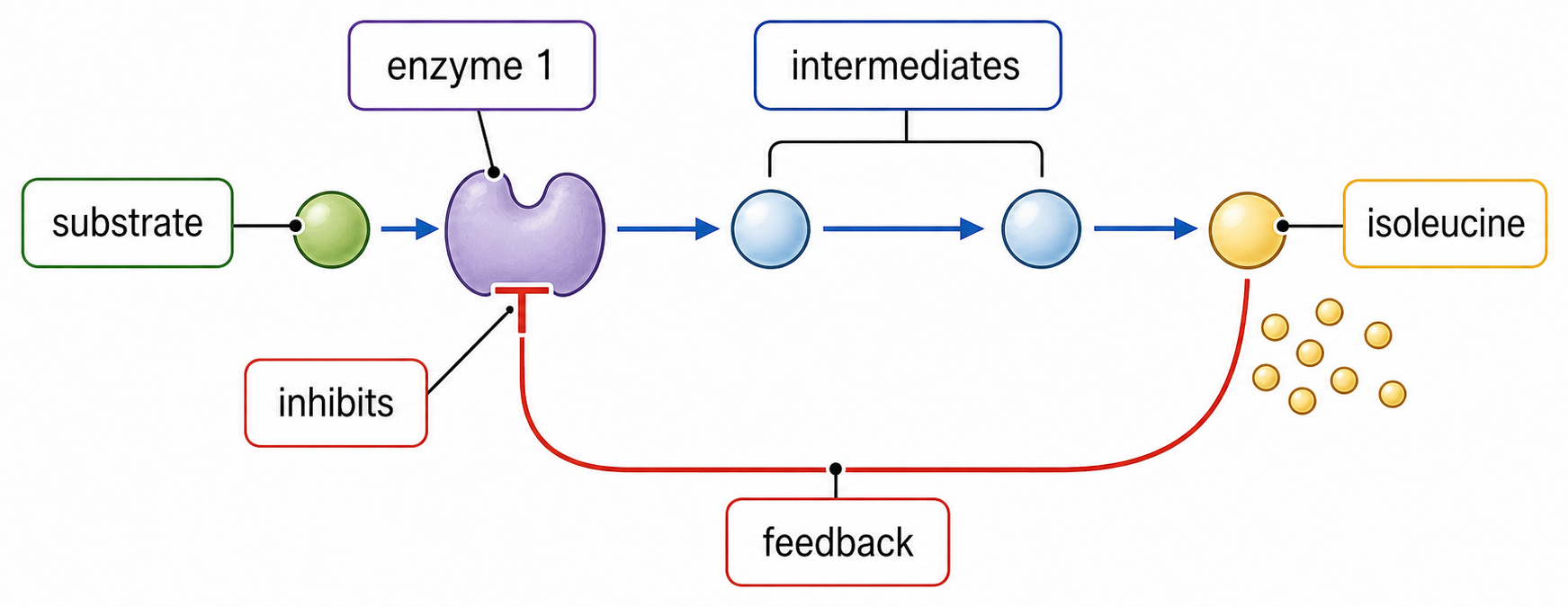
Feedback inhibition occurs when a pathway’s end product inhibits an earlier enzyme, preventing unnecessary accumulation.
The product binds a regulatory site or otherwise reduces flux at a committed step. When product concentration falls, inhibition eases and pathway activity can resume.
Trace the control loop:
If amino-acid synthesis slows when the amino acid accumulates, the product is acting as a signal that the pathway’s output is sufficient.
Feedback inhibition is regulation, not evidence that the pathway’s reactions have reversed.
This objective is assessed through structured response, commonly using Explain / Outline / State.
Explain / Outline / State
Build the answer around this relationship: End products can inhibit enzymes near the start of a pathway.
Representative question
Outline the control of metabolism by end-product inhibition.
a. metabolism is chains/web of enzyme-catalyzed reactions
OR
metabolic pathway is a chain of enzyme-catalyzed reactions
b. end product/inhibitor is final product of chain/pathway
c. inhibits/binds to/blocks the first enzyme in chain/pathway
d. non-competitive inhibition
e. end-product/inhibitor binds to an allosteric site/site away from the active site
f. changes the shape of the active site/affinity of the active site «for the substrate»
g. prevents intermediates from building up
OR
prevents formation of excess «end» product/stops production when there is enough OR
whole metabolic pathway can be switched off
h. negative feedback
i. binding of the end product/inhibitor is reversible
OR
pathway restarts if end product/inhibitor detaches/if end product concentration is low
j. isoleucine inhibits/slows «activity of first enzyme in» threonine to isoleucine pathway
Marking guidance:
Allow mark points shown in clearly annotated diagrams.
To gain mpd, mpe and mpf the answer must be in the context of end-product inhibition, not enzyme inhibition generally.
5 max
A mechanism-based inhibitor is processed by an enzyme into a reactive product that binds or modifies the enzyme’s catalytic machinery.
Because the enzyme’s own chemistry activates the inhibitor, the inhibition can be highly specific and effectively irreversible until new enzyme is made. It differs from simple reversible competition.
Identify the mechanism:
An inhibitor designed for one enzyme may be harmless until that enzyme converts it into a reactive species that covalently modifies a catalytic residue.
Specific activation does not make the inhibitor harmless; it can permanently reduce functional enzyme concentration.
Enzymes can act inside or outside cells, metabolic reactions release heat, pathways may be linear or cyclical, and pathway output is regulated by inhibition. Competitive inhibitors bind active sites and can be overcome by more substrate; non-competitive inhibitors bind allosteric sites; feedback inhibition uses end products to inhibit earlier enzymes; mechanism-based inhibitors trap enzymes after reaction begins.