Q BankQuestion BankDocsDocuments

C1.3.11 (HL)—Photolysis of water

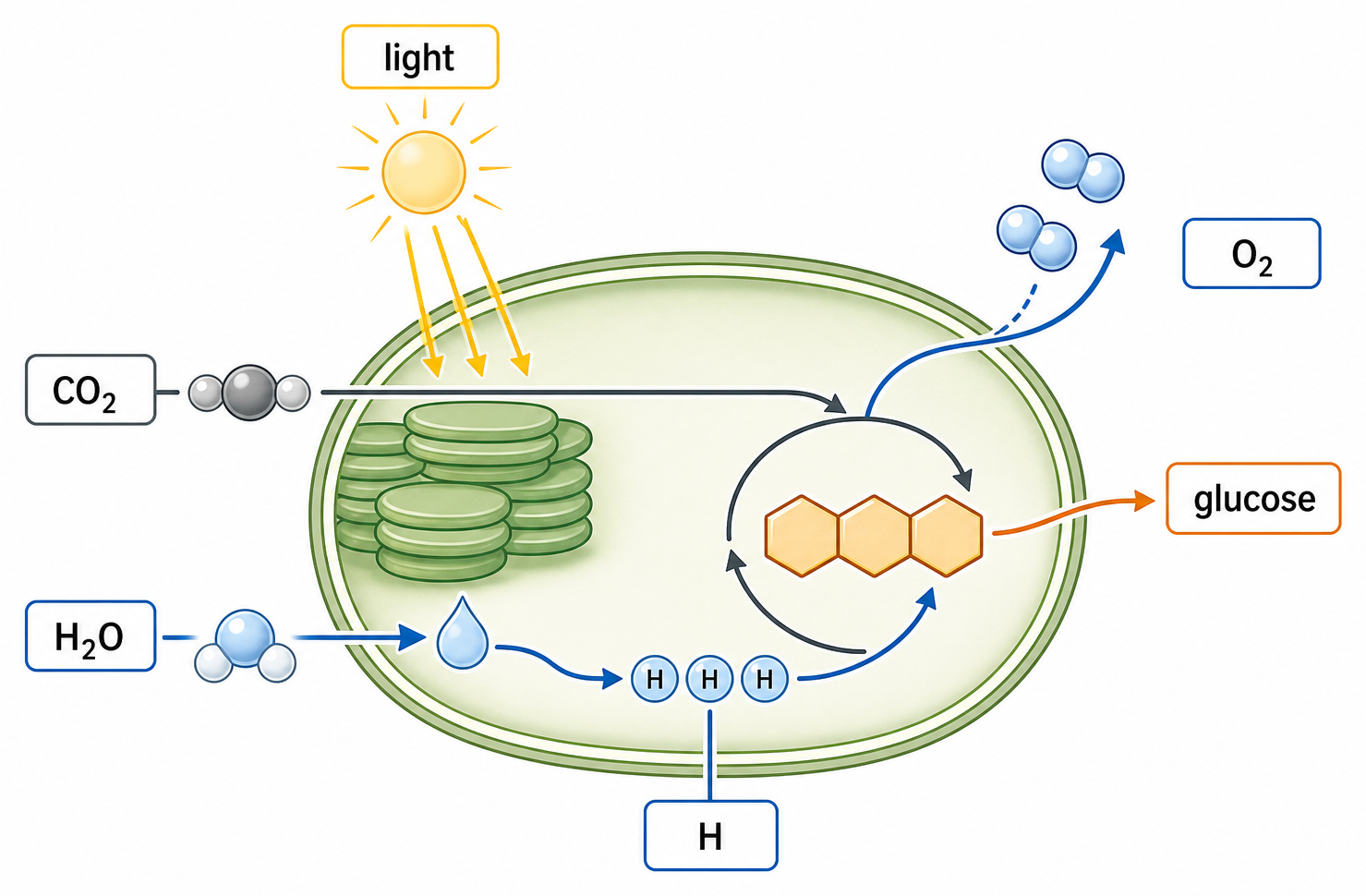
Photolysis splits water during the light-dependent reactions, supplying electrons and protons while releasing oxygen as a by-product, connecting the mechanism to observable photosynthesis evidence.

Syllabus
First assessment 2025
Objective
C1.3.11
Level
HL

Exam analysis

Chance of appearing5%of analysed past papers
Latest appearanceMay 2022
Most common paperPaper1
Typical marks1–3

Common command terms

  • Describe
  • Explain

Recent exam appearances

May 2022Paper1 ["HL"] · TZ231[ 1 ]C1.3.11 (HL)—Photolysis of water
May 2021Paper1 ["HL"] · TZ231[ 1 ]C1.3.11 (HL)—Photolysis of water
November 2019Paper2 ["HL"] · TZ04(b)(ii)[ 3 ]C1.3.11 (HL)—Photolysis of water
November 2017Paper2 ["HL"] · TZ04(b)[ 3 ]C1.3.11 (HL)—Photolysis of water
May 2013Paper2 ["HL"] · TZ27(c)[ 8 ]C1.3.11 (HL)—Photolysis of water
Practice this objective

Coverage 2013–2022 · Updated 15 Jul 2026

Photolysis and NADP reduction

HL only
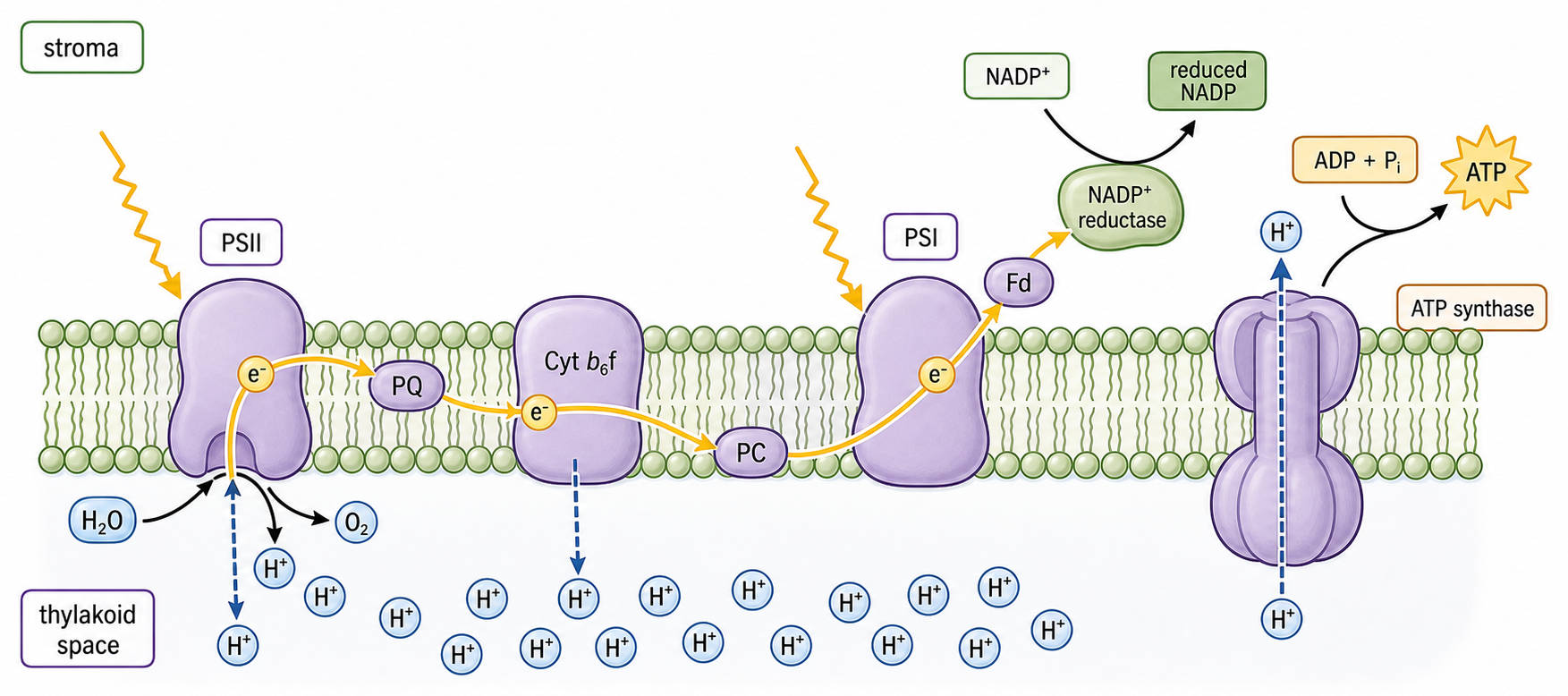
Thylakoid membrane showing PSII, electron carriers, PSI, photolysis, proton movement and NADP reduction.

Photosystem II uses light to excite electrons and replace them by photolysis of water: 2H₂O → 4H⁺ + 4e⁻ + O₂. The oxygen is released, while protons contribute to the thylakoid proton gradient and electrons enter the electron transport chain. Photosystem I re-excites the electrons; NADP accepts the high-energy electrons and H⁺ to form reduced NADP (NADPH), which carries reducing power to the Calvin cycle.

  • Photolysis of water supplies electrons, H⁺ and O₂.
  • O₂ is the waste product released from water splitting.
  • Photosystem I re-excites electrons for reduction of NADP.
  • Reduced NADP/NADPH carries hydrogen/electrons to the Calvin cycle.

Photolysis of water

HL only

Assessment in practice

1–3 marks
How it is assessed

This objective is assessed through structured response, commonly using Describe / Explain.

Command terms

Describe / Explain

What earns marks

Build the answer around this relationship: Photolysis uses light energy to split water.

Representative question

Question 1

[Maximum number: 8]

Some of the water carried to the leaves of a plant is used in photosynthesis. Explain the role of water in the light-dependent reactions of photosynthesis.
Trace Photosynthesis Mechanism

HL only

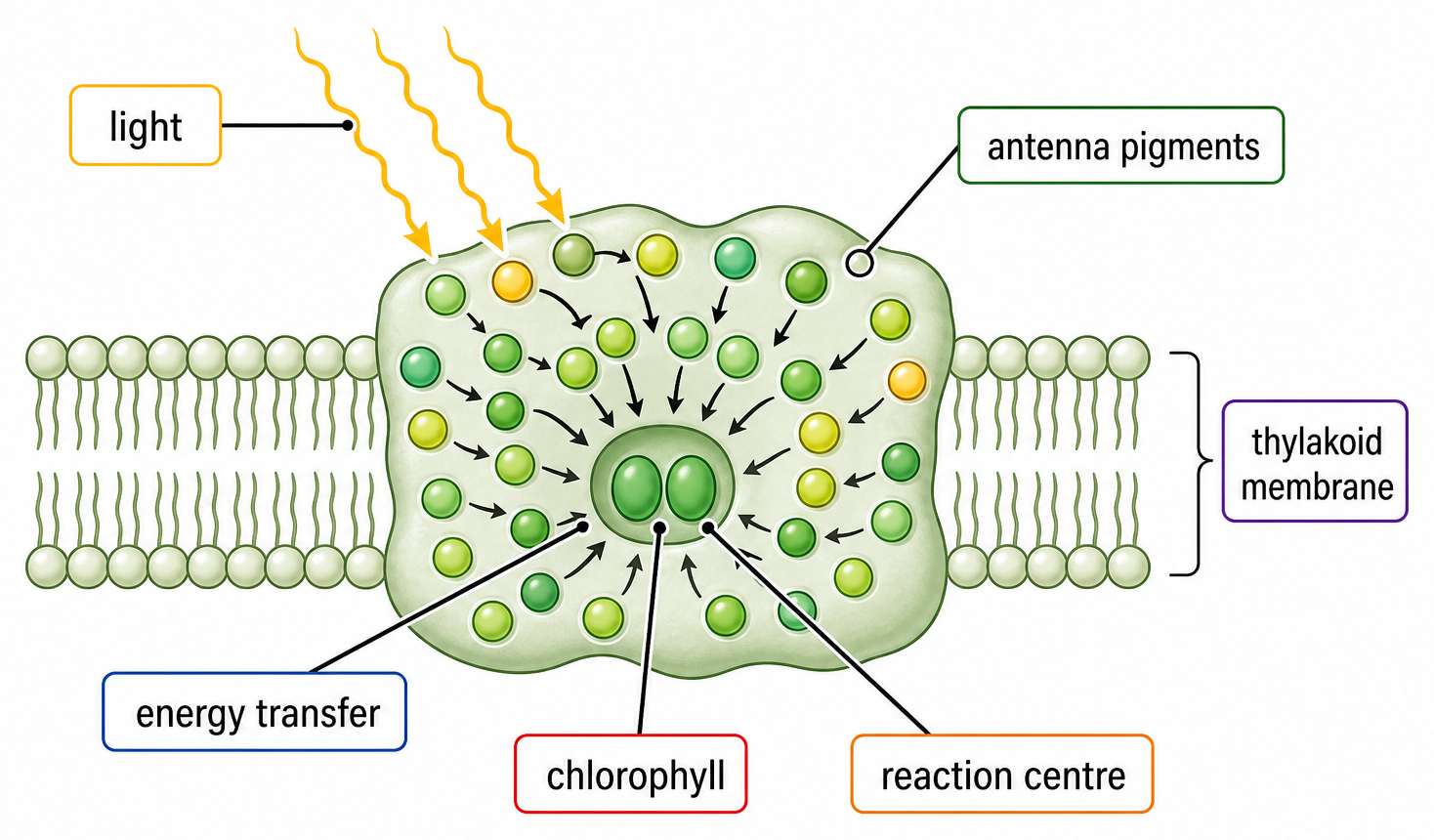
HL photosynthesis links light-dependent reactions to the Calvin cycle. Photosystems are pigment-protein arrays in thylakoid membranes; antenna pigments broaden absorption and pass energy to reaction-centre chlorophyll. PSII uses light to split water, supplying electrons, protons, and oxygen. Electron transport pumps protons into the thylakoid space, ATP synthase makes ATP by photophosphorylation, PSI re-excites electrons, and NADP is reduced. The Calvin cycle uses ATP and reduced NADP: Rubisco fixes CO2 to RuBP to form GP, GP is reduced to triose phosphate, most triose phosphate regenerates RuBP, and some becomes wider biomolecules.

  • Trace energy: pigments -> reaction centres -> ATP and reduced NADP.
  • Trace electrons/protons: water -> PSII -> carriers -> PSI -> NADP; proton gradient -> ATP synthase.
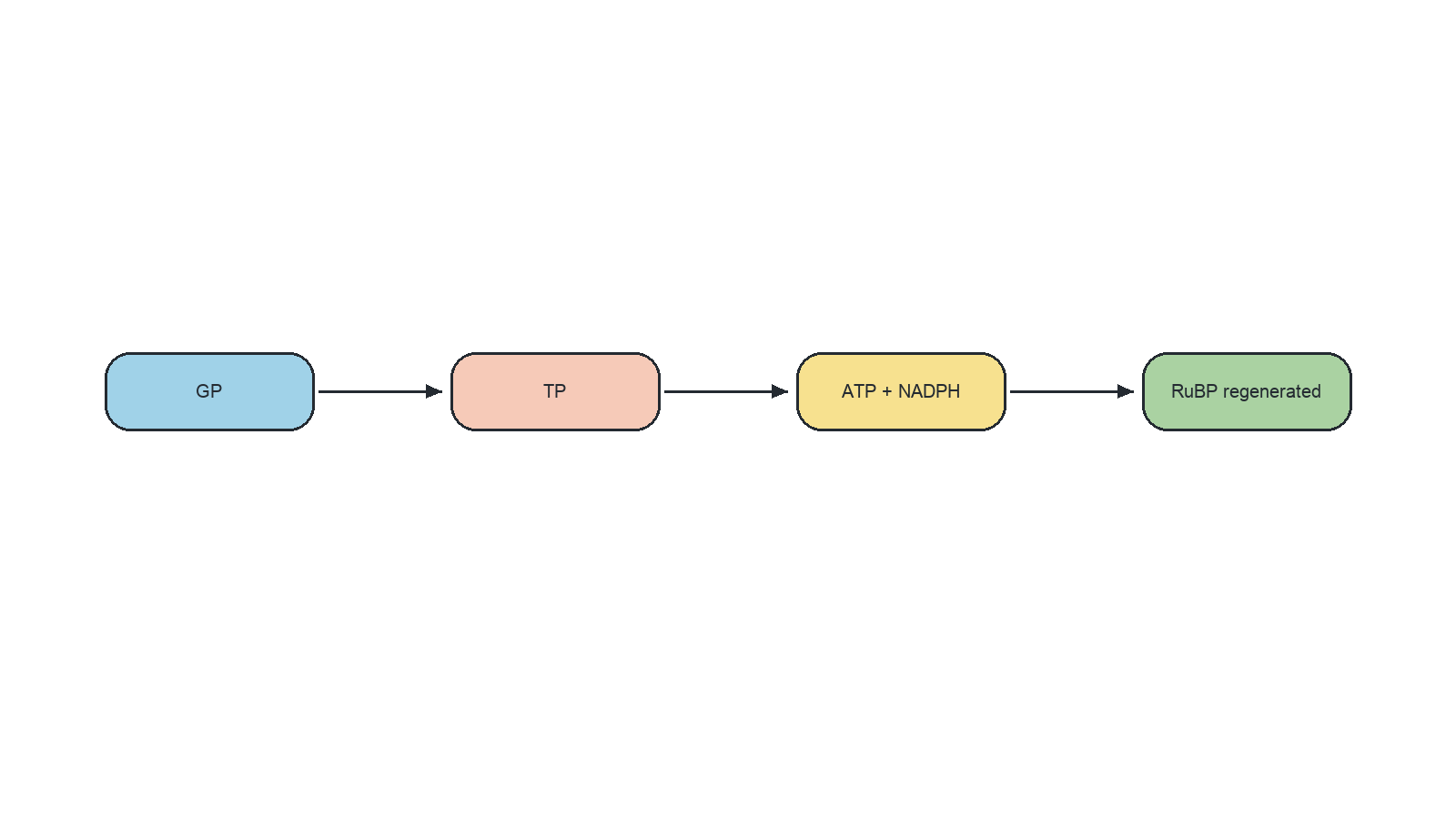
  • Trace carbon: CO2 -> RuBP/GP -> triose phosphate -> RuBP regeneration and biomolecule synthesis.
  • Trace exchange: light-dependent reactions supply ATP/reduced NADP; Calvin cycle returns ADP/NADP.

Concept essentials

  • Photolysis uses light energy to split water.
  • Electrons from water replace electrons lost by Photosystem II.
  • Photolysis produces protons that support the thylakoid proton gradient.
  • Oxygen is released as a by-product of water splitting.
ConceptIB Biology HL