EduNinja
(a)

Prostaglandins are small lipids produced in many tissues of the body. One role of prostaglandins is to cause inflammation at the site of an injury or infection. Inflammation is the normal first response of the immune system to injury or infection.

Cyclooxygenase (COX) is an enzyme that catalyses one of the steps in the reaction pathway for the formation of prostaglandins from phospholipids. The reaction pathway occurs in the smooth endoplasmic reticulum (SER) of cells. Part of the reaction pathway is shown in Fig. 1.3.
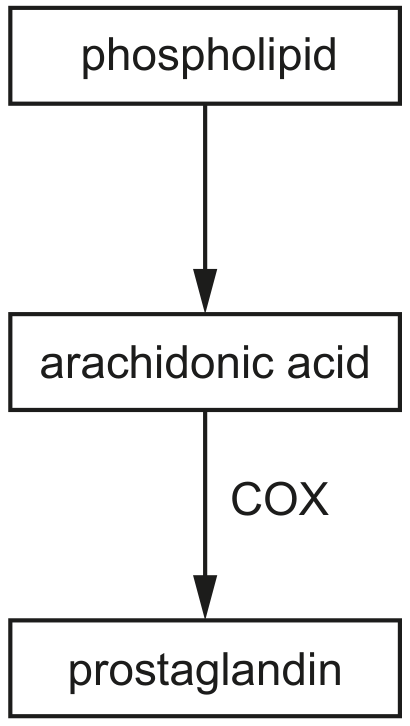
Fig. 1.3

Fig. 1.3

[ 2 ]
(i)

Prostaglandins are examples of cell-signalling molecules.

Outline the process of cell signalling that leads to a response by the cells involved in inflammation.

[ 2 ]

[Maximum number: 1]

A diagram of a chromosome from a dividing cell is shown in Fig. 1.1.

Fig. 1.1

Fig. 1.1

(a)

The control of the cell cycle can be affected by extracellular chemical messengers that bind to proteins and glycoproteins in the cell surface membrane. The overall mechanism is known as cell signalling.

State the term used to describe the proteins and glycoproteins that function in this way.

[ 1 ]
[Maximum number: 4]

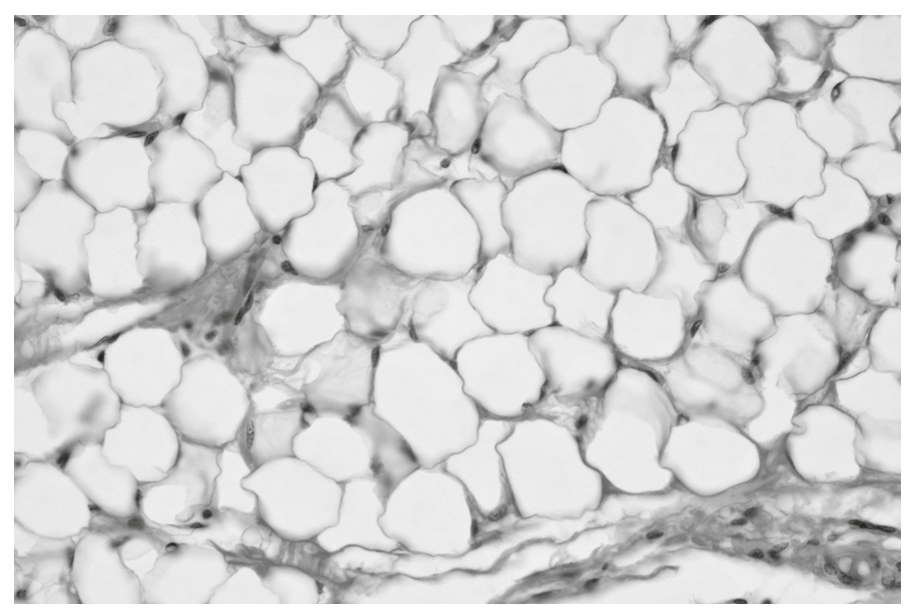
Adipose tissue, which is composed of cells known as adipocytes, stores large quantities of triglycerides and functions as an energy storage tissue.

Fig. 2.1 is a photomicrograph of adipose tissue.

Fig. 2.1

Fig. 2.1

(a)

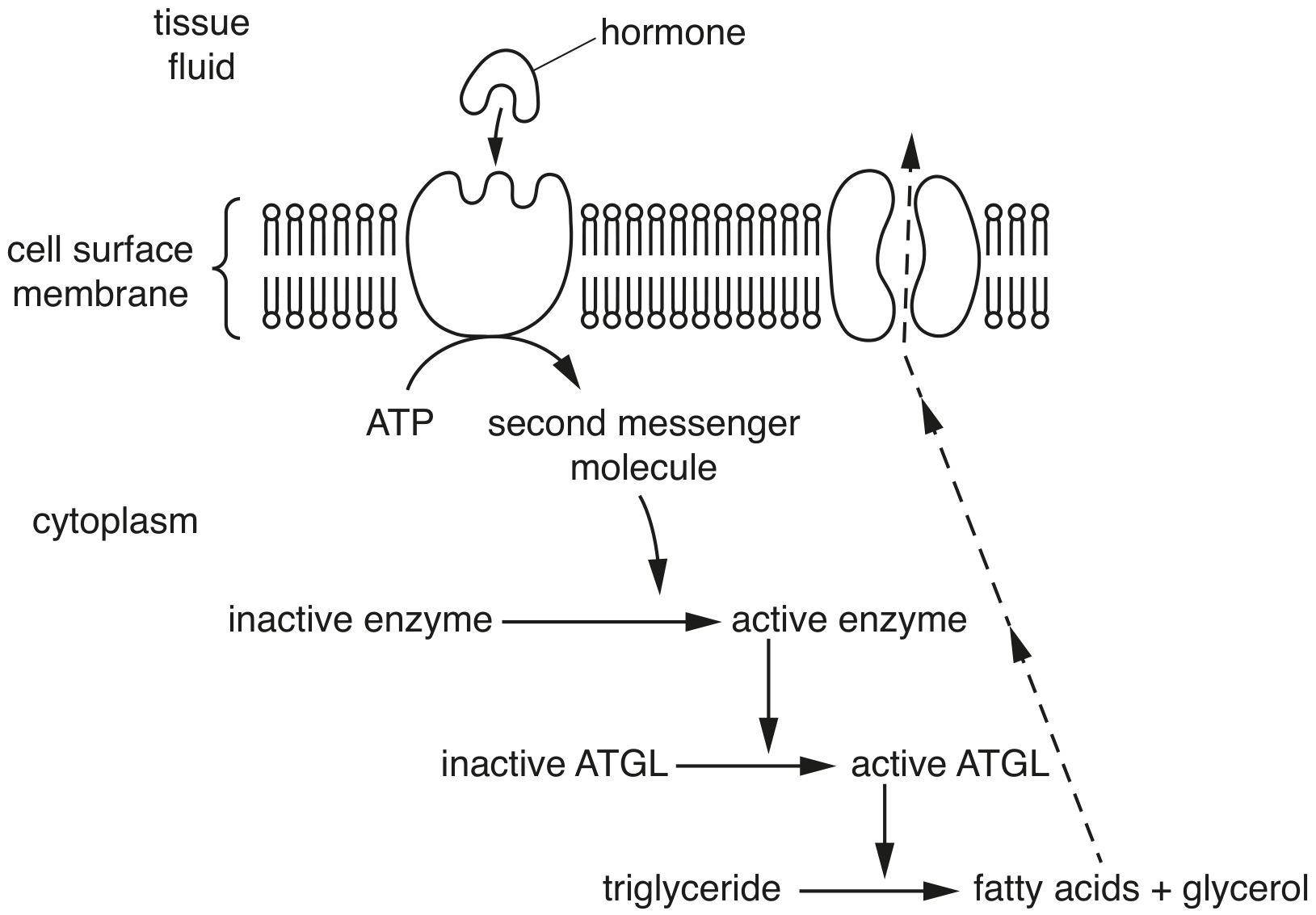
Adipocytes synthesise triglyceride lipase (ATGL), an enzyme that catalyses the formation or breakdown of triglycerides, as shown in Fig. 2.1.

Fig. 2.1

Fig. 2.1

The balance between triglyceride formation and breakdown is controlled by hormones. Fig. 2.2 is a summary of events occurring in an adipocyte when glycogen energy stores have been used up.

Fig. 2.2

Fig. 2.2

[ 4 ]
(i)

Fig. 2.2 is an example of cell signalling within the body.

With reference to Fig. 2.2, outline the process of cell signalling.

[ 4 ]
[Maximum number: 3]

Erythropoietin, also known as EPO, is a large glycoprotein synthesised by specialised cells in the kidney. These cells are very sensitive to changes in oxygen concentration in the blood passing through the kidney and respond to a low oxygen concentration by increasing the synthesis of EPO.

EPO acts at the surface of particular target cells, such as cells in the bone marrow. These bone marrow cells are stimulated to produce red blood cells.

(a)

All cells of the body are exposed to circulating blood plasma containing EPO, but only particular target cells respond.

[ 3 ]
(i)

Suggest and explain how EPO acts on target cells and why other cells are not affected.

[ 3 ]
[Maximum number: 3]

Follicle stimulating hormone (FSH) and luteinising hormone (LH) both consist of two polypeptide chains, the α\alpha and β\beta chains.
- The α\alpha chains of FSH and LH are identical.
- The β\beta chain of FSH has 111 amino acids and that of LH 121 amino acids.
- FSH and LH bind to different receptors in the cell surface membranes of their target cells.
- This binding leads to steroid synthesis by the target cells.

(a)

Describe what happens when FSH binds to its receptors on its target cells.

[ 3 ]
[Maximum number: 1]

Which statement about cell signalling is correct?

A

One type of receptor molecule will recognise all ligands in the body.

B

The binding of a ligand may cause a change to the shape of the receptor.

C

The receptors for ligands are always found on the inside of cells.

D

The same ligand is made by all of the cells in the body.

[Maximum number: 1]

What explains how a signal molecule produced by one cell can be detected by a target cell?

A

A signal molecule can bind to any type of cell surface receptor.

B

A signal molecule has a complementary shape to a cell surface receptor.

C

Signal molecules enter the cell by diffusion.

D

Signal molecules enter the cell by endocytosis.

[Maximum number: 1]

The diagram shows a simple cell signalling pathway in which a signal molecule leads to a response, such as a secretion.

Question image

Which row identifies P and Q ?

P

Q

activated enzyme in cytoplasm

target in cell surface membrane

lipid in cell surface membrane

extracellular enzyme

protein in cell surface membrane

activated enzyme in cytoplasm

target in cytoplasm

protein in cell surface membrane

[Maximum number: 1]

A student wrote three statements about cell signalling.
1 A signal chemical always has the same shape as a protein receptor on a target cell.
2 An increase in temperature may decrease the effect of cell to cell signalling.
3 A mutation may decrease production of active protein receptors for the cell surface membrane.

Which statements are correct?

A

1, 2 and 3

B

1 and 3 only

C

1 only

D

2 and 3 only

0