EduNinja
[Maximum number: 2]

Lipase is an enzyme with many commercial uses. Some species of bacteria are of great interest as they produce large quantities of lipase.

(a)

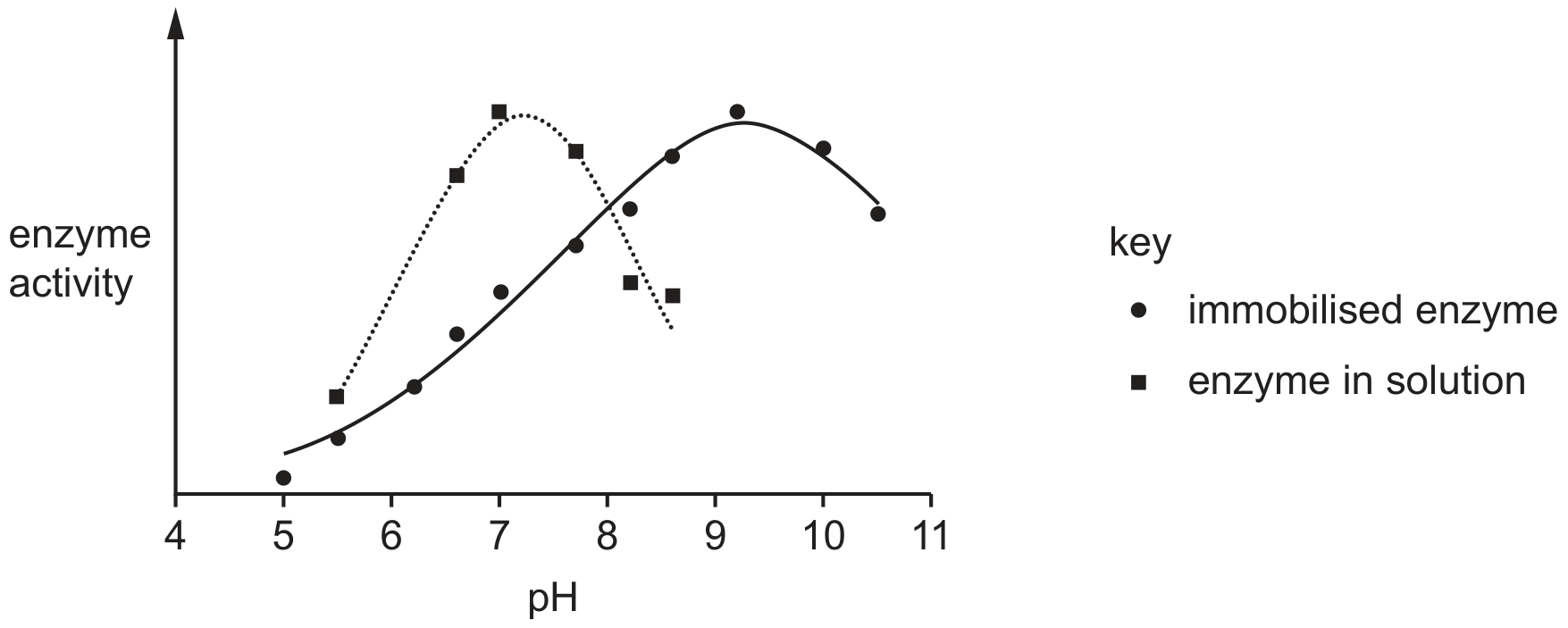
A separate investigation into the effect of pH on the same bacterial lipase compared the enzyme free in solution with the enzyme immobilised by physical attachment to a stable polymer.

At a temperature of 37C37^{\circ} \mathrm{C}, the optimum pH of the enzyme free in solution was the same as that shown in Fig. 2.2. The optimum pH of the immobilised enzyme was measured as pH 4 .

[ 2 ]
(i)

Suggest one reason to explain why the enzyme free in solution has a different optimum pH compared to the immobilised enzyme.

[ 1 ]
(ii)

Suggest one advantage of immobilising the extracted lipase for commercial use.

[ 1 ]
(a)

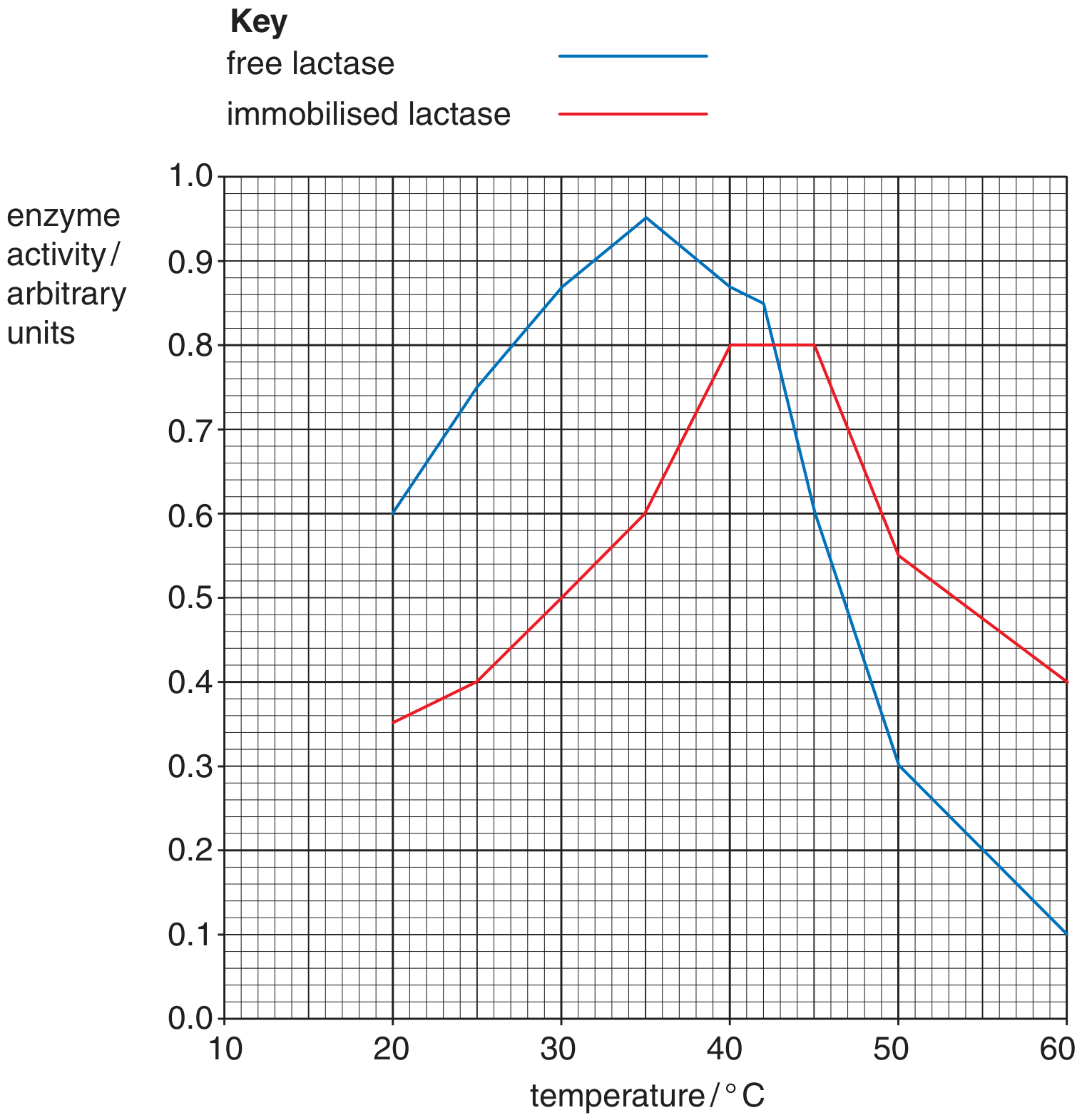
The enzyme lactase can be produced by biotechnology and then used to produce lactose-free dairy products. Lactase is frequently used immobilised in alginate beads.

Fig. 2.1 shows a comparison between the activity of lactase free in solution and lactase immobilised in alginate beads, over a range of temperatures. Equal concentrations of free lactase and immobilised lactase were used.

Fig. 2.1

Fig. 2.1

With reference to Fig. 2.1:

[ 5 ]
(i)

describe the effect of immobilisation on the activity of lactase

[ 3 ]
(ii)

suggest explanations for the differences between the activity of immobilised lactase and free lactase up to 40C40^{\circ} \mathrm{C}.

[ 2 ]
(b)

State the advantages of using immobilised enzymes instead of free enzymes.

[ 3 ]
(a)

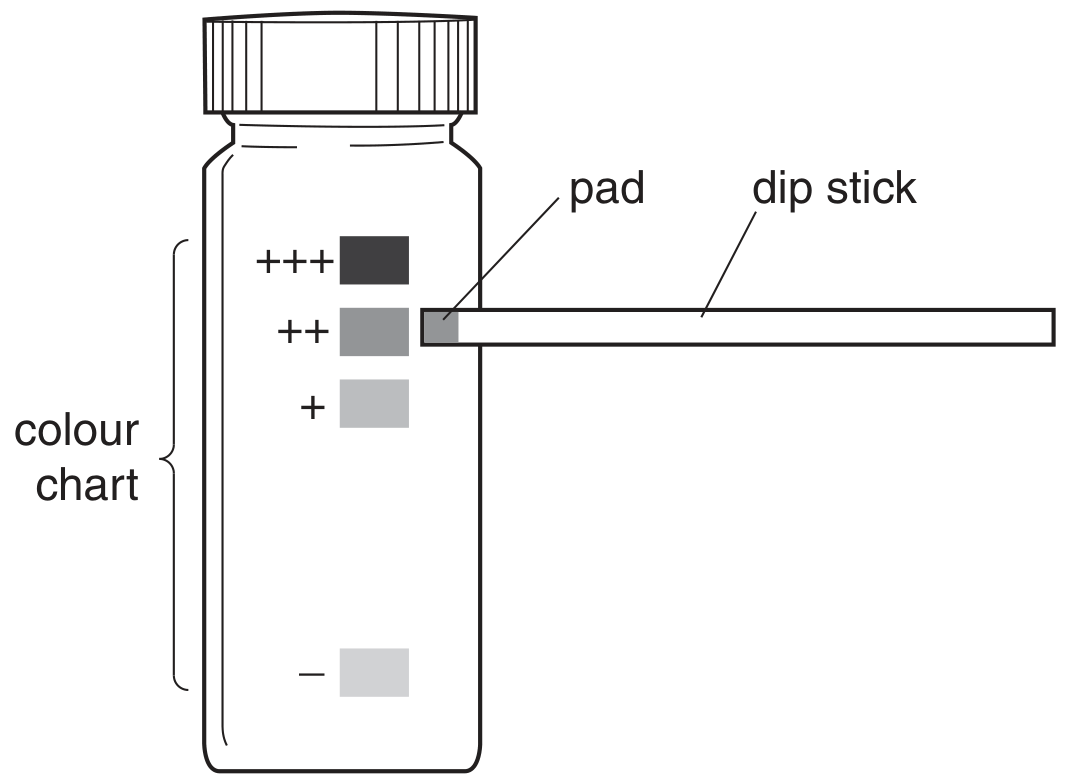
The first diagnostic test strip using immobilised enzymes was a dip stick to estimate the concentration of glucose in urine.

The dip stick is a thin strip of plastic with a cellulose pad containing two enzymes and a colour reagent (chromogen) at one end. The pad responds with a colour change after being dipped into a sample of urine that contains glucose. The colour can be matched against a graded colour chart to give a 'semi-quantitative' estimate of the concentration of glucose in the sample, as shown in Fig. 2.1. The chart shows the colours of a negative reaction (-) and three increasingly positive reactions (+, ++ and +++).

Fig. 2.1

Fig. 2.1

Explain why the estimate of glucose concentration achieved by this method is only 'semi-quantitative'.

[ 2 ]
(b)

One of the two enzymes immobilised in the cellulose pad on the test strip is glucose oxidase, which catalyses the following reaction:

 glucose + oxygen  glucose oxidase  gluconic acid + hydrogen peroxide \text { glucose }+ \text { oxygen } \xrightarrow{\text { glucose oxidase }} \text { gluconic acid }+ \text { hydrogen peroxide }

This reaction does not result in the development of colour by the chromogen. This is achieved by the activity of the second immobilised enzyme in the pad.

[ 1 ]
(i)

Name the second immobilised enzyme in the pad.

[ 1 ]
[Maximum number: 2]

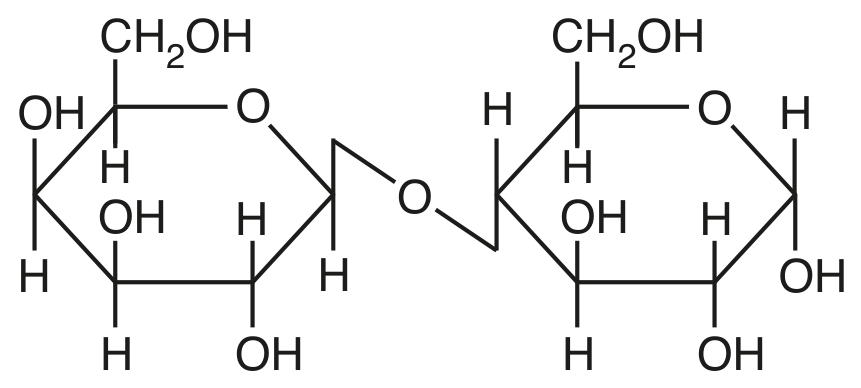
Fig. 2.1 shows the disaccharide lactose, which is found in milk.

Fig. 2.1

Fig. 2.1

(a)

Enzymes, such as lactase, are often immobilised for use in the food industry.

A scientist carried out an investigation to determine the effects of temperature on the activity of lactase when it was immobilised and when it was free in solution.

The scientist produced alginate beads containing lactase for use in this investigation. The beads varied in size. The scientist selected small beads for the investigation and put them into a glass column.

[ 2 ]
(i)

Suggest the advantage of using small beads rather than large beads.

[ 2 ]
(a)

Outline how an enzyme can be immobilised in alginate.

[ 2 ]
(b)

State two advantages, other than stability, of using an immobilised enzyme in an industrial process compared with the same enzyme that has not been immobilised.
1.
2.

[ 2 ]
[Maximum number: 1]

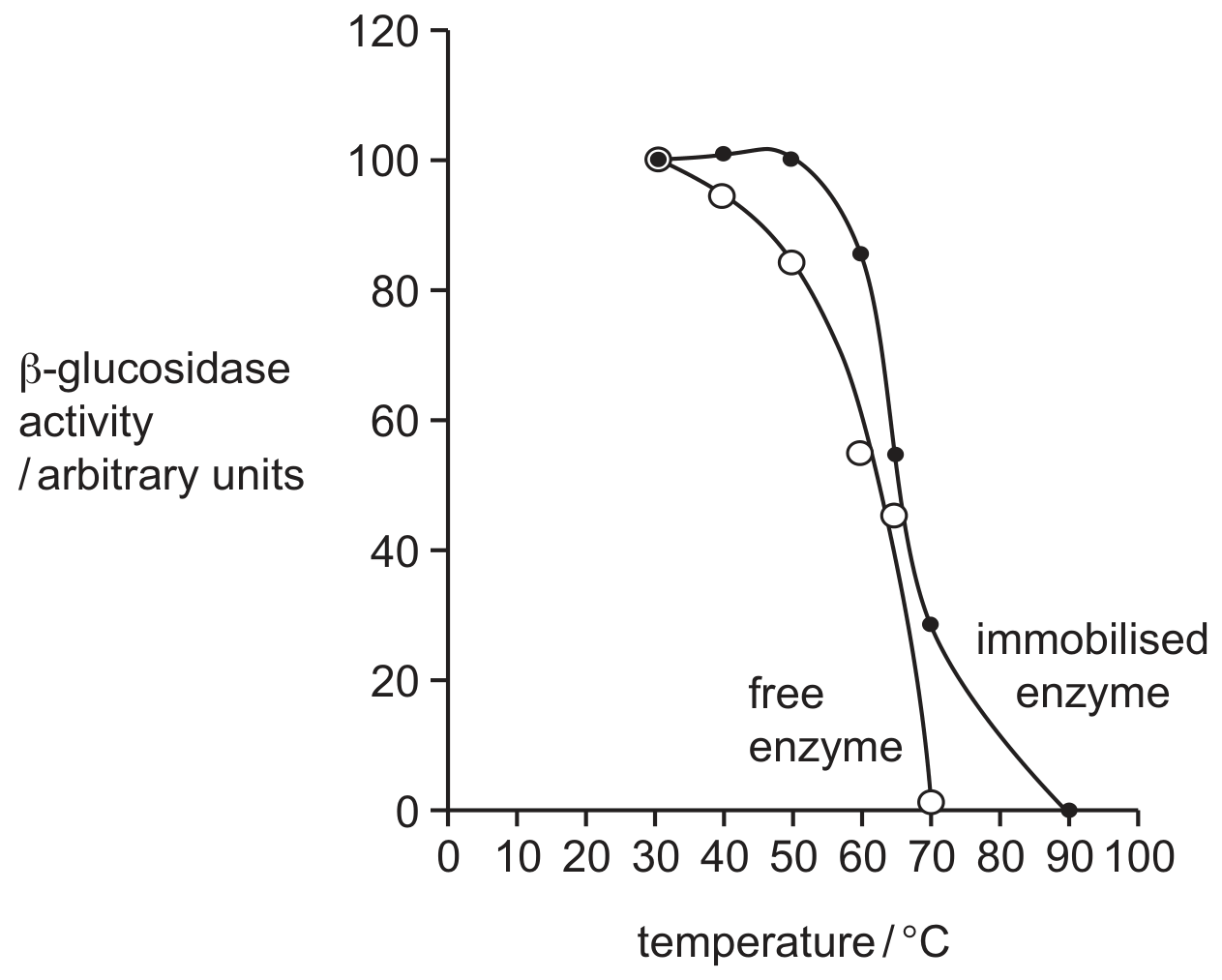
An experiment was conducted to investigate the effect of temperature on the activity of the enzyme β\beta-glucosidase. The enzyme was tested when in solution (free) and when immobilised in alginate beads.

The results are shown in the graph below.

Question image

Which statement about the effect of immobilisation of β\beta-glucosidase is correct?

A

It increases the kinetic energy of the enzyme.

B

It inhibits the activity of the enzyme.

C

It reduces the optimum temperature of the enzyme.

D

It stabilises the enzyme against denaturation.

[Maximum number: 2]

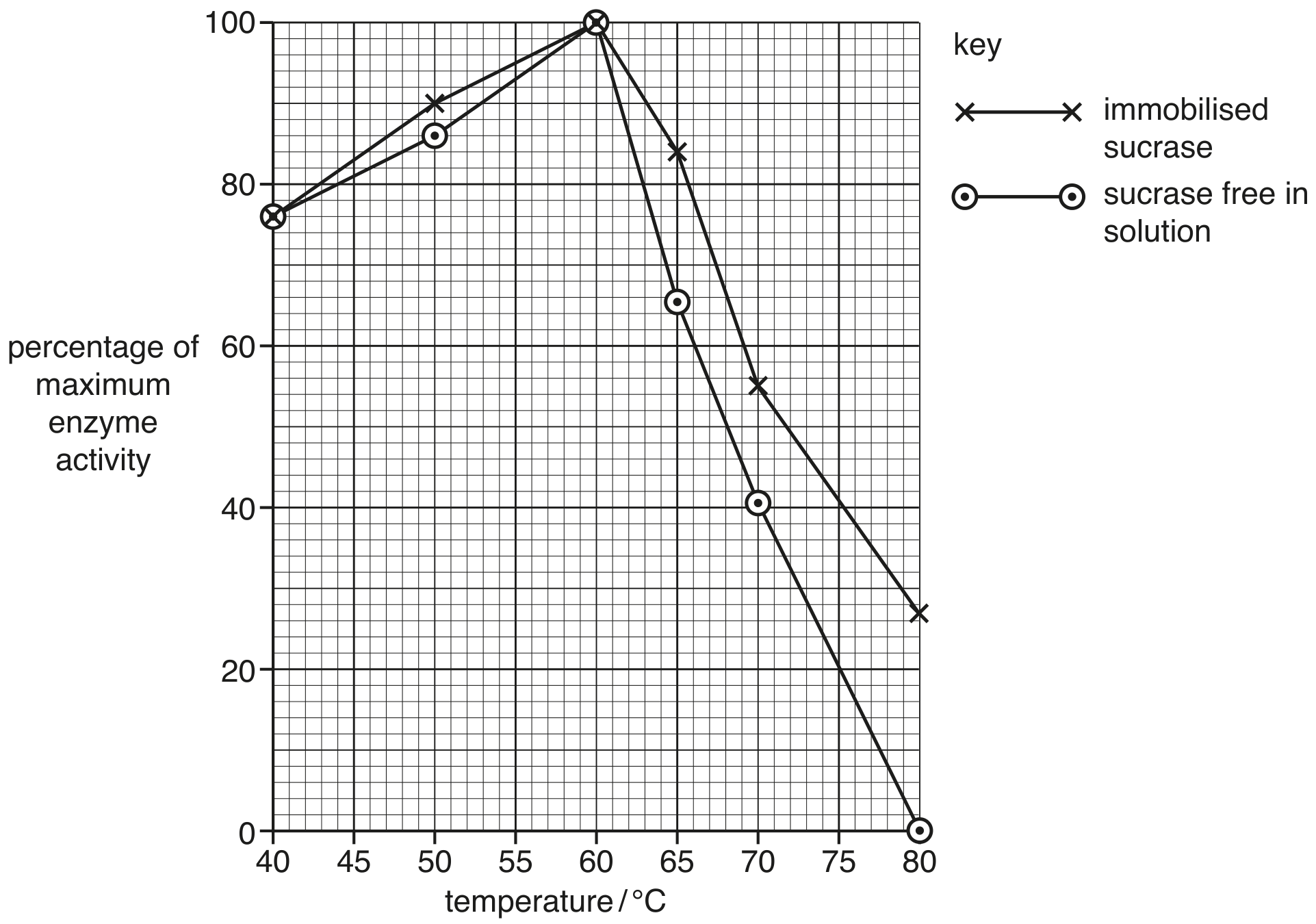
Researchers isolated a sucrase enzyme from the bacterium Bacillus subtilis. They immobilised the enzyme in alginate beads.

The researchers investigated the effects of temperature on the activity of the immobilised sucrase compared with the activity of the same enzyme free in solution.

The results are shown in Fig. 3.1.

Fig. 3.1

Fig. 3.1

(a)

There are many advantages of using immobilised enzymes in industry.

Suggest two advantages of using immobilised enzymes in industry other than remaining active over a greater range of pH .

Fig. 4.1

Fig. 4.1

[ 2 ]
[Maximum number: 1]

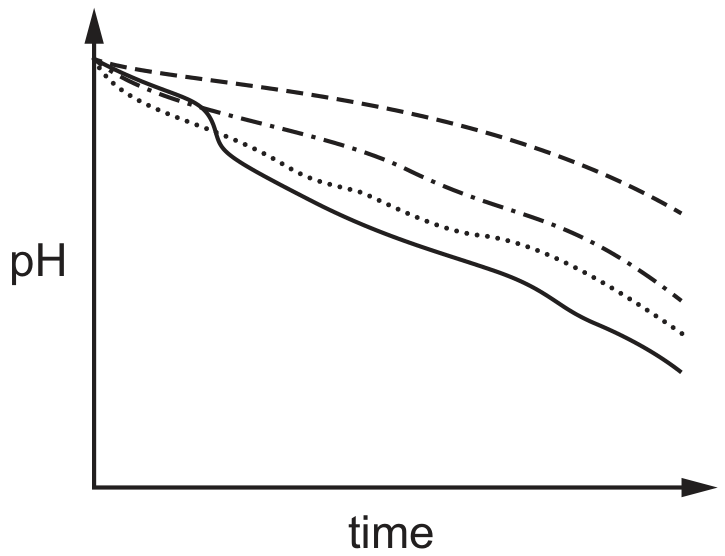
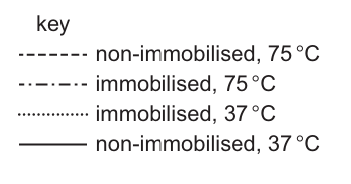
An investigation was carried out on the effect of temperature on the activity of an enzyme when it is immobilised and when it is non-immobilised (free in solution). The product of the enzyme

catalysed reaction causes a decrease in pH .

The graph shows the results of the investigation.

Question image
Question image

Which would give the highest yield of product?

A

immobilised, 37C37^{\circ} \mathrm{C}

B

immobilised, 75C75^{\circ} \mathrm{C}

C

non-immobilised, 37C37^{\circ} \mathrm{C}

D

non-immobilised, 75C75^{\circ} \mathrm{C}

[Maximum number: 1]

An experiment was carried out to compare the effect of pH on the activity of an enzyme that was in solution and the same enzyme that had been immobilised on a gel. All other variables were kept the same.

The results are shown in the graph.

Question image

Which statement explains these results when the enzyme is immobilised?

A

The primary structure has changed.

B

The secondary structure has changed.

C

The tertiary structure has changed.

D

The quaternary structure has changed.

[Maximum number: 1]

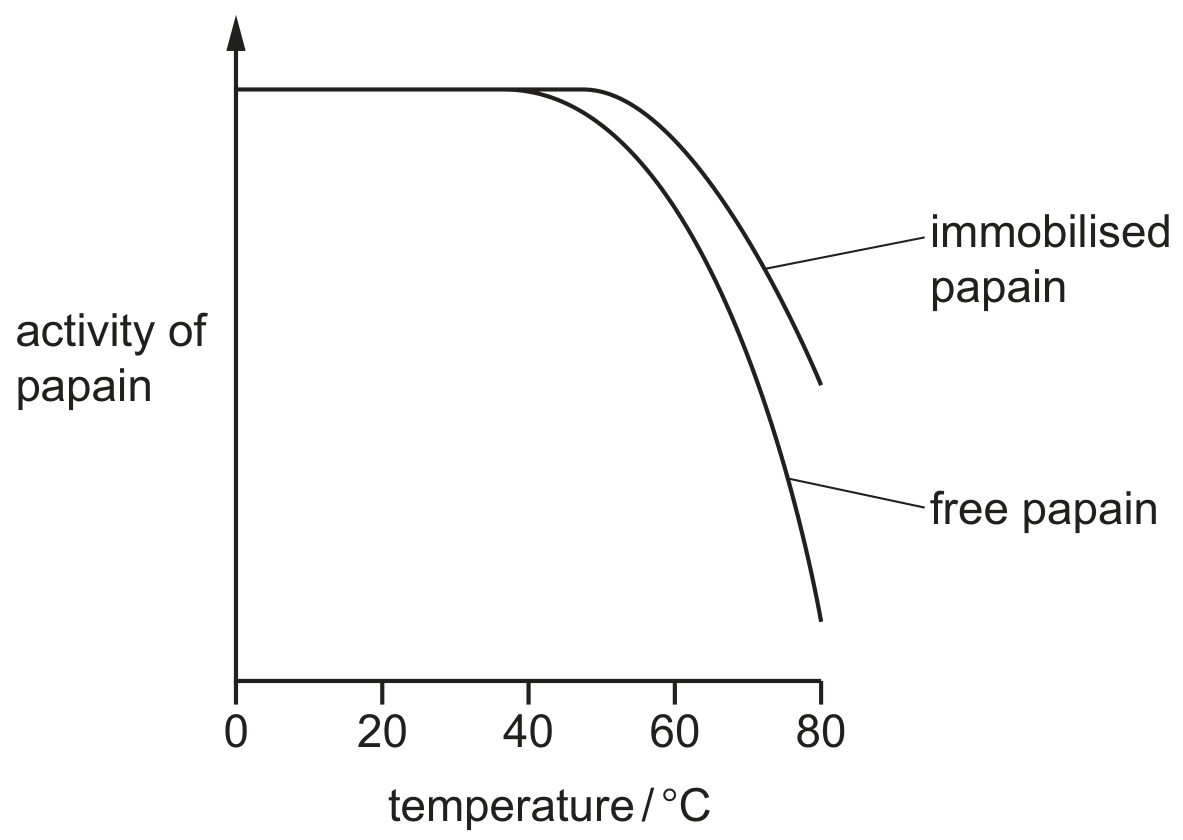
The graph compares the effect of temperature on the activity of the protease enzyme, papain, when in solution (free) and when immobilised in alginate beads.

Question image

Which statement about the effect of immobilisation of papain is correct?

A

It alters the shape of papain's active site at higher temperatures.

B

It decreases the activity of papain at higher temperatures.

C

It increases the stability of papain at higher temperatures.

D

It reduces the number of collisions of papain with the substrate.

0