EduNinja
[Maximum number: 1]

A student was provided with two test-tubes, one containing 10 cm310 \mathrm{~cm}^{3} of solution P and one containing 10 cm310 \mathrm{~cm}^{3} of solution Q . When these solutions were mixed together and left for 24 hours, the concentration of P decreased but the concentration of Q remained the same.

The student wrote the following conclusions.
1 P may break down over time.
2 Q may be a biological catalyst.
3 P may be the substrate for Q.
Which conclusions could be supported by the information?

A

1, 2 and 3

B

1 and 2 only

C

1 only

D

2 and 3 only
[Maximum number: 1]

Following a heart attack, the enzyme lactate dehydrogenase leaks into the blood plasma from damaged heart muscle.

Which steps are required to obtain an estimate of lactate dehydrogenase activity in a sample of blood plasma?

sterilise blood plasma by heating

incubate with substrate for lactate dehydrogenase

incubate with lactate dehydrogenase inhibitor

key

✓ = step required

X = step not required

×

x

×

×

×

[Maximum number: 1]

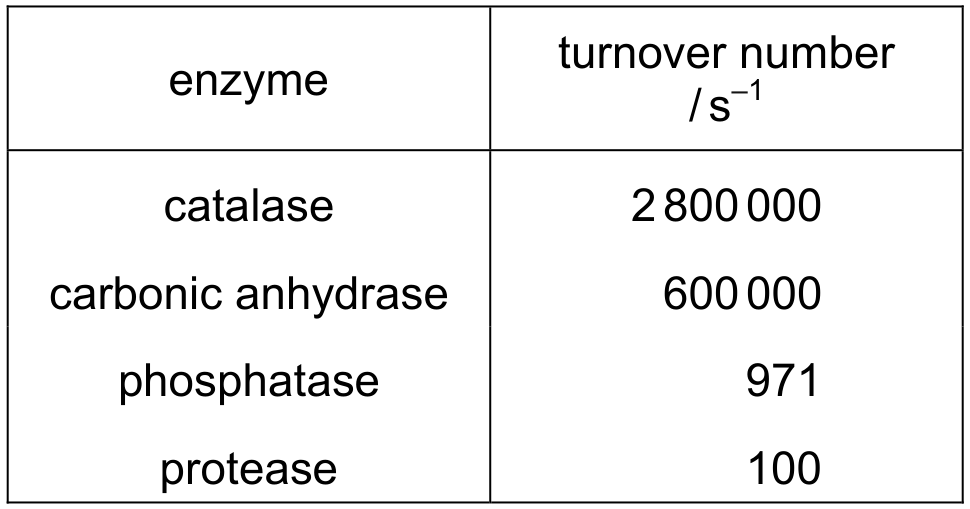
The number of substrate molecules one enzyme molecule can convert to product in a second is called the turnover number. This number is obtained when all conditions are optimum for the specific enzyme-catalysed reaction.

Table

How many times faster at converting substrate to product is catalase compared to phosphatase?

A

29

B

288

C

2884

D

28836

[Maximum number: 1]

Catechol is a chemical found in a number of fruits. Catechol can be oxidised to a quinone by the enzyme catechol oxidase.

Catechol oxidase is inhibited by parahyroxybenzoic acid (PHBA) which is structurally similar to catechol.

Catechol oxidase is also inhibited by phenylthiourea (PTU) which binds to a copper atom in the enzyme.

How do both these inhibitors reduce the enzyme activity?
1 altering the specificity of the enzyme
2 competing with substrates for the active site
3 decreasing the Vmax \mathrm{V}_{\text {max }} of the reaction

A

1, 2 and 3

B

1 only

C

2 only

D

3 only

[Maximum number: 1]

A student investigated the effect of enzyme concentration on the rate of hydrolysis of protein in milk.

When the enzyme and milk were mixed, the protein was hydrolysed and the mixture changed from cloudy to clear.

The student investigated five different enzyme concentrations and recorded the time taken for the mixture to become clear.

What is an appropriate control for this investigation?

A

Carrying out an experiment where the enzyme solution is replaced with water.

B

Carrying out each experiment in a thermostatically controlled water-bath at 35C35^{\circ} \mathrm{C}.

C

Repeating each experiment three times for each of the five enzyme concentrations.

D

Using the same volume of enzyme solution for each of the five experiments.

[Maximum number: 1]

Following a heart attack, the enzyme lactate dehydrogenase leaks into the blood plasma from damaged heart muscle.

Which steps are required to obtain the best estimate of lactate dehydrogenase activity in a sample of blood plasma?

sterilise blood plasma by heating

incubate with substrate for lactate dehydrogenase

incubate with lactate dehydrogenase inhibitor

key

✓ = step required

χ=\boldsymbol{\chi}= step not required

×

x

×

χ\boldsymbol{\chi}

×

[Maximum number: 1]

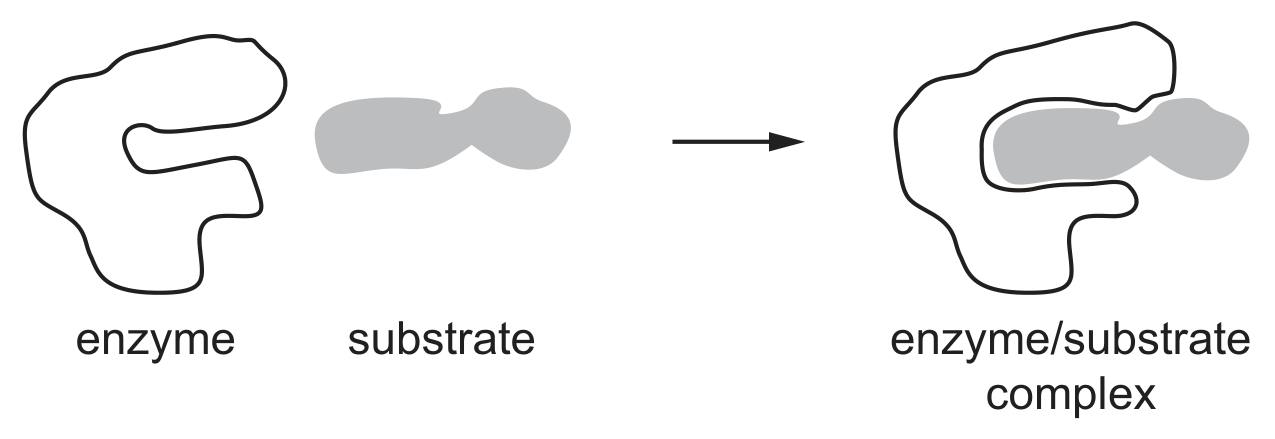
The diagram shows an enzyme, its substrate and an enzyme/substrate complex.

Question image

Which statement explains how the substrate is able to enter the active site of the enzyme?

A

Contact between the substrate and the enzyme causes a change in the enzyme shape.

B

The shape of the active site and the shape of the substrate are complementary.

C

The substrate within the active site forms hydrogen bonds with amino acids.

D

When the enzyme/substrate complex forms, the tertiary structure of the enzyme changes.

[Maximum number: 1]

How does increasing substrate concentration affect the rate of an enzyme-catalysed reaction in the presence of a competitive inhibitor?

A

The rate of the reaction decreases.

B

The rate of the reaction decreases initially and then recovers.

C

The rate of the reaction increases.

D

The rate of the reaction is not affected.

[Maximum number: 1]

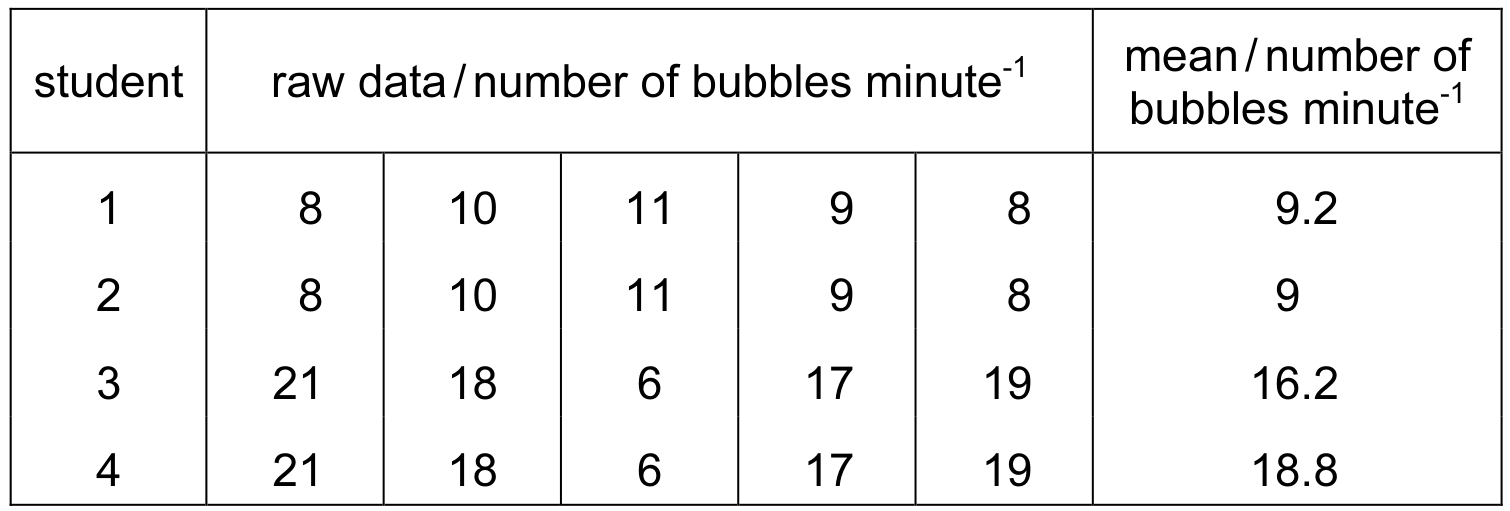
Two pairs of students each counted the number of bubbles of oxygen given off in a minute when investigating the effect of catalase from plant tissue on hydrogen peroxide.

Each pair repeated the experiment five times and calculated the mean number of bubbles per minute.

Which have correctly calculated the mean?

Table
A

1, 3 and 4 only

B

1 and 4 only

C

2 only

D

3 only

[Maximum number: 1]

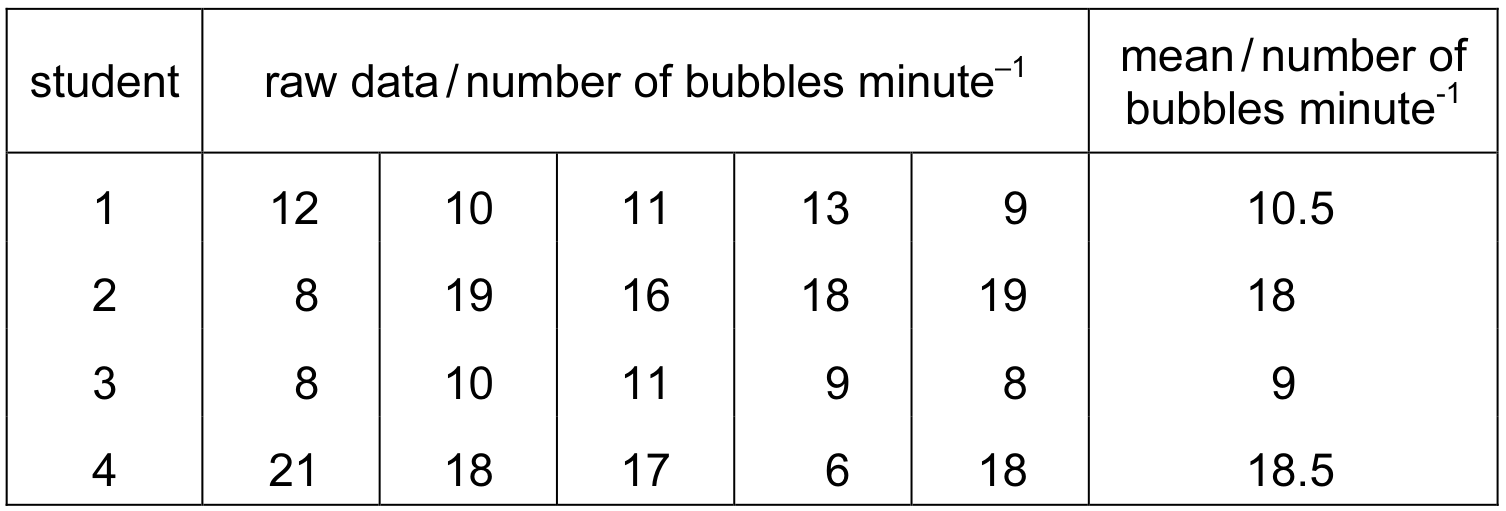
Four students, 1,2,3 and 4 , counted the number of bubbles of oxygen given off in a minute when investigating the effect of catalase from plant tissue on hydrogen peroxide.

Each student repeated the experiment five times and calculated the mean number of bubbles per minute.

Which have correctly calculated the mean?

Table
A

1 and 4 only

B

2 and 3 only

C

1, 2, 3 and 4

D

3 only

0