
EduNinja
[Maximum number: 4]

Therapeutic proteins are used to treat disease. The first purified therapeutic protein used was insulin, in 1922. The insulin was extracted from animal pancreases. Since 1982 most insulin has been made by recombinant DNA technology.

(a)

Fig. 3.1 shows the amino acid sequences of human calcitonin and calcitonin from the salmon fish, Salmo salar.


Table
Fig. 3.1

Fig. 3.1

[ 4 ]
(i)

The two amino acid sequences shown in Fig. 3.1 can be compared. The number of amino acids that occur at the same position in both sequences can be counted and expressed as a percentage of the total number of amino acids present in one sequence. This is called the percentage sequence similarity.

Use Fig. 3.1 to calculate the percentage sequence similarity of human and salmon calcitonin.

Show your working.

[ 2 ]
(ii)

Compared to human calcitonin, salmon calcitonin is more biologically active. It remains active in the human body for longer and binds to calcitonin receptors more readily.

Bioinformatics was used to identify this more biologically active form of calcitonin to treat osteoporosis.

Explain how bioinformatics helped identify salmon calcitonin as a suitable form of calcitonin to treat human osteoporosis.
[ 2 ]
[Maximum number: 5]

Malaria is a serious and often fatal infectious disease caused by Plasmodium. Drugs such as chloroquine are widely used to decrease the risk of getting malaria and also to treat people who have become infected. However, in many parts of the world, Plasmodium populations have become resistant to chloroquine.

Sequencing the genome of Plasmodium and the application of bioinformatics has provided several new targets for the development of anti-malarial drugs.

(a)

In parts of the world where Plasmodium is resistant to chloroquine, one of the most effective anti-malarial drugs currently in use is artemisinin. Artemisinin works by binding to an enzyme in Plasmodium called PfATP6, acting as an inhibitor.

A substance called curcumin, which has long been used as a spice and yellow food colouring in India and other countries, is also known to act against chloroquine-resistant Plasmodium. A group of researchers predicted that curcumin acts by binding to the same enzyme as artemisinin.

In order to test this hypothesis, and to try to find similar substances that might work even better than curcumin, the researchers used theoretical modelling to:
- look at the chemical structures of various molecules with a similar structure to curcumin (curcumin analogues)
- generate a three-dimensional model of the structure of the enzyme PfATP6
- investigate whether each curcumin analogue could bind to PfATP6.

The researchers predicted that several of the curcumin analogues would bind more strongly than curcumin to PfATP6.

[ 5 ]
(i)

Suggest advantages of using theoretical models in this research, rather than testing possible drugs in the laboratory.

[ 3 ]
(ii)

Suggest why theoretical modelling cannot completely replace laboratory trials in the search for new drugs.

[ 2 ]
[Maximum number: 3]

In 2014, scientists published a phylogenetic (evolutionary) tree diagram showing how and when different groups of insects developed from ancestral groups.

To construct the diagram, the scientists compared nucleotide and amino acid sequence data for 1478 genes from each of 103 different insect species. The 103 species represented all 32 orders of the class Insecta.

The data were used to arrange the species in related groups according to their degree of molecular similarity and to track how sequences changed over time.

(a)

For this study, new software for processing large quantities of data was developed.

[ 3 ]
(i)

Explain why this study needs to make use of bioinformatic techniques.

[ 3 ]
[Maximum number: 2]

Therapeutic proteins are used to treat disease. One example of a therapeutic protein is human growth hormone (hGH).
hGH has important roles in growth during childhood and in regulation of metabolism in adulthood.
Children described as hGH-deficient do not produce enough hGH and grow more slowly than other children. People who were hGH-deficient when they were children have a mean adult height that is 32 cm shorter than the population mean.

Daily injections of hGH are a treatment for hGH-deficient children that can increase growth rate, resulting in an increased adult height.

(a)

hGH is one of many proteins in the body whose secretion or production is controlled by a person's sleep-wake pattern.

The sleep-wake pattern describes when, during a 24 hour day, a person is asleep and when they are awake. For example:
- pattern 1 - asleep during the night and awake during the day (normal)
- pattern 2 - asleep during the day and awake during the night.

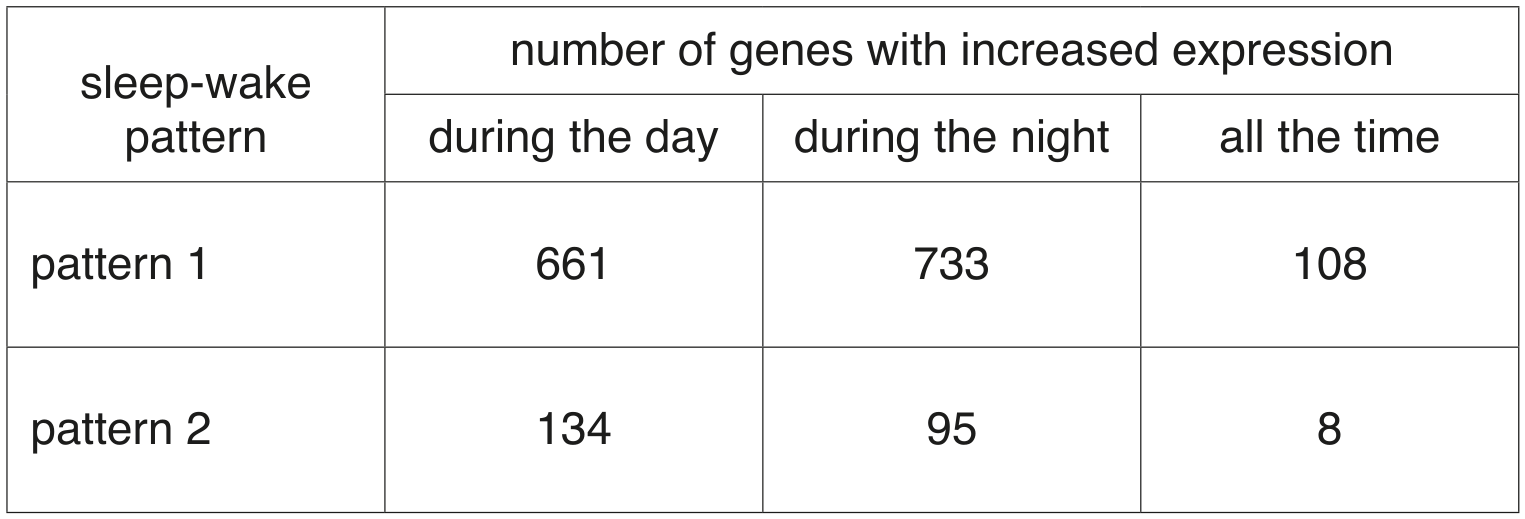
Researchers used microarray analysis to identify which genes have their expression changed by a person's sleep-wake pattern. They collected mRNA from:
- a group of people with sleep-wake pattern 1
- the same group of people whose sleep-wake pattern was changed to pattern 2.

A summary of the results is shown in Table 3.1.

Table 3.1

Table 3.1

[ 2 ]
(i)

Explain how bioinformatics can help to identify whether the genes whose expression is changed by moving from pattern 1 to pattern 2 are important to health.

[ 2 ]
[Maximum number: 3]

Genetic technology uses many different enzymes and techniques.

(a)

Describe the advantages of databases for the study and use of restriction endonucleases.

[ 3 ]
(a)

Genome-wide association studies find links between single nucleotide polymorphisms (SNPs) and phenotypic features such as human diseases. SNPs are points on the DNA that vary in the population because of DNA base substitutions.

A genome-wide association study investigates the effect of genetic variation on a disease. A large number of people with the disease and a large number of healthy control individuals provide DNA. Microarray chips are used to identify the genotype of each individual at many SNPs.

The Wellcome Trust Case Control Consortium (WTCCC) study was an important genome

wide association study.
- The study used a microarray chip that identified each person's genotype at 500000 different SNPs.
- The study looked for links between SNPs and 7 different diseases.
- For each disease, 2000 people with the disease were tested.
- Their results were compared with the results of 3000 healthy control individuals.

[ 2 ]
(i)

Explain why bioinformatics was important to the WTCCC study.

[ 2 ]
(a)

Information about amino acid and nucleotide sequences is stored in computer databases.

Outline the advantages of using databases of nucleotide sequences to investigate evolutionary relationships between species.

[ 3 ]
[Maximum number: 2]

Tyrosinase is an enzyme found in mammals. It is involved in the synthesis of melanin pigment. Mutations in the tyrosinase gene affect a mammal's hair colour.

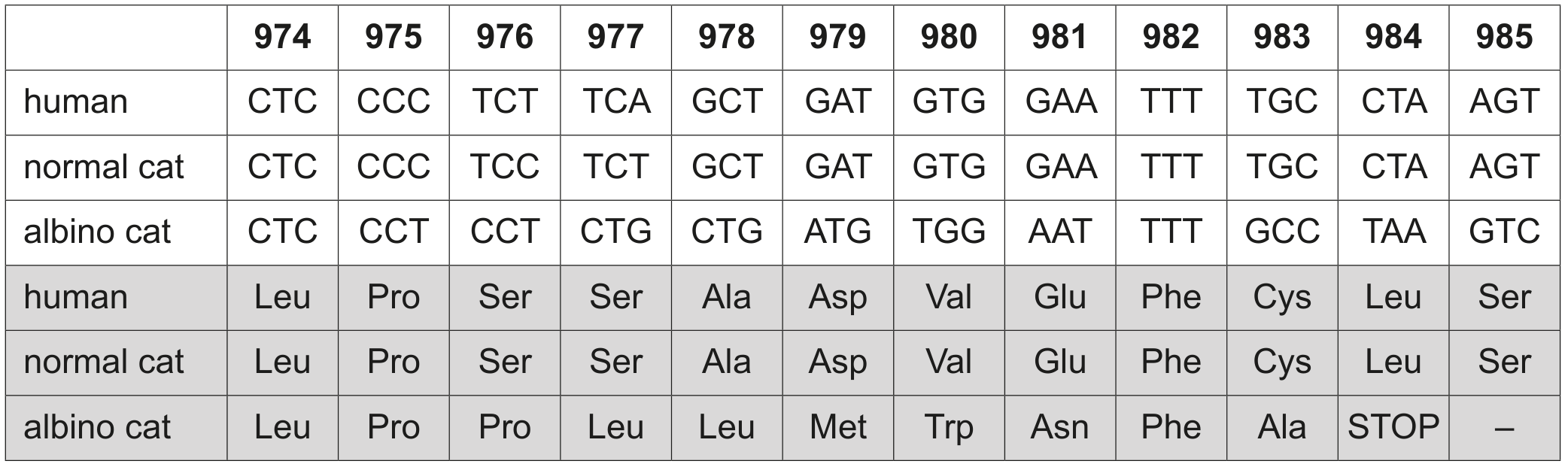
Table 5.1 compares DNA sequences for codons 974-985 of:
- the normal tyrosinase gene of humans (human)
- the normal tyrosinase gene of cats that have pigmented hair (normal cat)
- the tyrosinase gene of cats that show an albino phenotype (albino cat).

The corresponding amino acid sequences of each tyrosinase are shown in the shaded rows.

Table 5.1

Table 5.1

(a)
(i)

Bioinformatics was used to compare the whole sequence of the tyrosinase genes of humans and cats.

Explain why bioinformatics was used to compare these gene sequences and suggest a conclusion that could be made from the percentage similarity data obtained.

[ 2 ]
(a)

Explain what is meant by bioinformatics and outline the role of bioinformatics following the sequencing of genomes of humans and parasites.

[ 6 ]
0