(a)
The diagram outlines how a gene coding for human insulin is produced by genetic engineering techniques.
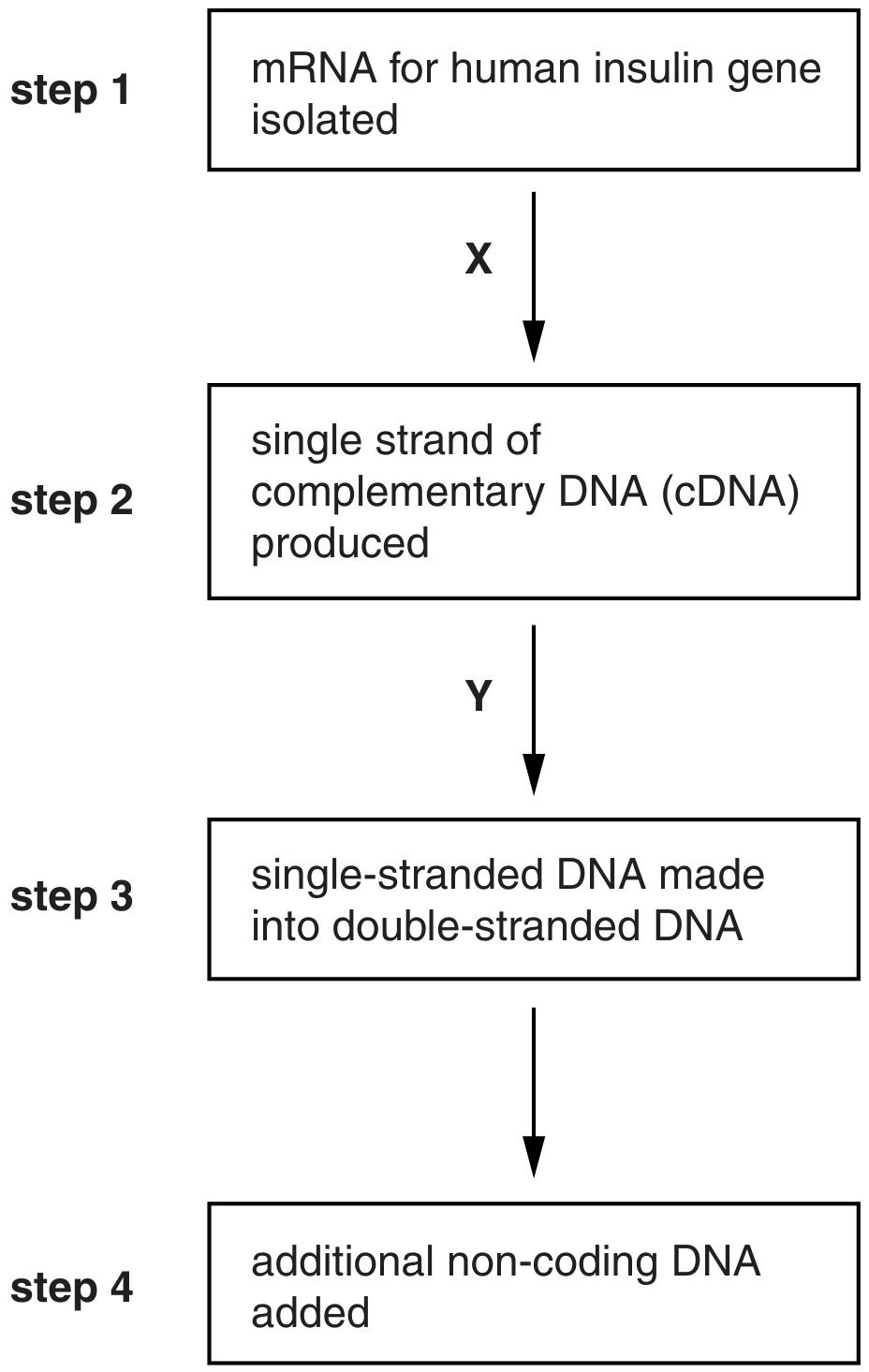
Fig. 3.1
[ 2 ]
(i)
Explain why the starting point in this procedure is mRNA.
[ 2 ]
 EduNinja
The diagram outlines how a gene coding for human insulin is produced by genetic engineering techniques.
Fig. 3.1
Explain why the starting point in this procedure is mRNA.
White-clawed crayfish, Austropotamobius pallipes, live in rivers and lakes in Europe.
In the 1850s, the North American signal crayfish, Pacifastacus leniusculus, was introduced to Europe. The introduced species carried a pathogen that causes a disease known as crayfish plague. This disease kills A. pallipes.
Since 1850, the population size of A. pallipes has reduced in many areas of Europe due to the spread of crayfish plague.
It is difficult to locate crayfish because they live underwater.
After an outbreak of crayfish plague in one country in Europe, researchers used an environmental DNA technique to find the locations in a river where populations of A. pallipes were still surviving.
Water samples were taken from locations along the river. Each water sample was filtered to obtain any cells or DNA that had been released by organisms into the water. The polymerase chain reaction (PCR) was carried out on this DNA using primers specific to A. pallipes DNA.
Suggest how the researchers were able to discover suitable sequences for the primers.
Golden Rice is a genetically modified form of rice that produces relatively large amounts of carotene in the endosperm. carotene is metabolised in the human body to produce vitamin A.
The original choice of a psy gene from daffodils was made because daffodils produce large amounts of carotene in their yellow petals, and because they are monocotyledonous plants, like rice.
Suggest explanations for the much lower production of carotene in rice containing the psy gene from daffodils than in rice containing the psy gene from maize.
Factor VIII can be made as a recombinant human protein.
The gene that codes for human factor VIII can be synthesised from messenger RNA purified from human liver cells.
Outline two sources, other than messenger RNA, from which genes can be obtained for genetic engineering.
Selective breeding has been used to improve the characteristics of crop plants, including maize and rice.
IR8 is a variety of rice plant that was developed in the 1960s.
IR8 was developed by breeding together two different varieties of rice:
- PETA, which produces a high yield
- DGWG, which is a dwarf variety.
Fig. 6.1 is a diagram showing the three varieties of rice.
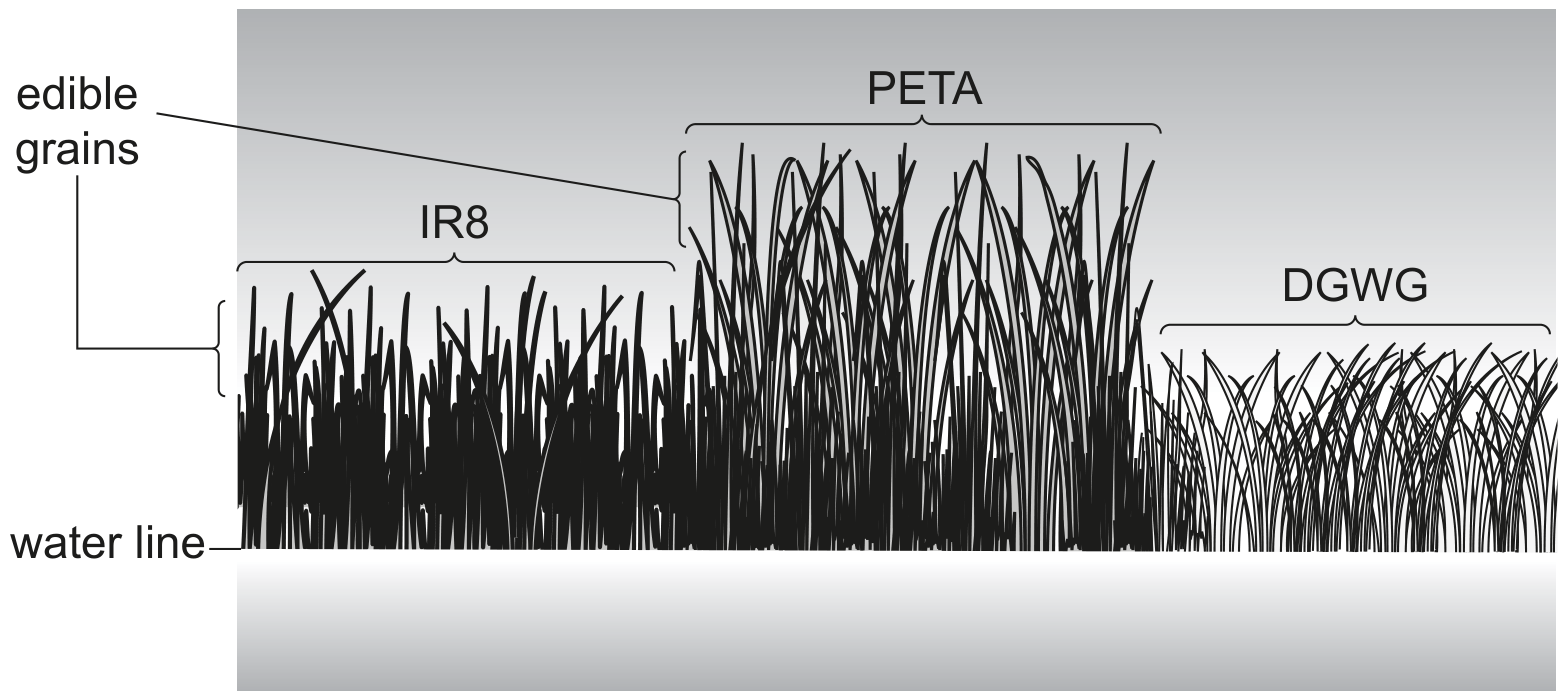
Fig. 6.1
In 2009, scientists produced a new variety of rice, IR64-Sub1, by breeding together:
- FR13A, a variety which has a low yield but has an allele for flood tolerance
- IR64, a variety which produces a high yield.
The scientists sequenced the DNA of these three rice varieties.
Suggest the benefit of sequencing the DNA of IR64-Sub1.