
EduNinja
[Maximum number: 2]

The courgette plant, Cucurbita pepo, produces edible fruits that vary in colour and shape.
Fruit colour in courgettes is controlled by the gene A / a.
Fruit shape in courgettes is controlled by the gene B/b.
- A yellow fruit is produced when the dominant allele A is present.
- A round fruit is produced when the dominant allele B is present.

Genes A / a and B/b occur on different chromosomes.
Table 1.1 shows the genotypes and phenotypes of four different varieties of courgette with respect to their fruit colour and shape.
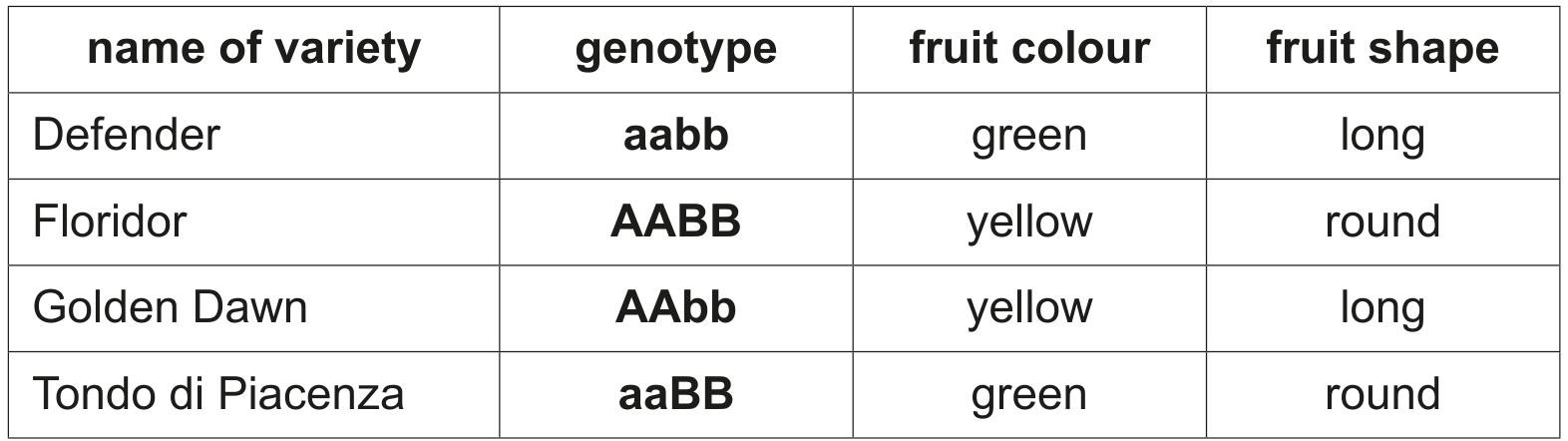
Table 1.1

Table 1.1

(a)
(i)

Outline how the WMV-resistant trait of Cucurbita ecuadorensis could be transferred to watermelon plants.

[ 2 ]
[Maximum number: 4]

Therapeutic proteins are used to treat disease. The first purified therapeutic protein used was insulin, in 1922. The insulin was extracted from animal pancreases. Since 1982 most insulin has been made by recombinant DNA technology.

(a)

Explain the advantages of producing human therapeutic proteins, such as insulin, by recombinant DNA technology.

Calcitonin is a small protein hormone consisting of 32 amino acids. One of its functions is to inhibit the activity of cells, called osteoclasts, that break down bone tissue.

Calcitonin has been used as a therapeutic protein to treat osteoporosis. In osteoporosis too much breakdown of bone tissue in older people leads to reduced bone density and a risk of breaking bones.

[ 4 ]
[Maximum number: 4]

Soybean, Glycine max, is an important food crop for human consumption and for feeding to animals.

Two varieties of soybean are Vinton 81 and GTS 40-3-2.
Vinton 81 has been developed in the traditional way by selective breeding (artificial selection) and GTS 40-3-2 is an example of a genetically modified (GM) organism.

(a)

GTS 40-3-2 is described as herbicide-resistant, as it can withstand the application of glyphosate herbicide. Glyphosate is sprayed on the crop to kill weeds.

Outline how genetic engineering gave GTS 40-3-2 the trait of herbicide resistance.

[ 4 ]
[Maximum number: 4]

Therapeutic proteins are used to treat disease. One example of a therapeutic protein is human growth hormone (hGH).
hGH has important roles in growth during childhood and in regulation of metabolism in adulthood.
Children described as hGH-deficient do not produce enough hGH and grow more slowly than other children. People who were hGH-deficient when they were children have a mean adult height that is 32 cm shorter than the population mean.

Daily injections of hGH are a treatment for hGH-deficient children that can increase growth rate, resulting in an increased adult height.

(a)

In 1985, several cases of a rare brain disease were discovered in people who had been treated many years previously with hGH obtained from pituitary glands. It was decided, from 1985 onwards, that only recombinant hGH should be used to treat patients.

Explain the advantages of producing human therapeutic proteins, such as hGH, by recombinant DNA technology.

[ 4 ]
[Maximum number: 4]

The filamentous fungus, Fusarium venenatum, can be grown in a fermenter and harvested as mycoprotein. It is sold as a food in a number of different countries.

The fungus is grown in continuous culture in 150000dm3150000 \mathrm{dm}^{3} airlift fermenters, in which the introduction of bubbles of compressed air both oxygenates and stirs the contents. The fungus grows as narrow, branched filaments, giving the harvested mycoprotein a naturally chewy, fibrous texture. Approximately 300 kg of fungus can be harvested per hour.

(a)

After about six weeks, mutants may appear in the fungal population, for example, a more highly-branched form of the fungus.

The fermenter is emptied, cleaned and repopulated with the original strain of F. venenatum every six weeks.

Explain why the fermentation process should be stopped before mutants appear.

[ 4 ]
[Maximum number: 2]

The rainbow trout, Oncorhynchus mykiss, is a fish that is bred in commercial fish farms. Rainbow trout that have a blue-silver colour are sold at a higher price than rainbow trout that have a brown colour.

The number of fish with each of the different colours was recorded in a breeding population in one fish farm.
- population total =2936
- number of blue-silver fish =1437
- number of brown fish =1499

(a)

The Atlantic salmon, Salmo salar, can be genetically modified (GM).

GM Atlantic salmon are bred in commercial fish farms for food production. In 2017, GM Atlantic salmon bred in Canada became the first GM animal to enter the human food chain.

Explain how the genetic modification of the Atlantic salmon can be used to increase food production.

[ 2 ]
[Maximum number: 2]

There are many different strains of the soil bacterium Bacillus thuringiensis. Each produces slightly different types of Cry-proteins, which are toxic to insects. Some types of cotton, known as Bt cotton, have been genetically modified to produce one of these proteins, Cry1Ac. This protein acts specifically to kill the larvae of butterflies and moths, including the cotton bollworm, Helicoverpa zea, a serious pest of cotton crops.

The genetically modified cotton contains a 'genetic package' that includes:
- the gene coding for Cry1Ac, the Bt protein
- a promoter
- a herbicide resistance gene that is used as a marker.

(a)
(i)

Suggest the advantages of using, in Bt cotton, the gene coding for Cry1Ac, rather than one of the genes coding for other types of the Cry-protein.

[ 2 ]
(a)

Pigs are farm animals used for livestock in some parts of the world. The first genetically modified (transgenic) pigs were produced in 1985. Foreign DNA was injected directly into the nuclei of zygotes. The foreign DNA was made up of two components:
- the gene coding for human growth hormone
- a section of mouse DNA that, in the presence of metal ions, allows transcription to begin.

[ 2 ]
(i)

The human growth hormone synthesised by the transgenic pigs had the effect of making the pigs grow faster, larger and heavier than non-genetically modified pigs.

Suggest reasons for this difference.

[ 2 ]
(b)

In 2015 pigs were produced that had part of their genome altered by a new technique. The technique involved:
- an RNA sequence designed to bind to a specific targeted pig gene
- a gene-editing enzyme that is able to cut out sections of DNA.

The technique was used on pig zygotes that had been created by IVF. All the zygotes treated grew into piglets and these all showed large deletions in the targeted gene.

This gene coded for a specific cell surface membrane protein. The piglets did not express the protein and this gave them resistance to infection by a virus that causes a serious disease in pigs.

[ 3 ]
(i)

A scientist stated that this new technique is a form of selective breeding, so is not genetic engineering.

Discuss whether this statement is true and whether public groups who oppose transgenic animals will be more or less likely to accept the new technique.

[ 3 ]
[Maximum number: 2]

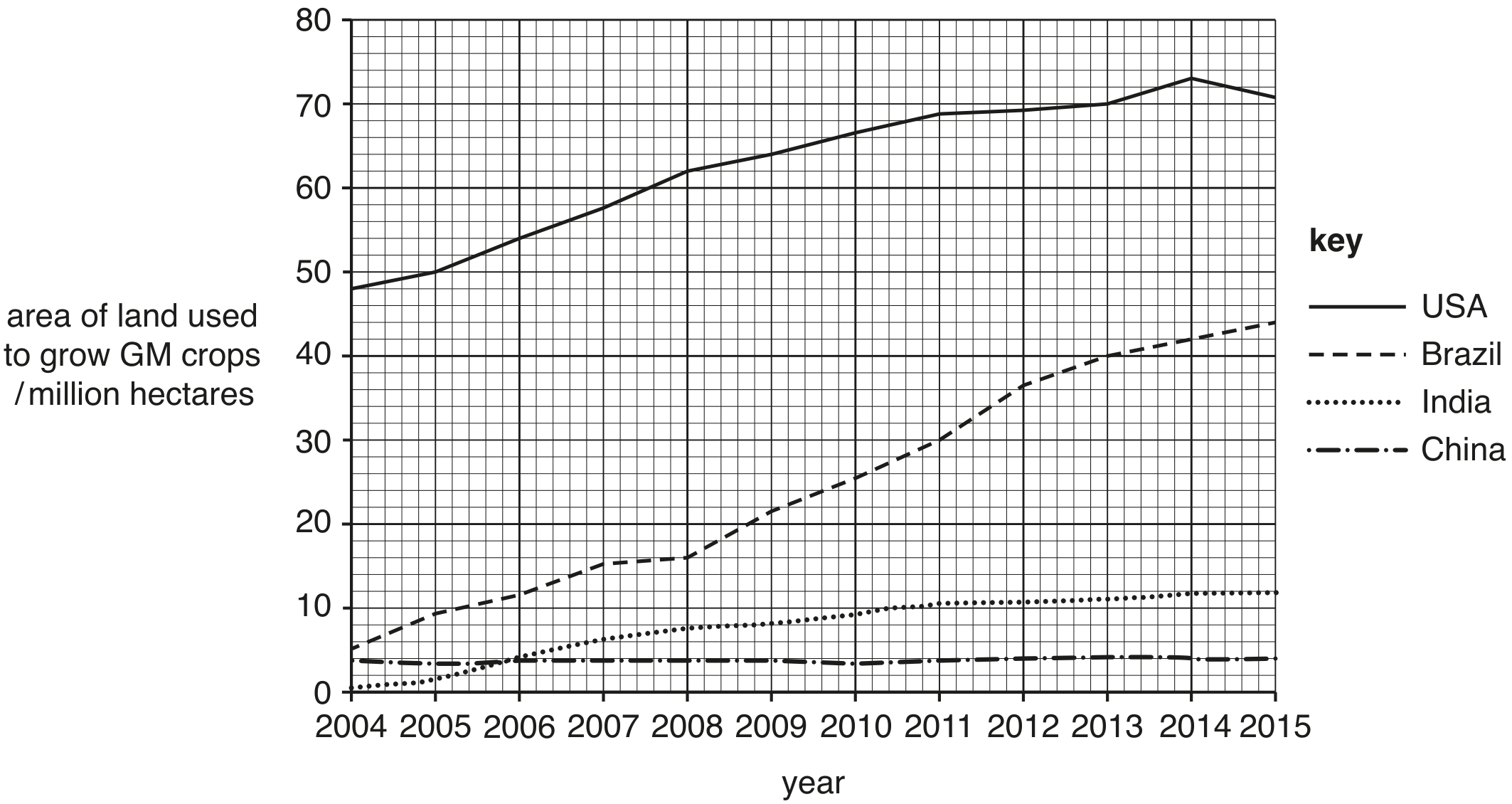
Fig. 5.1 shows the area of land that was used to grow genetically modified (GM) crops in the USA, Brazil, India and China from 2004 to 2015.

Fig. 5.1

Fig. 5.1

(a)
(i)

Describe the difference between Bt maize and non-GM maize that explains why Bt maize is resistant to insects.

[ 2 ]
[Maximum number: 4]

Maize, Zea mays, is an important food crop for human consumption and for feeding to animals.
Two varieties of maize are MON810 and Justina. Justina has been developed in the traditional way by selective breeding (artificial selection) and MON810 is an example of a genetically modified (GM) organism.

(a)

MON810 produces a chemical that is toxic to insect pests. It is described as insect-resistant. Outline how genetic engineering gave MON810 the trait of insect resistance.

[ 4 ]
0