EduNinja
[Maximum number: 6]

The evolutionary origin of the four-legged amphibians (such as frogs and toads) from fish has been the subject of much debate for many years.

Among living fish, the rarely-caught coelacanth and the lungfish are thought to be most closely related to these amphibians.

Samples of blood were taken from two coelacanths that were captured recently near Comoros.

The amino acid sequences of the α\alpha and β\beta chains of coelacanth and lungfish haemoglobin were compared with the known sequences of amphibian adults and their aquatic larvae (tadpoles). Organisms with more matches in the amino acid sequence of a polypeptide chain share a more recent common ancestor than those with fewer matches.

The comparisons with three species of amphibians, Xenopus laevis (XI), X. tropicana (Xt) and Rana catesbeiana (Rc) are shown in Table 2.1.
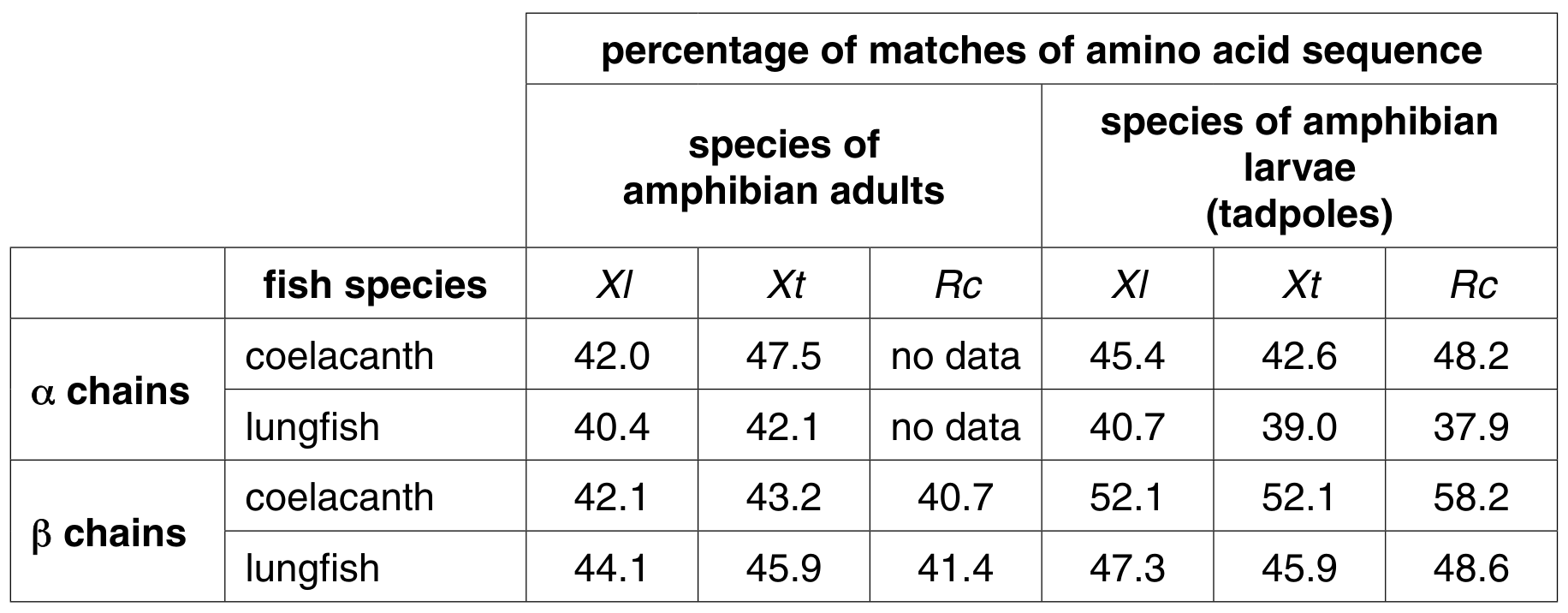
Table 2.1

Table 2.1

(a)

Coelacanth haemoglobin has a very high affinity for oxygen, suggesting that coelacanths, which have been captured at depths of between 200 m and 400 m , live in water that has a low concentration of oxygen.

Explain how an environmental factor, such as the low concentration of oxygen in deep water, can act:

[ 6 ]
(i)

as a stabilising force in natural selection

[ 3 ]
(ii)

as an evolutionary force in natural selection.
[ 3 ]
(a)

Researchers have found evidence of natural selection in humans.
- Originally, in human populations it was only babies and children that needed to digest the milk sugar, lactose. The gene coding for the enzyme lactase (LCT gene) was switched off before adulthood.
- Today, in many populations, some adult individuals have lactose intolerance, which means they cannot digest lactose. Lactose intolerance leads to side-effects such as abdominal pain after eating food containing lactose.
- A mutation has been identified that keeps the LCT gene switched on. An adult who has this mutation is able to digest lactose. This is called lactose persistence.
- Lactose persistence increased in populations in Europe several thousand years ago.
- The increase in lactose persistence in Europe coincided with an increase in farming of cows for milk.

[ 1 ]
(i)

Natural selection has caused this increase in lactose persistence.

State the type of selection that has caused this increase.

[ 1 ]
[Maximum number: 2]

Scientists have found very little evolutionary change in populations of two Australian songbirds, the zebra finch, Taeniopygia guttata castanotis, and the budgerigar, Melopsittacus undulatus.

(a)

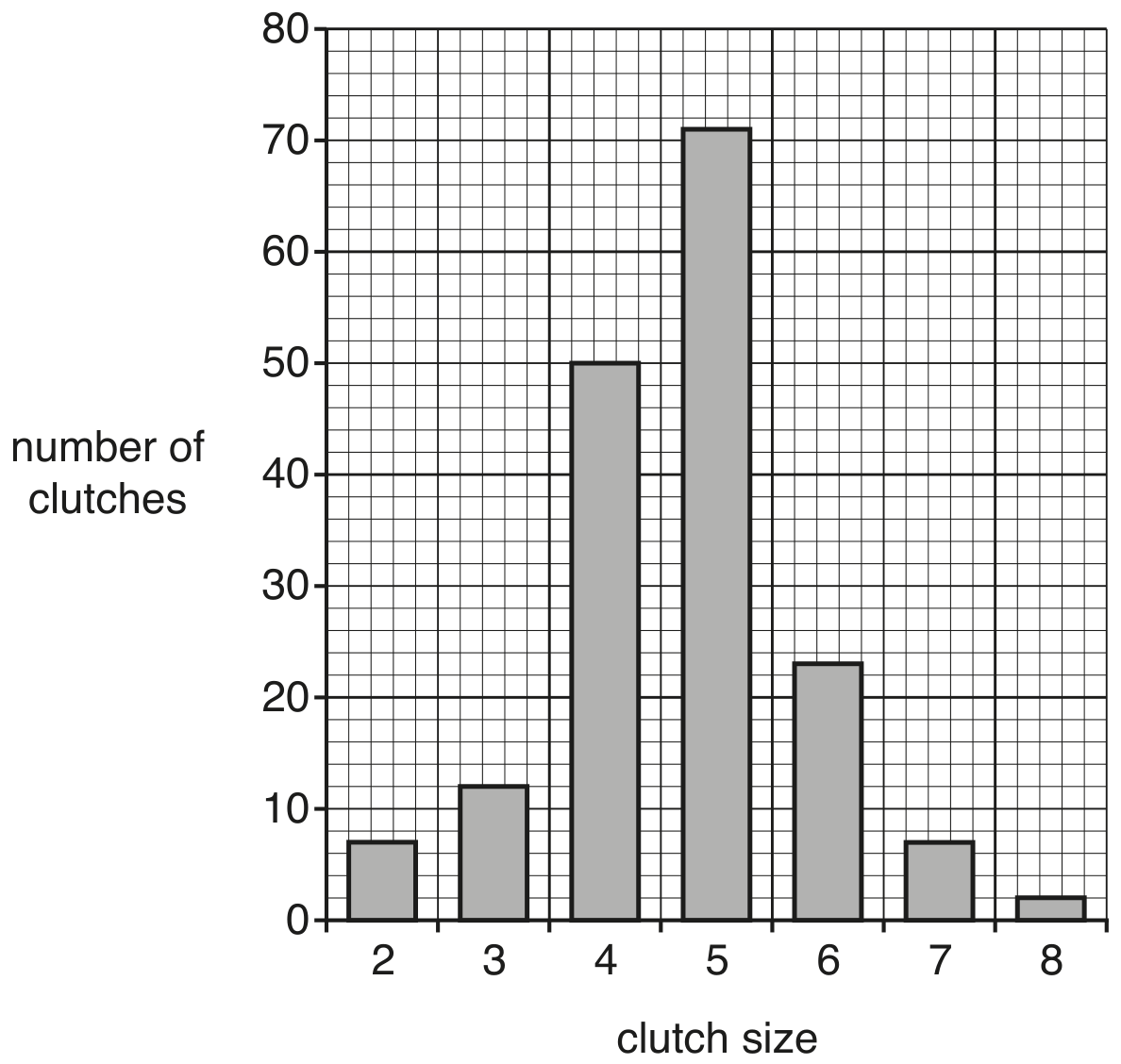
The number of eggs a bird lays in its nest is called the clutch size.

The variation in clutch size was investigated in the zebra finch over several years.
The data are shown in Fig. 2.1.

Fig. 2.1

Fig. 2.1

[ 2 ]
(i)

Describe the pattern shown by the data in Fig. 2.1.

[ 2 ]
[Maximum number: 3]

The Santa Cruz tarplant, Holocarpha macradenia, is a tall annual plant that grows only in the coastal grasslands in California. An annual plant is one that grows, flowers, produces seeds and dies in less than one year.

The tarplant used to be widely spread in California, but there are now only nine natural populations. It is listed as an endangered species.

(a)

The long-term survival of tarplant seeds in the soil provides a store of seeds that can help to ensure the future survival of the tarplant.

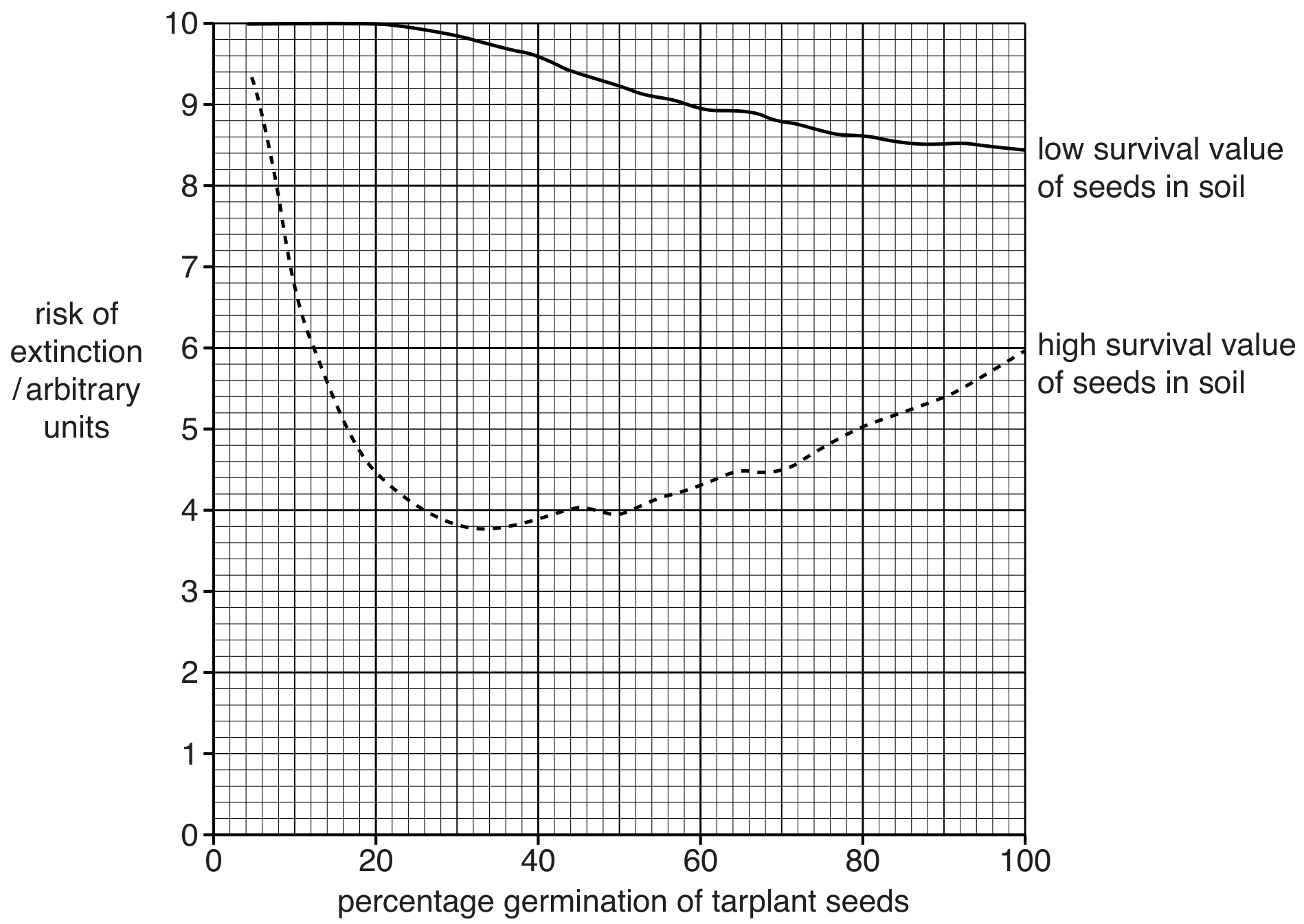
Little is known about the survival of tarplant seeds in the soil, or what percentage of these seeds is able to germinate. Researchers therefore used computer models to predict how these factors could affect the likelihood that the tarplant might become extinct.

In their models they used:
- high or low survival values of tarplant seeds in the soil
- different germination percentages of tarplant seeds.

The predictions of the models are shown in Fig. 4.1.

Fig. 4.1

Fig. 4.1

[ 3 ]
(i)

With reference to Fig. 4.1, describe the effect of each of the following on the risk of extinction of the tarplant:

high compared to low survival of the tarplant seeds

different germination percentages of the tarplant seeds.

[ 3 ]
(a)
(i)

Identify the type of natural selection that caused an increase in the mean concentration of insect-deterring chemicals in the non-sprayed populations.

[ 1 ]
(ii)

Identify the type of natural selection that caused the flowering period to remain the same in the non-sprayed populations.

[ 1 ]
[Maximum number: 1]

Mexican spadefoot toads, Spea multiplicata, live on land but return to ponds to breed. Eggs are laid in water and hatch into tadpoles, which feed in ponds before developing into adults.

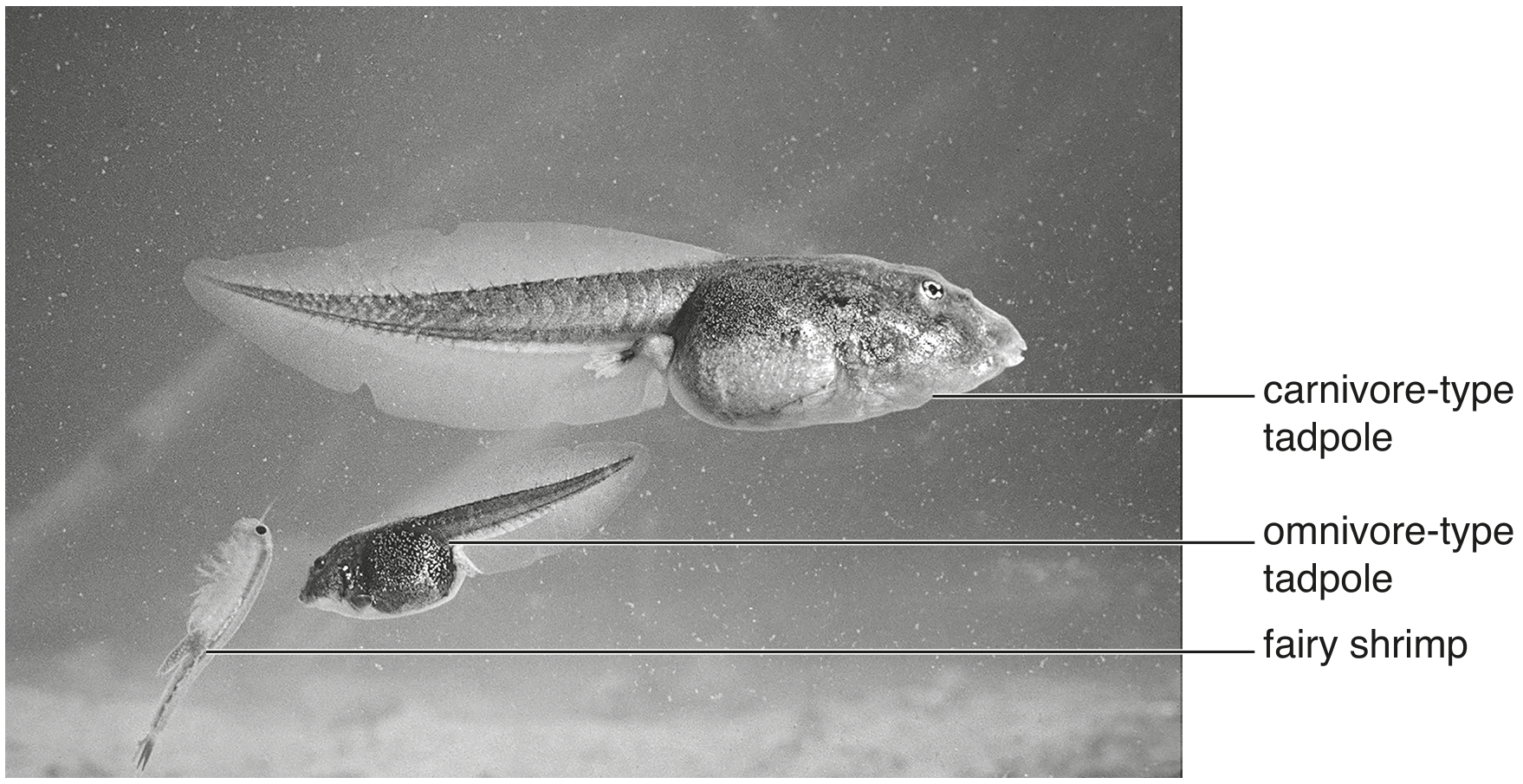
The tadpoles can be classified into two main types: omnivore-type tadpoles and carnivore-type tadpoles. Differences between the phenotypes of these two types of tadpole are related to their different feeding behaviours.
- Omnivore-type tadpoles feed on tiny pieces of detritus (dead material from plants and animals) and algae (microscopic photosynthetic organisms) at the bottom of ponds. These tadpoles grow slowly.
- Carnivore-type tadpoles feed on small animals in the water, such as fairy shrimp and small omnivore tadpoles. These tadpoles grow quickly.

Fig. 4.1 shows two tadpoles of the same age, one of each type. A fairy shrimp is also shown. All three organisms are at the same distance from the camera.

Fig. 4.1

Fig. 4.1

Between these two main types of tadpole there is a continuous range of tadpoles with intermediate body phenotypes and feeding behaviours.

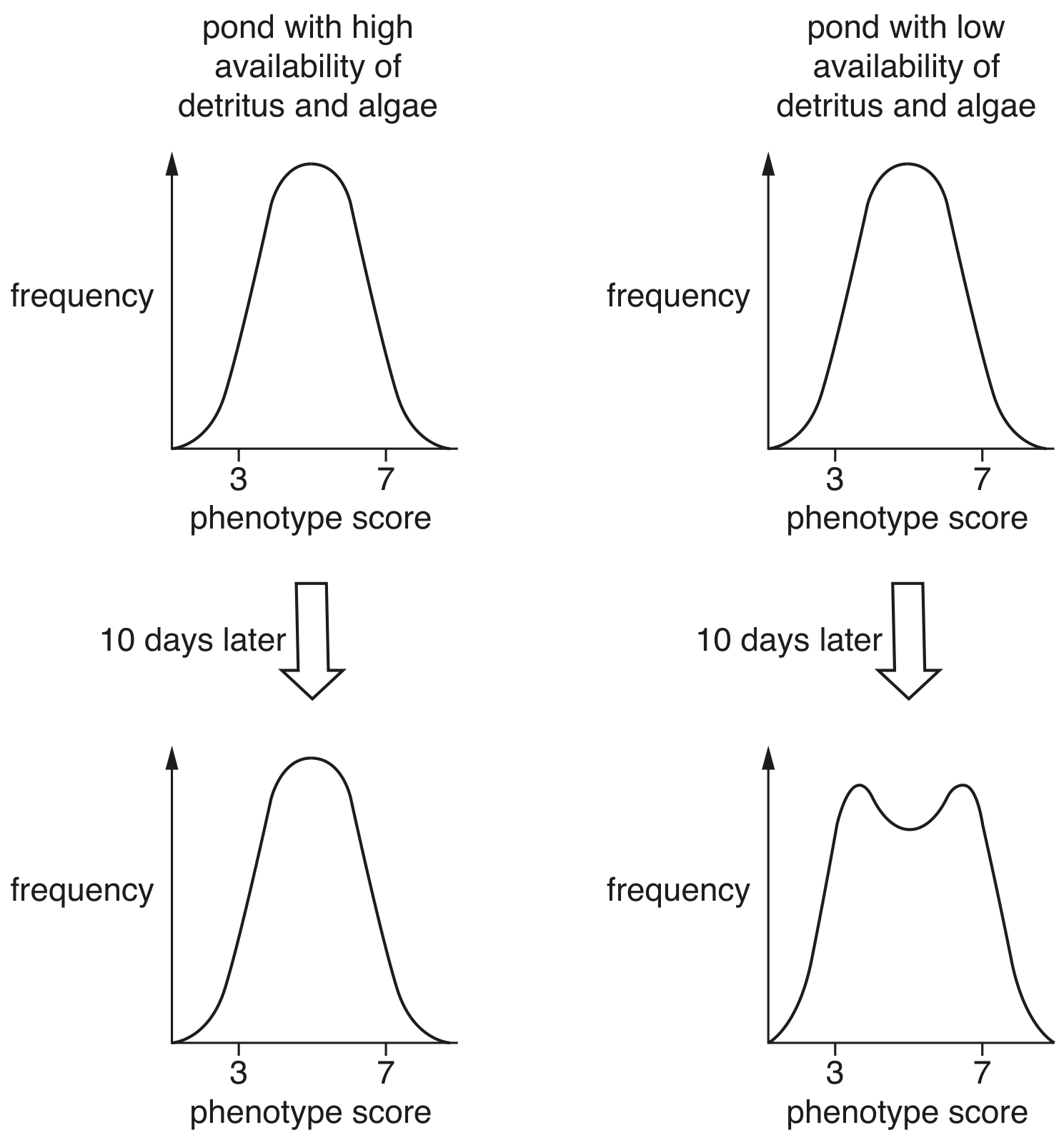
For any individual tadpole, regardless of age, it is possible to calculate a phenotype score depending on the features of the tadpole. A tadpole with a phenotype score close to 3 is a typical omnivore type and a tadpole with a phenotype score close to 7 is a typical carnivore type.

The phenotype scores were determined for a large number of tadpoles sampled from two ponds. The availability of detritus and algae was high for one pond and low for the other pond. All other conditions in the two ponds were similar.

For both ponds, phenotype scores were determined shortly after the tadpoles had hatched from eggs and ten days later.

The results are shown in Fig. 4.2.

Fig. 4.2

Fig. 4.2

(a)

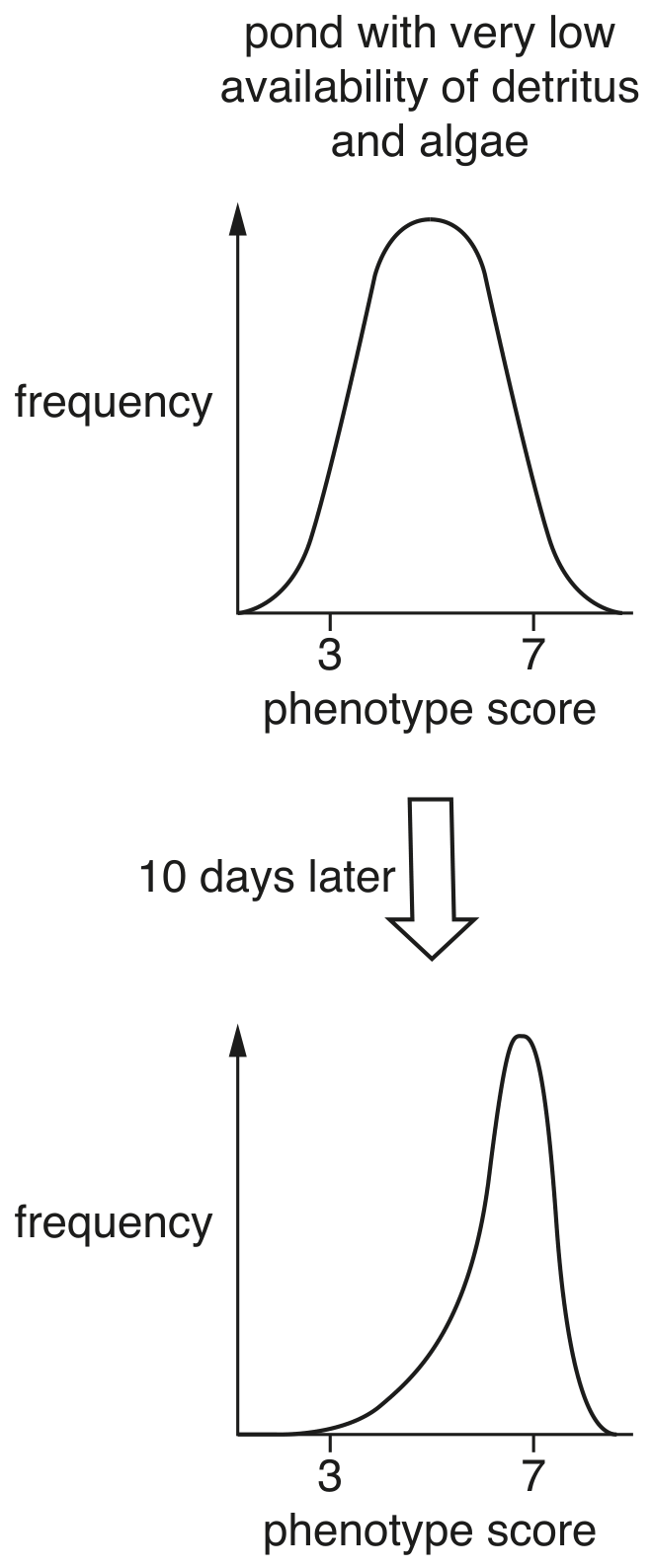
The phenotype scores of a large number of tadpoles were determined in a different pond with very low availability of detritus and algae. All other conditions were the same as the first two ponds. As previously, measurements were taken shortly after the eggs hatched and ten days later. After ten days, nearly all of the Mexican spadefoot toad tadpoles in this pond were carnivore types.

The results are shown in Fig. 4.4.

Fig. 4.4

Fig. 4.4

[ 1 ]
(i)

State the type of natural selection that is acting on the tadpoles in the pond with very low availability of detritus and algae.

[ 1 ]
[Maximum number: 3]

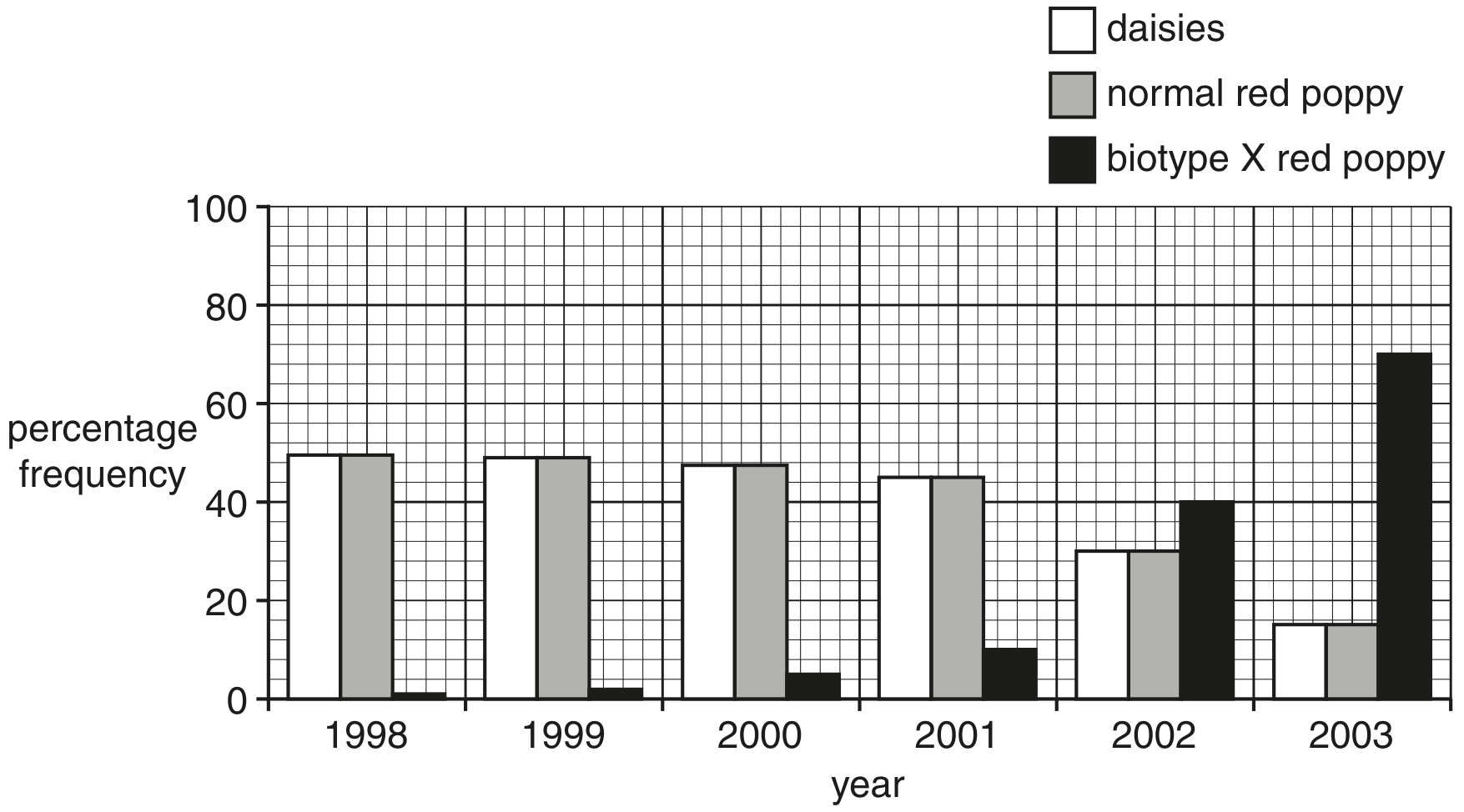
The red poppy, Papaver rhoeas, and several species of daisy of the family Compositae often co-exist as weeds of wheat fields.

Fig. 5.1 shows changes in the percentage frequency of red poppies and daisies in an area of wheat fields over a six year period from 1998 to 2003. From 1985, the herbicide metsulfuron-methyl was used to control weeds in this area of wheat fields. This practice continued throughout the six year period.

1998 showed the first occurrence of a red poppy known as biotype X. This red poppy had a specific mutation not present in normal red poppies.

Fig. 5.1

Fig. 5.1

(a)

Suggest how stopping the use of the herbicide metsulfuron-methyl and replacing it with a herbicide that inhibits a different target enzyme in weeds would affect the abundance of red poppies of biotype X.

[ 3 ]
[Maximum number: 1]

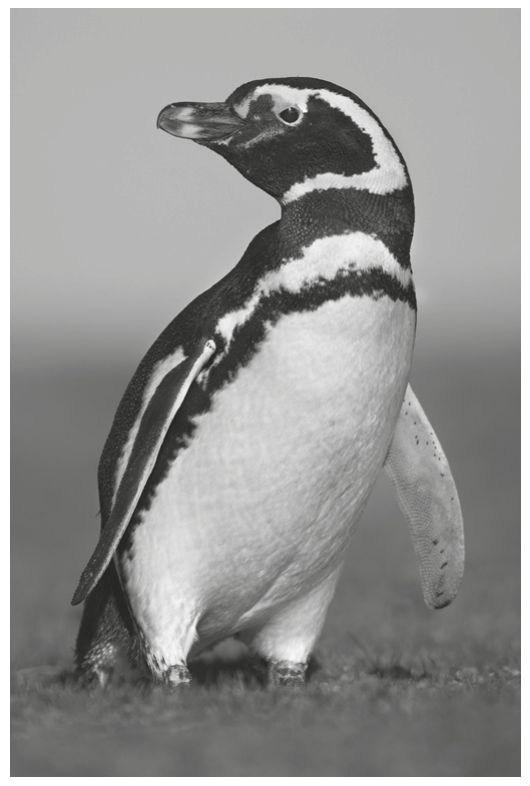
A 28-year study of Magellanic penguins, Spheniscus magellanicus, found in Argentina, provides evidence of natural selection.
Magellanic penguins lay their eggs in nests. They use their bills (beaks) to catch prey and feed their chicks (offspring) in the nest. Each breeding pair of penguins uses the same nest each year.

A Magellanic penguin is shown in Fig. 4.1.

Fig. 4.1

Fig. 4.1

- Data were collected for bill size every year from 1983 to 2010.
- Bill size was calculated using the length and depth of the bill.
- Bill size showed variation between the individuals.
- In 1983 all the penguins in one area were tagged.
- All tagged penguins were measured each year and their new chicks were tagged and measured.
- For each year of the study, an estimate of food availability was made.
- A statistical analysis was conducted to quantify whether selection had taken place.

(a)

Statistical analysis of the data showed that selection was not significant in most years of the study. However, a significant increase in bill size occurred in four years of the study.

[ 1 ]
(i)

Name the type of selection that occurred in these four years.

[ 1 ]
[Maximum number: 2]

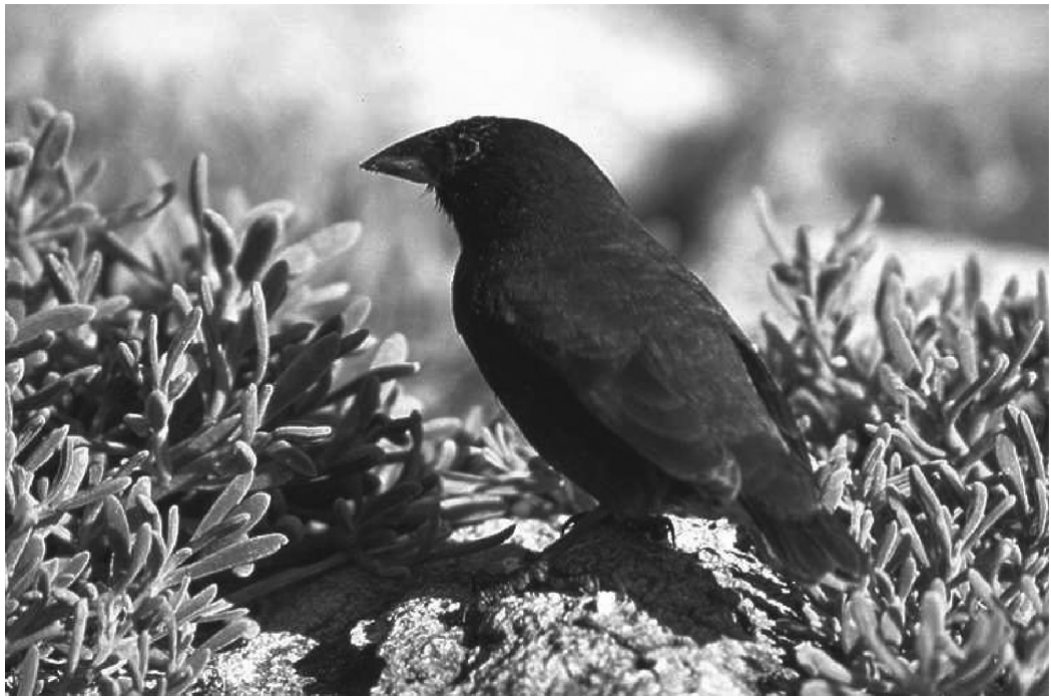
From 1975 to 1977 one of the Galapagos Islands, Daphne Major, experienced a severe drought. A ground finch, Geospiza fortis, feeds on seeds on Daphne Major.

Fig. 6.1 shows the ground finch, G. fortis.

Fig. 6.1

Fig. 6.1

- One of the few plants that survived the drought produced large seeds inside tough fruits.
- Many G. fortis died during the drought and the population declined from 1400 in 1975 to 190 in 1977.
- The mean beak depth of those G. fortis that died was 10.68 mm and the mean beak depth of those that survived was 11.07 mm .
- The mean beak depth of G. fortis before the drought was 10.86 mm .

(a)

Natural selection was taking place on Daphne Major.

State the type of natural selection operating on G. fortis during the drought and explain your answer.
type of natural selection
explanation

[ 2 ]
(a)

Octopuses are molluscs that have eyes very similar to those of mammals.

Octopuses and mammals are not closely related.
Octopuses and mammals have lenses that can change shape to focus on objects at different distances.

Suggest reasons why octopuses and mammals have evolved similar eye structures.

[ 2 ]
0