EduNinja
[Maximum number: 5]

Phenylketonuria (PKU) is a genetic disease which results in a raised concentration of the amino acid phenylalanine in the blood. If left untreated in a newborn baby, it can lead to brain damage. For this reason, babies may be tested for PKU soon after birth.

(a)

For some genetic diseases, the proportion of individuals that have the disease can vary in different parts of the world. Sometimes this is due to different environmental conditions. The number of cases of PKU is approximately ten times higher in Europe than in Sub-Saharan Africa.
- Individuals who are carriers of the recessive allele for PKU are more resistant to ochratoxin A, produced by a fungus found on contaminated grain products.
- Ochratoxin A has been linked to a form of renal cancer.
- The fungi that produce ochratoxin A are less common in dry regions such as Sub-Saharan Africa.

Suggest and explain the mechanism which has resulted in the different number of cases of PKU in European and Sub-Saharan populations.
[ 5 ]
(a)

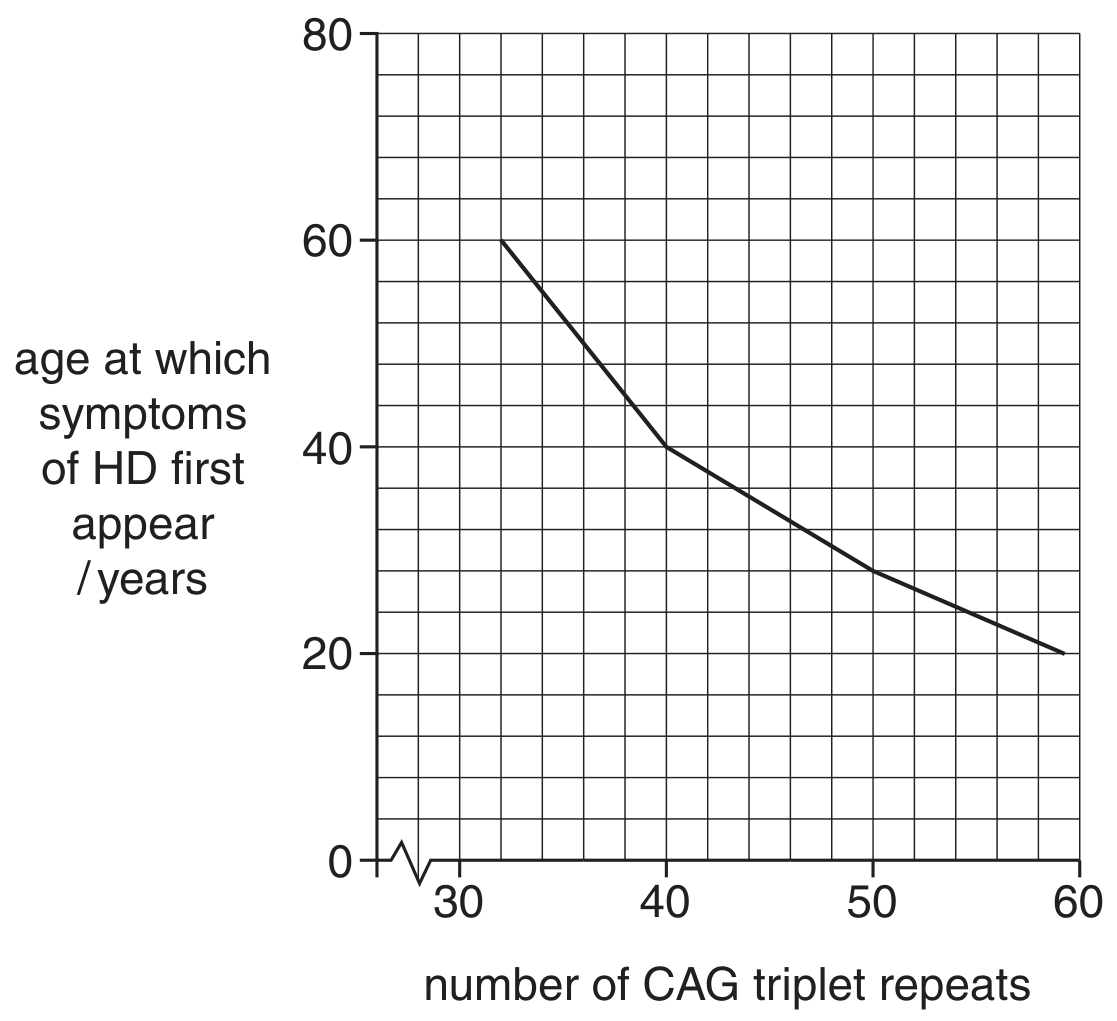
The dominant allele of the huntingtin gene contains many repeats of a triplet sequence of nucleotides, CAG. The age at which symptoms of HD first appear is linked with the number of CAG repeats.

This is shown in Fig. 1.1.

Fig. 1.1

Fig. 1.1

Describe the pattern shown in Fig. 1.1.

[ 2 ]
[Maximum number: 3]

The disease-causing bacterium, Pseudomonas aeruginosa, may occur in the form of a 'biofilm'. A biofilm consists of a layer of bacteria, growing on a surface and attached to one another. Such biofilms are difficult to control by antibiotics.

A mutant strain of P. aeruginosa has been found which produces biofilms that are indistinguishable from those of the wild-type bacteria. However, the mutant strain differs from the wild-type in its resistance to an antibiotic, A.

(a)

Explain the role of natural selection in the evolution of antibiotic resistance in bacteria.

[ 3 ]
[Maximum number: 5]

Mammoths are extinct mammals related to elephants. About three million years ago, the ancestors of mammoths migrated from Africa into Europe and Asia. There, about 1.7 million years ago, the steppe mammoth evolved and became adapted to the cooler conditions. Then, about 700000 years ago, as the climate changed and the Arctic became much colder, the woolly mammoth evolved.

Woolly mammoths showed a number of obvious adaptations to reduce heat loss, including thick fur, small ears and small tails.

(a)

Explain how variation and natural selection may have brought about the evolution of the woolly mammoth from the steppe mammoth.

[ 5 ]
[Maximum number: 1]

Steelhead trout, Oncorhynchus mykiss, are fish that live in streams in North America.
To increase the number of steelhead trout, captive breeding has occurred since 1992. Fish eggs and sperm are mixed and the young fish grow in large tanks of aerated water for the first year of their lives. Most are then released into the wild, however a few male and female fish are kept to become the parents of the next generation of captive-bred fish.

Each tank may hold up to 50000 fish. The young captive fish are fed processed food. Some young fish are unable to survive these conditions and a proportion die. Death is usually the result of poor wound-healing after accidents due to overcrowding and due to the spread of diseases.

(a)

Many of the differences in gene expression between the offspring of the wild and captive-bred fish were in genes coding for proteins involved in the immune response and in genes coding for proteins involved in wound healing. The fish from captive-bred parents expressed these genes to a greater degree.

The researchers concluded that the differences were inherited and adaptive.
Explain why the researchers concluded that the differences in gene expression between the two groups of fish were:

[ 1 ]
(i)

adaptive.

[ 1 ]
(a)

Researchers have found evidence of natural selection in humans.
- Originally, in human populations it was only babies and children that needed to digest the milk sugar, lactose. The gene coding for the enzyme lactase (LCT gene) was switched off before adulthood.
- Today, in many populations, some adult individuals have lactose intolerance, which means they cannot digest lactose. Lactose intolerance leads to side-effects such as abdominal pain after eating food containing lactose.
- A mutation has been identified that keeps the LCT gene switched on. An adult who has this mutation is able to digest lactose. This is called lactose persistence.
- Lactose persistence increased in populations in Europe several thousand years ago.
- The increase in lactose persistence in Europe coincided with an increase in farming of cows for milk.

[ 3 ]
(i)

Explain why there was selection for lactose persistence in humans several thousand years ago.

[ 3 ]
[Maximum number: 4]

When preparing infertile women for in-vitro fertilisation (IVF), it is necessary to stimulate the growth and maturation of several ovarian follicles. This is done by giving daily injections of the glycoprotein hormone, follicle stimulating hormone (FSH).

Each molecule of FSH has quaternary structure and consists of two different polypeptide chains, α\alpha and β\beta.

(a)

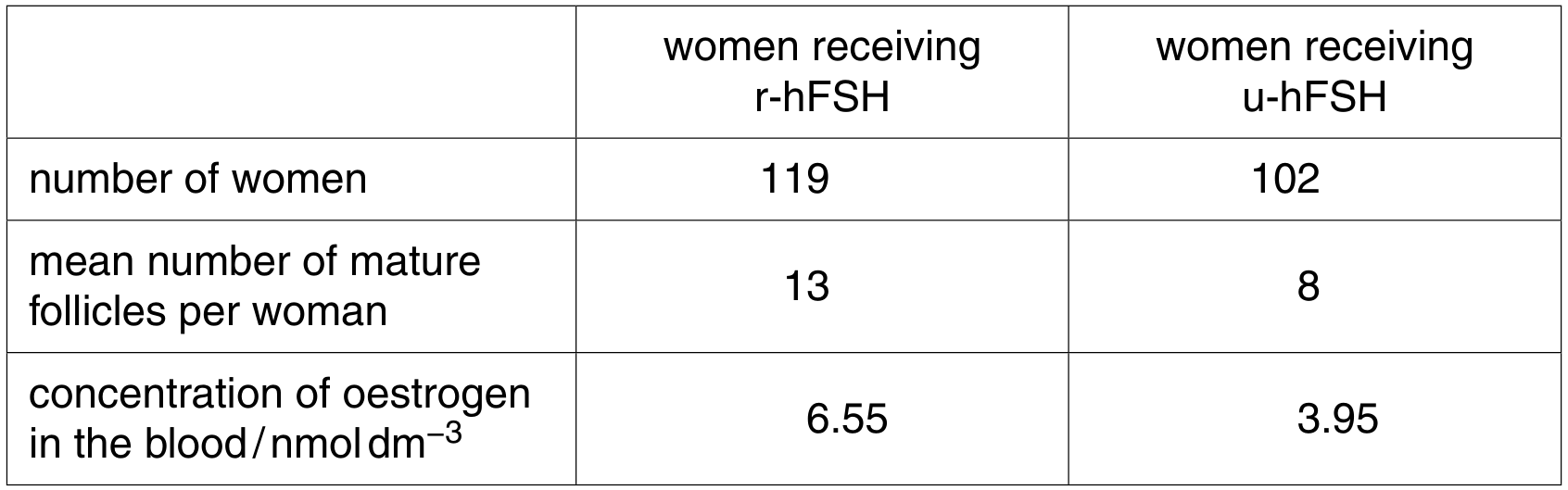
The effectiveness of r-hFSH was compared with that of u-hFSH. Women starting IVF treatment were randomly divided into two groups and given either r-hFSH or u-hFSH.

The differences between the two groups of women after FSH treatment are shown in Table 2.1.

Table 2.1

Table 2.1

[ 4 ]
(i)

With reference to Table 2.1, compare the effects of treatment with r-hFSH and u-hFSH and suggest explanations for the differences.

[ 4 ]
[Maximum number: 6]

The stickleback fish, Gasterosteus aculeatus, has two distinct forms, the saltwater form and the freshwater form. The larger, freshwater form is thought to have evolved from the smaller, saltwater form. Both forms have armour plating on each side of the body. The plates are made of bone and contain a high proportion of calcium.

The ectodysplasin gene, EDA, codes for a protein involved in the development of armour plates. The EDA gene has two alleles, low armour and high armour.

Three main morphs of armour plating have been described.
Complete morph armour plating:
- is found mainly in the saltwater form
- has many plates from head to tail to cover most of the body
- provides defence against large, predatory fish
- limits the growth of the fish.

Partial morph armour plating:
- is found mainly in the freshwater form
- has a reduced number of plates to cover only part of the body.

Low morph armour plating:
- is found mainly in the freshwater form
- has very few, undeveloped plates and no body cover.

(a)

In 1982, at Loberg Lake in Southern Alaska, the entire freshwater stickleback fish population was accidentally destroyed by humans.

In 1990, a new population of stickleback fish was found in the lake. Most of these fish had armour plates from head to tail on each side.

Suggest why these new stickleback fish have armour plates from head to tail on each side, despite living in freshwater.

[ 1 ]
(b)

From 1990, annual sampling took place in the lake.

Each year showed a reduction in the number of individuals with complete morph armour plating (from head to tail on each side). This change took place in a relatively short period of time.
- In 1990,96 % of the stickleback fish population had complete morph armour plating.
- In 1993,39 % of the stickleback fish population had complete morph armour plating.

Explain how natural selection has occurred in this new stickleback fish population.

[ 5 ]
[Maximum number: 8]

Scientists have found very little evolutionary change in populations of two Australian songbirds, the zebra finch, Taeniopygia guttata castanotis, and the budgerigar, Melopsittacus undulatus.

(a)

Describe the process of evolution by natural selection.

[ 4 ]
(b)

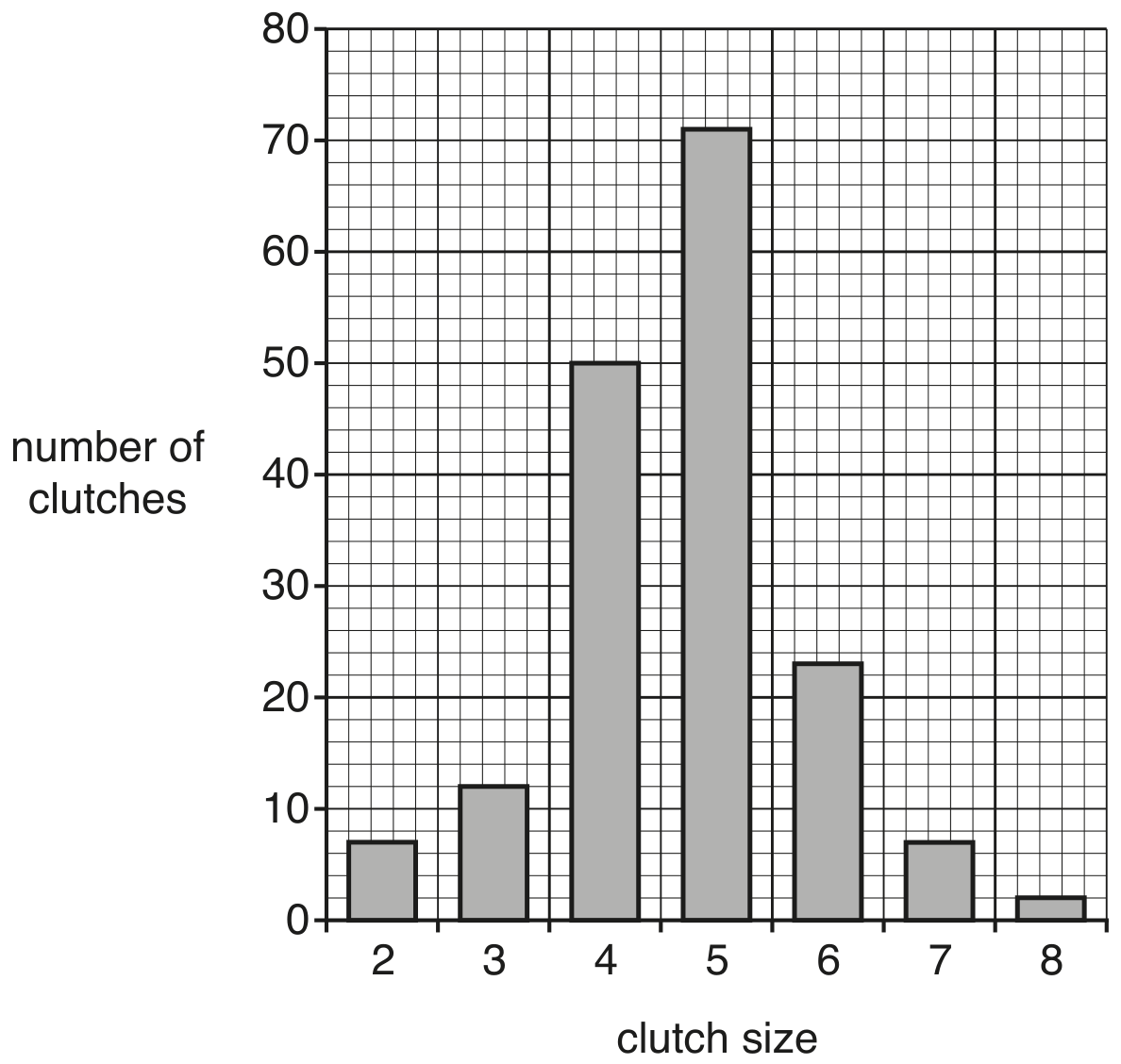
The number of eggs a bird lays in its nest is called the clutch size.

The variation in clutch size was investigated in the zebra finch over several years.
The data are shown in Fig. 2.1.

Fig. 2.1

Fig. 2.1

[ 4 ]
(i)

The data in this investigation were collected over 60 years ago.

The same investigation, carried out today, would produce the same pattern of results.
Explain how the selection factors acting on zebra finches would maintain the same pattern of results.

[ 4 ]
0