D4.1.12 (HL)—Types of selection

Directional, stabilizing and disruptive selection differ in which phenotypes are favoured and how variation changes in evolving populations in evolving populations.

Syllabus
First assessment 2025
Objective
D4.1.12
Level
HL

Exam analysis

Chance of appearing10%of analysed past papers
Latest appearanceNovember 2025
Most common paperPaper1
Typical marks1

Common command terms

  • Explain
  • Identify

Recent exam appearances

November 2025Paper1A ["HL"] · TZ138[ 1 ]D4.1.12 (HL)—Types of selection
May 2025Paper1B ["HL"] · TZ14(c)[ 2 ]D4.1.12 (HL)—Types of selection
May 2023Paper1 ["HL"] · TZ135[ 1 ]D4.1.12 (HL)—Types of selection
May 2022Paper1 ["HL"] · TZ236[ 1 ]D4.1.12 (HL)—Types of selection
November 2021Paper1 ["HL"] · TZ036[ 1 ]D4.1.12 (HL)—Types of selection
Practice this objective

Coverage 2016–2025 · Updated 16 Jul 2026

Three Selection Modes Reshape Trait Distributions

HL only

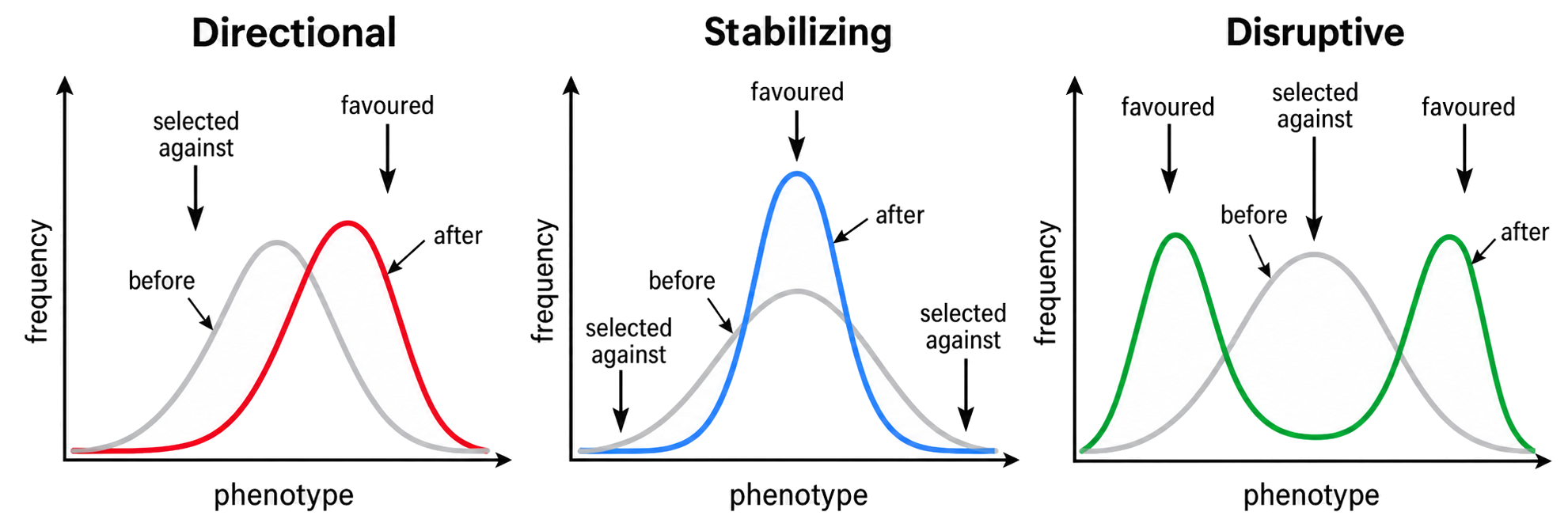
Directional, stabilizing and disruptive selection differ in which phenotypes have highest fitness; all can change allele frequencies.

Mode Favoured phenotype(s) Distribution outcome
Directional One extreme Mean shifts toward that extreme
Stabilizing Intermediate Variation narrows around the existing mean
Disruptive Both extremes Intermediate values decline and the distribution may become bimodal

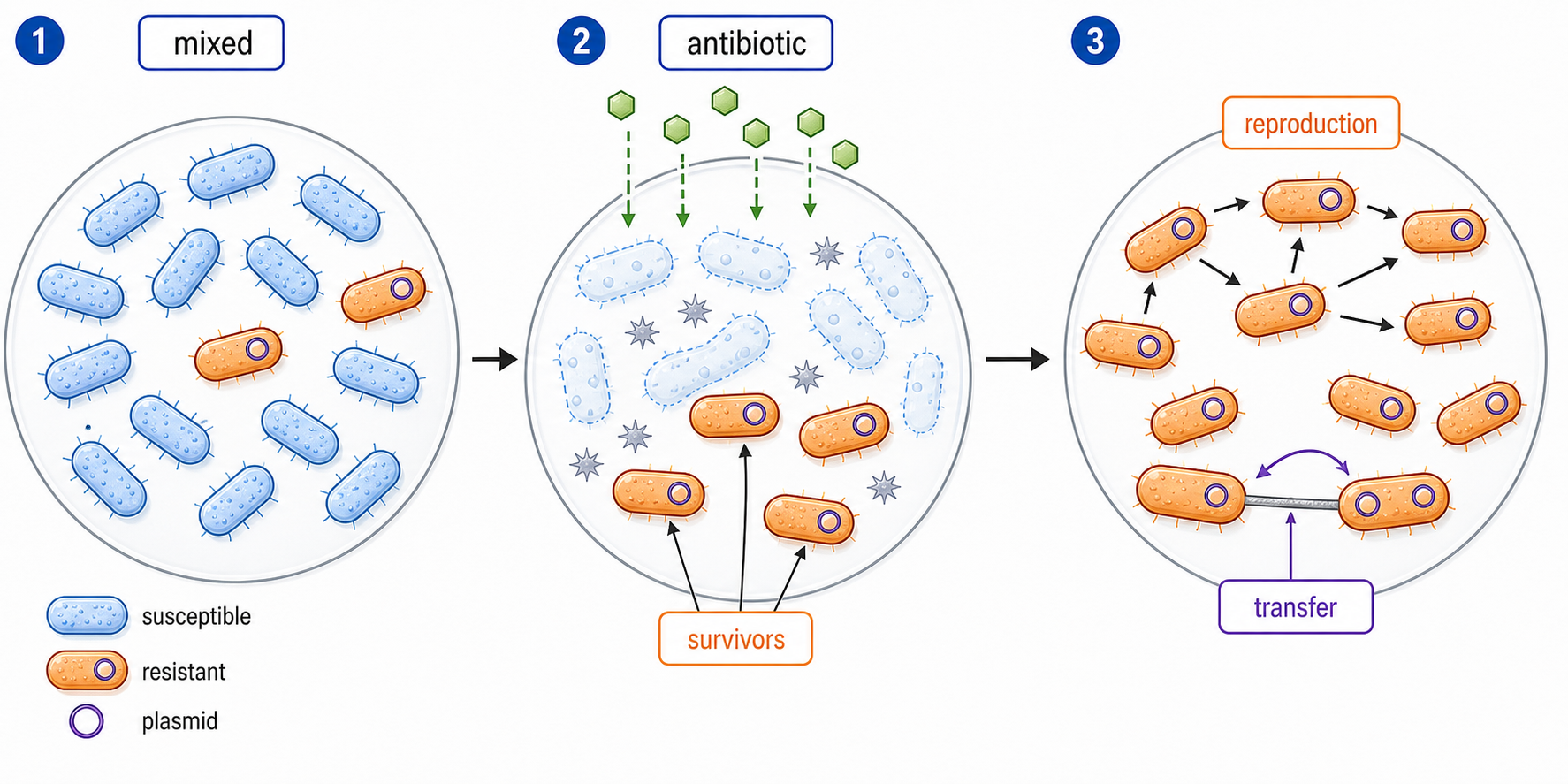
Antibiotic exposure can cause directional selection toward resistance; selection against very low and very high human birth weights illustrates stabilizing selection.

These labels describe fitness patterns, not the number of genes involved. Disruptive selection does not automatically produce new species.

Types of selection

HL only

Assessment in practice

1 marks
How it is assessed

This objective is assessed through structured response, commonly using Explain / Identify.

Command terms

Explain / Identify

What earns marks

Build the answer around this relationship: Directional selection shifts the population toward one extreme.

Representative question

Question 1

[Maximum number: 2]

Phenotypic variation allows natural selection within populations. Compare and contrast directional and disruptive selection.

Retrieve the HL Population Genetics Route

HL only

HL D4.1 turns selection into measurable population genetics. A gene pool changes when allele frequencies shift. Hardy-Weinberg gives a no-evolution baseline; selection graphs, isolated populations, artificial selection, and resistance show how forces move populations away from that baseline.

  • all alleles in an interbreeding population
  • directional, stabilizing, or disruptive selection favours different phenotype ranges
  • p and q calculate allele and genotype frequencies in equilibrium
  • selection, mutation, migration, drift, or non-random mating may be acting

HL Population Genetics

HL only

HL population-genetics questions ask students to quantify or model evolution. The answer starts with the gene pool and allele frequencies, then uses the model or selection graph to decide whether the population is at equilibrium or being shifted by selection, mutation, migration, drift, artificial selection, or isolation.

  • Use gene pool and allele frequency language to define evolution quantitatively.
  • Interpret selection graphs and isolated populations as changes in phenotype or allele frequencies.
  • Apply Hardy-Weinberg equations and equilibrium assumptions, then explain what deviations mean.

Concept essentials

  • Directional selection shifts the population toward one extreme.
  • Stabilizing selection favours intermediate phenotypes.
  • Disruptive selection favours both extremes over intermediate forms.