D4.2 Stability and change
Stability and change in ecosystems depend on sustainable resource use, pollution impacts, keystone species, rewilding, and succession processes over time.
- Syllabus
- First assessment 2025
- Topic
- D4.2
- Level
- HL
Stability and change in ecosystems depend on sustainable resource use, pollution impacts, keystone species, rewilding, and succession processes over time.
Ecosystem stability is the ability to maintain characteristic structures and processes continuously over time, despite ordinary fluctuations or disturbance.
| Evidence of stability | What may still change? |
|---|---|
| nutrient cycling continues | population sizes vary seasonally |
| food-web roles persist | individuals and local patches turn over |
| dominant community remains recognizable | storms, droughts or fires cause temporary departures |
Stable does not mean static. A system can change locally and still be stable if its defining organization persists or recovers.
Ancient rainforests, deserts and long-lived communities show that ecosystems can persist over very long timescales when supporting conditions and ecological processes continue.
Always state the timescale and property being judged. A population can decline while nutrient cycling remains stable, or a forest can persist while its species composition changes.
| Requirement | Why stability depends on it |
|---|---|
| continual energy input | replaces energy dissipated as heat during metabolism |
| producer biomass | captures light or chemical energy into organic molecules |
| decomposers and nutrient cycling | return mineral nutrients from waste and dead biomass for reuse |
| matter inputs and retention | supply elements needed to build biological molecules |
Energy is not recycled: it enters, is transferred and is lost as heat. Chemical elements can cycle repeatedly between organisms and the abiotic environment.
| Stability support | Mechanism |
|---|---|
| species diversity | multiple species can occupy different niches or partly replace lost functions |
| genetic diversity | varied alleles increase the chance that some individuals tolerate disease or environmental change |
| abiotic conditions within tolerance | key species can survive, reproduce and maintain their ecological roles |
Higher diversity often supports resilience, but it is not a guarantee. Stability still depends on interaction strengths, climate, energy supply and the type of disturbance.
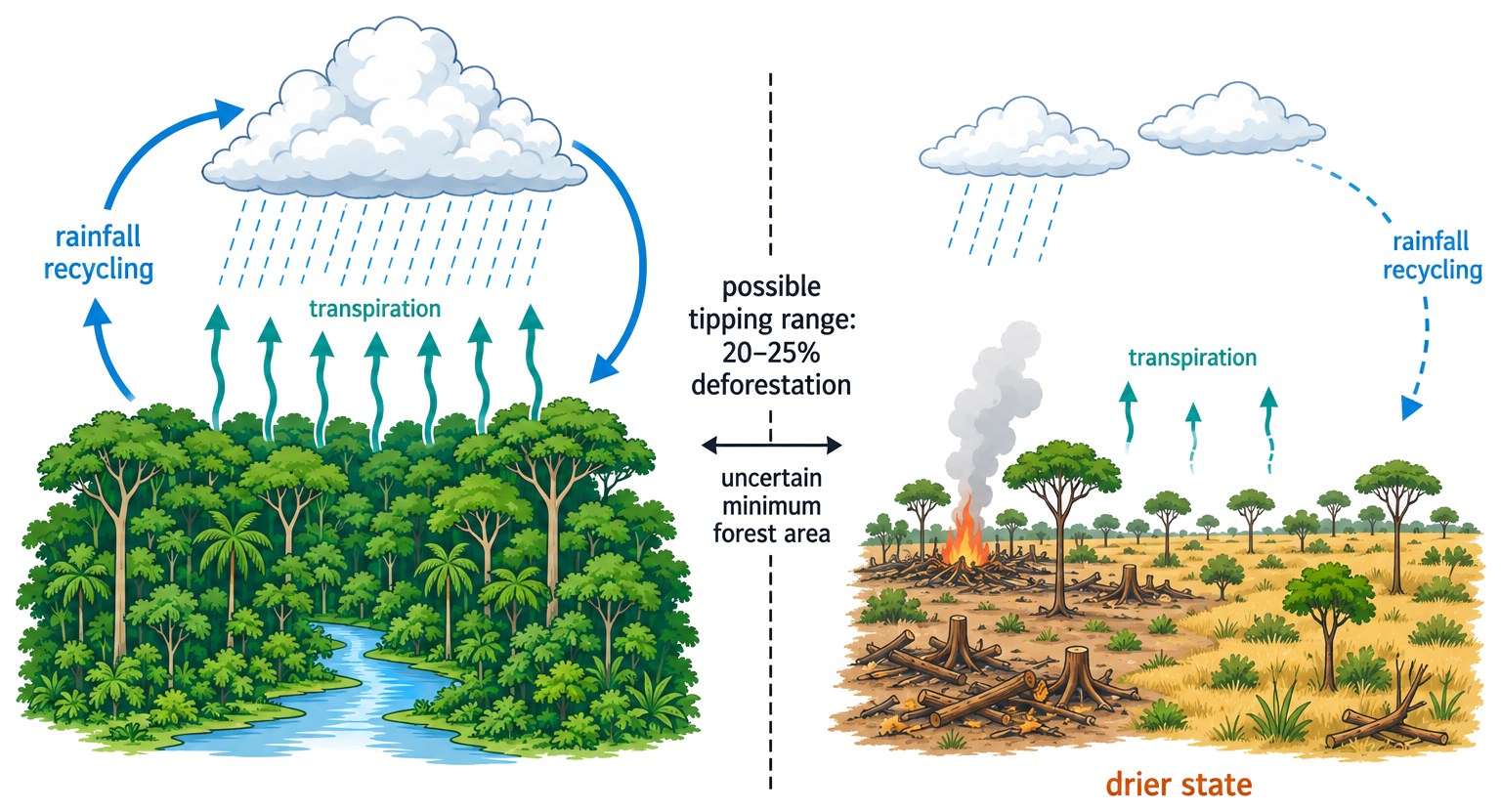
A tipping point is a critical threshold beyond which a small additional change can produce a disproportionately large shift to a different ecological state.
A tipping point is not simply any large change. The defining feature is a threshold response reinforced by feedback, often with difficult or incomplete reversal.
The exact minimum forest area and threshold are uncertain. A possible range is a risk estimate, not a precise prediction that collapse occurs at one universal percentage.
percentage change = (final forest cover − initial forest cover) ÷ initial forest cover × 100
| Quantity | Area (km²) |
|---|---|
| estimated pre-1970 cover | 4,100,000 |
| 2018 natural forest cover | 3,390,835 |
| change | −709,165 |
(−709,165 ÷ 4,100,000) × 100 = −17.3%. The negative sign indicates loss; the chosen initial year determines what the percentage describes.
A percentage of area lost does not by itself prove a tipping point. The ecological inference also needs evidence about fragmentation, rainfall feedback, fire and recovery.
| Mesocosm strength | Mesocosm limitation |
|---|---|
| isolates one manipulated variable | small scale omits migration and large food webs |
| allows replication and repeated measurements | container boundaries alter light, heat and movement |
| reduces damage to a natural ecosystem | short experiments may miss slow feedbacks |
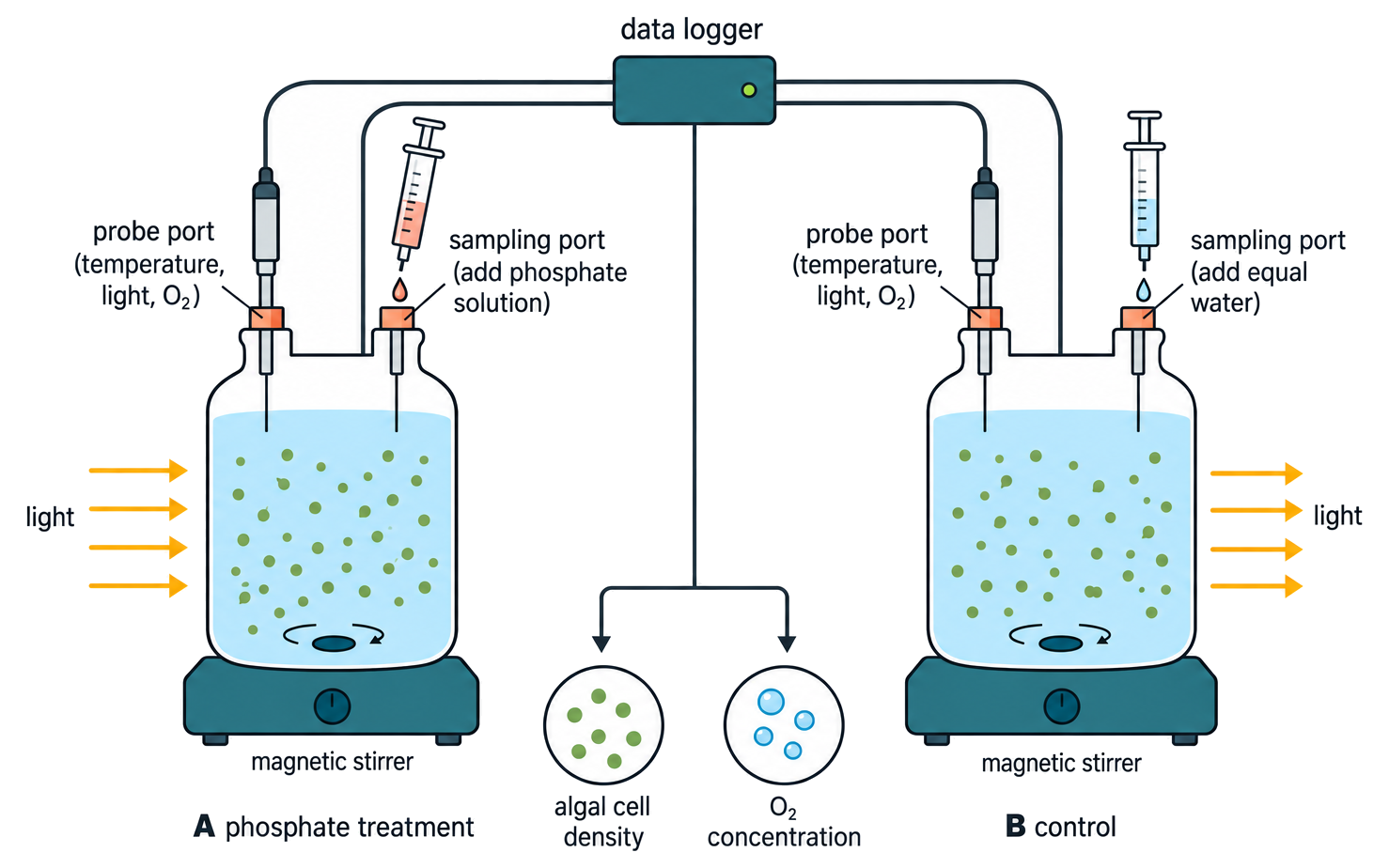
A sealed bottle can restrict matter exchange while still receiving light energy and losing heat. Producers, consumers and decomposers must together recycle matter within the model.
A mesocosm can test a mechanism under controlled conditions; transferring its result to nature requires cautious comparison with field evidence.
| Design element | Nutrient-enrichment test |
|---|---|
| independent variable | phosphate added to treatment only |
| control addition | equal volume of water without phosphate |
| controlled variables | starting culture, vessel, light, temperature, mixing and sampling |
| dependent variables | algal cell density and dissolved oxygen over time |
| reliability | replicate treatment and control vessels |
The design must also prevent escape or disposal of organisms and nutrients into natural water, and it must protect organisms from avoidable heat, starvation or oxygen stress.
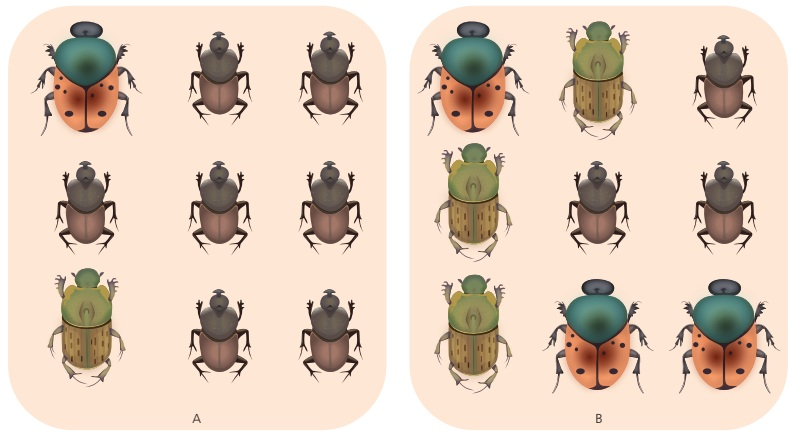
A keystone species has a disproportionately large effect on community structure relative to its abundance or biomass.
| Observation after removal | Keystone inference |
|---|---|
| many indirect population changes | the species controlled a trophic or habitat-forming interaction |
| loss of functions or community reorganization | its role was not readily replaced by other species |
| effect far exceeds its biomass share | impact is disproportionate, the defining criterion |
A common or dominant species can be important without being a keystone. “Keystone” compares ecological effect with abundance; it does not simply mean rare, large or charismatic.
The keystone role here is seed dispersal and recruitment. The prediction follows the controlled interaction: fewer agoutis → fewer successfully dispersed Brazil-nut seeds → long-term decline of trees and dependent species.
The largest effect may be delayed because adult Brazil-nut trees are long-lived. Short-term persistence of mature trees would not show that seed dispersal and future recruitment are secure.
continued energy input + nutrient recycling + diversity + tolerable abiotic conditions → ecological functions persist or recover; disturbance that weakens these supports can trigger reinforcing change and a new state
| Question | Evidence to seek |
|---|---|
| Is the ecosystem stable? | persistence or recovery of named structures and processes over a stated timescale |
| Is a tipping point plausible? | threshold-like response plus reinforcing feedback |
| Does one species have a keystone role? | disproportionate community change after its removal |
| Does a mesocosm support the mechanism? | replicated treatment–control difference with variables held constant |
Do not equate stable with unchanged, old with invulnerable, or correlated change with a demonstrated feedback mechanism.
Long-term harvesting is sustainable when removal, natural mortality and habitat damage do not exceed recruitment, growth and recovery of a viable reproducing population.
Renewable does not mean inexhaustible. A population can replenish itself only while enough breeding individuals and suitable habitat remain.
| Stock observation | Likely interpretation |
|---|---|
| many juveniles reaching reproductive age | recruitment can support future stock, if they survive |
| few large breeding adults | reproductive capacity may be weakened |
| catch stays high while fishing effort rises | stock may be declining despite similar landings |
| by-catch or habitat damage increases | harvest cost extends beyond the target stock |
Maximum sustainable yield is an estimated long-term catch near the balance between stock growth and losses. It depends on uncertain, variable recruitment and should be updated with long time-series data.
A single year’s catch cannot establish sustainability. Illegal discarding or poor age data can bias stock estimates and make a quota unsafe.
| Measure | Sustainable direction |
|---|---|
| extracted timber volume | no greater than replacement growth over the management period |
| replanting and natural regeneration | enough surviving trees of suitable species and age classes |
| soil disturbance and erosion | minimized so future productivity is retained |
| habitat structure and carbon storage | maintained across the managed landscape |
Seedlings planted today are not immediate replacements for mature trees. Assessment must use the time needed to restore biomass, habitat and carbon, not just a count of stems planted.
High short-term yield can coexist with falling long-term forest capacity. Sustainability prioritizes the continuing system over one harvest cycle.
| Practice | Stability benefit |
|---|---|
| cover crops or residue retention | shields soil and adds organic matter |
| contouring and reduced tillage | slows runoff and soil detachment |
| rotations and mixed vegetation | supports soil biota and interrupts pest cycles |
Fertile soil can form far more slowly than it is eroded, so it is effectively non-renewable on human farming timescales.
| Decision | Potential gain | Sustainability cost to monitor |
|---|---|---|
| fertilizer use | replaces limiting nutrients and raises yield | leaching, eutrophication and energy cost |
| pesticide use | reduces crop loss | non-target effects, resistance and biomagnification if persistent |
| irrigation | maintains growth during water shortage | aquifer depletion, salinization and energy use |
| local seasonal supply | can reduce transport | yield, storage and production method still affect total footprint |
No single favourable indicator proves sustainability. A high yield can depend on soil depletion, pollution or carbon emissions shifted outside the field boundary.
Algae do not directly “use up all the oxygen” simply by growing. The key oxygen-loss step is respiration, especially by decomposers processing dead biomass.
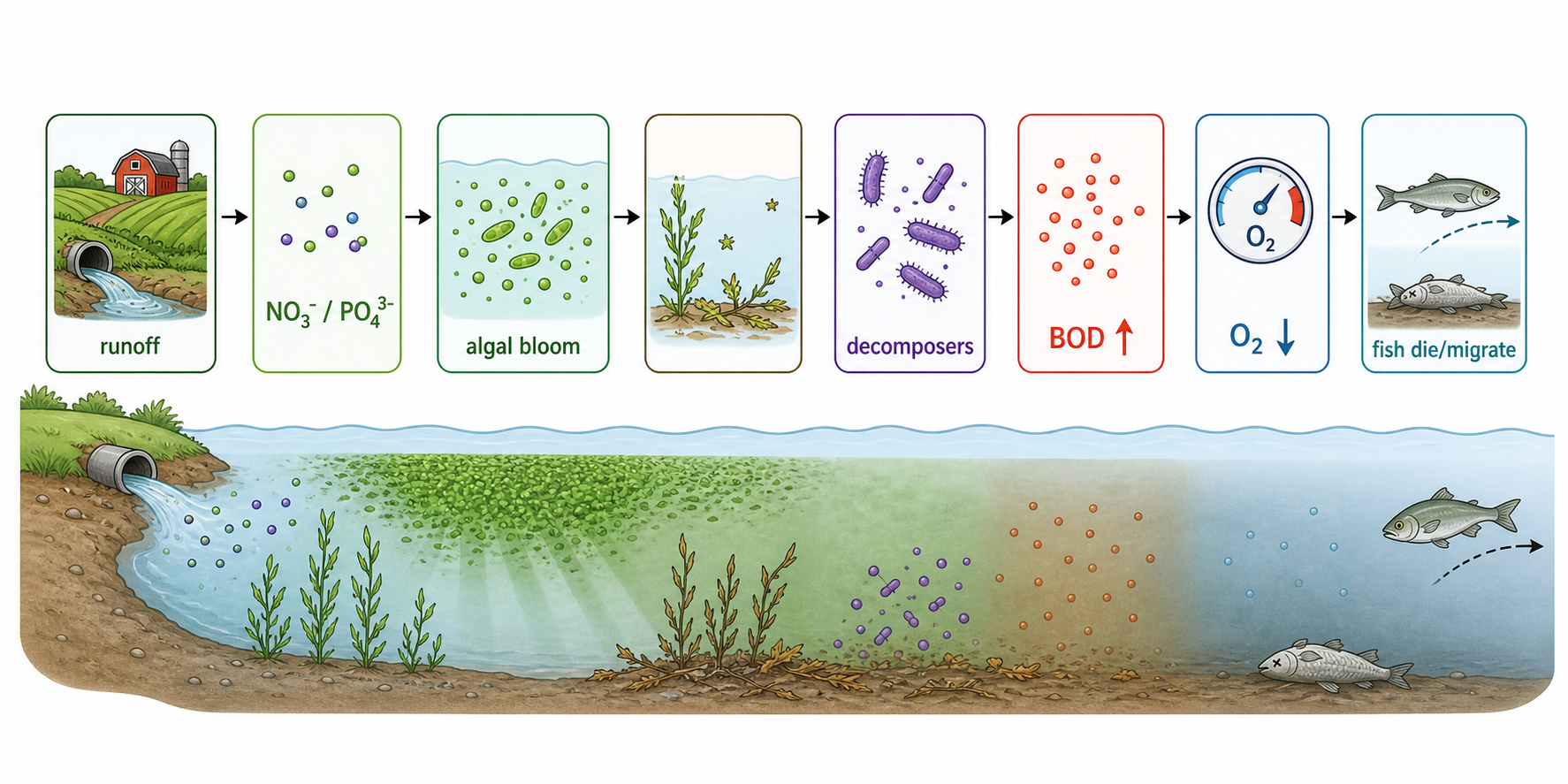
Biochemical oxygen demand (BOD) is the amount of dissolved oxygen used by aerobic biological activity while organic matter in a measured volume of water is broken down.
Darkness prevents photosynthesis from replacing oxygen during incubation. High BOD indicates much respirable organic matter and/or strong decomposer activity, not high oxygen availability.
Use matched volume, temperature, time and handling. BOD is an indirect pollution measure and does not identify the pollutant by itself.
| Ecosystem property | Typical eutrophication change |
|---|---|
| light penetration | falls as algal biomass and turbidity rise |
| submerged macrophytes | decline when photosynthesis becomes light-limited |
| producer diversity | often falls as bloom-forming species dominate |
| food-chain length | can shorten as habitats and oxygen-sensitive consumers disappear |
| net production | may rise initially even while stability and diversity fall |
Early nutrient enrichment can produce high primary production; later death, decomposition and hypoxia create the ecological damage. Sampling at only one time point can miss this sequence.
High productivity is not the same as a healthy or stable ecosystem. Composition, oxygen regime and food-web structure must also be judged.
| Process | Comparison being made |
|---|---|
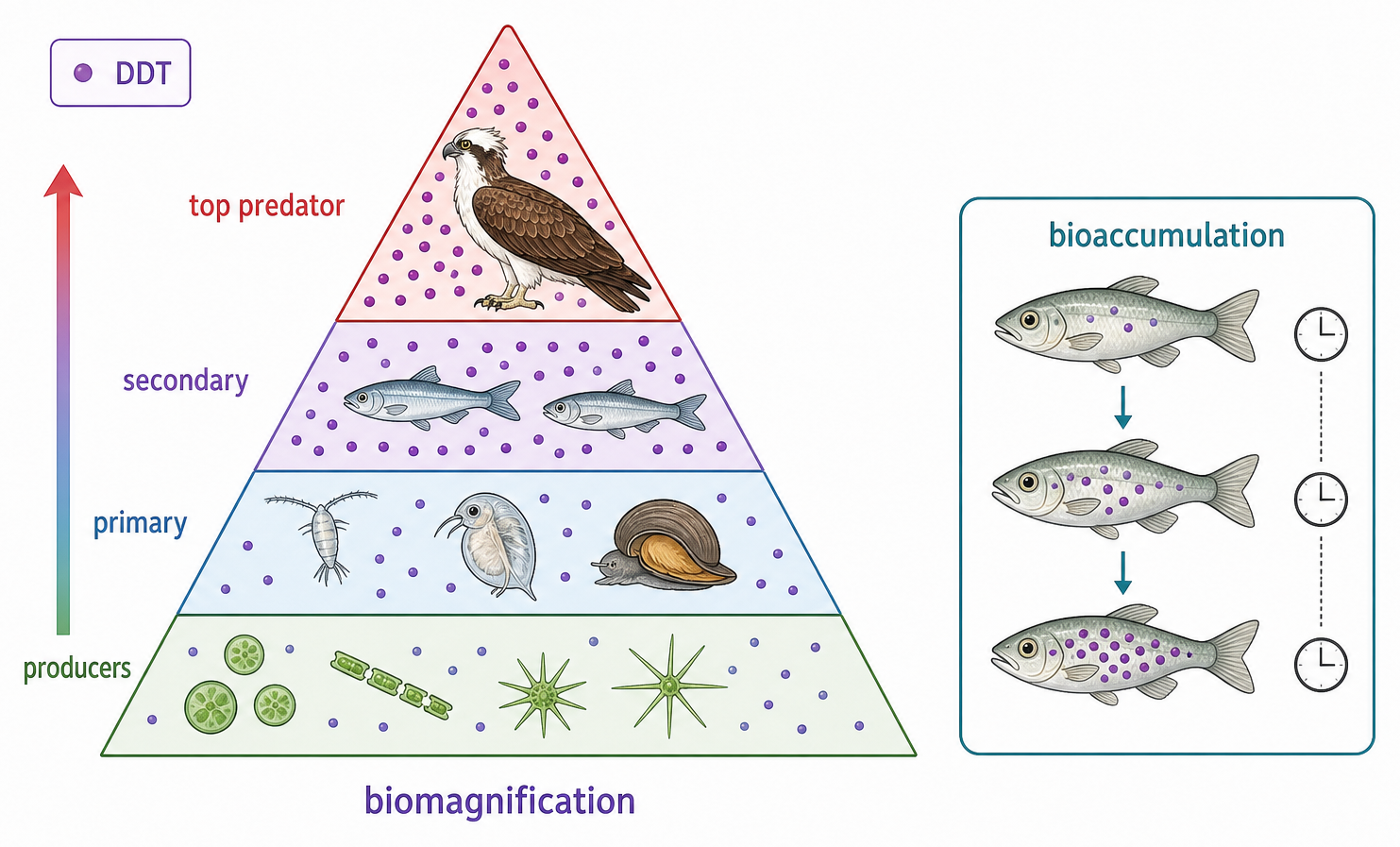
| bioaccumulation | toxin concentration in one organism increases over time because uptake exceeds breakdown and excretion |
| biomagnification | toxin concentration per unit biomass increases from one trophic level to the next |
Persistence prevents rapid degradation; fat solubility and poor excretion retain compounds such as DDT; predators consume contaminant loads from many prey.
| DDT property or effect | Consequence |
|---|---|
| persistent and fat-soluble | retained in animal tissues |
| biomagnifies | birds of prey receive high tissue concentrations |
| disrupts calcium deposition | thin eggshells crack more easily, reducing breeding success |
The pollutant does not create extra mass at each trophic level. Concentration rises because predators assimilate contaminants from many prey while biomass and energy are lost between levels.
| Plastic class | Operational size and examples | Dominant exposure route |
|---|---|---|
| macroplastic | greater than 5 mm; bags, bottles, line and packaging | entanglement, obstruction and ingestion as visible debris |
| microplastic | less than 5 mm; fragments, fibres and industrial particles | ingestion by small organisms and food-web transfer |
Fragmentation is not biodegradation. It redistributes the same persistent material into smaller particles with greater surface area and access to smaller organisms.
| Route | Example consequence |
|---|---|
| entanglement | restricted movement, injury, drowning or impaired feeding |
| mistaken ingestion | gut blockage, false satiation and starvation |
| transfer to offspring | albatross adults feed floating plastic to chicks that cannot regurgitate it |
| chemical transport | additives or persistent pollutants associated with plastic can enter tissues and food webs |
Sea turtles can mistake plastic bags for jellyfish. Albatrosses skim food from the ocean surface, where floating debris accumulates; mechanism and feeding behavior explain exposure better than a generic pollution claim.
Not every effect requires biomagnification. Entanglement and blockage are direct physical harms; chemical accumulation is a separate pathway that needs pollutant evidence.
The goal is a more self-sustaining system whose interactions maintain diversity and function with less continuous human control.
Rewilding is not simply “leave everything alone.” Reintroductions, invasive removal and corridors require monitoring for animal welfare, conflict, disease and unintended trophic effects.
Minimal intervention occurs after key pressures are removed. Hinewai therefore links restoration to succession: management creates conditions in which native community change can proceed.
Success is not measured only by tree cover. Native composition, connectivity, regeneration, fauna and ecological processes are also evidence of recovery.
measure stock and ecosystem condition → keep removal and pollution within recovery capacity → monitor delayed and indirect effects → reduce pressure or restore processes when indicators deteriorate
| Pressure | Mechanism to name |
|---|---|
| excess nutrient input | bloom → dead biomass → decomposer respiration → high BOD → hypoxia |
| persistent toxin | retention within organisms plus concentration across trophic levels |
| marine plastic | persistence, fragmentation, entanglement, ingestion and chemical transfer |
| harvesting | removal relative to recruitment, growth, age structure and habitat condition |
| degraded habitat | connectivity, species interactions and succession restored through rewilding |
A resource being renewable, a crop yield being high or a restoration site becoming greener is not enough. Sustainability claims require evidence that future ecological capacity is retained.
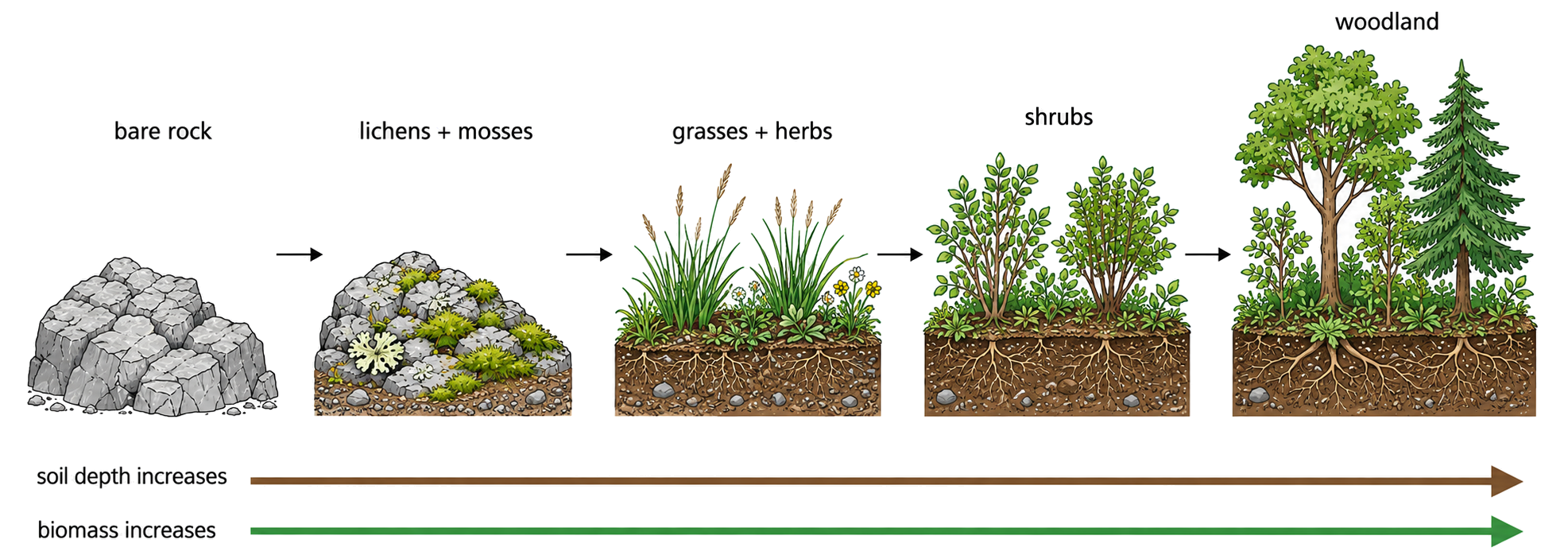
Ecological succession is an orderly change in community composition through time as abiotic conditions and species interactions alter which organisms can establish and compete.
| Starting condition | Succession type |
|---|---|
| new surface without developed soil | primary succession |
| disturbance removes organisms but leaves soil and some biological legacies | secondary succession |
Orderly does not mean identical or inevitable. Colonization history, climate and disturbance can redirect the route.
Nitrogen-fixing organisms can add biologically available nitrogen, while roots reduce erosion and decomposers recycle nutrients. Biotic change therefore improves abiotic conditions for later stages.
| Property | Early stage | Later stage |
|---|---|---|
| soil depth and organic matter | little | greater accumulation and retention |
| standing biomass | low | high |
| food-web complexity | few short pathways | more consumers, decomposers and interactions |
| nutrient source | external inputs and weathering dominate | internal cycling becomes more important |
| niches and diversity | few harsh-condition specialists | generally more opportunities and species |
These are broad trends, not a rule that every variable rises smoothly. Disturbance, invasion, local soil and dominance by a few species can interrupt or reverse them.
NPP = GPP − community respiration
| Stage | GPP | Community respiration | NPP and biomass accumulation |
|---|---|---|---|
| pioneer | low producer biomass, so GPP is low | also low | NPP can be a large proportion of GPP; biomass accumulates rapidly |
| developing | leaf area and GPP rise | respiration rises as biomass and consumers increase | continued positive NPP builds biomass |
| mature/climax-like | GPP may be high | high maintenance and food-web respiration | NPP is lower as production and respiration approach balance |
“Productivity increases throughout succession” is incomplete. GPP and NPP can follow different patterns because community respiration changes.
Cyclical succession is a recurring sequence of community states in the same area rather than progression to one permanently fixed endpoint.
A cycle requires a repeatable driver and return pathway. Seasonal fluctuation alone is not succession, and one disturbance followed by recovery is not necessarily cyclical.
| Control | Effect on the likely mature community |
|---|---|
| climate | sets temperature, water and seasonality constraints |
| soil and drainage | determine rooting conditions, oxygen and nutrient availability |
| species pool and interactions | determine which competitors, consumers and decomposers assemble |
| disturbance regime | can maintain mosaics or prevent one late stage dominating |
Complex food webs, deeper soils, high biomass, nutrient cycling and negative feedback can support relative stability under the prevailing conditions.
Climax is a model of a relatively stable state, not a universal final destination. Climate change, invasion or altered disturbance can move the system again.
| Human pressure | Mechanism | Maintained alternative state |
|---|---|---|
| repeated grazing | browsers remove seedlings before trees establish | grassland, heath or open wood pasture |
| controlled burning | kills young woody plants and resets vegetation age | managed heather moorland |
| wetland drainage | lowers the water table and changes oxygen and soil processes | agricultural land, peat extraction or other dry-land community |
Arrested succession or plagioclimax occurs when repeated disturbance prevents the expected local climax and maintains an earlier or alternative stable community.
Removing the pressure may allow succession to resume, but recovery depends on remaining soil, seed sources, hydrology and whether degradation has crossed another threshold.
starting substrate and biological legacies → pioneer establishment → organisms modify soil, light, moisture and nutrients → later species colonize and compete → local controls and repeated disturbance determine whether change approaches a mature state, cycles or remains arrested
| Observation | First explanation to test |
|---|---|
| no soil at the start | primary succession |
| soil remains after disturbance | secondary succession |
| GPP high but biomass accumulation slow | community respiration is also high |
| community states repeatedly return | recurring driver produces cyclical succession |
| woodland fails under repeated grazing or burning | succession is arrested at a plagioclimax |
Succession is directional only relative to current conditions. It is not a universal ladder toward one permanent best community.
[ 4 ]
Outline the features of ecosystems that make them sustainable.
[ 3 ]
Mesocosm experiments using water from Narragansett Bay were completed in the laboratory during a six month period. Discuss advantages and limitations of carrying out mesocosm investigations. be marked.
[ 6 ]
Explain how an ecological community structure could be affected by the removal of a keystone species.
[ 4 ]
Discuss the impact of overfishing in Lake Kariba and how sustainable harvesting of resources can be assessed.
[ 6 ]
Discuss the risks and benefits associated with the use of phosphate fertilizers in agriculture.
[ 6 ]
Discuss the causes and consequences of eutrophication.
[ 6 ]
Discuss the use of DDT (dichlorodiphenyltrichloroethane) in the control of the malarial parasite.
[ 4 ]
Explain the consequences of plastic pollution in marine environments.
[ 2 ]
Outline two methods of restoration of natural processes in ecosystems by rewilding, other than reintroducing a keystone species.
1.
2.
[ 3 ]
Distinguish between primary succession and secondary succession, giving an example of each.
[ 4 ]
Outline the ecological changes that will occur on the island of cooled lava.