D4.1.7—Sexual selection
Sexual selection favours traits that increase mating success, even when those traits may reduce survival in evolving populations in evolving populations.
- Syllabus
- First assessment 2025
- Objective
- D4.1.7
- Level
- HL
Sexual selection favours traits that increase mating success, even when those traits may reduce survival in evolving populations in evolving populations.

Coverage 2013–2020 · Updated 16 Jul 2026
Sexual selection is selection for traits that increase access to mates or fertilization success, even when they carry survival costs.
Mate choice and competition among same-sex individuals change reproductive success. The trait spreads when its mating advantage outweighs its costs.
Separate survival benefit from mating benefit before explaining a conspicuous trait.; separate variation, selection, inheritance and time
Peacock tail feathers may attract mates while making escape harder, so mating success can favour the tail despite predation risk. This gives a concrete prediction from the stated population.
Sexual selection is one component of natural selection, not a guarantee that the trait improves survival. Interpret the result within the stated selection model and evidence limits.
This objective is assessed through essay response, commonly using Explain / Suggest / Evaluate.
Explain / Suggest / Evaluate
Build the answer around this relationship: Sexual selection acts through mating success.
Representative question
Explain what is meant by exaggerated traits and how they may develop in males of a species.
plays a (major) role in mate selection / select male based on exaggerated trait;
can be hindrance to survival;
development of exaggerated traits represents expenditure of time/energy;
trait represents reproductive fitness / shows that the male is well-adapted;
more likely to mate and produce offspring;
trait is genetic / passed on to offspring;
trait is subject to natural selection / leads to greater exaggeration of trait;
example of species with exaggerated trait;
description of the trait in the example given;
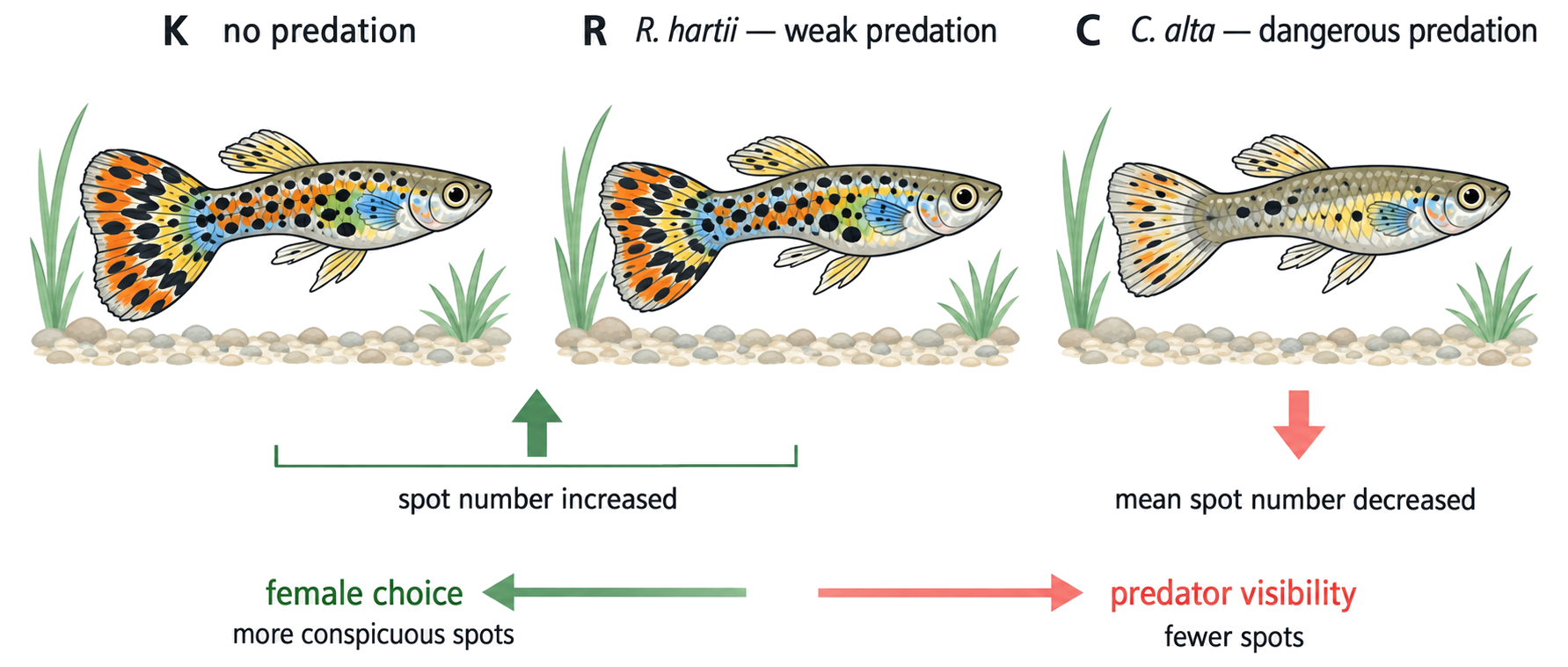
Core D4.1 examples follow the same causal route: heritable variation exists, a selection pressure acts, individuals differ in fitness, and alleles linked to higher reproduction become more common. Endler’s guppies and sexual selection are evidence versions of the same chain.
Core natural-selection exam answers should never stop at “the best adapted survive.” They need the chain: heritable variation exists, a named pressure acts, some individuals have higher fitness, and their alleles become more common over generations. Use this for abiotic pressure, overproduction, sexual selection, and Endler-style data.