Q BankQuestion BankDocsDocuments

D1.3 Mutation and gene editing

Mutation and gene editing explain how DNA sequence changes arise, affect proteins, create variation and can be studied or altered deliberately.

Syllabus
First assessment 2025
Topic
D1.3
Level
HL

A Gene Mutation Changes a DNA Sequence

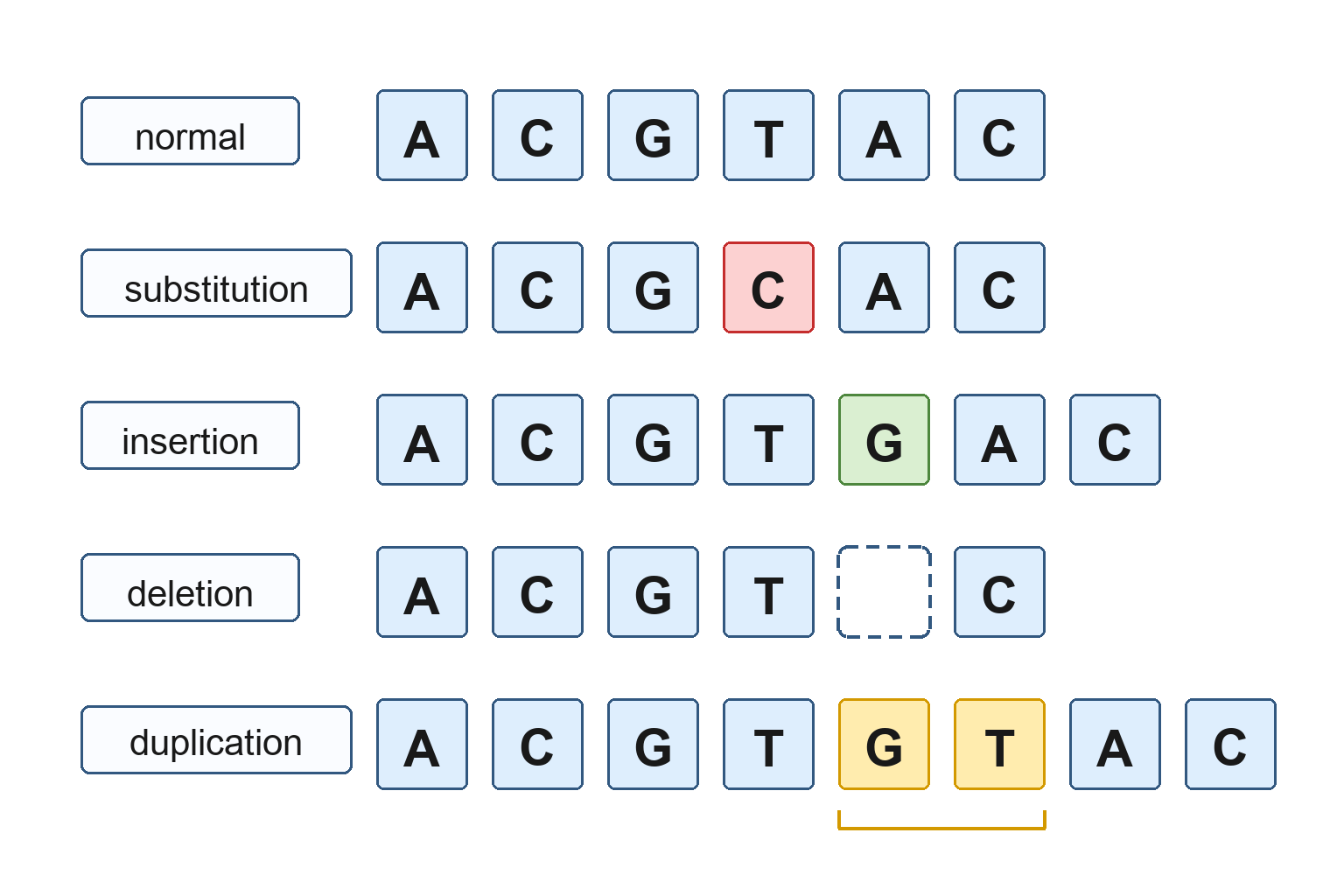
A gene mutation is a change in the nucleotide sequence of a gene, created when DNA is altered or copied inaccurately.

The sequence can change one base or many. Its effect depends on where the change occurs and how it alters transcription, translation or regulation.

Classify a mutation by: sequence change; location; codon or regulatory effect; resulting phenotype.

Changing one base in a coding region may alter one codon, while a change in a promoter may change how much mRNA is made.

A mutation is a sequence change, not automatically a visible trait or disease.

Gene mutations

Assessment in practice

1 marks
How it is assessed

This objective is assessed through structured response, commonly using Define / Identify / Distinguish.

Command terms

Define / Identify / Distinguish / Compare

What earns marks

Build the answer around this relationship: Gene mutations are changes in DNA nucleotide sequence.

Watch for

Naming a disease such as sickle-cell anemia instead of naming a mutation type.

Representative question

Question 1

[Maximum number: 2]

Mutations may increase variation within a species. Compare and contrast substitution and insertion mutations.

A Base Substitution Can Be Silent, Missense or Nonsense

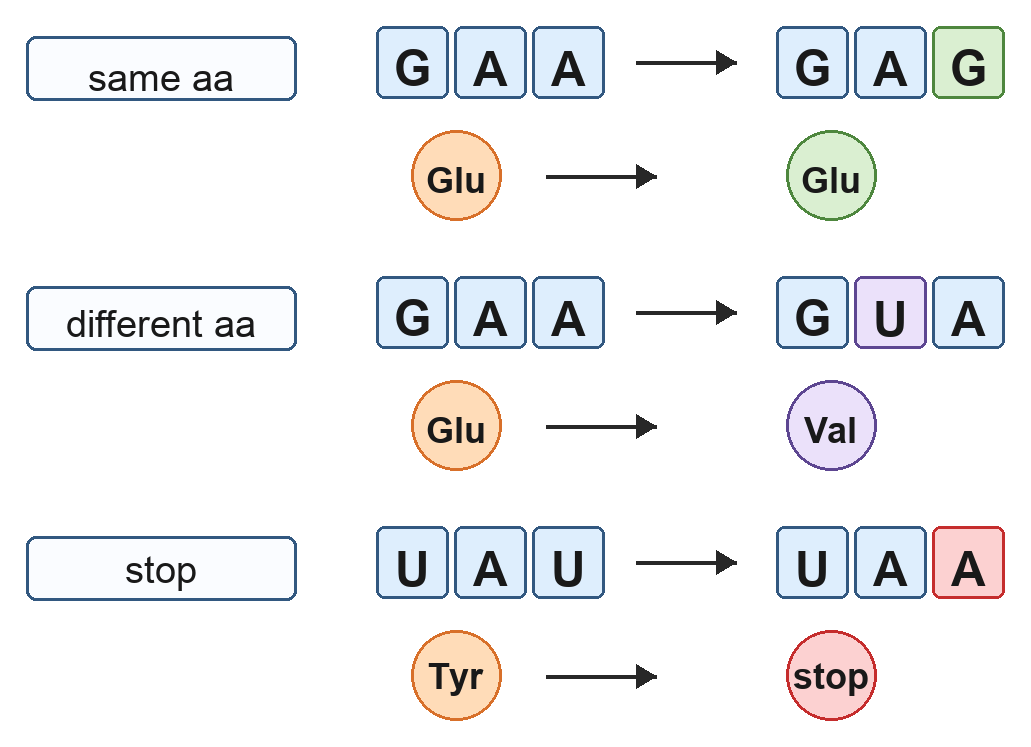
Replacing one base can leave an amino acid unchanged, substitute a different amino acid or create a premature stop codon.

The outcome follows the genetic code and codon position. Degeneracy can make a substitution silent, while a changed residue or early stop can alter folding and protein length.

Trace: original codon; substituted base; new codon; code-table result; protein consequence.

A codon change from GAA to GAG can remain glutamate, while a change to a stop codon truncates the polypeptide.

A substitution is not always harmful; assess the codon and protein context.

Base substitution consequences

Assessment in practice

1–4 marks
How it is assessed

This objective is assessed through structured response, multiple choice, commonly using Describe / Explain / Outline.

Command terms

Describe / Explain / Outline

What earns marks

Build the answer around this relationship: A substitution changes one base in a DNA sequence.

Watch for

Stopping at the DNA substitution without tracing the codon and amino acid consequence.

Representative question

Question 1

[Maximum number: 4]

Outline how a base substitution leads to sickle cell anemia.

Insertions and Deletions Can Shift the Reading Frame

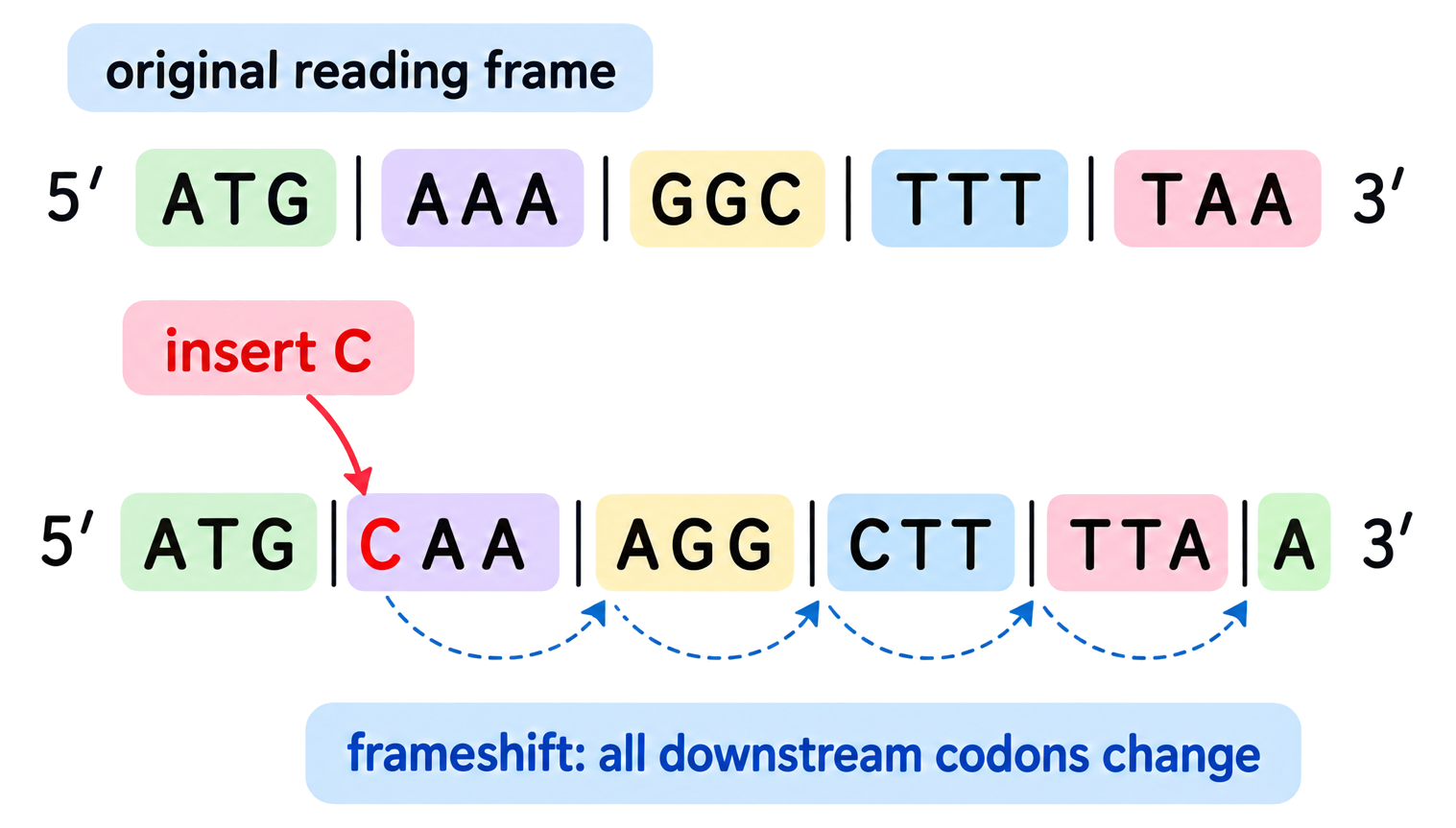
Adding or removing bases can cause a frameshift when the number changed is not a multiple of three, altering all downstream codons.

Ribosomes read triplets. A shifted grouping changes codons and often introduces an early stop, whereas a three-base insertion or deletion adds or removes one amino acid without shifting later codons.

Check: number of bases; reading-frame shift; downstream codons; stop signal.

Deleting one base near the start of a coding sequence changes every later triplet and can produce a nonfunctional protein.

Frameshift severity depends on location and rescue by a later change; it is not guaranteed to abolish function.

Mutations Arise from Replication Errors and Mutagens

Mutations can result from spontaneous DNA-copying errors or from mutagens such as radiation and reactive chemicals.

Errors can escape proofreading or repair. Mutagens increase the probability of particular DNA damage, but the resulting sequence change still depends on repair and cell context.

Identify source: copying or chemical/physical damage; lesion; repair outcome; final sequence change.

Ultraviolet radiation can create abnormal base links that, if unrepaired, become a mutation after replication.

A mutagen raises risk; it does not dictate one inevitable mutation in every exposed cell.

Causes of mutation

Assessment in practice

1–2 marks
How it is assessed

This objective is assessed through structured response, commonly using State / Explain / Evaluate.

Command terms

State / Explain / Evaluate / Identify

What earns marks

Build the answer around this relationship: Mutagens increase the frequency of DNA sequence changes.

Watch for

Giving vague environmental factors without identifying radiation, chemicals or carcinogens.

Representative question

Question 1

[Maximum number: 2]

Explain how chemical substances can cause cancer.

Mutation Occurs Randomly Relative to Need

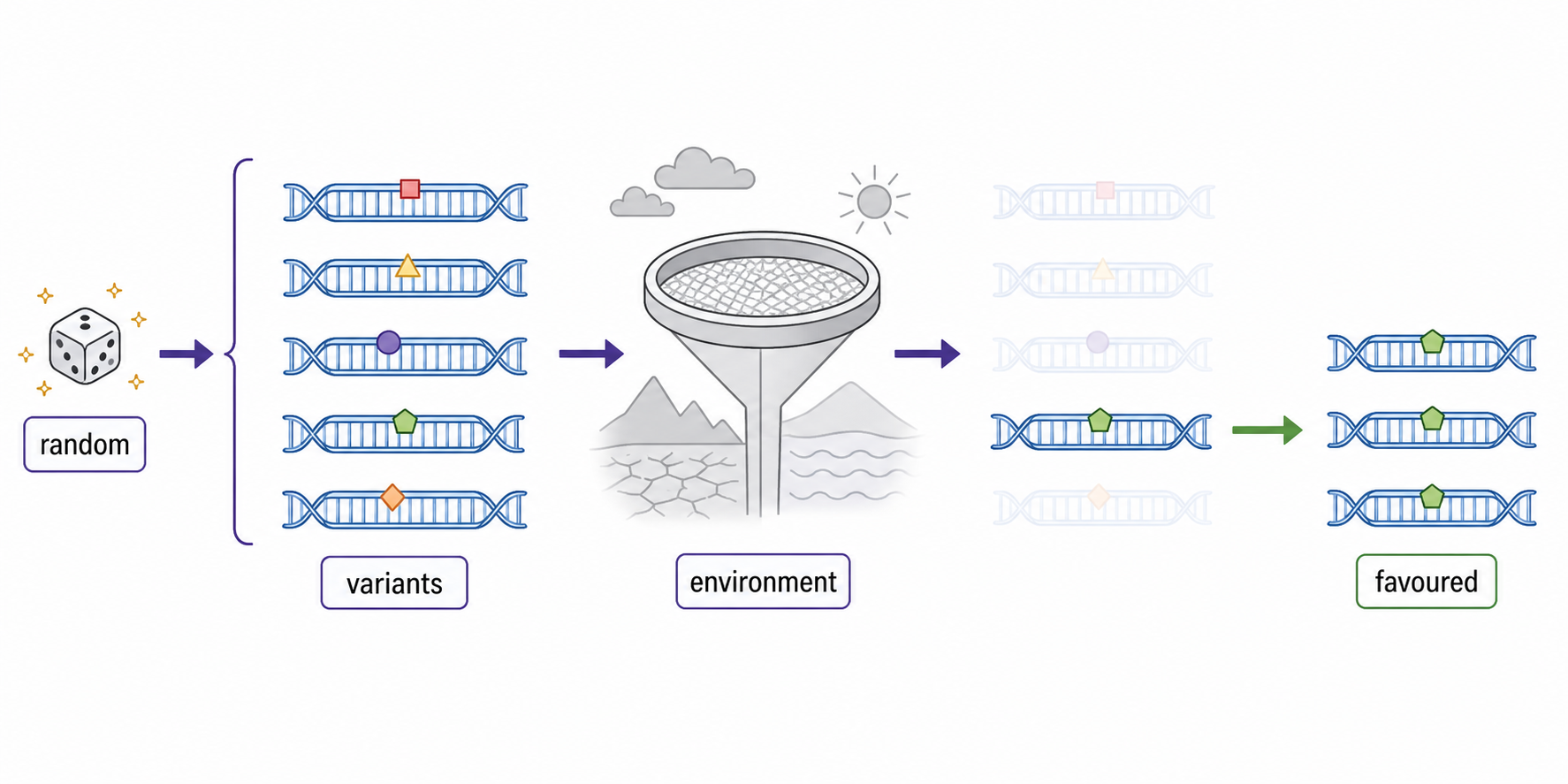
Mutations arise without being directed toward an organism’s current need; selection later changes the frequency of variants.

DNA chemistry and copying produce changes before the environment ‘chooses’ among them. A useful phenotype becomes more common because its carriers leave more offspring, not because need creates the mutation.

Separate timeline: mutation appears; environment filters phenotypes; population frequency changes.

A bacterium resistant to an antibiotic may already carry a resistance mutation before exposure, then survive when the drug is applied.

Random with respect to need does not mean every mutation is equally likely or has equal effects.

Randomness in mutation

Assessment in practice

1 marks
How it is assessed

This objective is assessed through multiple choice.

What earns marks

Build the answer around this relationship: Mutations are not directed by an organism’s needs.

Representative question

Question 1

[Maximum number: 1]

What is a feature of mutations?

A

They occur randomly.

B

They only occur in germ cells.

C

The frequency cannot be increased by external factors.

D

They only occur in certain base sequences of the genome.

Germline and Somatic Mutations Have Different Reach

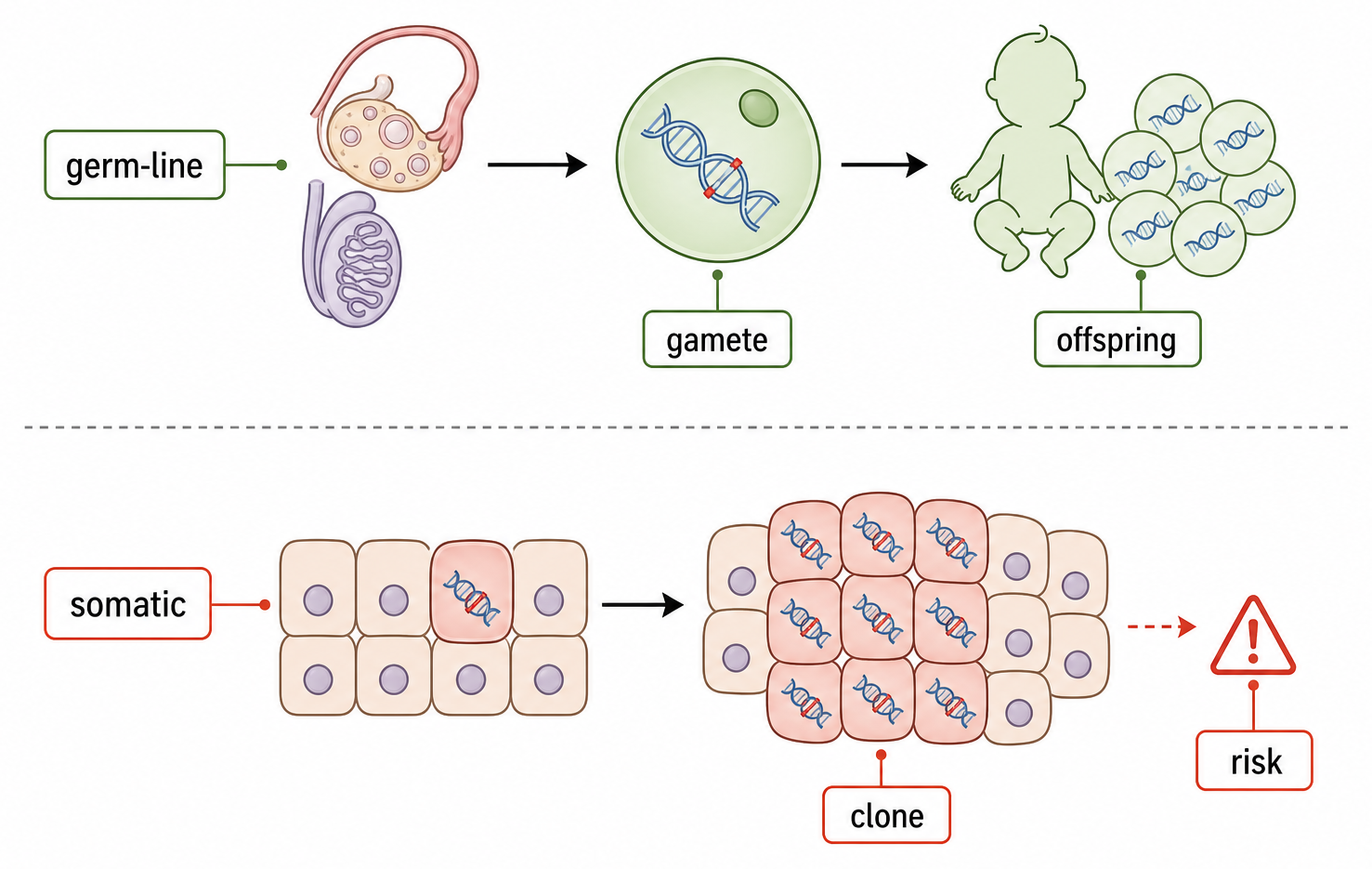
A mutation in a germline cell can enter gametes and be inherited, while a somatic mutation remains in the affected body lineage unless special reproduction transfers it.

Cell lineage determines who receives the altered DNA. Germline changes can affect offspring; somatic changes can produce a mosaic tissue or disease in one individual.

Classify impact by checking: cell lineage; whether gametes carry the change; individuals or tissues affected.

A mutation in a skin cell can expand into a patch of altered cells but is usually not passed to a child.

‘Somatic’ does not mean harmless; it can strongly affect the individual even without inheritance.

Consequences in germ vs. somatic cells

Assessment in practice

1–3 marks
How it is assessed

This objective is assessed through multiple choice, commonly using Distinguish.

Command terms

Distinguish

What earns marks

Build the answer around this relationship: Only germ-line mutations can normally be passed to offspring.

Watch for

Saying any mutation can automatically be inherited regardless of cell type.

Representative question

Question 1

[Maximum number: 1]

A mutation in which type of cell could be inherited?

A

Beta cell in the pancreas

B

T-cell in the lymph

C

Sperm cell in the testis

D

Skeletal muscle cell in the diaphragm

Mutation Supplies Variation for Natural Selection

Mutations introduce new alleles, providing genetic variation on which natural selection and other evolutionary processes can act.

Selection changes frequencies of existing variants; it does not create the initial DNA differences. Recombination and inheritance then distribute those alleles through populations.

Trace variation: DNA change; allele; heritable phenotype; differential reproduction; allele-frequency change.

A mutation that improves drought tolerance can become more common if carriers leave more offspring in dry conditions.

Mutation alone does not guarantee adaptation; the variant must be heritable and affect fitness in that environment.

Mutation as source of variation

Assessment in practice

1 marks
How it is assessed

This objective is assessed through multiple choice.

What earns marks

Build the answer around this relationship: Mutation produces new alleles.

Representative question

Question 1

[Maximum number: 1]

What causes variation in both sexually and asexually reproducing organisms?

A

Mutations

B

Polygenic inheritance

C

Crossing over

D

Independent assortment

Core Mutation Effects

Gene mutations are changes in the base sequence of DNA; main types are substitution, insertion, deletion, and duplication. Base substitutions can create SNPs and change codons; degeneracy can make substitutions silent, missense, or nonsense. Insertions or deletions not in multiples of three cause frameshifts that alter downstream codons and often disrupt protein function. Mutations can arise from replication errors, repair errors, or chromosome damage; mutagens include chemicals, ionizing radiation, and ultraviolet radiation. Mutations occur randomly with respect to organism need or advantage; mutation rate varies with DNA sequence, gene expression, repair, and mutagen exposure. Germ-line mutations can be inherited by offspring; somatic mutations affect only descendant body cells and can contribute to cancer. Mutation is the original source of new alleles and genetic variation; many are neutral or harmful, but variation supplies material for natural selection.

Gene Knockout Tests What a Gene Does

HL only

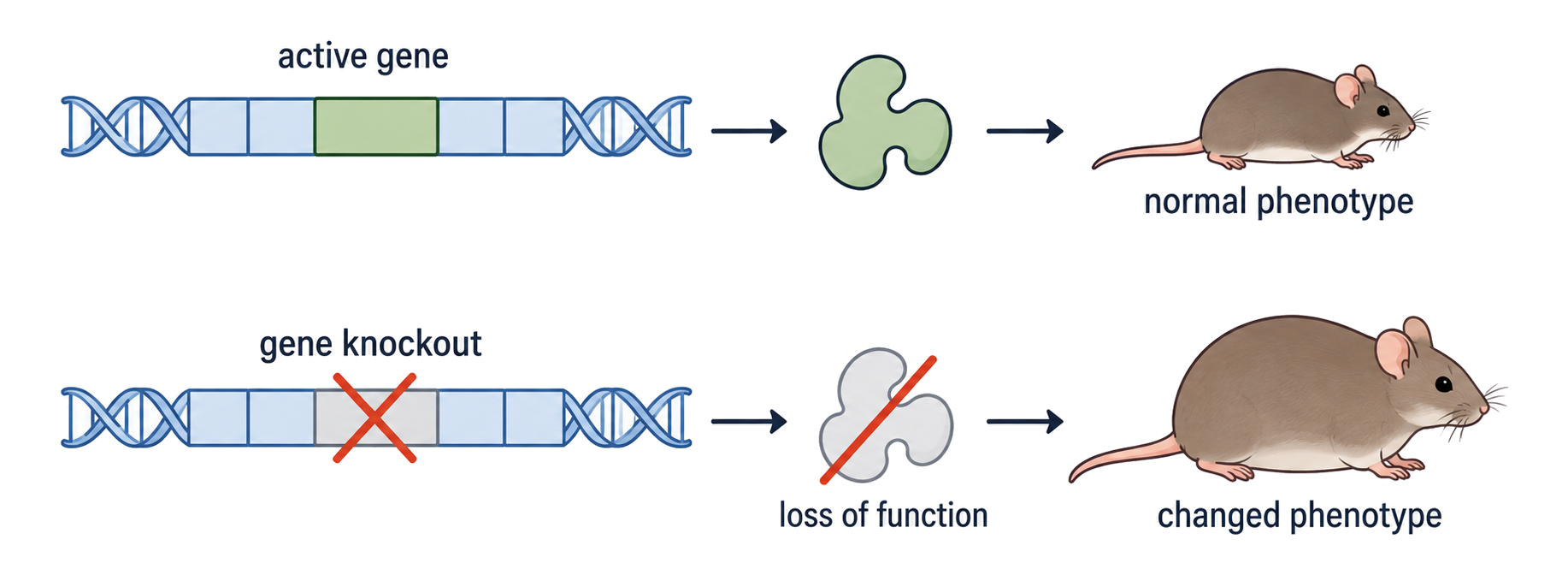
A gene knockout disables a gene so researchers can compare organisms or cells with and without its function.

The phenotype difference is evidence that the gene contributes to the affected process, especially when controls and rescue experiments support the link. Redundancy or compensation can hide effects.

Evaluate a knockout by checking: targeted gene; control; phenotype difference; alternative explanations.

Knocking out a transporter gene and observing loss of uptake suggests that the gene is required for that transport pathway.

A no-change phenotype does not prove the gene is useless; another gene may compensate.

Gene knockout

HL only

Assessment in practice

1 marks
How it is assessed

This objective is assessed through multiple choice.

What earns marks

Build the answer around this relationship: Gene knockout deliberately makes a specific gene inoperative.

Representative question

Question 1

[Maximum number: 1]

What is gene knockout used for?

A

Increasing protein production by editing a gene

B

Investigating the function of a gene by replacing it to make it inoperative

C

Identifying the presence of a gene by editing it to produce a different protein

D

Editing a gene to initiate cell death

CRISPR-Cas9 Targets a Chosen DNA Sequence

HL only

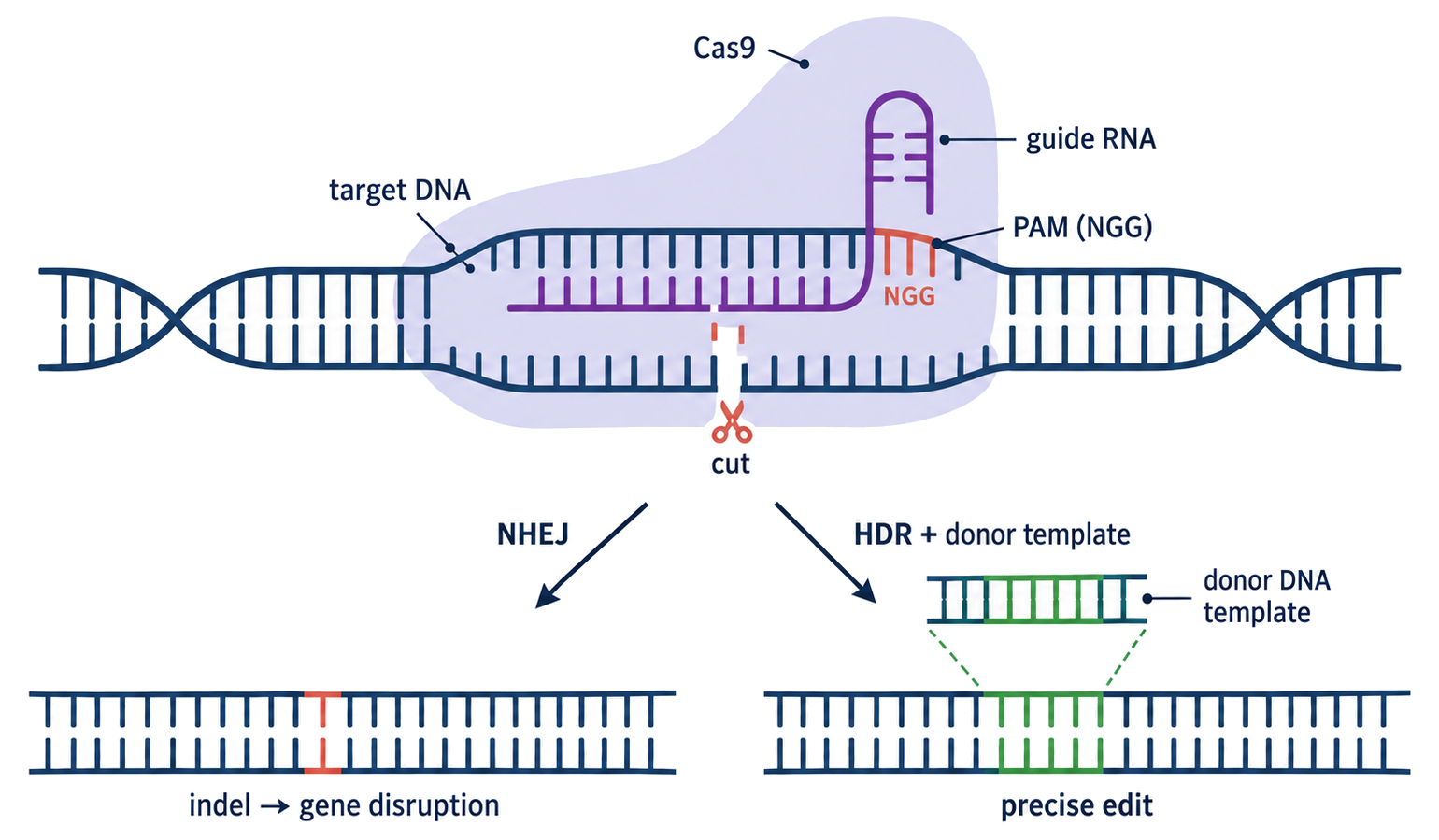
CRISPR-Cas9 gene editing uses a guide RNA to direct Cas9 to a complementary DNA sequence, where cutting enables targeted sequence change during repair.

Guide pairing positions the nuclease. The cell’s repair can create small disruptions or use a supplied template for a designed change, but repair outcomes are not perfectly predictable.

Trace: guide design; target pairing; Cas9 cut; repair pathway; edited sequence and verification.

A guide aimed at a disease-associated variant can direct a cut near that sequence, after which repair may disrupt or replace the target.

Targeted cutting is not guaranteed precision: off-target edits, delivery limits and repair variation require testing.

CRISPR-Cas9 gene editing

HL only

Assessment in practice

3 marks
How it is assessed

This objective is assessed through structured response, commonly using Explain.

Command terms

Explain

What earns marks

Build the answer around this relationship: Guide RNA directs Cas9 to a complementary DNA target.

Representative question

Question 1

[Maximum number: 3]

Explain ways in which CRISPR-Cas9 gene editing could be used to change the mutated dystrophin protein produced.

Conserved Sequences Reveal Important Functions

HL only

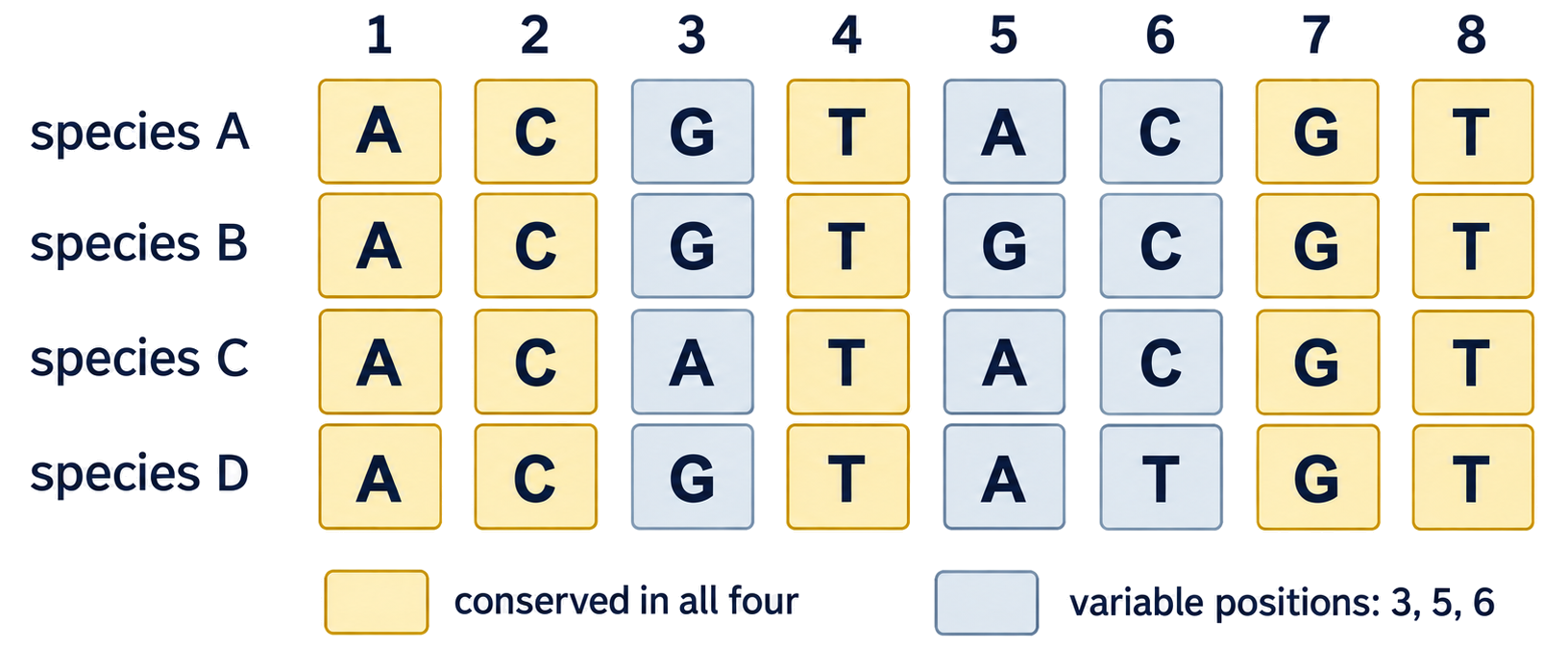
A conserved DNA sequence has remained similar across species because changes to it are often selected against or because its function is maintained.

Comparative sequence alignment can identify regions under constraint. Conservation suggests importance but does not by itself reveal the exact mechanism or prove every base is essential.

Use conservation as evidence by checking: species compared; sequence similarity; location; functional test or expression data.

A regulatory sequence conserved in many vertebrates may control a developmental gene, prompting experiments to test its role.

Conserved does not mean unchanged in every species or automatically beneficial; neutral conservation and linkage must be considered.

Conserved sequences

HL only

Assessment in practice

1 marks
How it is assessed

This objective is assessed through structured response, commonly using Identify.

Command terms

Identify

What earns marks

Build the answer around this relationship: Conserved sequences are similar across species or long evolutionary times.

Representative question

Question 1

[Maximum number: 1]

A bioinformatics analysis was performed on the protein PSY transcribed from the gene from corn and from daffodil to obtain the sequence alignment.

On the alignment, identify the longest part of the sequence where the consecutive amino acids are the same.

\begin{tabular}{|l|l|}
\hline Corn & ---MAI I LVRAASP-------GLSAAD---------SISH- \\
\hline Daffodil & ---MVVAILRVVSAIEIPIRLGFSEANWRFSSPKYDNLGRK \\
\hline Corn & QGTLQCSTLLKTKRPAARRWMPCSLLGLHPWEAGRP-SPAV \\
\hline Daffodil & KSRLSVYSLYTTSKYA-----------CVGFEAENNGKFLI \\
\hline & * * * * * * \\
\hline Corn & YSSLPVNPAGEAVVSSEQKVYDVVLKQAALLKRQLRTP--V \\
\hline Daffodil & RSSLVANPAGEATISSEQKVYDVVLKQAALVKDQTKSSRKS \\
\hline & * * * * * * * * * * * * * * * * * * * * * * * * * * * \\
\hline Corn & LDARPQDMDMPRN--GLKEAYDRCGE I CEEYAKTFYLGTML \\
\hline Daffodil & TDVKP-DIVLPGTVYLLKDAYDRCGEVCAEYAKTFYLGTLL \\
\hline & * * * * * * * * * * * * * * * * * * * * * * * * \\
\hline Corn & MTEERRRA I WA I YVWCRRTDELVDGPNANY I TPTALDRWEK \\
\hline Daffodil & MTPERRRAI WA I YVWCRRTDELVDGHNASHITPSALDRWEA \\
\hline & ** * * * * * * * * * * * * * * * * * * * * * * * * * * * * * * * * * \\
\hline Corn & RLEDLFTGRPYDMLDAALSDTISRFPIDIQPFRDMIEGMRS \\
\hline Daffodil & RLEDLFAGRPYDMFDAALSDTVSRFPVDIQPFMDMVEGMRM \\
\hline & * * * * * * * * * * * * * * * * * * * * * * * * * * * * * * * * * * \\
\hline Corn & DLRKTRYNNFDELYMYCYYVAGTVGLMSVPVMGIATESKAT \\
\hline Daffodil & DLKKSRYKNFDELYLYCYYVAGTVGLMSVPVMGIAPESLAE \\
\hline & * * * * * * * * * * * * * * * * * * * * * * * * * * * * * * * * * * \\
\hline Corn & TESVYSAALALGIANQLTNI LRDVGEDARRGRIYLPQDELA \\
\hline Daffodil & AESVYNAALALGIANQLTNI LRDVGEDARRGRIYLPQDELA \\
\hline & * * * * * * * * * * * * * * * * * * * * * * * * * * * * * * * * * * * * * * * \\
\hline Corn & QAGLSDEDIFKGVVTNRWRNFMKRQIKRARMFFEEAERGVN \\
\hline Daffodil & EAGLSDEDVFTGKVTDKWRSFMKRQIKRARTFFEQAEKGVT \\
\hline & * * * * * * * * * * * * * * * * * * * * * * * * * * * * * * \\
\hline Corn & ELSQASRWPVWASLLLYRQI LDEIEANDYNNFTKRAYVGKG \\
\hline Daffodil & E L SQA SRWP VWASLL LYRQI LDE I EANDYNNF TKRAYVSKV \\
\hline Corn & KKLLALPVAYGKSLLLPCSLRN---GQT \\
\hline Daffodil & KRLAALPLA YGKSLLIPLSLRPPSLSKA \\
\hline & * * * * * * * * * * * * * * * * \\
\hline
\end{tabular}

HL Gene Editing Evidence

HL only

Gene knockout makes a specific gene non-functional to investigate phenotype; model organisms such as mice, Drosophila, zebrafish, and Arabidopsis support KO libraries. Guide RNA directs Cas9 to a complementary DNA target sequence; Cas9 cutting enables deletion, replacement, insertion, or gene disruption. Conserved sequences remain similar across species or long evolutionary times; conservation suggests essential function, lower mutation rate, or strong purifying selection.

ConceptIB Biology HL